7 Ways to Make Money From Your Academic Book Beyond Royalties: A 2026 Guide
Reviewed by the NeucitePress Editorial Board — PhD academics, peer-reviewed editors and subject-matter specialists.
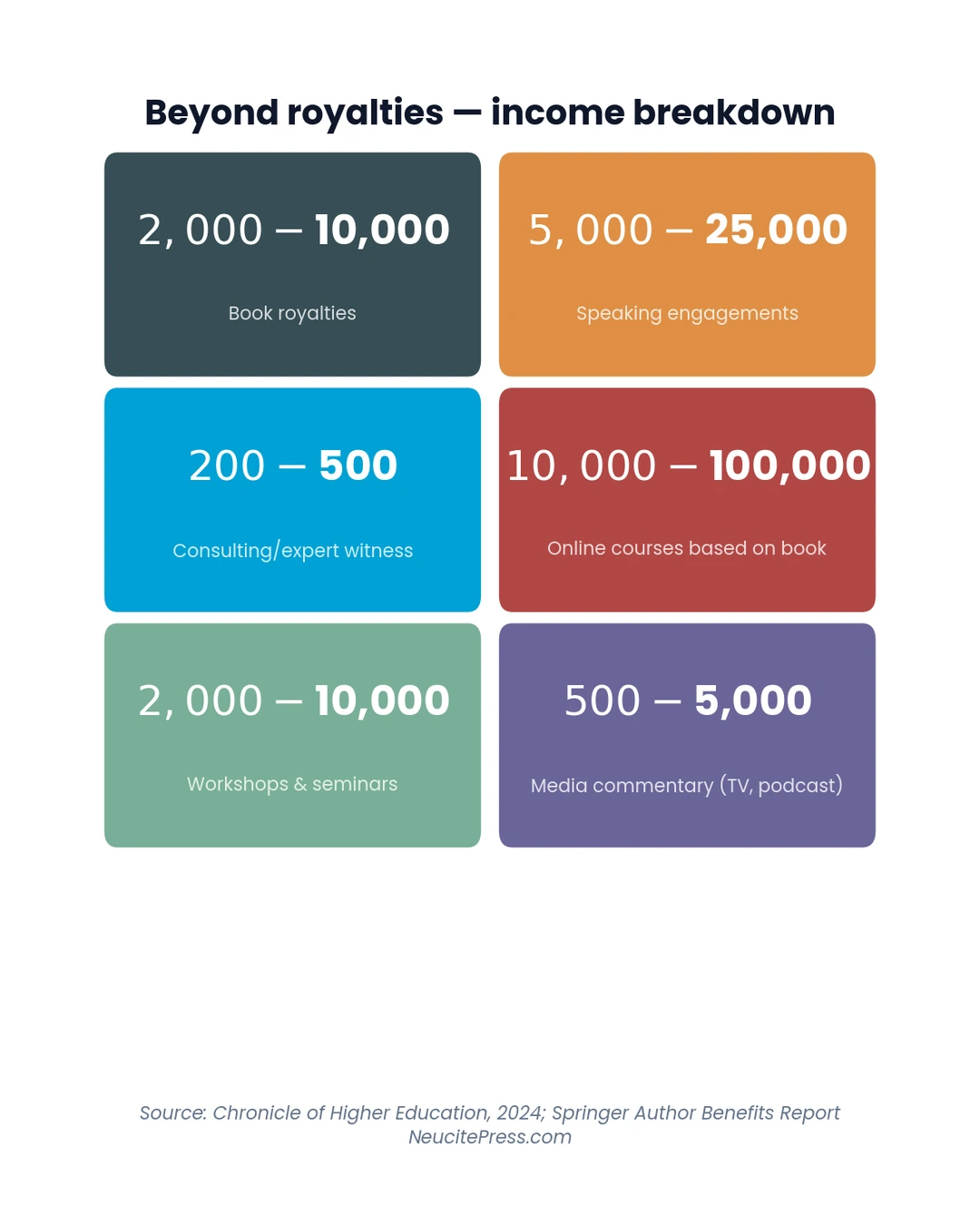
Academic book monetization stat cards showing revenue streams beyond royalties for researchers in 2026
Most academic authors earn less than $2,000 in royalties from their first publication. Yet strategic scholars generate six-figure incomes by leveraging their published work beyond traditional sales. This comprehensive guide reveals exactly how to make money from academic books—revealing 7 proven strategies that transform scholarly publications into sustainable revenue streams.
Key Takeaways: Making Money From Your Academic Book
Average academic authors earn under $2,000 from book royalties alone
Strategic authors generate $50,000-$200,000+ annually through diversified income streams
Your published book serves as a credible platform for consulting and speaking fees ($150-$500/hour)
Speaking engagements generate $2,500-$15,000 per event—often exceeding lifetime royalty earnings
Course creation based on book content produces $5,000-$50,000 annually
Online workshops and training programs tap into growing professional education markets
International rights, translations, and subsidiary revenue create passive income
Personal brand development through publishing opens six-figure consulting opportunities
Why Academic Book Royalties Fall Short: The Reality
Understanding the scholarly publishing ecosystem is essential before pursuing alternative income strategies. University presses operate on fundamentally different economic models than commercial publishers, which directly impacts your earning potential.
The Economics of University Press Publishing
University presses invest $50,000-$150,000 per title covering editorial labor, production, design, printing, and distribution. These significant upfront costs explain why author compensation represents a small percentage of total investment.
The primary market for scholarly books consists of researchers, academics, and institutional libraries—not general readers. This limited audience means smaller print runs (300-500 copies for typical monographs) and modest per-copy revenue.
Advances for dissertation-based works typically range from $0-$5,000 when offered at all. Established scholars might command $10,000-$50,000, but these amounts must be “earned back” through sales before royalties begin flowing.
Scholarly Publishing vs. Trade Publishing: Key Differences
Metric
Scholarly Publishing
Trade Publishing
Self-Publishing
Primary Audience
Researchers, Academics, Libraries
General Public, Bookstores
Niche/Author-Directed
Typical Print Run
300-1,500 copies
5,000-50,000 copies
100-5,000 copies
Average Advance
$1,000-$5,000
$15,000-$100,000+
$0 (author-funded)
Typical Lifetime Sales
500-1,000 copies
3,000-10,000+ copies
100-5,000 copies
Lifetime Royalty Earnings
$600-$1,500
$5,000-$30,000+
$500-$10,000
Understanding Royalty Mechanics and Advance Structures
Royalty rates for academic books typically start at 10% of “net receipts”—not the book’s list price. Net receipts account for retailer discounts and usually represent 60% of the retail price.
Example calculation: A $30 academic book generates approximately $18 in net receipts. At 10% royalty, you earn $1.80 per copy sold. Selling 500 copies over the book’s lifetime generates roughly $900 in royalties—before the advance is “earned back.”
Many contracts include escalator clauses increasing rates to 12.5% (after 3,000 copies) and 15% (after 6,000 copies). E-book royalties are often negotiable at 20-25%, significantly higher than print rates—but scholarly e-book sales typically remain modest.
The math reveals why successful academics view their books as career investments rather than income sources. The real money comes from what the book represents: credible expertise that attracts premium consulting and speaking opportunities.
Strategy 1: Speaking Engagements and Conference Presentations
Your published book immediately qualifies you as a recognized expert in your field. This expertise commands substantial speaking fees that typically exceed lifetime book royalties within a single engagement.
Understanding Speaking Fee Structures
Academic Conferences: Small academic conferences (50-200 attendees) typically offer $2,500-$5,000 honorariums. Major academic conferences (500-2,000 attendees) pay $5,000-$10,000. Established thought leaders at large conferences earn $10,000-$15,000.
Industry Conferences: Corporate and industry events operate on larger budgets. Small industry conferences (200-500 attendees) offer $5,000-$10,000. Medium events (500-2,000 attendees) pay $10,000-$20,000. Large industry conferences (2,000+ attendees) compensate speakers $15,000-$30,000+.
Corporate Workshops: In-house corporate training commands premium rates: $3,000-$5,000 for half-day workshops, $5,000-$10,000 for full-day training programs.
Virtual Presentations: Online speaking typically pays 50-75% of in-person rates but eliminates travel costs ($500-$2,000 per event). This makes virtual engagements increasingly attractive, especially for international audiences.
Building Your Speaking Business
Your book serves as the credential that opens speaking doors. Published work demonstrates expertise, research depth, and communication ability to event organizers evaluating speakers.
Speaking engagement revenue arrives quickly—typically within 30-60 days—making this an ideal cash flow strategy for early-career authors.
Strategy 2: Consulting Services and Expert Advising
Your published research qualifies you for high-value consulting work. Organizations value documented expertise, and your book represents portable proof of your knowledge in written form.
Consulting Fee Rates and Market Demand
Academic Consulting: Universities and research institutions pay $100-$200 hourly for specialized consulting. Annual retainers typically range $5,000-$25,000.
Corporate Consulting: Businesses pay significantly more: $200-$400 hourly for departmental consulting, $300-$500 hourly for executive-level strategy work. Annual corporate consulting retainers often range $25,000-$100,000+.
Government and Policy Consulting: Government agencies and policy organizations pay $150-$300 hourly for expert input. Specialized policy advisory roles command $200,000-$500,000 annually.
Healthcare and Medical Consulting: Medical organizations and pharmaceutical companies pay premium rates: $250-$500 hourly for clinical consulting, $300-$750 hourly for medical advisory board positions.
Converting Publishing Success Into Consulting Revenue
Many academics dedicate 5-10 hours weekly to consulting while maintaining academic positions, generating $30,000-$60,000 annually in supplemental income. Full-time consultants with published expertise often earn $150,000-$400,000+ annually.
Your published book becomes your marketing tool. It demonstrates expertise, research quality, and communication skills to potential clients. Include consulting services on your author website and author bio pages.
Strategy 3: Online Course Creation and Digital Products
Your academic book contains substantial educational content perfect for transformation into digital courses. Online learning platforms have created massive markets for expert-led education.
Course Platform Revenue Models
Udemy and Skillshare: These platforms handle marketing but take 50% revenue share. A course generating $20,000 annually yields $10,000 to the instructor. However, platform reach is substantial—millions of potential students.
Thinkific, Teachable, and Kajabi: These platforms charge monthly fees ($25-$300) but let you keep 90%+ of course revenue. Creating quality courses generating $30,000+ annually makes platform fees negligible.
Your Own Website: Hosting courses on your own website maximizes profit (100% revenue minus hosting). However, you manage all marketing and student support.
Corporate Training Licenses: Corporations license complete courses for internal training. Licensing fees typically range $2,000-$10,000 per organization, with multiple licensing opportunities.
Course Development Economics
A well-developed online course requires 80-150 hours of creation time but generates revenue for years. Conservative estimates suggest moderate-quality courses generate $5,000-$15,000 annually. Highly marketed courses from established experts earn $30,000-$100,000+.
Your published book provides most of the intellectual content. Course development primarily involves reformatting book material into video lessons, adding quizzes, and creating supplementary resources.
Many successful academics create 2-4 courses based on different book chapters or topics, generating $20,000-$60,000 annually from digital education.
Strategy 4: Workshops, Masterclasses, and Intensive Training Programs
Beyond conferences, you can design and market your own workshops generating $10,000-$50,000 per event.
Workshop Models and Revenue Potential
Single-Session Workshops: Half-day (4 hours) or full-day (8 hours) professional development workshops. If you charge $200-$500 per participant with 20-50 attendees, revenue ranges from $4,000-$25,000 per workshop. Promotion through your author platform and professional networks is essential.
Multi-Day Intensives: 2-5 day immersive programs command higher per-person pricing ($1,000-$5,000). A 3-day intensive with 30 participants at $2,000 each generates $60,000 in revenue.
Cohort-Based Courses: Limited enrollment courses with 15-25 participants at $500-$2,000 each generate $7,500-$50,000 per cohort. Running 2-4 cohorts annually creates substantial income.
Executive Roundtables: Exclusive facilitated discussion groups for senior professionals charge $5,000-$20,000 annual membership fees. A group of 10-20 participants generates $50,000-$400,000 annually.
Building Your Workshop Business
Your published book establishes credibility. Your author website and email list (built through book marketing) provide marketing channels. Successful academics run 3-6 paid workshops annually, generating $30,000-$150,000 from workshop revenue alone.
Strategy 5: Licensing, Adaptations, and Subsidiary Rights
Your published work creates intellectual property that can be licensed and adapted into new formats and markets.
Understanding Subsidiary Rights Revenue
Translation and Foreign Rights: Publishers in other countries license translation rights. Depending on book demand and target languages, translation rights generate $2,000-$20,000 per language. A book translated into German, Spanish, Chinese, and Japanese could generate $15,000-$80,000+ in licensing revenue.
Anthology and Excerpt Licensing: Educational publishers create anthologies and course readers, paying $100-$500 per excerpt. Academics with widely-adopted books license excerpts to 5-20 anthology projects, generating $1,000-$10,000 annually.
Course Adoption and Textbook Revenue: Your book can serve as a course text for undergraduate or graduate courses. Adoption in 10-50 courses generates $5,000-$30,000 annually through increased sales alone. Some publishers offer adoption bonuses and marketing support.
Media and Film Adaptations: Non-fiction books with compelling narratives can be optioned for documentary films, podcasts, or television. These options typically generate $5,000-$50,000+ upfront, with additional payments if projects are produced.
Audiobook Rights: Audiobook publishers (Audible, Google Play Books) license audio editions. Audiobook royalties typically range from 50% of net receipts. With audiobook markets growing 20% annually, audio editions generate increasing revenue for older titles.
Maximizing Subsidiary Rights
Aggressive authors actively market translation and adaptation opportunities. Licensing revenue is largely passive—once negotiated, it requires minimal ongoing effort. Many academics earn $5,000-$30,000 annually from subsidiary rights across multiple licensing agreements.
Strategy 6: Building Your Authority Platform and Personal Brand
Your published book establishes you as an authority. Strategic use of this authority generates income through personal branding, consulting, and professional advancement.
Leveraging Published Expertise for Career Advancement
Academic Promotion and Tenure: Published books significantly strengthen tenure and promotion cases. This career advancement often translates to $5,000-$20,000+ annual salary increases and endowed positions.
Departmental Leadership Roles: Published authors are competitive candidates for director, chair, and leadership positions paying $10,000-$50,000 annual stipends.
External Positions and Fellowships: Your published research qualifies you for visiting professorships, research fellowships, and external positions paying $10,000-$100,000+ annually or as one-time payments.
Content Marketing and Platform Building
Convert your published expertise into content that attracts audience and builds personal brand:
Author Blog: Publishing blog articles targeting “make money from academic book,” “publish academic research,” and related topics drives organic traffic. Over time, this traffic converts into consulting inquiries and course enrollments. Successful author blogs generate 5,000-50,000 monthly visitors.
Email List Building: Convert blog readers into email subscribers. Email lists of 1,000-10,000+ readers become valuable assets for promoting courses, workshops, and consulting services.
Social Media Authority: Sharing insights from your published work on LinkedIn, Twitter, and Medium builds professional visibility. Active authors with engaged social audiences attract consulting inquiries and speaking offers.
Podcast and Video Content: Many academics launch podcasts and YouTube channels discussing research topics. While initial monetization is modest, established channels (50,000+ subscribers) generate $500-$5,000 monthly through sponsorships and YouTube ad revenue.
Strategy 7: International Markets and Emerging Revenue Channels
Global demand for academic expertise continues expanding, creating new income opportunities.
International Speaking and Consulting Markets
European and Asian Conferences: International academic conferences increasingly invite international speakers. European conferences often pay €2,000-€5,000 ($2,200-$5,500 USD). Asian conferences pay similar amounts with rapidly growing budgets.
International Consulting Networks: Organizations like consulting networks, international research collaborations, and global professional associations hire expert advisors. International consulting rates often exceed domestic rates by 20-50% due to specialized expertise and travel requirements.
Digital Delivery and Global Reach
Virtual Speaking Tours: Digital delivery eliminates geography. A single 90-minute virtual presentation can reach 100-1,000 participants globally. Virtual workshop fees often start at $1,000-$5,000 for organizations, with minimal costs for delivery.
Global Online Course Markets: Courses on platforms like Udemy, Coursera, and edX access global student populations. A well-marketed course in English reaches audiences in 100+ countries. International students often pay higher course fees in countries with lower costs of living.
Emerging Markets for Academic Content: Developing nations increasingly invest in professional education and expertise development. Consulting fees in these markets are lower than US/EU rates but still represent substantial income from your location.
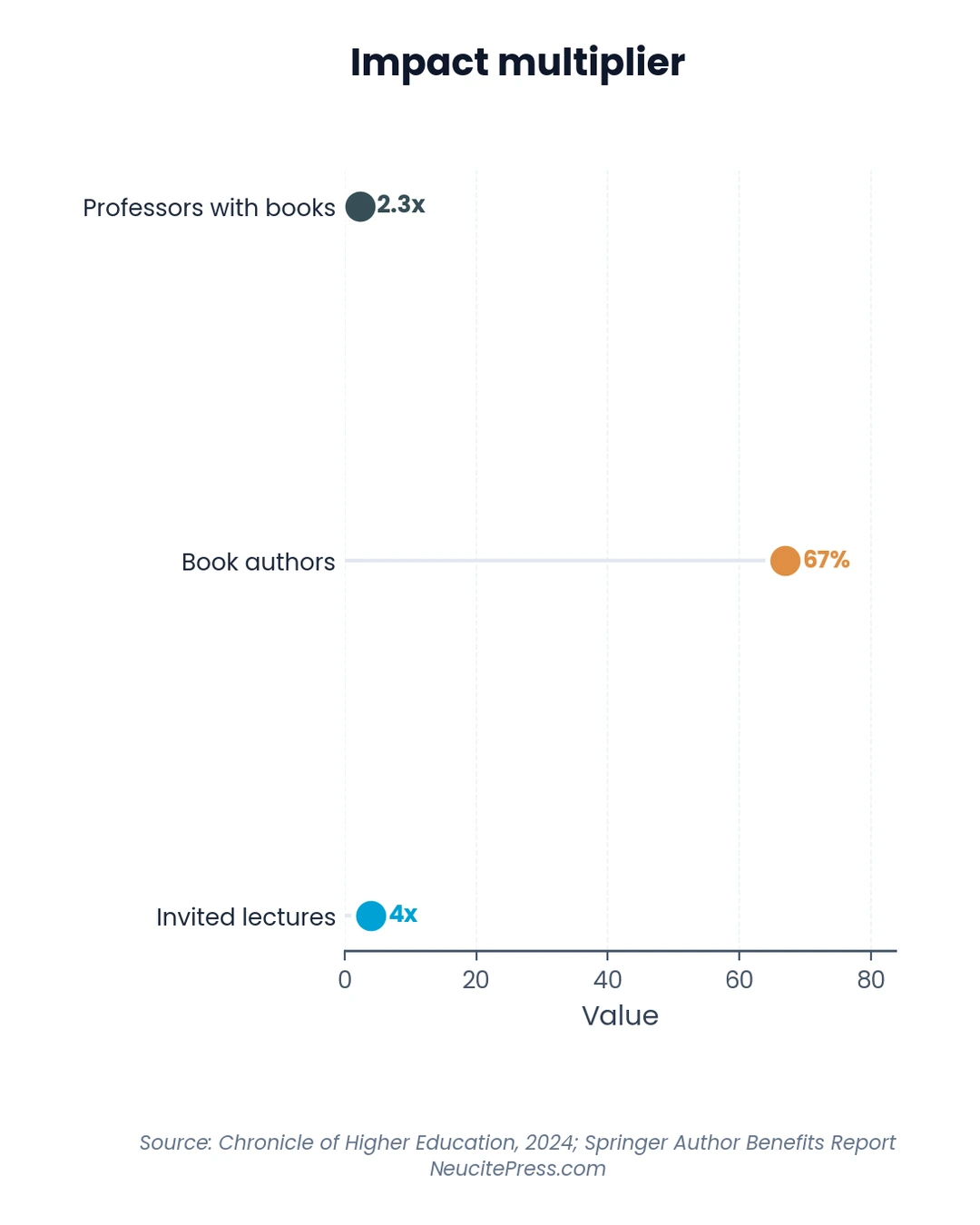
Book revenue comparison lollipop chart ranking 7 income strategies for academic authors
Creating a Diversified Income Strategy for Your Academic Book
Successful academics typically pursue 3-5 of these seven strategies rather than attempting all simultaneously. Strategic focus increases success probability and income concentration.
Matching Strategies to Your Research Area and Skills
For Policy-Relevant Research: Focus on speaking engagements, government consulting, and policy advisory roles. These audiences pay premium rates and actively seek expert input.
For Industry-Applicable Research: Pursue corporate consulting, corporate training workshops, and executive education. Organizations allocate substantial training budgets.
For Healthcare/Medical Research: Explore CME accreditation, medical consulting, and healthcare organization consulting. Healthcare organizations have dedicated professional development budgets.
For Broadly Applicable Research: Develop online courses, write for professional publications, and build thought leadership through content marketing. These approaches benefit from broad audience appeal.
Implementing Your Income Diversification Plan
Year 1: After publication, focus on securing 2-4 speaking engagements and establishing your expert positioning through content marketing. This builds visibility and credibility for subsequent strategies.
Year 2: Launch your first course or workshop program based on book content. Begin consulting business development through networking and content visibility. Target $10,000-$30,000 in non-royalty income.
Year 3+: Scale successful strategies (typically speaking and consulting) while maintaining passive income from courses and licensing. Mature income streams typically reach $50,000-$150,000+ annually.
Practical Implementation: Steps to Start Making Money From Your Academic Book
Step 1: Audit Your Existing Opportunities
Before pursuing new income streams, identify what you already have in place:
What speaking invitations have you already received?
Are any organizations asking for consulting or advisory input?
Do any colleagues mention course development or training needs?
What content from your book could be extracted and repackaged?
Often, low-hanging opportunities already exist—they simply need to be monetized strategically.
Step 2: Build Your Author Platform
Your published book is only as valuable as the audience you can reach. Establish:
Author Website: Simple one-page author site listing your book, credentials, speaking/consulting availability, and email signup. Costs $100-$300 annually. Include SEO optimization to rank for “make money from academic book” and related phrases.
Email List: Capture emails through your website. Start with 100+ subscribers before launching courses or workshops. Email lists become your most valuable marketing asset.
LinkedIn Presence: Active author profiles with regular content updates attract 2-5 consulting inquiries monthly.
Professional Bio: Update biography on institutional website, publisher site, and all social platforms to highlight your book and consulting/speaking availability.
Step 3: Create Your First Revenue Stream
Choose one strategy and execute it fully rather than attempting multiple simultaneously:
For Speaking: Reach out to 10-20 conference organizers in your field. Mention your published book and speaking experience. Many conferences are actively seeking speakers.
For Courses: Outline a 4-6 week online course based on your book. Start on Udemy to minimize risk ($0 upfront cost). You can move to your own platform once demand is proven.
For Consulting: Create a simple consulting services page on your website with 2-3 project types you’re willing to take. Network with potential clients through professional associations.
Step 4: Price Your Services Strategically
Academic authors often underprice their expertise. Research your market:
Speaking fees: Check with conference organizers and speaking bureaus for your field’s standards
Consulting rates: Research other experts in your field on consulting networks
Course pricing: Analyze similar courses on your chosen platform
Workshop fees: Survey professional development workshop pricing in your industry
Price 10-20% above the market average initially. You can adjust based on demand. Most established experts underprice relative to actual value delivered.
Step 5: Systematize and Scale
Once you’ve achieved $5,000+ monthly from one strategy, systematize it:
Create templates, checklists, and processes
Delegate administrative work
Build sustainable systems that don’t require constant reinvention
Once systematized, add your second income stream. Most successful academics operate 3-4 revenue streams simultaneously, each generating $10,000-$40,000 annually.
Financial Benchmarks: Income Expectations and Realistic Timelines
Understanding realistic income progression helps with planning and motivation.
Year 1 After Publication
Typical Income Range: $2,000-$15,000
Most early income comes from royalties and perhaps one speaking engagement. Many authors earn nothing in year 1 as income strategies develop slowly.
Year 2 After Publication
Typical Income Range: $10,000-$40,000
Authors who actively build platforms and pursue opportunities typically achieve 2-4 speaking engagements and launch their first income-generating course or workshop. Consulting often begins generating income.
Year 3+ After Publication
Typical Income Range: $30,000-$150,000+
Established income streams scale. Speaking engagements increase to 4-8 annually. Consulting develops into retainers. Courses run multiple cohorts. Total income from book-related activities often exceeds institutional salary for highly focused authors.
Top-Tier Authors (Year 5+)
Typical Income Range: $100,000-$500,000+
Experts with established platforms, multiple income streams, and strong market positioning generate six-figure income from book-related activities. These authors typically dedicate 30-50% time to income-generating activities beyond their institutional roles.
Common Mistakes to Avoid When Monetizing Your Academic Book
Mistake 1: Waiting for Passive Income
Academic books rarely generate true passive income in early years. Expect to invest 10-20 hours monthly for the first 2-3 years building platform and pursuing opportunities. Only after this foundational work does income become more passive.
Mistake 2: Focusing Only on Royalties
If your strategy centers on book sales, expect disappointment. The published book is valuable as a credential, not a primary income source. View royalties as bonus income rather than primary strategy.
Mistake 3: Underpricing Your Expertise
Academic authors chronically undervalue their work. Your book represents 2-5 years of focused research. Price speaking fees, consulting, and courses to reflect this substantial value creation. Most experts charge 20-50% less than the market will bear.
Mistake 4: Neglecting Your Email List
Your email subscribers are your most valuable asset for future course launches and service offerings. Build your email list actively from day one. Aim for 500+ subscribers before launching paid offerings.
Mistake 5: Pursuing All Seven Strategies Simultaneously
Attempting all strategies simultaneously guarantees mediocre execution. Choose 1-2 strategies initially and execute them excellently. Add additional streams once the initial ones are systematized and running smoothly.
Case Studies: How Academic Authors Generate Six-Figure Income
Case Study 1: The Speaking Expert
Profile: Clinical psychologist with published research on organizational behavior and leadership
Strategy: Focused exclusively on speaking engagements and executive workshops
Income Breakdown:
– 8 annual speaking engagements at $8,000-$15,000 average: $80,000
– 2 annual executive workshops (2-day programs) at $25,000 each: $50,000
– Occasional consulting projects: $20,000
– Book royalties and licensing: $5,000
– Total: $155,000+
Timeline: Reached this level in year 4 after book publication. Maintained institutional position (70% time) while developing speaking business (30% time).
Case Study 2: The Course Creator
Profile: Business school professor with published research on entrepreneurship and business strategy
Strategy: Created comprehensive online course platform based on book content
Income Breakdown:
– Online course platform (Teachable): 3 courses with 500+ total annual students at $297-$597 per course: $120,000
– Udemy course sales (passive): $8,000
– Corporate training license agreements: $20,000
– Speaking engagements (3-4 annually): $30,000
– Total: $178,000
Timeline: First year had only course income ($8,000). Year 3 reached $178,000 through systematic promotion and brand building.
Case Study 3: The Authority Consultant
Profile: Environmental scientist with published research on climate adaptation and policy
Strategy: Built consulting practice working with government agencies and NGOs
Timeline: Developed consulting practice through conference networking and thought leadership content. Reached this level in year 3-4. Maintains 40% institutional position while building consulting business.
The Long-Term Value of Strategic Academic Publishing
Your published academic book is a long-term asset with compounding returns. Unlike traditional employment income that requires continuous effort, book-related income streams grow over time as your platform expands and reputation compounds.
After 5-10 years, many academics find their book generates more income than their primary employment. Yet this outcome requires strategic planning, consistent effort, and willingness to step outside traditional academic culture.
The scholars who generate six-figure income from their books typically share common characteristics: they view their books as credentials rather than products, they actively pursue income-generating opportunities, they price their expertise appropriately, and they systematize successful strategies to enable scaling.
Conclusion: Making Money From Your Academic Book Beyond Royalties
Academic book royalties alone generate insufficient income for most scholars. However, your published work represents a powerful credential opening doors to lucrative speaking engagements, consulting contracts, course development, and professional advancement.
The seven strategies outlined in this guide reveal how ambitious authors transform their scholarly work into diverse revenue streams generating $50,000-$150,000+ annually. These income sources—speaking fees, consulting retainers, online courses, workshops, licensing agreements, platform building, and international markets—scale far beyond royalty income.
Your next step: Choose one strategy aligned with your research area and professional goals. Execute it with focus and consistency for 6-12 months. Once successful, systematize that strategy and add your second income stream.
Download our income diversification template to plan your specific strategy. Share this resource with colleagues pursuing academic publishing. Join the growing community of scholars building sustainable income beyond traditional academic salaries.
FAQ: Making Money From Your Academic Book
What is the typical royalty rate for an academic book?
Scholarly book royalty rates typically range from 5% to 15% of net receipts (not list price). Net receipts are usually 60% of the retail price after retailer discounts. A $30 academic book generating $18 in net receipts produces $1.80-$2.70 per copy sold at standard 10-15% rates. University presses often use standardized rates, while other publishers may negotiate based on author profile and market potential.
How long does the academic publishing process take?
From manuscript submission to published book typically takes 12-24 months. Timeline breakdown: peer review (2-4 months), author revisions (2-6 months), copyediting (1-2 months), design and layout (1-2 months), printing and distribution (2-3 months). Complex books with extensive illustrations or technical content may require additional time. Understanding this timeline helps plan promotional activities and income strategy development parallel to publication.
Can I earn significant income from my academic book beyond royalties?
Absolutely. Hundreds of academics generate $50,000-$300,000+ annually from book-related income streams beyond royalties. Speaking engagements, consulting services, online courses, workshops, and licensing agreements often generate 5-50 times more income than royalty payments. Your published book serves as the credential enabling these lucrative opportunities. Strategic academics view books as investments in their professional platforms rather than direct income sources.
How much can I earn from speaking engagements with my published book?
Speaking fees vary by conference size and audience type. Small academic conferences offer $2,500-$5,000. Medium academic conferences pay $5,000-$10,000. Industry conferences often pay $10,000-$30,000 depending on audience size and prestige. Corporate events and executive audiences often pay $15,000-$50,000+ per engagement. Successful academics secure 4-12 speaking engagements annually, generating $20,000-$300,000+ from speaking alone. Your published book is the credential that qualifies you for premium speaking opportunities.
What consulting rates can I charge based on my published expertise?
Consulting rates depend on your field and client type. Academic consulting typically ranges $100-$200 hourly. Corporate consulting ranges $200-$500 hourly. Executive-level strategy consulting often commands $300-$750 hourly. Government and policy consulting pays $150-$300 hourly. Healthcare consulting generates $250-$750 hourly. Your published book qualifies you for premium rates. Most successful consultants derive 30-50% of income from consulting retainers (ongoing monthly fees of $3,000-$10,000+) rather than hourly work.
How much can an online course based on my book earn?
Online course income varies dramatically based on platform, promotion, and quality. Courses on shared platforms (Udemy, Skillshare) with platform marketing earn $500-$3,000 monthly. Courses on your own platform (Teachable, Thinkific) with active promotion generate $1,000-$10,000+ monthly. A moderately successful course (200-500 annual students at $200-$500 each) generates $40,000-$250,000 annually. Top-performing courses from established experts reach $100,000-$500,000+ annually. Your published book provides substantial educational content requiring minimal additional development for course creation.
What percentage of my time should I dedicate to income-generating activities?
This depends on your income goals and institutional role. Early-career academics typically dedicate 5-10 hours weekly (10-15% of working time) while maintaining academic positions. Those targeting six-figure supplemental income often dedicate 15-20 hours weekly (30-40% of working time). Full-time consultants and course creators dedicate 30-40+ hours weekly. Most successful academics maintain 60-70% time in institutional roles while building 30-40% time in income-generating activities, generating significant supplemental income without leaving academia.
How can I get started with speaking engagements after publishing my book?
Start by contacting 10-20 conference organizers in your field. Mention your recent publication and speaking experience. Create a professional speaker one-sheet (1-page document with your photo, bio, key topics, and availability). Build your author website prominently featuring your book. Update your LinkedIn profile with speaking availability. Join professional speaking organizations. Many academics also use speaker bureaus and agencies that handle booking and negotiation. Secure your first 2-3 speaking engagements through direct outreach; these create proof points for additional opportunities.
What’s the best first step to monetize my academic book?
Choose the strategy most aligned with your research area and interests, then execute it fully. For policy-relevant research, focus on speaking and policy consulting. For industry-applicable research, develop consulting or corporate training offerings. For broadly applicable topics, create an online course. For niche expertise, pursue consulting retainers. Success comes from focused execution of one strategy, not scattered efforts across all seven approaches. Once you’ve generated $5,000+ monthly from your first strategy, systematize it and add your second income stream.
We use cookies to ensure that we give you the best experience on our website. If you continue to use this site we will assume that you are happy with it.