Regional vs International Journal: Positioning Strategy Guide
Since the first scientific periodical launched in 1665, academic publishing has grown explosively. Today, the landscape holds over 11,000 indexed titles in databases like Thomson Reuters. This vast choice presents a critical challenge for scholars.
Reviewed by the NeucitePress Editorial Board — PhD academics, peer-reviewed editors and subject-matter specialists.
Researchers worldwide face a pivotal decision: where to submit their work. The choice between a regional journal vs international journal directly impacts visibility, career advancement, and funding. It’s a complex strategic puzzle.
We understand the pressures. Concerns range from peer review standards to reaching the right audience. This guide demystifies the process. We provide a clear framework to align your publication strategy with your research topics and professional goals.
Key Takeaways
- The academic publishing landscape has expanded significantly since the first journal in 1665.
- Choosing the right publication path is a critical decision impacting a researcher’s career.
- The strategic choice between regional and international outlets affects visibility and funding.
- This guide offers a data-driven framework to simplify the journal selection process.
- Our goal is to help scientists contribute effectively to the global pool of knowledge.
Understanding the Landscape of Academic Journals
The academic publishing ecosystem has transformed dramatically since The Philosophical Transactions of the Royal Society debuted in 1665. Today’s landscape features over 11,000 indexed titles, creating complex choices for researchers worldwide.
Historical Growth and Global Trends in Publishing
We observe stark contrasts between developed and emerging countries’ publishing models. Developed nations treat academic journals as profit-generating enterprises, while emerging countries rely heavily on government funding.
Data from 2010 reveals significant disparities: the Netherlands published 847 scientific journals, Switzerland 202, and Sweden just 30. Yet their research output remains comparable, demonstrating that journal quantity doesn’t directly correlate with scientific productivity.
Key Pain Points and Funding Challenges for Researchers
Brazil exemplifies funding challenges, where national publications account for one-third of scientific output but depend entirely on government support. This creates vulnerability during economic downturns.
Researchers face additional barriers including language requirements and variable quality standards. Studies by Meneghini and Packer (2007) document potential bias against submissions from emerging countries.
Massive research investments in China, India, and Brazil have increased scientific productivity, yet national journals often struggle with limited resources and international perception challenges.
regional journal vs international journal: A Detailed Comparison
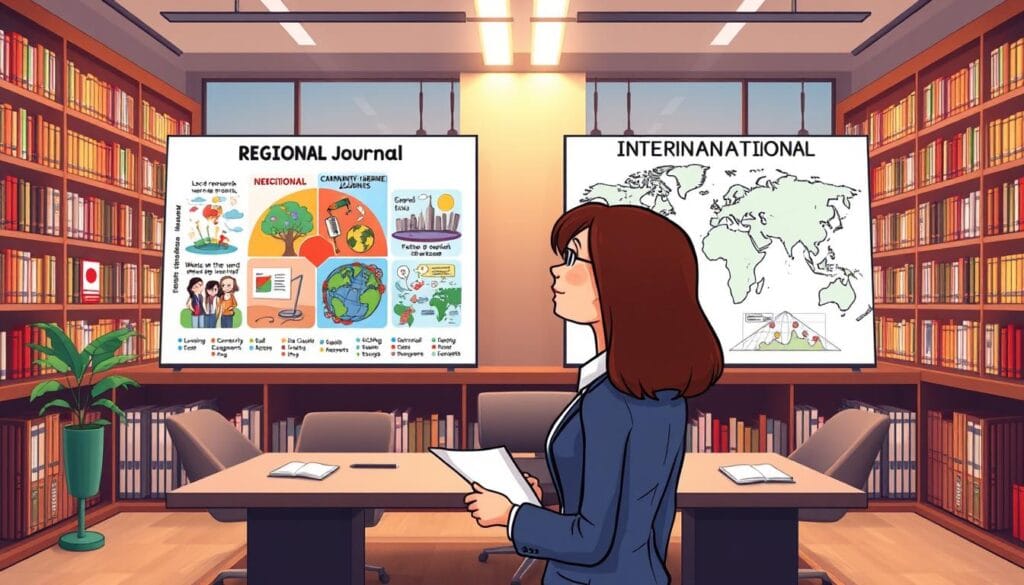
Scientific authors face essential differences when selecting between nationally-focused and globally-oriented periodicals. We examine critical dimensions that influence publication success and research impact.
Scope, Language, and Accessibility Considerations
Global publications prioritize universally applicable studies. Organometallic reactions produce consistent results worldwide. Local outlets excel with region-specific research like endemic diseases.
English serves as the scientific lingua franca according to Meneghini and Packer (2007). Domestic periodicals often publish in native languages. This enables broader participation from local researchers.
Editorial Practices and Peer Review Standards
Editorial board composition shows significant disparities. Developed nations contribute disproportionately to high-impact publications. Braun and Diospatonyi (2005) documented this imbalance.
Review quality varies substantially between publication types. International venues maintain rigorous assessment standards. National outlets sometimes face reviewer availability challenges.
Impact Factor, Indexing, and Global Visibility
The Clarivate Impact Factor remains a key benchmark despite criticism. Citations measure research influence effectively. Global databases like SCIE ensure widespread discoverability.
Specialized indexes like SciELO evaluate regional publications. They require international editorial representation. This enhances credibility and accessibility for local research.
Strategies for Positioning and Enhancing Journal Impact
Strategic positioning requires concrete tools that transform complex publication decisions into actionable steps. We provide researchers with practical frameworks that bridge theory and application.
Actionable Checklists, Downloadable Templates, and Decision Frameworks
Our comprehensive journal selection checklist enables systematic evaluation of publication options. Researchers assess indexing status, peer review rigor, and editorial board composition.
We offer downloadable templates for submission readiness and strategic positioning. These tools help authors align their work with appropriate venues based on scope and audience.
Leveraging Data-Driven Benchmarks and Visual Tools
Concrete benchmarks inform effective decision-making. Author fees averaging $1,250 support quality improvements in open access models.
Visual tools including comparison tables and timeline

s simplify complex factors. Researchers can effectively plan budgets and submission timelines.
Proper indexing in digital formats remains crucial for visibility. Our frameworks emphasize this critical step in the publication process.
These strategies empower scientists to enhance their research impact through informed publication choices. The result is greater visibility and contribution to scientific knowledge.
Conclusion
The final publication decision stands as one of the most consequential choices researchers make throughout their projects. Both publication pathways serve distinct purposes in advancing scientific knowledge globally.
We emphasize that strategic selection depends on research scope, target audience, and professional objectives. Original work retains value regardless of publication venue. Sharing findings with relevant audiences drives scientific progress forward.
Download our practical templates and decision frameworks to streamline your publication process. As highlighted in recent research on journal selection strategies, careful venue matching significantly enhances research impact.
Disclaimer: This guide provides educational frameworks. Consult institutional requirements for final decisions. We remain your trusted partner in navigating complex publishing landscapes across various countries and disciplines.
FAQ
What is the primary difference in scope between a regional and an international publication?
The main distinction lies in their geographical and topical focus. A regional periodical typically concentrates on research relevant to a specific country or area, often publishing articles in the local language. An international publication aims for a worldwide audience, covering globally significant topics and primarily using English as the lingua franca to maximize reach among scientists.
How does the peer review process differ between these two types of publications?
While both types employ peer review to ensure quality, the standards and composition of the editorial board can vary. International publications often enforce more rigorous, universally recognized criteria and involve a diverse panel of reviewers from various countries. Regional publications may have a review board composed mainly of local experts, focusing on the work’s relevance to the region, which can sometimes lead to different evaluation benchmarks.
Which type of publication offers better visibility and citation potential for my research?
International publications generally provide superior global visibility. They are more likely to be indexed in major databases like Scopus and Web of Science, leading to a higher impact factor and greater citation counts. This broader dissemination exposes your work to a wider audience of researchers. However, publishing in a respected regional periodical can be highly impactful for studies with strong local or national relevance, ensuring your findings reach the key audience within that specific community.
Are there significant differences in publication fees and funding models?
Yes, the financial models can differ. Many international publications operate on an Article Processing Charge (APC) model, where authors pay fees to publish open access. Regional publications might have lower or no fees, sometimes being subsidized by academic institutions or societies within the country. Researchers should consider their funding options when choosing where to submit their manuscript.
Can publishing in a regional journal hinder my academic career?
Not necessarily. The choice depends on your career goals and the nature of your research. For scientists aiming for a global academic career, a strong record in international publications is often crucial. However, publishing in high-quality, reputable regional periodicals is valuable, especially if your work addresses local issues or contributes significantly to the scientific literature of a specific country. A balanced portfolio can demonstrate both global engagement and local impact.