How to Build a Strong Editorial Board: Recruitment Strategies
Reviewed by the NeucitePress Editorial Board — PhD academics, peer-reviewed journal editors and medical communication specialists.
Last updated: July 2026 • Reviewed by the NeucitePress Editorial Board • Reading time: 8 minutes
A journal’s editorial board is its credibility made visible. Authors check it before submitting, indexing databases scrutinize it before granting inclusion, and readers use it — consciously or not — as a proxy for whether the journal is a serious, well-run operation. Yet editorial board recruitment is often treated as an afterthought, filled through personal favors or convenience rather than a deliberate strategy. This guide covers what makes a board actually effective, where to find the people who belong on it, how to onboard them properly, and the recruitment mistakes that quietly undermine journals that otherwise do everything else right.
What Makes an Editorial Board Effective
A strong editorial board is not simply a list of impressive names. It needs to function as a working body that can credibly evaluate submissions across the journal’s full scope, sustain that capacity as members rotate off, and represent the journal fairly to the wider research community. Three characteristics matter most.
Breadth of Subject Expertise
If a journal covers several subfields, its board needs members active in each of them. A board weighted entirely toward one narrow specialty will struggle to find qualified reviewers or make informed decisions once submissions drift outside that specialty, which happens more often than editors expect as a journal’s scope and reputation grow.
International and Institutional Diversity
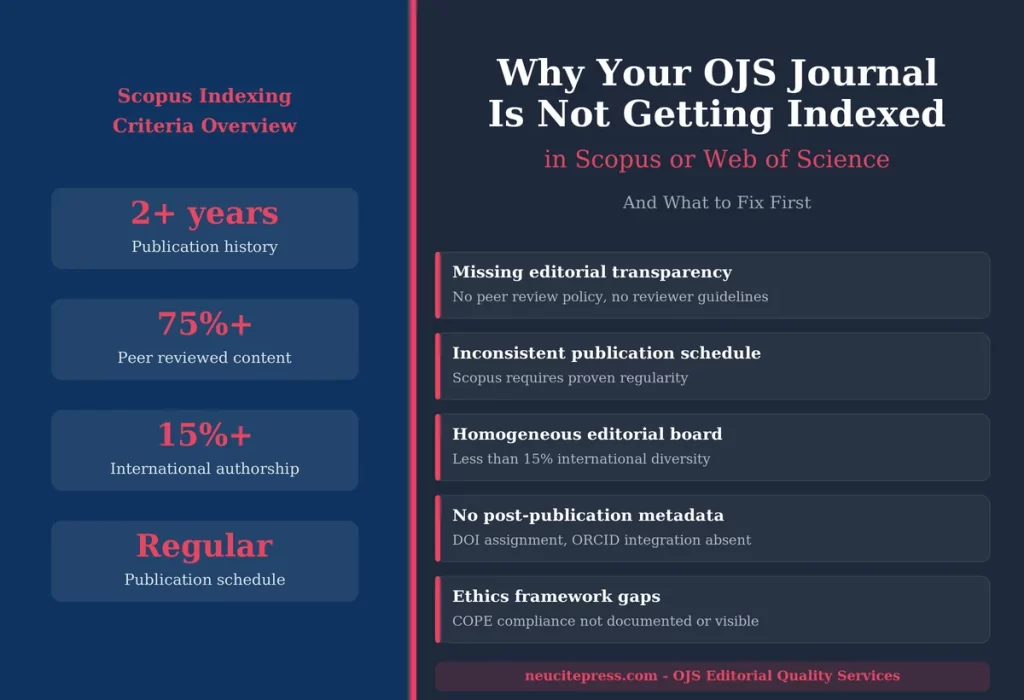
Geographic and institutional diversity is not just good practice — it is an explicit evaluation criterion used by major indexing services. Scopus’s content selection process, for example, weighs the international composition of a journal’s editorial board and its authorship as part of deciding whether to index a title, and reviewers are more likely to flag a board that is concentrated in one country or a small cluster of institutions. Beyond indexing, a geographically and institutionally diverse board reduces the appearance (and reality) of a journal serving as a closed loop for one department or network.
Active, Publishing Researchers
Board members who are no longer actively publishing or engaging with current literature in the field lose touch with what a rigorous, up-to-date review actually requires. The strongest boards mix senior figures who bring institutional credibility with mid-career researchers who are closer to the current pace of the literature and often more willing to do the actual work of reviewing.
Where to Find Editorial Board Candidates
Conference Networking
Academic conferences remain one of the most reliable places to identify potential board members, because you can observe how someone engages with questions, how well they know the literature outside their own narrow niche, and how they handle disagreement — all of which matter more for board service than publication count alone.
Citation-Based Outreach
Editors can look at who is actively publishing and being cited in the journal’s core subject areas and approach those researchers directly, rather than relying only on existing personal networks. This widens the pool beyond an editor’s immediate circle and is one of the more effective ways to build genuine subject and institutional diversity rather than defaulting to people already known to the founding editors.
Promotion from the Reviewer Pool
Reviewers who consistently deliver thorough, timely, well-reasoned reports are often the best-informed candidates for board seats, because they have already demonstrated the judgment and reliability the role demands under real conditions, not just on paper. Many journals treat strong reviewer performance as the primary pipeline for board succession, rather than searching cold for new candidates when a seat opens.
Professional Societies and Existing Board Referrals
Subject-specific professional societies can be a good source of candidates who are already embedded in the field’s professional infrastructure. Current board members are also a natural source of referrals, though editors should be careful that this channel doesn’t simply reproduce the same narrow network the board already has — a common failure mode discussed below.
Onboarding and Defining Responsibilities
Recruiting the right people is only half the job; a board that isn’t properly onboarded will underperform regardless of the credentials on paper. A clear onboarding process should cover:
- Written role expectations. How many manuscripts a board member is expected to review or oversee per year, expected turnaround times, and what “board member” actually means for this journal — some journals expect direct peer review, others expect editorial oversight and occasional review only.
- Term length and renewal process. Fixed terms (commonly two to four years, renewable) keep the board from becoming static and give editors a natural point to reassess fit and rebalance representation.
- Access to systems and editorial policy. New members need training on the journal’s manuscript management system, its conflict-of-interest policy, and its house style for review reports before their first assignment, not after.
- A named point of contact. New board members should know exactly who to go to with questions, rather than being left to figure out informal norms on their own.
Board Size Considerations
There is no universal correct board size — it depends on submission volume, subject breadth, and how much of the review workload the board itself is expected to carry versus outside reviewers. A board that is too small cannot cover the journal’s full scope and burns out quickly under submission volume; a board that is too large becomes difficult to coordinate, dilutes individual accountability, and can end up with members who rarely engage meaningfully. Many editors find it useful to map current and anticipated subject areas against current board expertise at least once a year and recruit deliberately to fill the gaps that surface, rather than growing the board reactively whenever a well-known name expresses interest.
Common Recruitment Mistakes
| Mistake | Why It Hurts the Journal |
|---|---|
| Board concentrated at one institution or in one country | Signals a closed network to authors and indexing reviewers; raises questions about impartiality and can jeopardize indexing applications |
| Recruiting only through personal favors | Narrows expertise coverage and tends to reproduce the same professional network repeatedly |
| No defined term limits | Board becomes static, disengaged members are never replaced, and succession planning never happens |
| Prestige over engagement | Big names who never respond to review requests are worse than less famous members who reliably deliver |
| No onboarding process | New members are unclear on expectations, leading to inconsistent review quality and slow turnaround |
Bringing It Together
Building a strong editorial board is an ongoing discipline, not a one-time hiring exercise. The journals with the most durable, credible boards treat recruitment as a continuous process — watching the reviewer pool for future board members, tracking subject and geographic gaps, and revisiting board composition on a set schedule rather than only when a vacancy forces the issue. Combined with clear onboarding and defined terms, this approach produces a board that can genuinely support the journal’s growth rather than simply decorating its masthead.