Image Copyright for Books: How to Use Photos Legally in 2026
Reviewed by the NeucitePress Editorial Board — PhD academics, peer-reviewed journal editors and medical communication specialists.
Last updated: October 2026 • Reviewed by the NeucitePress Editorial Board • Reading time: 6 minutes
Finding a photograph online does not give you the right to print it. Under US law, an original photograph or illustration is protected from the moment it is created, with no registration and no copyright symbol required, and that protection applies to the image whether or not it sits behind a paywall. For a book author, the practical rule is simple: for every image, know who owns it and on what terms you may use it, and keep that record. This guide sets out the routes that work, and the checks to make before an image goes into print.
This article is general information for authors, not legal advice. Rules differ by country, so check the law in each market where you will sell the book.
What the law says
- Protection is automatic. For works created on or after 1 January 1978, US copyright lasts for the author’s life plus 70 years. Works made for hire, anonymous and pseudonymous works last 95 years from first publication or 120 years from creation, whichever is shorter (US Copyright Office, Circular 15A).
- Public domain cutoff. The Copyright Office states that all works published in the United States before 1 January 1931 are in the public domain. A work from the 1930s or later may still be protected, so check the date and the country of first publication.
- Damages can be large. Under 17 U.S.C. 504(c), a court may award statutory damages of $750 to $30,000 per work infringed, increased to as much as $150,000 per work for willful infringement, and reduced to as little as $200 where the infringer proves it was unaware and had no reason to believe the use was infringing. A rights holder can also seek actual damages and profits, and can ask for removal of the image.
- Intent does not remove liability. An innocent mistake can still be infringement, which is why a written record matters.
Five lawful ways to get an image
- Make it yourself. Your own photographs, diagrams and charts are yours, provided they do not reproduce someone else’s protected work or show identifiable people or private property in ways that need releases.
- Use the public domain. Works whose copyright has expired, and works dedicated to the public domain such as CC0, can be used without permission. Still credit the source, and keep a note of why you believe the image is public domain.
- Use a Creative Commons licence correctly. The licence is a set of conditions, not a general permission.
- Buy a licence. Stock agencies and museums license images for defined uses. Read the licence for print run, territory, formats and duration, and for whether cover use is allowed.
- Ask for permission. Contact the rights holder in writing, name the book, formats, territories, languages and print run, and get a signed agreement before you publish.
Which route fits this image? A quick decision tree
Creative Commons licences in a sold book
| Licence | Credit required | Changes allowed | Commercial use |
|---|---|---|---|
| CC BY | Yes | Yes | Yes |
| CC BY-SA | Yes | Yes, shared under the same licence | Yes |
| CC BY-ND | Yes | No | Yes |
| CC BY-NC | Yes | Yes | No |
NonCommercial licences are unsuitable for a book you sell. A ShareAlike licence can affect how you may license the adapted image. Record the image title, creator, source URL, licence version and the date you checked it, and credit it exactly as the licence requires.
Permissions and fair use
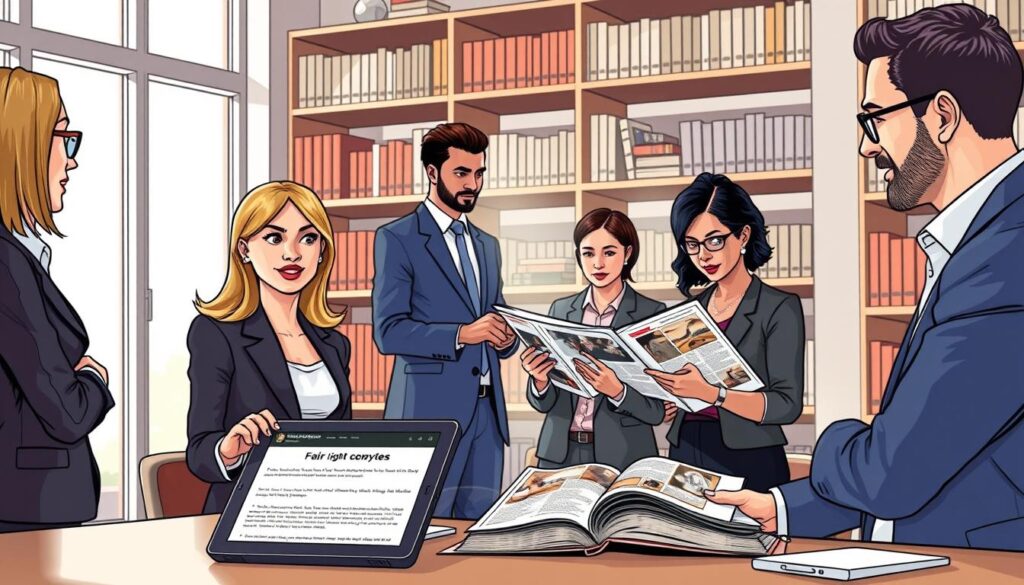
When an image is neither free nor licensed, ask the rights holder. Start early, because replies from museums, agencies and estates can take weeks. A request should name the book, the publisher, the formats and territories, the languages, the print run and the placement (cover or interior), and should ask for permission in writing. Some institutions charge separately for a high-resolution file. File every request and reply with the signed permission.
Fair use is a US doctrine that permits some unlicensed use in certain circumstances, such as criticism, comment and scholarship. A court weighs four factors: the purpose and character of the use, the nature of the copyrighted work, the amount and substantiality of the portion used, and the effect on the potential market for the work. The Copyright Office stresses that there is no formula or fixed percentage that guarantees a use is fair, and that each case is judged on its facts. Reproducing a whole photograph as an illustration is much harder to defend than quoting a short passage. Many publishers prefer written permission to a fair-use argument, and many contracts require you to warrant that you hold the rights to every image.
Credit lines and record keeping
- Use a consistent credit line: Figure number, title, creator, year, source and licence.
- Keep one rights log for the whole book, with a file for each image: source, licence or permission, date, fee, scope and expiry.
- Check that the permission covers every format you plan to produce, including print, ebook and translations, and every country where you will sell.
- For the cover, check whether the licence allows use on a cover, because many stock and Creative Commons terms treat it differently from interior use.
Frequently asked questions
Can I use an image I found through a search engine?
Only if you can identify the owner and the licence. Appearing in search results is not a licence.
Can I use a chart from a published article?
Usually you need permission from the copyright holder, often the publisher. Many publishers run a permissions service, and some journal articles carry an open licence that already permits reuse with credit. Check the article page.
Do I need permission to redraw a figure?
Copying the data is generally not the issue, but redrawing a distinctive figure can still copy its protected expression. When in doubt, build a new figure from the underlying data and cite the source.

NeucitePress services for authors
We handle figures, covers and production. Third-party image permissions remain the author’s responsibility.
Typesetting with up to 30 figures placed with captions, reference formatting, ISBN assignment, two cover concepts and distribution through Amazon KDP, IngramSpark and Google Books.
Up to 75 figures with professional redrawing if needed, a professional index, developmental editing and copyediting, and DOI registration.
Three cover concepts, two revision rounds, print-ready and digital files, and source files. Licensed stock images are extra if needed.