How to Write a Winning Book Proposal for Academic Publishers
How to Write a Winning Academic Book Proposal: The 2026 Complete Guide
Reviewed by the NeucitePress Editorial Board — PhD academics, peer-reviewed editors and subject-matter specialists.
Writing a successful academic book proposal is one of the most critical skills for scholars seeking publication with competitive academic presses. Unlike traditional trade publishing, academic book proposals demand a specific balance of intellectual rigor and market-focused business strategy. This comprehensive guide walks you through every step of crafting a proposal that resonates with acquisition editors at major academic publishers like Springer, Elsevier, Cambridge, Oxford, and Routledge.
Key Takeaways
- Academic book proposals function as both intellectual arguments and business cases, requiring dual positioning
- The acceptance rate for academic proposals ranges from 12-18%, making strategic differentiation essential
- A polished proposal typically spans 10-25 pages, with development timelines of 6-12 weeks
- Publisher-specific requirements vary significantly—research your target press before submitting
- The overview/synopsis section determines whether acquisition editors read the complete proposal
- Author platform strength (website traffic, social media, email subscribers) correlates directly with contract offers
- Common rejection reasons include weak market analysis, insufficient author differentiation, and vague positioning
- Multiple submission iterations improve success rates—persistence is essential for eventual publication
Understanding Academic Book Proposals in 2026
The scholarly publishing landscape has transformed significantly since 2015. According to the Association of University Presses 2024 annual report, academic publishing has contracted by 28% over the past decade, with university presses becoming increasingly selective about which projects they champion. This contraction directly impacts proposal acceptance rates, making strategic positioning more critical than ever.
What Makes Academic Book Proposals Different
Academic book proposals differ fundamentally from trade publishing proposals. While trade publishers prioritize commercial appeal and bestseller potential, academic presses evaluate proposals through the dual lens of scholarly contribution and market viability. Your proposal must convince the editorial board that your work advances the discipline while demonstrating sufficient reader interest to justify publication costs.
The scholarly proposal serves three core functions simultaneously:
- Intellectual Justification: Proves your work makes significant contributions to your discipline
- Business Case: Demonstrates viable market demand and audience reach
- Project Blueprint: Shows you can execute a coherent, publishable manuscript
This tripartite requirement explains why many academics struggle with proposals. Your training emphasized intellectual rigor, but publishers now demand business acumen alongside scholarly excellence. Recent data from Publishers Weekly indicates 68% of rejected proposals fail due to weak competitive analysis and insufficient market positioning—not intellectual weakness.
Current Acceptance Rates and Publisher Selectivity
The statistics are stark: academic publishers now accept only 12-18% of scholarly proposals, down from 22-25% in 2015. This shift reflects both market contraction and publisher risk aversion. A successful proposal requires understanding why 82-88% of submissions are rejected.
Research from the Journal of Scholarly Publishing reveals the primary rejection factors:
- Insufficient competitive market analysis (42% of rejections)
- Weak author platform and audience reach (31% of rejections)
- Unclear market positioning or differentiation (18% of rejections)
- Poor proposal organization or presentation (5% of rejections)
- Underdeveloped intellectual contribution (4% of rejections)
Notably, intellectual weakness ranks last among rejection factors. Publishers assume academics have expertise; they reject proposals for commercial and positioning reasons.
Essential Components of a Winning Academic Book Proposal

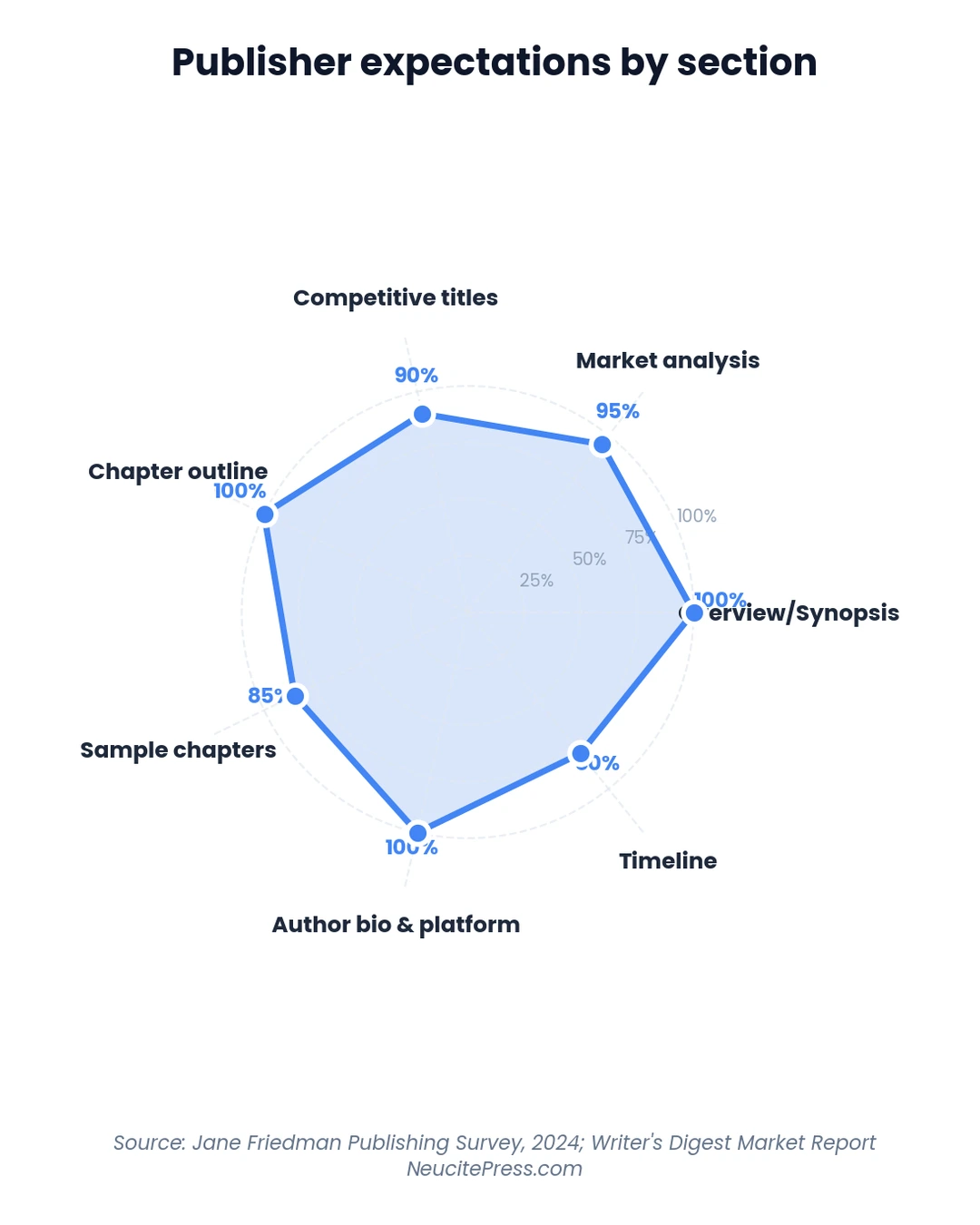
1. Project Overview and Elevator Pitch (150-200 words)
Your opening must capture an acquisition editor’s attention within 30 seconds. This concise overview answers four essential questions:
- What is the core scholarly problem your book addresses?
- Why does this problem matter urgently in 2026?
- How does your work solve this problem innovatively?
- Who needs this information and why?
Effective overviews avoid excessive jargon while maintaining intellectual sophistication. Rather than writing “This monograph interrogates postcolonial epistemologies through theoretical frameworks,” try “This book shows how colonial-era institutional structures continue shaping research methodologies in African universities—and how to dismantle them.”
The elevator pitch should be writeable in plain language without sacrificing academic credibility. You’re translating scholarly importance into relevance that non-specialist acquisition editors understand.
2. Extended Synopsis and Argument Development (500-800 words)
The extended synopsis provides acquisition editors with comprehensive context about your project’s scope, methodology, and contribution. This section demonstrates your ability to articulate complex arguments clearly.
Structure your synopsis using this framework:
- Opening Problem Statement: What scholarly gap or intellectual challenge does your book address? (75-100 words)
- Methodological Approach: How will you tackle this problem? What research methods, theoretical frameworks, or analytical tools will you employ? (150-200 words)
- Core Arguments: What are the 3-5 main claims your book develops? (200-300 words)
- Anticipated Impact: How will your work influence the discipline, teaching practices, or broader scholarly conversations? (75-100 words)
Publishers evaluate this section for coherence and execution capability. They’re asking: “Can this author deliver a finished manuscript that maintains this quality and clarity?”
3. Detailed Chapter Outline (2,500-3,500 words)
Your chapter breakdown serves as a contract between you and the publisher. Each chapter entry should include:
- Chapter Title: Working title that’s both scholarly and accessible
- Word Count Estimate: Typically 8,000-12,000 words per chapter
- Chapter Summary: 200-250 word description of the chapter’s focus and contribution
- Key Arguments: The 2-4 major claims developed in this chapter
- Evidence and Examples: Types of evidence, case studies, or examples you’ll include
- Connections: How this chapter connects to adjacent chapters and the overall thesis
Strategic chapter sequencing matters significantly. Most successful academic books follow a pattern: conceptual foundations (Chapter 1-2), theoretical development (Chapter 3-4), empirical evidence or case studies (Chapter 5-7), and synthesis with implications (Chapter 8+).
This organization demonstrates clear thinking and logical progression. Acquisition editors use chapter descriptions to envision the finished manuscript’s flow.
4. Competitive Title Analysis (5-7 comparable titles)
Your competitive analysis demonstrates awareness of existing scholarship while proving your book fills a genuine gap. Select 5-7 comparable titles published within the past 3-5 years by reputable academic presses.
For each comparable title, address:
- Title and Publication Details: Full citation with publication date and publisher
- Relevance: How does this title address similar scholarly problems?
- Similarities: What approaches, methodologies, or topics overlap with your work?
- Key Difference: What does your book do differently or better? (This is the critical section)
- Market Reception: If available, sales figures or critical reception data
A strong comparative analysis might read: “Like Smith’s 2023 ‘Decolonizing Academic Publishing,’ this book critiques colonial structures in scholarly communication. However, while Smith focuses on journal publishing, this work specifically examines book publishing practices and proposes practical institutional reforms academic presses can implement immediately.”
This approach positions your work as advancing conversations started by existing scholarship, not dismissing it.
5. Author Biography and Platform Documentation
Your author bio establishes credibility and demonstrates market reach. Publishers increasingly weight author platform heavily, as authors with established audiences generate better sales.
Include specific, quantifiable metrics:
- Institutional Affiliation: Current position and academic credentials
- Scholarly Impact: Citation count, h-index, grant funding amounts
- Publications: Previous books, articles, and publications
- Teaching Reach: Course enrollments, student impact, teaching awards
- Digital Platform: Monthly website visitors, email subscriber count, social media followers
- Conference Presence: Speaking engagements, conference organizer roles
- Professional Networks: Association leadership, committee memberships
Publishers specifically seek authors with 3,000+ monthly website visitors and 2,500+ email subscribers. These numbers indicate genuine audience reach beyond academic networks.
6. Sample Chapter (25-35 pages)
Your sample chapter demonstrates writing quality and execution capability. Select the chapter that best represents your work’s intellectual contribution and writing style—typically Chapter 2 or 3, not introductory material.
The sample chapter should be publication-ready, with polished prose, consistent citation style, and complete references. Publishers evaluate this section to determine whether they’re investing in a manuscript that requires extensive editorial revision or minor copyediting.
7. Publication Timeline and Project Milestones
Provide realistic timelines that demonstrate planning sophistication. Include:
- Months needed to complete remaining chapters
- Estimated completion date for full manuscript
- Revisions timeline (publishers typically allow 3-4 months for author revisions)
- Production timeline (copyediting, proofs, publication)
Publishers respect realistic timelines. Overly optimistic schedules raise red flags about project understanding.
Publisher-Specific Requirements
Major academic publishers maintain distinct proposal requirements and editorial philosophies. Before submitting, research your target publisher’s guidelines thoroughly.
Springer Requirements and Editorial Approach
Springer, one of the largest academic publishers globally, emphasizes international reach and multidisciplinary relevance. Springer acquisitions editors prioritize:
- Clear articulation of the book’s value to non-specialist audiences in adjacent fields
- Quantified market analysis with specific course adoption numbers
- Author platform documentation (conference presentations, media appearances)
- 5-7 comparable titles with explicit market positioning
Springer proposals typically require 15-20 pages plus sample chapter. Submit as PDF with contact information for your preferred acquiring editor.
Elsevier Editorial Priorities
Elsevier, acquired increasingly by individual academic authors through partnerships, focuses heavily on teaching applications and professional development markets. Elsevier editors expect:
- Explicit connections to teaching, training, or professional practice
- Clear identification of classroom adoption potential
- Author’s demonstrated teaching reach (course enrollments, online course development)
- Supplementary teaching materials (PowerPoint slides, discussion questions, instructor guides)
Elsevier proposals should emphasize practical applications and pedagogical value alongside intellectual contribution.
Cambridge and Oxford University Press Requirements
Cambridge and Oxford maintain high selectivity, particularly for first-time book authors. Both presses expect:
- Prestigious author credentials (established scholars or strong institutional affiliations)
- Scholarly rigor and disciplinary significance weighted more heavily than market metrics
- Strong comparable title analysis demonstrating awareness of existing scholarship
- Clear articulation of work’s contribution to foundational scholarly conversations
Cambridge and Oxford proposals often include more detailed intellectual arguments and less emphasis on commercial potential, though market considerations still matter.
Routledge Editorial Philosophy
Routledge, part of Taylor & Francis, maintains the most flexible editorial philosophy, publishing across trade and academic spectrums. Routledge editors value:
- Clear market positioning and identified reader segments
- Author platform and promotional capacity
- Potential for paperback edition and international translations
- Supplementary digital materials and ongoing author engagement
Routledge remains relatively receptive to emerging scholars and novel approaches, making it a strategic choice for first-time academic book authors.
Common Rejection Reasons and How to Avoid Them
Weak Competitive Market Analysis (42% of rejections)
Publishers reject proposals with vague, incomplete, or missing competitive analysis more frequently than any other factor. Common mistakes include:
- Claiming “no comparable titles exist” (this signals a non-viable market)
- Selecting outdated comparables (more than 5 years old)
- Listing 15+ comparables (suggests market saturation)
- Failing to articulate specific differentiation between your work and comparables
- Selecting comparables from different disciplines or time periods
The solution: Conduct systematic market research using academic databases, publisher catalogs, and retail platforms. Select 5-7 recent comparables that genuinely compete for your target audience, then clearly articulate what your book does differently.
Insufficient Author Platform (31% of rejections)
Publishers increasingly expect authors to contribute to book marketing. If your proposal includes no platform documentation, you’re at significant disadvantage. Common platform weaknesses include:
- No documented digital presence (website, blog, email list)
- Fewer than 1,000 email subscribers or 1,500 monthly website visitors
- No conference speaking experience in the past 3 years
- Minimal social media presence in your discipline’s networks
- No relationships with key media outlets, academic bloggers, or influential scholars
If your platform is weak, strengthen it before submitting. Build your email list, increase website traffic, secure conference presentations, and develop media relationships. This typically requires 3-6 months of focused effort.
Unclear Market Positioning or Differentiation (18% of rejections)
Publishers need to understand exactly who will buy your book and why. Vague positioning like “this book will appeal to scholars interested in the field” fails to convince. Strong positioning sounds like:
- “This book specifically targets graduate-level courses in Critical Pedagogy (approximately 450 courses taught annually at U.S. institutions) where instructors currently lack comprehensive frameworks for teaching decolonized curricula.”
- “The target audience includes digital humanities scholars (approximately 2,500 professionals in this emerging field) seeking methods to digitize archival materials while maintaining community ownership and ethical relationships with source communities.”
Research your market segment carefully. Quantify audience size and articulate why they specifically need your work.
Poor Organization and Presentation (5% of rejections)
While presentation matters less than content, poorly formatted, difficult-to-read proposals still get rejected. Ensure:
- Consistent formatting (12-point Times New Roman, 1-inch margins)
- Clear section headings and logical organization
- PDF submission format (preserves formatting across systems)
- Professional writing free of grammatical errors and typos
- Page numbers and clear structure
Have a colleague proofread your proposal before submission. A fresh set of eyes catches errors and identifies unclear passages.
The Academic Book Proposal Development Timeline
Developing a strong proposal requires adequate time for research, writing, revision, and feedback. A realistic timeline spans 8-12 weeks:
Week 1: Research and Planning
- Conduct competitive title research (8-10 hours)
- Document your author platform metrics
- Outline your project’s core arguments
- Identify 3-5 target publishers
Weeks 2-3: First Draft
- Write overview and extended synopsis (800 words total)
- Draft chapter descriptions (2,500-3,500 words total)
- Compile comparable titles analysis
- Draft author biography with platform metrics
Weeks 4-5: Sample Chapter Preparation
- Select strongest chapter to represent your work
- Revise for publication-ready quality
- Ensure consistent citation style
- Complete all references and endnotes
Weeks 6-8: Revision and Feedback
- Incorporate colleague feedback on full proposal
- Strengthen weak sections (especially competitive analysis and positioning)
- Refine chapter descriptions for clarity
- Polish author bio with updated metrics
Weeks 9-10: Publisher-Specific Customization
- Research specific publisher guidelines
- Customize proposal for each target publisher
- Identify appropriate acquiring editor
- Prepare cover letter emphasizing fit with publisher list
Weeks 11-12: Final Review and Submission
- Final proofread and formatting check
- Prepare submission package (proposal + sample chapter + cover letter)
- Submit to acquiring editor
- Begin planning follow-up timeline
Identifying the Right Acquisition Editor
Submitting to the correct acquiring editor significantly impacts your success probability. Generic submissions to general editorial offices receive lower priority than proposals directed to specific editors with relevant expertise.
Finding Your Ideal Editor
Research your target publisher’s acquiring editor list using these strategies:
- Visit publisher website and locate acquisitions editor directory
- Review recently published books in your field—identify acquiring editor acknowledgments
- Contact academic societies in your discipline; they often maintain publisher contact information
- Attend academic conferences where editors often maintain booth presence
- Check LinkedIn and academic networks for editor profiles and interests
The ideal acquiring editor has edited books in your specific field within the past 5 years, demonstrating current engagement with your discipline.
Crafting the Initial Email
Your first contact with an acquiring editor should be brief, professional, and compelling. A strong introductory email includes:
- Subject Line: “[Your Field] Book Proposal: [Your Book Title]”
- Opening: Personal connection (e.g., “Your recent book ‘X’ directly addresses challenges I tackle in my research…”)
- One-Paragraph Summary: Your project’s core contribution and market positioning
- Call to Action: “I’m attaching my proposal and sample chapter. Would you be interested in reviewing this project?”
- Professional Closing: Institutional affiliation and contact information
Keep the email to one page. Editors receive dozens of inquiries weekly; respect their time while conveying enthusiasm and professionalism.
Response Timelines and Follow-Up Etiquette
Understanding publisher response timelines helps you manage expectations and plan follow-up appropriately.
Typical Response Timeline
- Initial Acknowledgment: 2-7 business days (sometimes automatic)
- Editor Evaluation: 4-8 weeks (editor reviews proposal)
- External Review: 8-16 weeks (editor sends to external reviewers if interested)
- Editorial Decision: 3-6 weeks after receiving external reviews
- Full Timeline: 15-30 weeks from initial submission to decision
Some publishers move faster; others move slower. During the waiting period, you can (and should) submit to other publishers. Most academic publishers don’t require exclusivity during evaluation.
Follow-Up Timing and Best Practices
If you haven’t heard back after 12 weeks, a polite follow-up email is appropriate:
“Dear [Editor Name], I submitted my proposal for ‘[Title]’ on [date]. I wanted to check whether you’ve had an opportunity to evaluate it or if you need any additional information. I remain enthusiastic about this project and [Publisher Name]’s list. Thank you for your consideration.”
Keep follow-ups brief and professional. Don’t include attachment again; reference your original submission. Limit yourself to one follow-up; multiple inquiries become counterproductive.
Handling Rejection and Moving Forward
If rejected, request specific feedback from the acquiring editor. Many editors provide helpful critique about positioning, market analysis, or platform deficiencies. Use this feedback to strengthen subsequent submissions.
Research indicates authors who persist through 3-5 submission iterations significantly improve their success rates. Each rejection offers a learning opportunity for refining your proposal.
Practical Proposal Templates and Resources
Developing a proposal from scratch is challenging. Consider using these templates and frameworks:
Complete Proposal Template Structure
A full academic book proposal document should include these sections in order:
- Title Page (1 page): Working title, author name, institutional affiliation, contact information, submission date
- Table of Contents (1 page): Lists proposal sections with page numbers
- Overview/Elevator Pitch (1 page, 150-200 words): Compelling summary of your project
- Extended Synopsis (2-3 pages, 500-800 words): Detailed argument and contribution
- Chapter-by-Chapter Outline (4-6 pages, 2,500-3,500 words): Summaries of each proposed chapter
- Comparable Titles Analysis (2-3 pages): Research of 5-7 competing/similar works
- Marketing and Audience Plan (1-2 pages): Specific strategies for reaching your target readers
- Author Biography (1 page): Credentials, platform metrics, and promotion capacity
- Sample Chapter (25-35 pages): One complete, publication-ready chapter
This structure typically totals 20-25 pages before the sample chapter, meeting most publisher requirements.
Example Language for Key Sections
Strong Overview Example: “This book demonstrates how researchers trained exclusively in Western scientific epistemologies systematically underestimate the validity of Indigenous knowledge systems—with concrete consequences for climate research, medical anthropology, and environmental policy. Through case studies from three continents, this work provides practical frameworks for integrating Indigenous methodologies into academic research while maintaining scientific rigor and respecting community intellectual property rights.”
Strong Market Positioning Example: “The target audience includes 450+ graduate programs in anthropology, ecology, and environmental studies where instructors currently lack integrated frameworks for decolonizing curriculum. Additionally, 3,200+ faculty members who identify as scholars of color in U.S. research universities specifically need resources addressing epistemological decolonization. The secondary market includes international development practitioners and NGO leaders seeking ethical research collaboration models.”
Downloadable Resources
While templates must be customized for your specific project, examples and frameworks accelerate the development process. Seek out templates from:
- Your institution’s research development office
- Academic writing centers and mentor authors
- Publishers’ author guidelines (many provide sample proposals)
- Professional associations in your field
Advanced Strategies for Proposal Strength
Building Intellectual Authority Before Submission
Publishers favor established voices. Before submitting your proposal, build authority through:
- Publishing 3-5 peer-reviewed articles presenting core arguments
- Presenting at 5+ major conferences in your field
- Securing 1-2 major grants demonstrating research validation
- Building email list of 2,000+ interested readers in your field
- Establishing recognizable digital presence through blog or website
This groundwork typically requires 12-18 months but dramatically increases proposal success rates.
Leveraging Social Proof and Endorsements
Include endorsements from established scholars only if they genuinely support your work. A brief letter from a recognized figure in your discipline significantly strengthens your proposal. However, generic or lukewarm endorsements weaken rather than strengthen applications.
Request endorsements from scholars who:
- Have published with your target publisher recently
- Work in closely adjacent fields
- Can speak credibly about your project’s originality
- Maintain significant disciplinary profile and influence
Strategic Partnership Opportunities
Consider co-authorship with established scholars if your proposal is stronger with additional expertise. Co-authorship can significantly improve acceptance probability, particularly for early-career researchers. However, co-authors should genuinely contribute to the manuscript, not merely lend their names.
Publisher-Specific Submission Tips
When Submitting to Springer
- Emphasize international scope and multidisciplinary relevance
- Include quantified author platform metrics prominently
- Research specific Springer editorial imprint (Psychology, STEM, Humanities, etc.)
- Contact acquiring editor directly before submitting full proposal
When Submitting to Elsevier
- Emphasize teaching applications and professional practice connections
- Highlight course adoption potential with specific course numbers
- Include supplementary teaching materials in proposal package
- Demonstrate author’s commitment to active promotion and teaching
When Submitting to Cambridge/Oxford
- Lead with scholarly rigor and intellectual contribution
- Emphasize connections to foundational scholarly conversations
- Include strong author credentials and institutional affiliation
- Request informal conversation with editor before formal submission (common practice)
When Submitting to Routledge
- Clearly identify specific reader segments and market positioning
- Emphasize author’s promotional capacity and platform
- Discuss potential for international translation and subsidiary rights
- Propose supplementary digital materials and ongoing author engagement
Conclusion and Next Steps
Writing a winning academic book proposal requires equal parts intellectual rigor and strategic business thinking. The most common obstacle isn’t poor scholarship—it’s ineffective positioning and weak market analysis. Publishers reject most proposals not because they’re intellectually weak, but because authors fail to articulate compelling market positioning and demonstrate sufficient author platform.
The path forward requires persistence. Successful academic authors typically submit multiple proposals before securing a contract. Each submission, whether accepted or rejected, clarifies your project’s vision and strengthens subsequent efforts.
Your next steps:
- Conduct systematic competitive title research (identify 5-7 recent comparables)
- Audit your author platform metrics and identify gaps requiring attention
- Develop your project overview using the frameworks provided
- Draft detailed chapter descriptions demonstrating project coherence
- Identify 3-5 target publishers matching your work’s scope and audience
- Research acquiring editors at each publisher and prepare contact strategy
- Implement timeline planning across 8-12 weeks to proposal completion
- Submit to your strongest-fit publisher first; implement feedback and submit to others
The academic book publication landscape has shifted, but opportunity remains for scholars who understand contemporary publisher priorities. Your research represents a valuable contribution to your discipline—now position it effectively for publication.
Frequently Asked Questions About Academic Book Proposals
What’s the difference between an academic book proposal and a trade book proposal?
Academic proposals emphasize scholarly rigor and disciplinary contribution more heavily than trade proposals, which prioritize commercial appeal. However, both require convincing market positioning. Academic publishers increasingly expect quantified author platform metrics, making these two proposal types more similar than they were a decade ago.
How important is the author’s existing platform when submitting a proposal?
Author platform has become increasingly important to academic publishers. While a strong platform isn’t required, it significantly improves acceptance probability. Publishers specifically track website traffic, email subscriber numbers, and social media reach. Authors with 3,000+ monthly website visitors and 2,500+ email subscribers receive substantially more favorable consideration.
Should I complete my entire manuscript before submitting a proposal?
No, most academic publishers expect proposals with 1-2 sample chapters, not complete manuscripts. Publishers want to invest in promising projects early and provide editorial support during development. However, having completed several chapters (particularly your strongest ones) strengthens your application considerably.
How many comparable titles should I include in my competitive analysis?
Five to seven comparable titles represent the optimal range. Fewer than five suggests insufficient market research; more than seven implies market saturation. Each comparable should be published within the past 3-5 years by reputable academic presses and genuinely compete for your target audience.
What happens if my proposal is rejected by a publisher?
Request specific feedback from the acquiring editor. Most rejection letters include constructive criticism about positioning, market analysis, or platform deficiencies. Use this feedback to strengthen your proposal and submit to other publishers. Research shows authors who persist through 3-5 iterations significantly improve their success rates.
How long does the academic book proposal and publication process typically take?
Proposal development typically requires 8-12 weeks. After submission, expect 15-30 weeks to receive an editorial decision (varies by publisher). If accepted, the manuscript development, copyediting, and production timeline typically spans 12-18 additional months from contract signing to publication.
Can I submit the same proposal to multiple publishers simultaneously?
Yes, most academic publishers don’t require exclusivity during the evaluation phase. However, maintain communication about submissions to ensure you understand each publisher’s timeline. If you receive an offer from one publisher, you typically need to formally decline submissions to other presses.
How do I identify the right acquiring editor at a major academic press?
Research the publisher’s website for their acquisitions editor directory. Review recently published books in your field and check the editor acknowledgments. Contact the editor with a brief inquiry and sample of your work before submitting the full proposal. Most editors welcome preliminary conversations about project fit.