Academic Book Marketing: 15 Proven Strategies to Boost Sales & Visibility in 2026
Reviewed by the NeucitePress Editorial Board — PhD academics, peer-reviewed editors and subject-matter specialists.
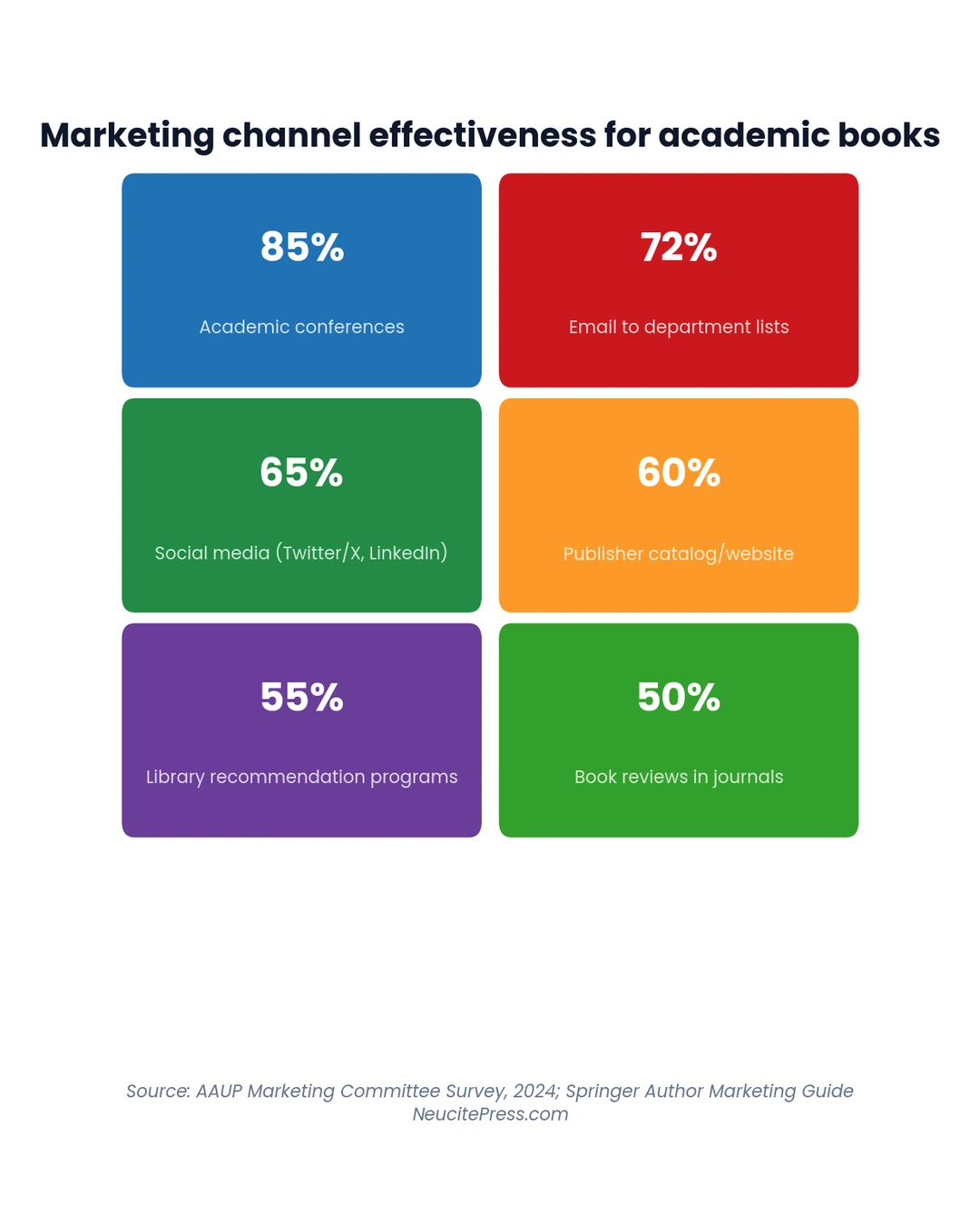
Your academic book deserves an audience. Yet most scholarly authors struggle to move beyond the default 500-1,000 lifetime sales, primarily to institutional libraries. This guide reveals 15 proven academic book marketing strategies that successful scholars use to multiply their visibility and impact.
The stark reality: effective book marketing for academics isn’t optional—it’s essential. An author with a title ranking around position 581,000 on Amazon sees roughly 8 sales monthly. Strategic promotion can transform these numbers dramatically.
Unlike commercial publishing, academic book marketing requires a different approach. You need strategies that respect academic values, fit limited time budgets, and leverage your institutional advantages. This comprehensive guide draws on documented best practices from university presses, successful authors, and marketing experts in scholarly publishing.
Why Academic Book Marketing Matters: The Numbers Behind the Problem
Academic book marketing statistics reveal a consistent pattern. A 2022 publishing industry survey found that scholarly monographs typically sell between 300-800 copies lifetime. Commercial academic titles perform slightly better at 800-1,200 copies, while crossover scholarly works can reach 1,500-3,000 copies.
The primary buyers? University libraries and institutional collections account for 60-75% of academic book sales. Individual scholar purchases represent only 15-25% of total volume. This reality fundamentally changes your academic book marketing strategy.
| Publication Type | Lifetime Sales | Primary Audience | Publisher Marketing Support |
|---|---|---|---|
| University Press Monograph | 400-600 copies | Academic Libraries (70%) | Limited to catalogs |
| Commercial Academic Title | 800-1,200 copies | Mixed Academic/Professional | Moderate support |
| Crossover Scholarly Work | 1,500-3,000 copies | General Educated Readers | Significant promotion |
University presses operate with severely constrained marketing budgets. A typical press allocates $500-$2,000 total per title for marketing. Commercial publishers prioritize high-volume titles, leaving niche scholarly works underpromooted. This gap creates an opportunity: authors who implement strategic academic book marketing gain significant competitive advantage.
But beyond sales numbers lies something more valuable. Effective promotion leads to expanded professional networks, speaking invitations, media features, policy influence, and the profound satisfaction of seeing your research make a real difference. These outcomes often matter more than raw sales figures.
Strategy #1: Social Media Marketing for Academics
Social media marketing for academics requires platforms where scholarly professionals actually spend time. LinkedIn and specialized academic networks outperform general-audience platforms for research-based content.
LinkedIn Marketing for Scholarly Authors
LinkedIn reaches over 15 million academics and researchers globally. A well-executed LinkedIn strategy for book promotion includes:
- Launch announcements: Post when your book releases with compelling framing of its relevance to academic professionals
- Research insights: Share key findings or chapter excerpts, positioning your work within broader disciplinary conversations
- Behind-the-scenes content: Discuss your research journey, methodology challenges, or surprising discoveries during the writing process
- Engagement in discussions: Respond thoughtfully to trending academic topics, linking back to your book’s relevance
- Article series: Use LinkedIn’s long-form article feature to publish expanded content based on your book chapters
Studies of academic LinkedIn strategies show 3-8% engagement rates from targeted professional networks—significantly higher than general social media. Academics share and comment on scholarly content at rates 2-3x higher than average LinkedIn users.
Twitter/X for Reaching Academic Communities
Academic Twitter communities, particularly in STEM and social science disciplines, actively discuss and share scholarly works. Hashtags like #AcademicTwitter, #ScholarSunday, and discipline-specific tags (#geography, #anthropology) connect you with engaged audiences.
Effective academic Twitter tactics include live-tweeting from conferences, sharing key research findings with hashtags, and participating in journal clubs or reading groups discussing relevant literature.
Strategy #2: Email List Building for Academic Authors
Email list building for academic authors creates a direct channel to interested readers. Unlike social media algorithms, email reaches subscribers consistently and builds a foundation for future work.
Collecting Email Addresses Strategically
Build your email list through multiple channels:
- Your institutional website: Add a simple signup form promising book updates or research insights
- Conference presentations: Have a signup sheet at presentations—attendees interested enough to attend are highly qualified prospects
- Course syllabi: Include your email signup link with a brief note about sharing research developments with students
- Guest blog posts: Every article you contribute should include a bio linking to your email signup
- Interview appearances: Podcast, webinar, and media appearances should direct interested listeners to join your email list
Academic authors who actively build email lists typically reach 500-2,000 subscribers within 12 months. These subscribers represent highly engaged readers who directly support book sales and speaking opportunities.
Email Campaigns That Convert
Successful academic authors use email to share:
- Book launch announcements with exclusive excerpts
- Research updates and emerging findings related to the book’s topic
- Speaking appearances and event invitations
- Media mentions and award recognition
- Related reading recommendations and disciplinary news
Conversion rates from academic email lists average 2-5% for book purchases, with 8-12% opening rates for launch announcements among academics.
Strategy #3: Conference Promotion and Speaking Engagements
Conference marketing for academic books places your work directly in front of your target audience. Major disciplinary conferences gather thousands of active scholars in your field.
Planning Conference Presentations Around Book Content
Structure conference presentations explicitly around your book’s core themes:
- Core argument symposium: Present your book’s central argument alongside 2-3 colleagues presenting complementary perspectives
- Methodology workshop: Lead a hands-on session teaching the research methods your book exemplifies
- Roundtable discussion: Moderate discussion with other authors in your area, positioning your book as a key contribution
- Book panel: Propose a dedicated book panel with 2-3 respondents critiquing and engaging with your work
Conference booths and materials cost $1,000-$5,000 but generate 50-150 direct book sales plus networking opportunities worth far more. Many presses will cover or subsidize booth costs for authored marketing efforts.
Organizing Post-Conference Momentum
Maximum ROI comes from actions after the conference:
- Send thank-you emails to everyone who visited your booth with a special discount code
- Connect with interested attendees on LinkedIn, sharing your book with personalized notes
- Submit articles or commentary pieces responding to conference discussions
- Propose follow-up workshops or seminars with conference organizers
Strategy #4: Institutional Library Marketing and Adoption Programs
Institutional library marketing targets the largest single group of academic book buyers. University and research libraries purchase scholarly monographs systematically through approval plans and subject-specific selections.
Reaching Academic Librarians Directly
Academic librarians decide which titles to acquire for their collections. Direct outreach includes:
- Library journal advertising: Place ads in Collection Building, Library Journal, or discipline-specific library publications
- Subject librarian outreach: Identify and contact librarians responsible for your subject area
- Library consortium presentations: Many regions have library consortia that make coordinated purchasing decisions
- Approval plan refinement: Work with your publisher to ensure your title appears in relevant approval plans
One successful strategy: offer complimentary copies to department liaisons or research centers, who then recommend acquisitions to their institutional librarians. This peer recommendation carries significant weight in library purchasing decisions.
Course Adoption and Academic Program Integration
Get your book adopted as required or recommended reading in graduate and upper-level undergraduate courses. This single strategy drives 50+ copies per adoption cycle.
Reach out directly to department chairs and graduate program directors:
- Provide free desk copies to any professor who requests them
- Offer course adoption discounts (typically 20-30% off list price)
- Provide instructor materials or supplementary content
- Facilitate bulk orders for classroom use
Strategy #5: Amazon Optimization for Academic Books
Amazon SEO for academic books improves discoverability when researchers and students search for related topics. With 40-50% of book discovery happening on Amazon, optimization matters significantly.
Keyword Optimization in Amazon Book Categories
Work with your publisher to strategically select Amazon categories and keywords:
- Primary category: Choose the most obvious disciplinary category
- Secondary categories: Select 1-2 adjacent categories where your work crosses disciplinary boundaries
- Search keywords: Use 7 Amazon keyword slots for topic-specific search terms researchers actually use
Avoid generic academic keywords. Instead, target specific research topics, methodologies, and disciplinary niches. An example: instead of just “academic book marketing,” use “academic book marketing strategies,” “scholarly publishing,” and “research book promotion 2026.”
Amazon Enhanced Content Strategy
Use every available Amazon feature:
- Enhanced description: Add formatted text highlighting key concepts, chapters, and research contributions
- Author biography: Establish credibility and mention your book’s unique approach
- First 20-30 pages preview: Include your introduction and first chapter to demonstrate quality and relevance
- Author images and video: Add a professional author photo and, if possible, a short video discussing the book’s core argument
Academic titles with full enhanced content see 15-25% higher conversion rates than those with minimal information.
Strategy #6: Strategic Media Outreach and Op-Eds
Media outreach for academic authors places your research in front of general educated audiences. Op-eds and expert commentary create visibility that benefits your book sales and professional reputation.
Identifying Target Publications
Different publications reach different audiences:
- Major newspapers (NYT, Washington Post, Wall Street Journal): Reach 1-2 million educated readers; very competitive but highest prestige
- Online publications (The Conversation, Medium, Substack): More accessible; reach relevant disciplinary communities
- Discipline-specific publications: Trade journals and field-specific websites reach concentrated audiences of your peers
- Magazine articles (Atlantic, Smithsonian, etc.): Niche but highly engaged audiences
The Conversation specifically welcomes academic authors. Publishing an excerpt or analysis from your book there generates 20,000-100,000+ reads plus significant media pickup. One author’s Conversation article generated 57,000+ clicks and 20+ media pickups.
Crafting Compelling Op-Eds from Your Book
Transform your book’s core argument into timely, relevant op-ed pieces:
- Hook to current events or policy debates your research informs
- Lead with a surprising finding or compelling statistic from your research
- Explain the practical relevance to readers’ concerns
- End with a clear call to action or implication for readers
Include your book title and publication information naturally in your bio or closing paragraph. Most publications include author bios that link to your work.
Strategy #7: Podcast Guest Appearances and Audio Marketing
Podcast marketing reaches engaged listeners during commutes, exercise, and other activities. Academic podcasts have highly interested, relevant audiences.
Identifying the Right Podcast Opportunities
Target academic podcasts in your discipline:
- Disciplinary research podcasts with 5,000-50,000 regular listeners
- University-hosted series featuring faculty research
- Author interview podcasts that regularly feature academic books
- Professional association podcasts reaching practitioners in your field
Smaller podcasts (5,000-10,000 listeners) often generate better engagement and book sales than huge general-audience shows. Highly engaged listeners in your field matter more than casual listeners.
Preparing for High-Impact Podcast Appearances
Success requires preparation:
- Listen to multiple episodes to understand the show’s format and audience
- Develop 2-3 compelling stories that illustrate your book’s key insights
- Prepare specific data points or surprising findings to share
- Request that the host mention your book and provide purchase links in the episode description
- Share the episode with your networks after publication
Strategy #8: Book Launch Planning and Timeline Management
Book launch marketing concentrates your promotional effort around publication dates when media interest is highest and bookstores feature new releases.
Six-Month Pre-Launch Planning
Start these activities 6 months before publication:
- Complete your publisher’s author questionnaire thoroughly
- Compile a targeted media contact list with journalist emails
- Reach out to influential scholars in your field requesting endorsements
- Schedule podcast appearances and speaking engagements
- Develop op-ed pitches for major publications
- Notify your university communications office about the upcoming release
Launch Week Activities
Concentrate intense promotional effort during launch week:
- Published book announcement across all social media channels
- Email announcement to your subscriber list
- Launch event (virtual, in-person, or hybrid) bringing together interested readers
- First round of media appearances and podcast releases
- Special promotional pricing or bonuses for early purchases
Post-Launch Momentum: Months 2-12
Maintain visibility through the critical first year:
- Monthly social media content featuring different chapters or research findings
- Presentation of your book at 2-4 conferences during the first year
- Quarterly email updates to your subscriber list
- Ongoing pursuit of awards and review opportunities
- Solicitation of course adoptions from related academic programs
Strategy #9: Peer Review Solicitation and Award Submissions
Book reviews and awards provide third-party validation that dramatically increases credibility and sales. Reviews in reputable journals reach your exact target audience while awards generate media attention.
Identifying Target Review Publications
Work with your publisher to identify 15-25 journals and publications that review books in your field. Provide a review copy and a personalized letter to the review editor explaining why the book suits their publication.
High-impact reviews in top-tier journals dramatically increase visibility:
- American Historical Review (history)
- Journal of Economic Literature (economics)
- Contemporary Psychology (psychology)
- Nature (interdisciplinary science)
- Field-specific journals with book review sections
Award Submissions and Recognition Programs
Submit your book to relevant awards:
- Major book awards: Pulitzer Prize, National Book Award, etc. (long shots but massive visibility if won)
- Discipline-specific prizes: Virtually every academic discipline has specific book awards
- University press awards: Many presses sponsor annual awards for the best books they’ve published
- Professional association awards: Your discipline’s professional organizations typically give annual awards
Even winning smaller disciplinary awards generates 20-50 additional sales plus media features in discipline-specific publications. Multiple award nominations and wins create cumulative visibility.
Strategy #10: Guest Blogging and Content Marketing
Academic content marketing through guest blog posts on established platforms extends your reach beyond your own audience. Each post reaches 5,000-50,000 engaged readers while positioning your book as a key contribution.
Identifying Guest Blogging Opportunities
Target platforms that reach academic audiences:
- Academic blogs: Established platforms in your discipline with regular reader bases
- University press blogs: Many academic publishers maintain blogs featuring books they publish
- Professional association platforms: Many associations publish member blogs or journals
- Open-access journal platforms: Many have blogs discussing published research
- Discipline-specific news sites: Online publications focused on your academic field
Creating Compelling Guest Content
Successful guest posts for academic audiences:
- Extract a compelling chapter concept and expand it slightly
- Address a current discipline-specific debate your book informs
- Share surprising research findings with context and implications
- Discuss the methodology or approach that makes your book unique
- Always include a link to your book and author bio explaining your work
Strategy #11: Leveraging Your Institutional Platform
University marketing for authors activates free institutional resources most academics underutilize. Your institution has communication infrastructure, media relationships, and promotional channels.
University Communications and Campus Marketing
Contact your university’s communications or public relations office before publication. They typically offer:
- Press release distribution to local and regional media
- Institutional website features and announcements
- Social media promotion through university accounts
- Campus event coordination assistance
- Media training for interviews
Provide them with:
- A compelling book description and “why it matters” angle
- High-resolution cover image and author photo
- Suggestions for journalists or outlets to contact
- Your availability for interviews at least 2-3 weeks before publication
Departmental and Collegial Support
Alert your department chair and colleagues about the publication. Many departments:
- Feature publications on their website and newsletter
- Share announcements with affiliated departments and collaborators
- Help coordinate lectures or presentations at other institutions
- Support award submissions with institutional resources
Strategy #12: Publisher Partnerships and Co-Marketing Opportunities
Publisher marketing support offers significant leverage for your individual efforts. University presses and academic publishers can multiply your reach through their established distribution and media channels.
Activating Publisher Resources
Academic publishers typically provide:
- Catalog distribution to thousands of libraries and academic retailers
- Sales rep coverage through university bookstores and academic distributors
- Seasonal promotion through publisher catalogs and mailings
- Publisher website marketing and featured book slots
- Limited media outreach through established press contacts
To maximize publisher support:
- Complete author questionnaires thoroughly and on time
- Respond quickly to requests for information or materials
- Notify your publisher about self-organized promotional activities
- Provide regular updates about media placements or speaking invitations
- Request specific support (review copy distribution, media pitches, etc.)
Coordinating Author Efforts with Publisher Activities
Effective coordination prevents duplication while creating sustained momentum:
- Share your promotional calendar with your publisher 4-6 weeks in advance
- Alert them when articles mentioning your book publish
- Provide lists of conferences where you’ll present or have booths
- Coordinate timing of different promotional channels
Strategy #13: Measuring Marketing ROI and Success Metrics
Tracking book marketing metrics transforms guesswork into strategic decision-making. Understanding which promotional activities drive actual results helps you allocate limited time wisely.
Key Performance Indicators for Academic Books
Track these specific metrics:
- Direct sales data: Your publisher provides sales figures; track them monthly to see which promotional periods spike sales
- Website traffic: Google Analytics shows traffic spikes from specific media mentions or social media posts
- Email engagement: Open rates, click-through rates, and conversion rates for book-promotion emails
- Social media engagement: Likes, comments, shares, and follower growth from book-related posts
- Speaking engagements: Number of presentations, audience sizes, and direct feedback on book interest
- Media mentions: Track where articles reference your book and which outlets drive traffic
- Course adoptions: Number of classes adopting your book as required reading
- Review publications: Journal reviews and award recognitions provide both validation and visibility
Cost Per Outcome Analysis
Calculate the efficiency of different promotional activities:
- Virtual events: Typically cost $5-$15 per attendee; generate 1-3 book sales per 100 attendees
- In-person events: Cost $25-$75 per attendee; generate 5-10 book sales per 100 attendees
- Media placements: A significant feature article typically drives 50-150 direct sales
- Conference presentations: 2-5 direct sales per conference appearance; additional speaking invitations and networking
- Email campaigns: 2-5% conversion rate from engaged academic email lists
Use these metrics to identify your highest-impact promotional activities and double down on them.
Strategy #14: Building Long-Term Author Platform and Visibility
Beyond individual book sales, author platform building creates lasting professional advantage. Visibility and credibility from one book’s promotion carry forward to future publications, speaking opportunities, and career advancement.
Creating Sustainable Content Systems
Develop content distribution systems that continue generating visibility:
- Author website or blog: Central hub for your work, publications, and professional information
- Regular email newsletter: Monthly or quarterly updates keeping your audience informed
- Social media presence: Consistent, valuable posting on platforms where your audience congregates
- Guest article pipeline: Regular contributions to relevant publications and platforms
- Speaking circuit: Positioning yourself as an invited expert at conferences and institutions
Leveraging Success for Future Opportunities
Each promotional success creates new opportunities:
- Media appearances lead to speaking invitations
- Strong book sales or awards enable better publisher support for future books
- Established media relationships lead to easier placements for future articles
- Growing email lists provide engaged audiences for future work
- Professional network expansion creates collaborative opportunities
Strategy #15: Creating a Personal Action Plan
Book marketing action plans transform these strategies from abstract concepts into concrete, implementable steps. A written plan keeps you accountable and ensures consistent effort.
Assessing Your Starting Point
Before writing your plan, honestly assess your current resources:
- Time availability: How many hours weekly can you dedicate to promotion?
- Budget: What funding do you have for promotional activities?
- Technical skills: What marketing channels do you already know how to use effectively?
- Existing platforms: Do you have an audience already (email list, social media following, speaking invitations)?
- Institutional support: What resources does your university offer?
- Publisher support: What can your publisher contribute?
Prioritizing Strategies for Maximum Impact
Select 5-7 strategies that match your resources and strengths:
- If tech-savvy: Prioritize content marketing, social media, and email lists
- If great speaker: Emphasize conferences, podcasts, and public presentations
- If good writer: Focus on op-eds, guest blogging, and thought leadership
- If strong networks: Leverage personal connections for reviews, endorsements, and speaking invitations
- If limited time: Prioritize high-leverage activities (media placement, conferences) over continuous-effort activities (daily social media)
Monthly Action Checklist
Execute consistently with a simple monthly checklist:
- Week 1: Review previous month’s metrics and plan adjustments
- Week 2: Execute one major promotional activity (conference, guest article, media outreach, podcast recording)
- Week 3: Create and publish content (social media posts, email update, blog post)
- Week 4: Network and relationship building (reach out to contacts, coordinate with collaborators)
This simple rhythm maintains momentum while remaining manageable alongside teaching, research, and service obligations.
SEO Best Practices for Academic Book Marketing
Optimizing your online presence for search engines ensures your book appears when researchers search for related topics. These SEO strategies for academic books improve organic discoverability.
Keyword Targeting and Content Optimization
Effective SEO starts with understanding how your target audience searches:
- Primary keyword: “academic book marketing” should appear naturally in your first 100 words of content, title, and headers
- Related keywords: Naturally incorporate variations like “book marketing for academics,” “scholarly book promotion,” “academic publishing marketing”
- Long-tail keywords: Include specific queries like “how to market academic book,” “book marketing strategies scholars,” “academic book sales strategies”
- LSI keywords: Use related terms like university presses, scholarly publishing, research dissemination, peer review, institutional libraries
Maintain natural keyword density of 0.5-1% for primary keywords. Prioritize readability and authentic writing over keyword stuffing, which damages SEO and reader experience.
On-Page and Technical SEO Elements
Optimize these technical elements:
- Title tag: 55-60 characters including primary keyword near the beginning
- Meta description: 150-155 characters summarizing key value proposition and including target keywords
- Header hierarchy: Use H1 for page title, H2 for major sections, H3 for subsections
- Image alt text: Describe images clearly, including relevant keywords where natural
- Internal linking: Link to related content about scholarly publishing, book promotion, and academic marketing
- URL structure: Keep slug descriptive and keyword-relevant (academic-book-marketing-strategies)
Building Authority and Backlinks
Academic content builds authority through:
- Quality citations: Link to peer-reviewed studies, industry reports, and authoritative sources
- Author credentials: Establish expertise through biographical information and publication history
- Backlinks: Encourage mentions and links from academic blogs, university press sites, and scholarly publications
- Structural data: Use schema markup for articles, authors, and publications to improve search visibility
FAQ: Academic Book Marketing Questions Answered
How far in advance should I start planning book promotion?
Begin promotion planning at least 6 months before publication. This timeline allows you to:
- Build relationships with media contacts and potential reviewers
- Secure podcast appearances and speaking engagements
- Complete publisher questionnaires and coordinate with their publicity team
- Develop content marketing pieces and op-ed pitches
- Build anticipation through social media and email list growth
Ideally, begin 9-12 months before publication to maximize speaking invitations and media placements around release date.
What’s the single most effective academic book marketing strategy?
If you must choose one strategy, conference presentations targeting your disciplinary core deliver the highest ROI. They place you directly in front of your exact target audience, generate direct sales, build professional networks, and create opportunities for future speaking invitations and collaborations.
However, combining 3-5 complementary strategies (conference presentations + media placement + email list + social media + guest content) creates significantly better results than any single tactic.
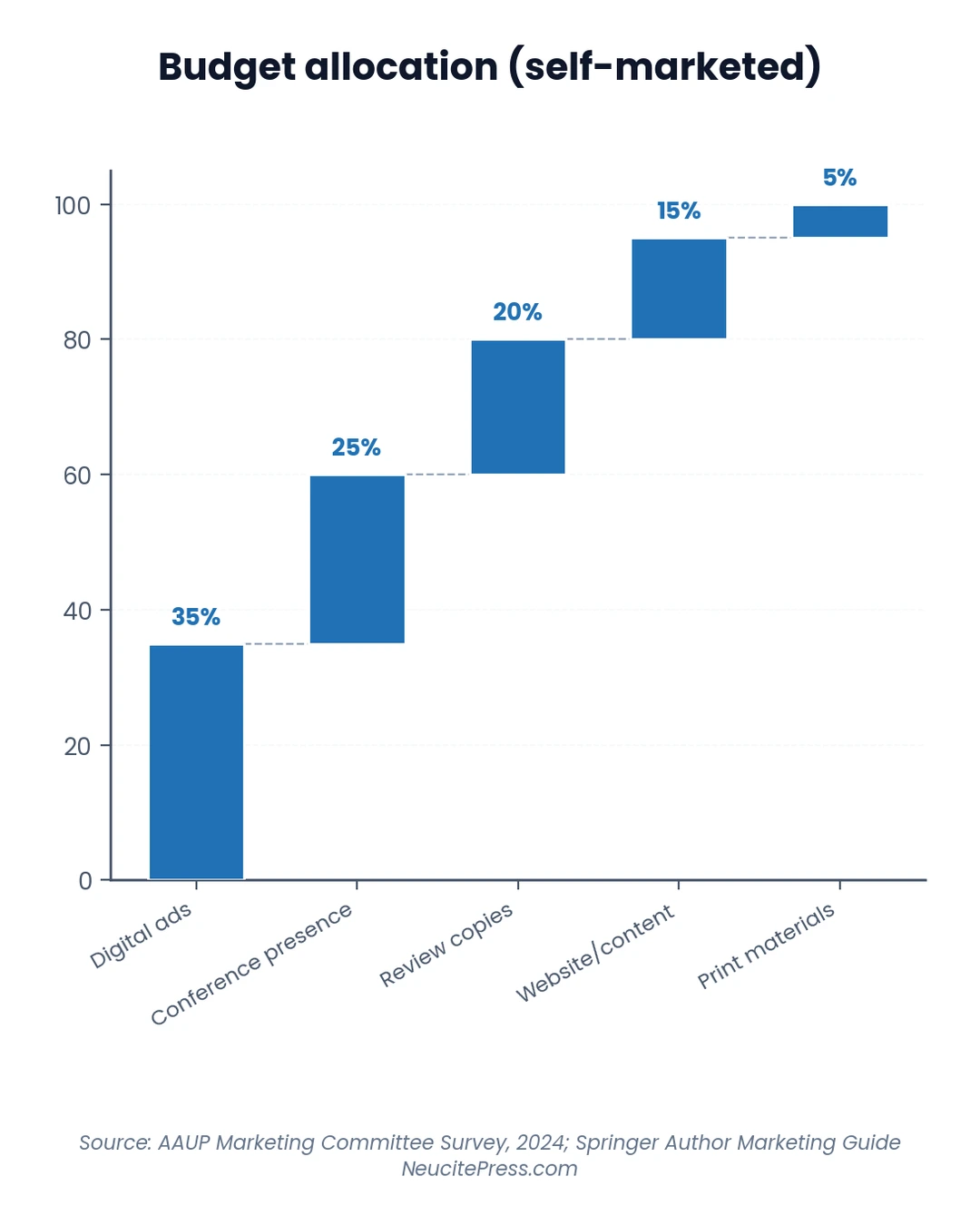
How much should I spend on academic book marketing?
Budget recommendations depend on your goals:
- Minimal budget ($500-$1,000): Focus on free/low-cost tactics (social media, email, personal outreach, university resources)
- Moderate budget ($1,500-$5,000): Add conference booths, guest article advertising, podcast sponsorships
- Significant budget ($5,000+): Consider professional marketing support, comprehensive advertising, or coordinated campaigns across multiple platforms
Many university presses provide modest marketing budgets ($500-$2,000) for author-supported promotion. Universities often have additional funding available through communications offices or research support budgets.
Can I do academic book marketing while managing teaching and research responsibilities?
Yes, if you prioritize strategically. The key is selecting 4-5 high-leverage activities requiring minimal weekly time rather than attempting all 15 strategies. A sustainable academic book marketing plan requires 5-8 hours weekly during the critical pre-launch and launch periods (6 months total), then 2-3 hours weekly for the following 12 months.
How long does it take to see results from book marketing efforts?
Timeline expectations:
- Immediate (weeks 1-4): Social media engagement, email list signups, website traffic increases
- Short-term (months 1-3): Direct sales from marketing activities, media mentions, speaking invitations
- Medium-term (months 3-12): Cumulative effect becomes visible; reviews publish; course adoptions increase
- Long-term (year 2+): Sustained sales, professional network expansion, speaking opportunities from established reputation
Most authors see meaningful results within 3-6 months of consistent effort, with peak sales often occurring 6-12 months after publication.
What metrics should I track to measure marketing success?
At minimum, track:
- Monthly sales figures (from your publisher)
- Website visits to your book page or institutional profile
- Email list size and engagement metrics
- Number of speaking invitations and conferences attended
- Media mentions and review publications
- Social media engagement (followers, engagement rate, shares)
Compare these metrics to baseline figures before promotion began to measure improvement. Establish specific targets for your most important metrics (e.g., increase sales 50%, grow email list to 1,000 subscribers, present at 4 conferences).
Conclusion: Your Path Forward in Academic Book Marketing
The scholarly authors succeeding in today’s publishing landscape aren’t waiting for publishers to create visibility. They’re taking strategic action to connect their research with the audiences who need it most.
Your book represents significant intellectual investment and expertise. You deserve an audience. The 15 strategies in this guide provide a roadmap for amplifying visibility, expanding professional networks, and measuring real impact—all while respecting academic values and time constraints.
Start with this action: Choose 3 strategies from this guide that align with your strengths and resources. Commit to 6 months of consistent implementation. Track your results carefully. Then scale what works and adjust what doesn’t.
The authors experiencing breakthrough success—the ones whose books sell 10x typical benchmarks, whose research influences policy, whose work reaches unexpected audiences—share one characteristic: they took deliberate action based on proven strategies.
Your work deserves to make a difference. Let these academic book marketing strategies be your guide.
Resources for Academic Authors
- The Conversation (theconversation.com): Publish excerpts reaching 20,000-100,000+ readers
- Association of American University Presses (aaupnet.org): Industry data and publishing insights
- Scholarly Kitchen (scholarlykitchen.sspnet.org): Discussion of scholarly communication and publishing
- LSE Impact Blog (blogs.lse.ac.uk/impactblog): Research impact and dissemination strategies
- Humanities Commons (hcommons.org): Open-access academic social network
- Academia.edu: Share your research and book information with interested scholars