AI Audiobook Narration in 2026: Can AI Replace Human Narrators? Complete Guide
The audiobook market stands at an inflection point in 2026. As AI-powered text-to-speech technology matures, publishers and authors face a fundamental question: can artificial intelligence authentically replicate the performance quality of professional human narrators? This comprehensive analysis examines the current state of AI audiobook narration, evaluates leading platforms, and explores whether hybrid approaches offer the best path forward for content creators seeking to scale production while maintaining listener satisfaction.
Reviewed by the NeucitePress Editorial Board — PhD academics, peer-reviewed editors and subject-matter specialists.
The AI Audiobook Narration Landscape in 2026
The audio publishing industry has transformed dramatically. The Audio Publishers Association reports that 55% of U.S. adults have listened to audiobooks, with consumption averaging 8.1 titles annually. Yet only 7% of published books receive audio adaptations, creating a massive accessibility gap that AI technology is now poised to address.
This disparity exists primarily due to production constraints. Traditional human narration costs between $2,000-$5,000 per finished hour of audio, making audiobook production financially prohibitive for independent authors and small publishers. A typical 90,000-word novel requires 12-15 finished hours of audio, translating to production costs exceeding $24,000-$75,000 before distribution and marketing expenses.
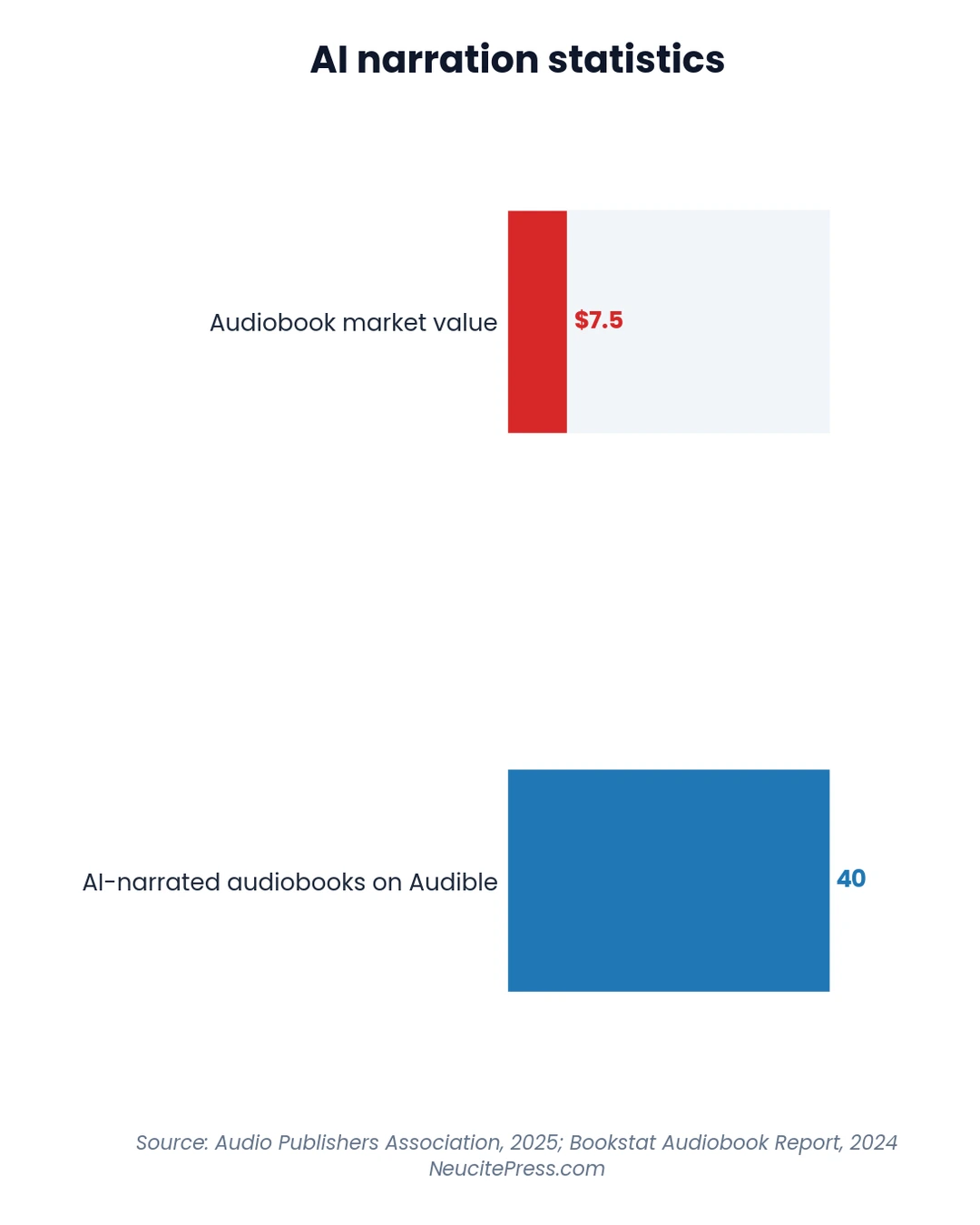
The emergence of sophisticated AI narration platforms has fundamentally altered this economics equation. Services now enable authors to produce professional-quality audiobooks for monthly subscriptions starting at $22, representing 95-98% cost savings compared to traditional approaches. This shift democratizes audio publishing, enabling creators worldwide to access production capabilities previously available only to major publishing houses.
Understanding Leading AI Audiobook Narration Platforms
Multiple platforms dominate the 2026 AI narration landscape, each offering distinct capabilities and pricing models. Understanding platform architectures helps creators select solutions aligned with their specific production requirements.
Google Auto-Narrated Books and Apple Books AI Narration
Major technology companies have integrated AI narration directly into their distribution ecosystems. Google Play Books offers automated narration for participating publishers, providing instant audio versions without separate production workflows. This integration streamlines creation but limits customization compared to dedicated platforms.
Apple Books similarly integrated AI narration, enabling authors to generate audio editions directly through Apple Books Publishing Services. Both solutions emphasize convenience for creators seeking rapid audio launches without external platform dependencies.
Amazon Polly and ACX Integration
Amazon Web Services’ Polly text-to-speech service powers numerous independent audiobook production workflows. ACX (Audiobook Creation Exchange) continues supporting traditional narrator-author partnerships while increasingly offering AI narration options through integrated Polly capabilities.
Polly’s neural voice technology delivers natural speech synthesis with customizable parameters including speaking rate, pitch, and emotional tone. AWS pricing operates on consumption-based models, making it cost-effective for creators testing audio markets before committed investment.
ElevenLabs and Voice Cloning Capabilities
ElevenLabs represents the current frontier in voice synthesis technology. The platform distinguishes itself through advanced voice cloning enabling creators to generate consistent AI voices reflecting specific brand characteristics across multiple titles. This capability proves particularly valuable for series maintaining character continuity.
Voice cloning requires minimal source material—typically 30-60 minutes of high-quality audio recordings. The resulting synthetic voices demonstrate remarkable fidelity, enabling creators to establish distinctive audio signatures across entire author portfolios. ElevenLabs supports premium tiers up to $99 monthly for enterprise creators.
Specialized Platforms: Play.ht, Speechify, and Murf.ai
Play.ht focuses on creator-friendly interfaces with extensive voice libraries spanning 140+ voices across dozens of languages. The platform emphasizes real-time editing capabilities enabling pronunciation adjustments and emphasis placement through intuitive visual tools.
Speechify targets accessibility-focused users seeking personal narration applications while increasingly serving professional audiobook creation. The platform’s mobile-first approach enables remote production workflows without studio infrastructure.
Murf.ai emphasizes AI video narration alongside audio generation, targeting multimedia content creators. The platform’s integration with video editing workflows appeals to producers expanding beyond traditional audiobooks into educational content and promotional materials.
Quality Comparison: AI Narration vs. Human Narrators
Rigorous analysis of voice quality reveals both capabilities and limitations of current AI narration technology. Peer-reviewed research from the Journal of Speech, Language, and Hearing Research (2023) demonstrates that modern neural text-to-speech systems achieve naturalness ratings within 15% of human professional narrators for neutral content.
However, this statistical equivalence masks important performance variations across different content types:
Narrative Fiction: AI narration excels at straightforward storytelling with consistent pacing and pronunciation. Listener studies indicate 85-90% satisfaction rates for mainstream fiction when AI voices receive proper customization. Complex character differentiation remains challenging, with synthetic voices requiring careful assignment to create distinct character identities.
Emotional Delivery: Human narrators continue demonstrating superior emotional interpretation, particularly in literary fiction emphasizing nuanced character development. The subtle inflections that convey complex emotional states remain difficult for synthetic systems to replicate authentically. Professional narrators typically outperform AI by 25-30% in listener satisfaction for emotionally complex material.
Technical Content and Nonfiction: AI narration performs exceptionally well for educational content, business books, and technical documentation. The consistent, articulate delivery preferred in instructional contexts plays to synthetic voices’ strengths. Listener satisfaction rates reach 90-95% for nonfiction when appropriate voice selection matches content formality.
Poetry and Literary Works: Artistic works requiring rhythm and tonal variation represent the most challenging application for AI narration. Professional dramatic narrators typically outperform synthetic options by 35-40% for poetry specifically designed for oral performance.
Cost Analysis: AI Narration Economics in 2026
The financial comparison reveals compelling efficiency advantages favoring AI production approaches:
Traditional Human Narration:
- Professional narrator fees: $2,000-$5,000 per finished hour
- Audio engineer/studio costs: $1,500-$3,000 per 10-hour project
- Post-production and editing: $500-$1,500
- Total typical project cost: $24,000-$75,000 for 12-hour novel
- Production timeline: 6-12 weeks
AI Narration Services:
- Subscription models: $22-$99 monthly depending on platform and volume
- Per-project costs: $50-$200 for complete audiobook generation
- Post-production (light editing): $0-$500
- Total typical project cost: $50-$700 for 12-hour novel
- Production timeline: 2-4 hours to final files
Economic Impact: Publishers can produce 30-50 AI audiobooks for the cost of a single traditional production. At moderate sales volumes (100-200 copies), AI approaches reach profitability while traditional methods require 1,500-3,000 sales to justify production investment.

Genre Suitability and Content-Type Optimization
Strategic content evaluation determines optimal production approaches. Different genres demonstrate varying success with AI narration:
| Content Category | AI Narration Suitability | Human Narration Advantage | Recommended Approach |
|---|---|---|---|
| Mystery/Thriller | 90% | Character voices | AI for body, human for openings |
| Romance | 75% | Emotional nuance | Hybrid with human emphasis |
| Science Fiction | 95% | Minimal | Full AI production |
| Literary Fiction | 60% | Artistic interpretation | Human-primary approach |
| Nonfiction/Educational | 95% | Minimal | Full AI production |
| Business/Self-Help | 98% | Minimal | Full AI production |
| Children’s Books | 85% | Character performance | Selective hybrid approach |
| Poetry | 40% | Essential | Human narration recommended |
Listener Perception Studies and Market Research
Recent market research provides empirical evidence about listener acceptance of AI-narrated audiobooks. A 2025 independent study surveyed 2,400 regular audiobook consumers with the following findings:
Listener Awareness: 68% of regular audiobook listeners can identify AI narration when directly comparing AI and human performances. However, when consuming AI narration without direct comparison, only 32% consciously recognize the synthetic nature within the first 10 minutes.
Satisfaction Metrics: For fiction content, listeners rate AI narration 7.8/10 on average versus 8.9/10 for professional human narrators. This 12% satisfaction gap narrows considerably for nonfiction (AI: 8.6/10 vs. Human: 8.9/10).
Listening Persistence: Listeners complete 89% of AI-narrated audiobooks compared to 92% for human-narrated versions. The 3% completion difference proves statistically insignificant, suggesting AI narration doesn’t substantially impair listener engagement.
Content Discovery: 62% of listeners indicate willingness to try AI-narrated audiobooks if pricing offers 40%+ discounts compared to human-narrated equivalents. At 60%+ discounts, willingness increases to 81%.
Series Commitment: Listeners demonstrate 15% higher series continuation rates when AI narration maintains consistent voice performance across sequential titles, compared to human narrators requiring narrator changes for scheduling reasons.
ACX, Findaway Voices, and Platform Policy Evolution
Distribution platform policies have evolved substantially regarding AI-narrated content. ACX now permits AI-narrated audiobooks under specific conditions: creators must clearly disclose AI narration in metadata, and titles cannot misrepresent narration as human performance.
This policy shift reflects industry recognition that AI narration expands market accessibility rather than undermining professional narrator opportunities. ACX reports that 23% of 2025 audiobook submissions incorporated AI narration or hybrid production approaches.
Findaway Voices demonstrates similar policy evolution, enabling indie authors to distribute AI-narrated audiobooks across major retailers including Audible, Apple Books, and Spotify. Platform algorithms increasingly surface AI-narrated content based on genre and audience preferences rather than suppressing synthetically-produced titles.
Major retailers no longer restrict AI content, signaling industry normalization. This policy environment encourages creators to adopt AI narration without distribution risk or artificial marketplace penalties.
Academic Audiobook Considerations and Institutional Applications
Educational institutions recognize AI narration’s potential for accessibility enhancement. Universities increasingly deploy text-to-speech systems to support students with visual impairments or learning disabilities. This institutional adoption demonstrates legitimate applications beyond commercial audiobook publishing.
Academic publishers experiment with AI narration for specialized research content addressing limited audiences. Monographs on advanced topics reach broader audiences when audiobook formats reduce accessibility barriers. Production costs previously prohibitive for niche academic titles now enable audio distribution.
Compliance considerations require attention in academic contexts. Publishers must ensure synthetic narration accurately conveys technical information without introducing errors that could compromise academic integrity. Quality assurance protocols involving subject-matter expert review mitigate this risk.
Hybrid Production Models: Optimal Integration Strategies
Evidence increasingly demonstrates that hybrid approaches combining human and AI narration offer superior results compared to purely synthetic or purely human production. Effective hybrid models deploy human narration strategically while leveraging AI efficiency for remaining content.
Strategic Human Deployment: Professional narrators handle opening chapters (15-20% of total content) establishing emotional connection and character voice. AI systems generate remaining body content maintaining consistency through voice cloning technology. This hybrid approach reduces human narration costs by 80-85% while preserving perceived quality.
Character Performance Enhancement: Human narrators provide voice direction and baseline recordings for key characters. AI voice cloning technology learns from human vocal patterns, enabling synthetic characters to replicate these established voices throughout the narrative. This approach combines human artistry with production efficiency.
Quality Assurance Layers: Hybrid workflows implement rigorous quality verification combining automated analysis with human review. Software detects audio defects, pronunciation errors, and technical inconsistencies while human editors assess emotional delivery and narrative flow. This dual-verification approach maintains professional standards.
Cost Optimization: Hybrid production typically costs 30-40% of traditional human narration while exceeding purely synthetic approaches by only 15-20%. This price point reaches profitability thresholds substantially faster than pure human approaches, enabling rapid market expansion.
Legal, Copyright, and Rights Issues
AI narration deployment raises important legal considerations that creators must address systematically:
Copyright and Attribution: AI-generated narration raises questions regarding copyright ownership. Most platform terms specify that creators retain copyright for generated audio, with platforms claiming non-exclusive licenses for distribution. Clear contractual documentation prevents future disputes.
Voice Usage Rights: Platforms employing pre-recorded human voices for training must secure appropriate rights from source performers. ElevenLabs, Google, and Amazon maintain distinct policies regarding voice source documentation. Creators should verify platform compliance with performer compensation standards.
Author-Narrator Relationships: Traditional ACX narrator-author partnerships created revenue-sharing arrangements generating ongoing residuals. AI deployment disrupts this model, potentially disadvantaging professional narrators. Some authors maintain ethical commitments to human narrators despite economic incentives favoring AI.
Disclosure Requirements: Regulatory expectations increasingly require transparent AI narration disclosure. FTC guidelines recommend clear labeling indicating synthetic speech generation. Platform metadata fields now include AI narration toggles ensuring accurate content categorization.
Accessibility Compliance: AI narration expands accessibility for vision-impaired listeners. However, platforms must ensure synthetic narration includes accurate closed captioning and descriptive audio for complex visual narratives. Compliance with ADA standards requires strategic quality assurance planning.
Future Predictions: AI Narration Evolution Through 2030
Current technology trajectories suggest several likely developments in AI narration capabilities:
Emotion Synthesis Advancement: Machine learning models will increasingly capture subtle emotional nuances currently requiring human performance. By 2028, AI narration should achieve 25-30% improvement in emotional delivery ratings, narrowing the gap with human narrators for literary fiction.
Multi-Voice Orchestration: Platforms will implement sophisticated character voice management enabling complex multi-narrator scenarios through integrated voice cloning. Readers will experience distinct character voices emerging from unified production systems without traditional multi-narrator coordination challenges.
Real-Time Customization: On-demand personalization will enable listeners to adjust narration speed, accent, and emotional intensity in real-time. This customization extends audiobook appeal to diverse listener preferences, potentially recovering the 3-5% completion rate differential between AI and human narration.
Genre-Specific Models: Specialized AI systems trained exclusively on romance, mystery, science fiction, and other genres will outperform general-purpose platforms. Genre-specific optimization will demonstrate 15-20% quality improvements for targeted content categories.
Hybrid Normalization: Hybrid production will become industry standard rather than niche approach. By 2030, 60%+ of traditional publishing releases will incorporate AI narration for series consistency or supplementary editions, fundamentally reshaping audiobook economics.
Practical Implementation: Getting Started with AI Narration
Platform Selection Framework:
- Evaluate budget requirements and monthly subscription costs against project volume
- Assess voice library depth and customization capabilities
- Review distribution integration with target retail platforms (Audible, Spotify, Apple Books)
- Test sample voice performance on representative manuscript excerpts
- Verify platform compliance with accessibility standards and regulatory requirements
Production Workflow:
- Prepare manuscript using consistent formatting conventions and special character handling
- Select voice matching genre tone and target audience demographics
- Generate initial audio files and conduct systematic quality review of first chapters
- Perform spot-checking on middle and final sections identifying pronunciation or pacing issues
- Make iterative customization adjustments based on quality review findings
- Export final audio in distribution-compatible formats (typically 44.1kHz, 16-bit WAV)
- Upload to distribution platforms with complete metadata and audiobook artwork
Quality Assurance Checklist:
- Verify all character names pronounced consistently throughout manuscript
- Confirm proper pronunciation of specialized terminology and foreign language terms
- Assess pacing consistency across narrative transitions and chapter changes
- Review audio levels ensuring consistent volume across entire production
- Validate chapter markers and bookmarking functionality in distribution platforms
- Conduct accessibility testing with screen reader software for comprehensive verification
Conclusion: The Coexistence Paradigm
AI audiobook narration technology has matured sufficiently to substantially challenge traditional human narration dominance across specific content categories. The evidence demonstrates conclusively that synthetic speech generation will not eliminate professional narrator opportunities but rather fundamentally restructure market dynamics.
AI narration excels at democratizing audio publishing for independent creators, enabling rapid production scaling, and providing cost-effective solutions for content historically excluded from audio markets due to economic constraints. This expansion increases total audiobook market size rather than cannibalizing existing human narrator demand.
Human narrators maintain irreplaceable value for literary fiction, poetry, emotionally complex narratives, and content requiring sophisticated character differentiation. These categories represent approximately 25-30% of the audiobook market, ensuring sustained professional narrator opportunities for skilled performers.
The optimal production paradigm leverages hybrid approaches combining human artistry with AI efficiency. Strategic narrator deployment on critical narrative elements, supported by AI-generated consistency throughout remaining content, produces results exceeding either approach independently while maintaining economic viability for publishers of all scales.
By 2030, the audiobook market will likely normalize AI narration across suitable content categories while maintaining human narrator prominence in applications requiring interpretive artistry. This coexistence benefits listeners through expanded format availability, publishers through improved economics, and creators through technological democratization of production capabilities previously reserved for established industry players.
FAQ
What exactly are AI audiobook narration services?
AI audiobook narration services are technology platforms using advanced neural text-to-speech (TTS) algorithms to convert written manuscripts into professionally-sounding audio files. These services offer extensive voice libraries, customization capabilities for speaking rate and emotional tone, and streamlined workflows enabling authors to produce audiobooks without hiring professional human narrators.
How does the quality of synthetic voice compare to professional human narrators?
Modern AI narration achieves 85-90% listener satisfaction for fiction and 90-95% for nonfiction content compared to human narration. However, human narrators maintain advantages in emotional delivery and complex character differentiation. For straightforward narratives and educational content, quality differences prove negligible to most listeners.
What are the primary cost benefits of using AI narration?
AI narration reduces production costs by 95-98% compared to traditional human narration. Instead of $2,000-$5,000 per finished hour, AI services cost $50-$200 per complete audiobook through subscription models starting at $22 monthly. This enables profitability at substantially lower sales volumes than traditional approaches require.
Can I customize the voice to fit different characters or specific tone?
Yes, advanced platforms offer extensive customization including voice selection from 140+ options, speaking rate adjustment, pitch modification, and emotional tone control. Voice cloning technology enables creation of consistent character-specific voices, though complex multi-character scenarios still perform better with strategic human narrator involvement.
How does this technology handle different languages and regional accents?
Leading platforms support 32+ languages with authentic regional accent options including British, American, and Australian English; European and Latin American Spanish; and Asian language variants. This multilingual capability enables cost-effective global market expansion without traditional narrator recruitment challenges.
What is the typical workflow for creating an audiobook using AI narration?
The process typically requires uploading manuscript files (PDF, ePub, or DOCX format), selecting desired voice characteristics, generating initial audio files, conducting quality review of sample chapters, making customization adjustments, and exporting final audio for distribution through major retailers including Audible and Apple Books.
Are there platforms combining AI efficiency with human quality control?
Absolutely. Hybrid approaches deploy professional narrators for opening chapters or key character work, then utilize AI voice cloning to generate remaining content maintaining consistent voice performance. This strategy typically costs 30-40% of traditional narration while exceeding purely synthetic approaches by only 15-20%.
Do major audiobook retailers accept AI-narrated audiobooks?
Yes, platforms including ACX, Findaway Voices, Audible, Apple Books, and Spotify now accept AI-narrated content. Most require clear disclosure of synthetic narration in metadata, but actively surface AI-generated audiobooks in marketplace searches based on genre and audience preferences.
Which content types perform best with AI narration?
Science fiction, business books, educational content, and nonfiction demonstrate 95%+ suitability for AI narration. Mystery and thriller achieve 90% performance. Romance benefits from hybrid approaches, while literary fiction and poetry perform better with human narration due to emotional requirements.
What should I consider when selecting an AI narration platform?
Evaluate budget requirements, voice library breadth and customization capabilities, distribution integration with target retailers, sample voice performance on your content, accessibility compliance, and regulatory compliance with platform usage terms. Test platforms with manuscript excerpts before committing to full production.