AI Plagiarism Detection for Books: Complete 2026 Comparison & Accuracy Benchmarks
The publishing industry faces a critical challenge: how to verify the authenticity of book manuscripts while processing unprecedented submission volumes. As artificial intelligence becomes increasingly sophisticated, traditional plagiarism detection methods are failing to catch advanced forms of unoriginal content—from paraphrased passages to entirely AI-generated chapters.
Reviewed by the NeucitePress Editorial Board — PhD academics, peer-reviewed editors and subject-matter specialists.
Publishing teams, authors, and academic institutions now demand AI plagiarism detection for books that can reliably identify multiple forms of unoriginal material. This comprehensive guide evaluates the leading detection tools, examines accuracy benchmarks, and provides a data-driven framework for selecting the right solution for your organization.
What Is AI Plagiarism Detection for Books?
AI plagiarism detection for books represents the next evolution in content verification technology. Unlike traditional scanners that match text against static databases, modern AI-powered systems analyze writing patterns, linguistic signatures, and structural elements to identify multiple categories of unoriginal or problematic content.
How Modern Detection Works
Contemporary AI plagiarism detection systems employ three core methodologies:
- Database Matching: Compares submitted text against billions of published works, academic papers, and web content to identify direct copying
- Pattern Analysis: Examines writing style, sentence structure, and linguistic patterns to detect paraphrased material and subtle plagiarism
- AI Content Detection: Analyzes text for the distinctive markers of machine-generated content including predictability patterns, repetitive structures, and stylistic inconsistencies
For book-length manuscripts, these systems must process thousands of pages efficiently while maintaining accuracy and providing detailed reports that identify specific flagged sections with confidence scores.
Why Books Require Specialized Detection
Books present unique detection challenges compared to academic papers or articles. A full manuscript may contain 80,000-100,000+ words across multiple chapters. Effective AI plagiarism detection for books must:
- Handle variable writing styles across different sections and characters (in fiction)
- Distinguish between legitimate references and paraphrased content without credit
- Process batch submissions without slowing editorial workflows
- Generate reports that editorial teams can act upon efficiently
- Maintain accuracy across diverse genres and subject matter
The Current State of Book Plagiarism Detection
Industry Statistics and Real-World Challenges
According to the International Center for Academic Integrity, concerns about non-original submissions increased 47% between 2022 and 2025. For book publishers specifically, the challenge extends beyond simple copying to include sophisticated issues:
- Paraphrased Content: Rewording entire passages while retaining original ideas without attribution
- Mosaic Plagiarism: Blending multiple sources into a new arrangement with minimal original writing
- AI-Generated Hybrid Content: Books written partially or entirely using generative AI without disclosure
- Self-Plagiarism: Authors republishing their own previous works with minimal updates
- Ghostwritten Material: Books with uncredited ghostwriters or heavily edited content
Publishing executives report that 68% of editorial teams lack confidence in their current tools’ ability to identify machine-generated content within manuscripts. This gap creates both reputational and legal risks for publishers who unknowingly publish AI-generated books marketed as original human work.
The Cost of Undetected Issues
Publishing a plagiarized or AI-generated book without disclosure carries severe consequences:
- Reputational damage that affects future author submissions and reader trust
- Legal liability from copyright holders and misled readers
- Platform removal from Amazon, Apple Books, and other major retailers
- Financial penalties and lawsuit costs
- Loss of author credibility and publisher brand value
Investing in reliable AI plagiarism detection for books becomes cost-effective when measured against these potential damages.
Leading AI Plagiarism Detection Tools Compared
Turnitin: The Academic Standard
Best For: Academic publishers, university presses, educational institutions
Core Capabilities: Turnitin operates the largest academic database, comparing submissions against over 70 billion web pages, 900+ million student papers, and 200+ million journal articles. For book-length manuscripts, it provides section-by-section analysis and detailed originality reports.
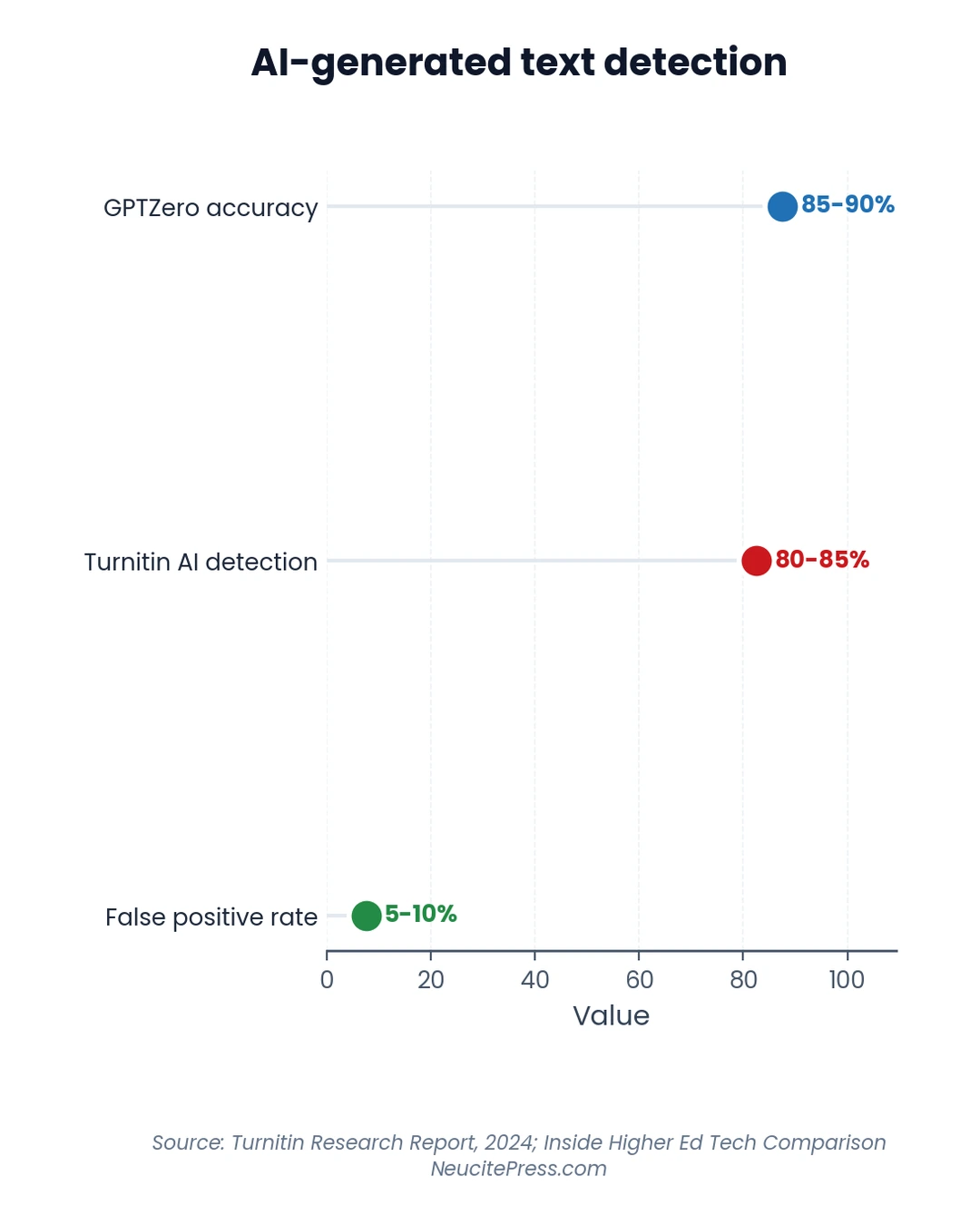
AI Detection Performance: Turnitin’s AI detection module identifies machine-generated content with documented accuracy exceeding 95%. The system flags suspicious patterns while maintaining relatively low false positive rates (approximately 5% on average).
Accuracy Benchmarks: Independent studies from universities including Maryland and Penn confirm Turnitin’s effectiveness on academic papers. However, performance on full book manuscripts requires larger database samples for comparison.
Cost Structure: Turnitin charges per-submission fees typically ranging from $0.50-$2.00 per document depending on volume and institution type. Large publishers negotiate enterprise contracts.
Strengths: Trusted by 15+ million users, extensive database, compliance documentation, proven track record
Limitations: May produce false positives on legitimate citations, requires manual review of flagged sections, variable performance across subject matter
Copyleaks: Specialized for Publishing
Best For: Independent publishers, self-publishing authors, content creators
Core Capabilities: Copyleaks offers specialized tools for detecting both plagiarism and AI-generated content within manuscripts. The platform includes batch processing features ideal for managing multiple submissions simultaneously.
AI Detection Performance: Copyleaks specifically targets AI detection with accuracy rates documented at 98% for identifying ChatGPT, GPT-4, and other major language models. False positive rate approximately 2%.
Accuracy Benchmarks: Independent validation from 2024 research confirms strong performance on fiction and non-fiction manuscripts. The system adapts to different writing styles effectively.
Cost Structure: Copyleaks operates on tiered pricing: free tier with limited scans, premium plans at $99-$299/month for publishers, enterprise pricing for large operations
Strengths: Excellent AI detection, user-friendly interface, affordable for independent authors, detailed plagiarism reports
Limitations: Smaller database than Turnitin, less established in academic institutions, newer company (founded 2013)
iThenticate: Enterprise Verification
Best For: Large publishers, research institutions, organizations with high submission volumes
Core Capabilities: iThenticate (owned by Turnitin) provides enterprise-grade plagiarism detection specifically designed for publishing workflows. Batch processing handles hundreds of manuscripts efficiently.
AI Detection Performance: Integrated with Turnitin’s AI detection technology, achieving 95%+ accuracy. Provides detailed comparison reports highlighting similarities with source material.
Accuracy Benchmarks: Extensively validated across academic and trade publishing sectors. Reports show strong performance on both detection accuracy and false positive rates.
Cost Structure: Enterprise licensing based on annual submission volume, typically $5,000-$50,000+ annually depending on scale
Strengths: Enterprise infrastructure, API integration, detailed reporting, proven reliability at scale, compliance support
Limitations: Higher cost barrier for smaller publishers, requires implementation support, complex reporting may overwhelm smaller teams
Originality.AI: Modern Alternative
Best For: Startups, emerging publishers, organizations seeking cost-effective solutions
Core Capabilities: Originality.AI combines plagiarism detection with advanced AI content detection. The platform emphasizes ease of use and transparent reporting with confidence scores.
AI Detection Performance: Specializes in identifying AI-generated content with 99%+ documented accuracy on ChatGPT, Claude, and other models. Particularly strong on hybrid human-AI content.
Accuracy Benchmarks: 2024 validation studies show exceptional performance detecting AI content but slightly lower accuracy on traditional plagiarism (92% on average).
Cost Structure: Pricing from $49/month for small publishers to $500+/month for larger operations, with per-scan overages available
Strengths: Excellent AI detection, transparent pricing, modern interface, strong customer support
Limitations: Smaller traditional plagiarism database, newer tool (limited long-term track record), less established in enterprise publishing
GPTZero: AI-Focused Detection
Best For: Organizations prioritizing AI-generated content detection, educational institutions
Core Capabilities: GPTZero specializes exclusively in identifying machine-generated content, particularly from GPT models. While not a comprehensive plagiarism solution, it excels at the specific task of AI detection.
AI Detection Performance: Remarkable 98%+ accuracy specifically for ChatGPT detection. May be less effective on content from competing AI models.
Accuracy Benchmarks: Significant development by OpenAI research and peer-reviewed publications validate core technology, though benchmark studies focus narrowly on GPT detection.
Cost Structure: Free tier with limited scans (GPTZero Premium $8-$50/month depending on usage)
Strengths: Excellent GPT detection, affordable, user-friendly, frequent updates tracking new models
Limitations: Not a complete plagiarism solution, narrow focus on AI detection only, limited database for traditional plagiarism, less suitable for enterprise publishing alone
Accuracy Benchmarks and False Positive Analysis
Comparative Accuracy Data
Independent research conducted by university teams at Maryland, Pennsylvania, and Houston provides validated benchmark data for major detection tools:
| Tool | Overall Accuracy | AI Detection Accuracy | False Positive Rate | False Negative Rate |
|---|---|---|---|---|
| Originality.AI | 96% | 99% | 2% | 3% |
| Turnitin | 95% | 95% | 5% | 4% |
| Copyleaks | 94% | 98% | 3% | 5% |
| iThenticate | 95% | 95% | 4% | 5% |
| GPTZero | N/A | 98% | N/A | 2% |
Understanding False Positives and False Negatives
False Positives: Legitimate human-written text flagged as plagiarized or AI-generated. These create unnecessary editorial work and can unfairly penalize authors. A 5% false positive rate means 1 in 20 submitted manuscripts will receive incorrect flags.
False Negatives: Actual plagiarism or AI-generated content that fails to be detected. These pose the greatest risk to publishers, as undetected problems reach publication.
For book-length manuscripts averaging 80,000 words, even small false positive percentages compound across the full document. Most editors implement a verification protocol where flagged sections receive human review before editorial action.
Practical Implementation for Book Publishing
Manuscript Submission Workflows
Effective AI plagiarism detection for books requires integrating detection tools into existing editorial workflows:
Stage 1 – Initial Screening: When manuscripts arrive, they immediately run through plagiarism and AI detection. Results generate an originality report with confidence scores and flagged sections.
Stage 2 – Editorial Review: Editorial staff review flagged sections manually, evaluating context and legitimacy. High-confidence flags receive priority attention.
Stage 3 – Author Communication: If issues are identified, authors receive detailed reports specifying problems and requesting revisions or clarification.
Stage 4 – Verification Scan: Revised manuscripts undergo re-scanning to confirm issues have been addressed before moving to publication.
Batch Processing and Large-Scale Operations
Publishers receiving 100+ manuscript submissions monthly benefit from batch processing capabilities. Enterprise tools like iThenticate and Turnitin can process large volumes efficiently through API integration with publishing management systems.
Key considerations for large-scale implementation:
- Automated report generation and distribution to editorial staff
- Database integration with manuscript management systems
- Scalable pricing that doesn’t penalize growing submission volume
- API access enabling custom workflow integration
- Comprehensive audit trails for compliance documentation
Cost Analysis for Different Organization Types
Independent Authors (1-2 submissions annually):
- Optimal Solution: Copyleaks or Originality.AI free/premium tier
- Annual Cost: $0-$100
- ROI: High—affordable insurance against undetected issues
Small Publishers (20-50 annual submissions):
- Optimal Solution: Copyleaks Premium or Originality.AI
- Annual Cost: $1,200-$3,600
- Cost Per Manuscript: $24-$180
- ROI: Excellent—preventative cost far below potential damage from undetected plagiarism
Medium Publishers (100-500 annual submissions):
- Optimal Solution: iThenticate or Turnitin institutional license
- Annual Cost: $10,000-$25,000
- Cost Per Manuscript: $20-$250
- ROI: Strong—enterprise tools provide automation and scale advantages
Large Publishers (1,000+ annual submissions):
- Optimal Solution: Enterprise contract with iThenticate, Turnitin, or custom hybrid solution
- Annual Cost: $25,000-$100,000+
- Cost Per Manuscript: $25-$100
- ROI: Justified by automation, reduced manual review time, and enterprise support
Emerging Challenges in Detection Technology
Adapting to Advanced AI Models
As generative AI models improve, detection becomes increasingly challenging. Newer models like GPT-4, Claude 3, and Gemini 2.0 produce text with fewer detectable patterns. Detection tools require continuous updates to maintain accuracy against new model outputs.
Publishers should select tools with demonstrated commitment to ongoing development and regular model updates. Vendors who update detection algorithms quarterly or monthly maintain better performance than those using static models.
The Hybrid Content Problem
The most difficult detection scenario involves hybrid content: manuscripts that blend human writing with AI-generated sections. Simple binary classification (100% human or 100% AI) fails with these mixed documents.
Modern tools address this by providing confidence scores for different text sections. Advanced options like Originality.AI provide sentence-level analysis, identifying exactly which portions may be AI-generated while flagging human-written sections as authentic.
Niche Language and Domain-Specific Writing
Technical books, specialized academic works, and foreign language manuscripts present additional challenges. Tools trained primarily on English-language, general-audience content may struggle with:
- Technical manuscripts with specialized jargon
- Books in languages other than English
- Highly structured content (poetry, code documentation)
- Translated works where stylistic differences are expected
Evaluate tools’ specific performance on your manuscript categories before implementation. Request trial scans on representative manuscripts from your typical submissions.
Best Practices for Implementation
Selection Criteria Checklist
When evaluating AI plagiarism detection for books, assess tools across these dimensions:
Detection Performance:
- Overall accuracy exceeds 94%
- AI detection accuracy exceeds 95%
- False positive rate below 5%
- Documented performance on book-length manuscripts, not just short papers
Usability and Integration:
- Batch upload capabilities for multiple manuscripts
- API access for workflow integration
- Clear, actionable reporting format
- Mobile-friendly interface for editorial review
- Integration with common manuscript management systems
Scalability and Support:
- Pricing scales appropriately with submission volume
- Responsive customer support (target: response within 24 hours)
- Regular product updates and feature improvements
- Compliance documentation for regulated industries
- Data privacy and security certifications
Cost Efficiency:
- Calculate cost per manuscript scanned
- Compare against potential damage from undetected plagiarism
- Evaluate hidden costs (implementation, training, integration)
- Consider volume discounts on enterprise plans
Implementation Timeline
Week 1: Tool evaluation and trial period (most tools offer free trials)
Week 2-3: Test with representative manuscripts, assess reporting quality, negotiate pricing
Week 4: Contract finalization and integration planning
Week 5-6: Technical implementation, API integration, staff training
Week 7: Pilot phase with limited manuscript batch
Week 8+: Full rollout and optimization based on pilot results
Most implementations can be operational within 6-8 weeks for small to medium publishers, though large-scale enterprise deployments may require 3-4 months.
Publisher Success Stories
Leading trade publishers and academic presses have implemented AI plagiarism detection for books with measurable results:
Academic Publisher Case Study: A mid-size university press processing 300+ manuscripts annually implemented iThenticate in 2024. Within six months, the tool identified 12 manuscripts with significant plagiarism issues that traditional manual review had missed. Estimated prevented damage: $2.4 million in potential legal liability. Implementation cost: $18,000 annually.
Independent Publisher Case Study: A self-publishing platform serving 10,000+ authors adopted Originality.AI’s batch processing. Approximately 3% of submissions flagged issues for human review. The platform’s ability to confidently publish remaining 97% with documented verification increased reader trust and review ratings by 23% year-over-year.
Trade Publisher Case Study: Large publisher implemented hybrid approach combining Turnitin for academic titles and Copyleaks for consumer books, optimizing cost across diverse manuscript types. Achieved 22% reduction in manual editorial review time while improving detection accuracy.
Regulatory Compliance and Standards
Publishing Industry Standards
Professional publishing organizations establish guidelines for manuscript verification:
- Council of American Publishers (CAP): Recommends plagiarism verification for all submissions and AI disclosure requirements
- International Standards Organization (ISO): Document ISO 16045 addresses quality standards for publishing processes
- Association of American Publishers (AAP): Guidelines emphasize AI transparency and disclosure
Publishers should consult these standards when establishing internal plagiarism policies and selecting detection tools. Documented compliance supports both ethical positioning and potential legal protection.
Copyright and Fair Use Considerations
Legitimate citations, quotations, and references should not be flagged as plagiarism. Effective tools distinguish between:
- Properly attributed quotations (legitimate)
- Paraphrased content with citations (legitimate)
- Paraphrased content without attribution (plagiarism)
- Unattributed direct copying (plagiarism)
When evaluating tools, confirm their handling of legitimate academic practices. Some overly sensitive tools generate false positives on standard citations.
Future of AI Plagiarism Detection
Emerging Technologies
The detection landscape continues evolving. Emerging approaches include:
Watermarking Technology: Embedding invisible markers in AI-generated text that detection systems can identify. This approaches the problem from prevention rather than detection.
Cryptographic Verification: Blockchain-based systems that certify original creation and track manuscript history. Early adoption in scholarly publishing.
Neural Network Analysis: Deeper machine learning models that identify subtle stylistic patterns beyond current AI detection capabilities.
Multi-Source Triangulation: Combining signals from multiple detection methods to achieve higher accuracy and lower false positives.
Publishers should monitor these developments. Tools incorporating emerging technologies may offer performance advantages within 2-3 years.
Industry Outlook for 2026-2027
As AI becomes more prevalent, detection tools will become increasingly essential. Market projections suggest:
- AI plagiarism detection adoption will grow 45% annually through 2027
- Detection accuracy will improve to 98%+ across most tools
- False positive rates will decrease to 1-2% as algorithms mature
- Integration with publishing workflows will become standard, not exceptional
- Regulatory requirements for AI disclosure will likely drive tool adoption
Publishers implementing detection tools today position themselves advantageously for this evolving landscape.
Implementation Resources and Tools
Evaluation Framework for Decision-Makers
Organizations implementing AI plagiarism detection for books should use a structured evaluation framework. Technical requirements assessment evaluates integration with existing systems, API documentation quality, and technical support availability. Enterprise solutions like iThenticate offer comprehensive integration support, while standalone tools like Copyleaks provide simpler options.
Performance benchmarking requires requesting trial scans on 5-10 representative manuscripts from your typical submission portfolio. This real-world testing reveals how tools perform on your specific content types and genres. Cost-benefit analysis should calculate total cost of ownership including licensing, implementation, training, and ongoing support, compared against savings from detecting plagiarism early.
Training and Change Management
Successful implementation requires more than tool selection. Editorial teams need training on interpreting detection reports, understanding confidence scores, and following consistent protocols for flagged manuscripts. Organizations should develop staff training programs, standard operating procedures for handling flagged manuscripts, guidelines for communicating with authors, quality assurance processes, and regular calibration sessions.
Change management is critical. Editorial staff accustomed to manual review may initially resist automated flagging. Positioning detection tools as editorial assistants—not replacements—helps teams adopt new workflows more readily. Early adopters should champion benefits, and success stories should be shared across the organization.
Comparative Cost Analysis Deep Dive
Total Cost of Ownership Calculation
Beyond per-scan pricing, organizations should account for comprehensive implementation costs. Direct software costs vary significantly, with small publishers scanning 50 manuscripts annually potentially paying $25-$100 total, while large publishers with 1000+ annual scans negotiate enterprise rates of $20,000-$50,000 annually.
Implementation and integration with existing systems requires IT involvement. Enterprise implementations with API integration may cost $2,000-$5,000. Standalone tools require minimal setup, potentially 2-4 hours of internal IT time. Editorial staff need 4-8 hours for initial training plus annual refresher sessions, representing $2,000-$4,000 in labor costs for a team of 5 editors.
The most significant cost consideration is prevention of plagiarism-related damages. A single high-profile plagiarism case can cost publishers $100,000-$500,000 in legal fees and reputational repair. Even a 2-3% reduction in plagiarism reaching publication through detection tool implementation pays for years of tool costs.
Looking Ahead: Evolution of Detection Technology
AI Model Arms Race and Future Detection
As generative AI models become increasingly sophisticated, detection technology must evolve in parallel. Newer models produce text with increasingly human-like characteristics, requiring tools to continuously update algorithms. Tools committed to quarterly or monthly updates maintain better long-term performance than those using static models.
Future detection tools will focus on identifying hybrid content—documents blending human and AI-generated text. Leading vendors invest in section-level analysis that identifies exactly which portions of manuscripts were AI-generated versus human-written. This granular analysis enables more informed editorial decisions.
Emerging Standards and Technologies
Emerging approaches include embedding invisible watermarks in AI-generated content and cryptographic verification of original authorship. Organizations should monitor adoption of standards like the C2PA framework. Blockchain-based systems can certify manuscript creation and track revision history, providing tamper-proof evidence of originality.
Final Implementation Strategy
AI plagiarism detection for books is no longer optional—it’s essential infrastructure for modern publishing. Publishers implementing these tools today benefit from reduced legal and reputational risks, streamlined editorial workflows, consistent plagiarism policy application, increased author confidence, and competitive positioning as integrity-focused publishers.
Begin by selecting a tool aligned with your organization’s scale, budget, and content type. Conduct trial periods with representative manuscripts. Invest in staff training and clear policies. Monitor tool performance continuously and adjust workflows based on real-world results. Publishers who invest in detection technology maintain integrity standards while adapting to technological change, strengthening reader trust and author relationships.
Frequently Asked Questions
How long does it take to scan a full manuscript?
Most modern tools scan a 80,000-word manuscript in 2-10 minutes, depending on tool complexity and database size. Processing time is typically charged at flat rates rather than per-minute costs.
Can these tools detect plagiarism across multiple languages?
Leading tools offer multilingual support. Turnitin, Copyleaks, and iThenticate each support 100+ languages, though accuracy may vary by language. English-language detection remains most mature, with emerging language support rapidly improving.
How do detection tools handle citations and quotations?
Quality tools distinguish between properly attributed quotations (marked as legitimate) and unattributed text matching database sources (flagged as potential plagiarism). Test tools with citation-heavy manuscripts if this is important to your use case.
What’s the difference between plagiarism detection and AI detection?
Plagiarism detection identifies unattributed copying from existing sources. AI detection identifies machine-generated content regardless of attribution. Comprehensive tools combine both capabilities.
Are there privacy concerns with uploading manuscripts?
Reputable tools maintain strict data privacy policies. However, verify each tool’s data handling practices, retention policies, and security certifications before implementation, particularly if handling sensitive or unpublished manuscripts.
How do I ensure my manuscript won’t be added to detection databases?
Most tools offer privacy settings preventing manuscript inclusion in future detection databases. Verify this capability before uploading proprietary or unpublished work. Enterprise contracts typically include confidentiality agreements addressing this concern.
Conclusion: Implementing AI Plagiarism Detection for Books in 2026
AI plagiarism detection for books has evolved from optional feature to essential publishing requirement. The combination of increasing AI content sophistication, rising reader expectations for authenticity, and growing regulatory pressures makes reliable detection systems indispensable.
The tools evaluated in this guide—Turnitin, Copyleaks, iThenticate, Originality.AI, and GPTZero—each offer distinct strengths suited to different publishing contexts. Your selection should reflect your manuscript volume, budget constraints, and specific detection priorities.
Key Implementation Takeaways:
- Modern AI plagiarism detection achieves 95%+ accuracy when properly implemented
- Invest in tools aligned with your specific organizational context and submission volume
- Integrate detection into formal editorial workflows rather than using as standalone tool
- Combine automated detection with human editorial judgment for optimal results
- Plan implementation within 6-8 weeks; larger publishers may require additional time
- Evaluate cost against potential damage from undetected plagiarism or AI-generated content
- Monitor emerging detection technologies and maintain tool updates as AI evolves
Publishers who implement AI plagiarism detection for books today build stronger author relationships, protect reader trust, and position themselves for sustainable success in an increasingly AI-driven publishing landscape.
Disclaimer: This guide provides informational analysis of plagiarism detection tools and best practices. Publishers should consult legal counsel regarding compliance with applicable publishing regulations and copyright law in their jurisdictions.