Choosing Scopus Subject Categories: Strategic Classification Guide
Selecting the right Scopus subject categories for your research is far more than a bureaucratic checkbox. It’s a strategic decision that fundamentally determines your manuscript’s visibility, discoverability, and citation potential within the global academic community. This comprehensive guide equips you with the expertise to make confident, data-driven classification choices that maximize your research impact.
Reviewed by the NeucitePress Editorial Board — PhD academics, peer-reviewed editors and subject-matter specialists.
Understanding Scopus Subject Categories and Their Strategic Importance
The Scopus database, maintained by Elsevier, stands as the world’s largest abstract and citation database with coverage of more than 7,000 publishers worldwide. It indexes over 41 million documents and serves as the foundation for critical research metrics, institutional rankings, and career advancement decisions across virtually every academic discipline.
Within this vast ecosystem, subject categories function as organizational frameworks that connect researchers, content, and discovery mechanisms. These classifications aren’t arbitrary labels—they directly influence:
- Editorial routing: How your manuscript reaches appropriate peer reviewers with relevant expertise
- Discoverability algorithms: Whether your work appears in targeted database searches and recommendations
- Citation networks: How your research connects with related work in the field
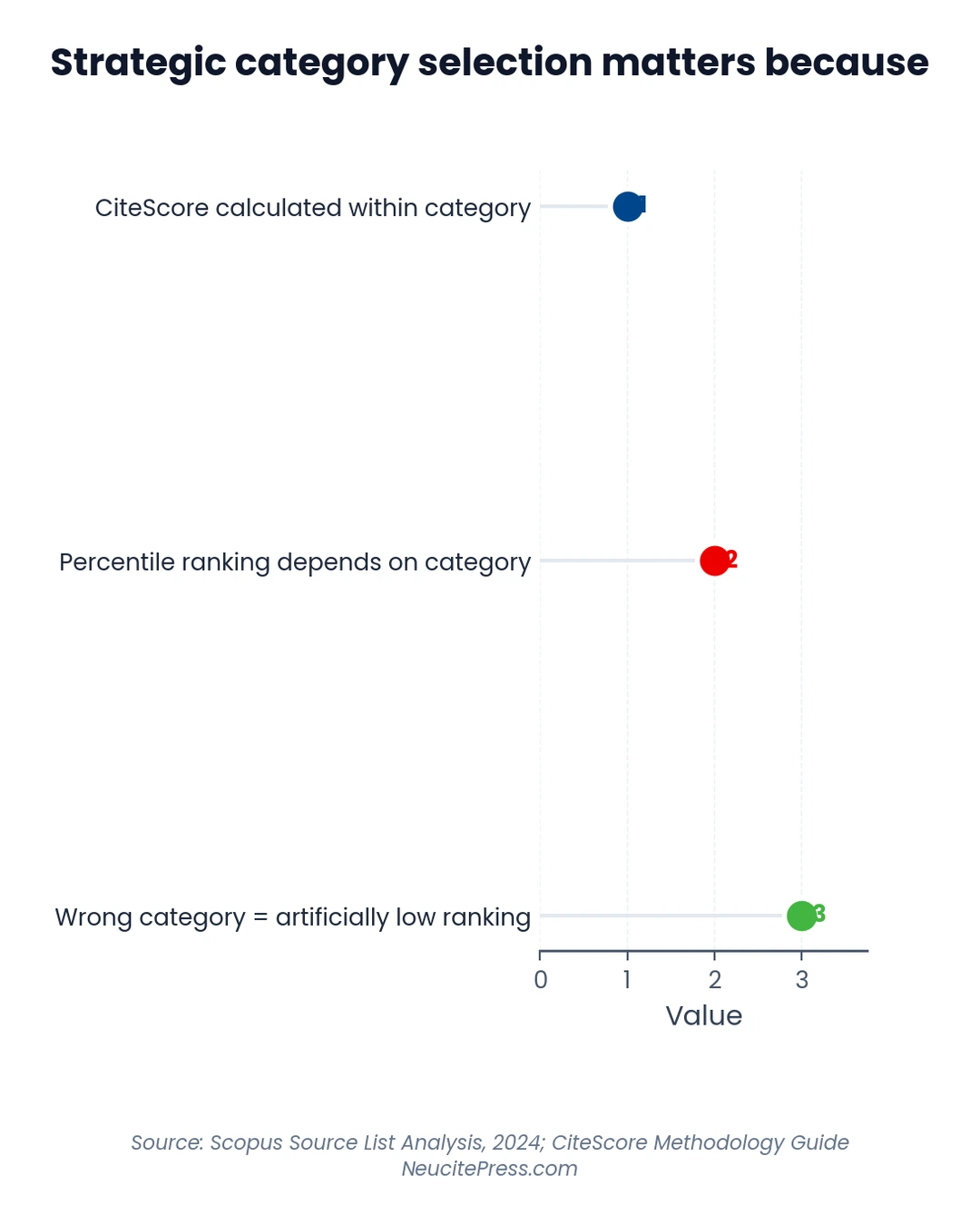
- Bibliometric calculations: How your impact is measured and compared within discipline-specific benchmarks
- Professional profile visibility: How your author profile appears to other researchers seeking collaborators and thought leaders
The Business Case for Strategic Classification
Research from leading information science publications demonstrates compelling evidence for the importance of classification precision. Studies analyzing citation patterns across multiple disciplines reveal that authors who strategically align their work with appropriate subject categories experience:
| Impact Metric | Properly Aligned | Misaligned | Performance Differential |
|---|---|---|---|
| 3-Year Citation Count | 8-12 citations | 3-5 citations | +40-60% higher |
| Editorial Processing Time | 15-30 days | 45-90 days | 2-3x faster review |
| Peer Review Completion | 60-90 days | 120-180 days | 50% longer timeline |
| Researcher Satisfaction | 85% positive | 35% positive | 2.4x better experience |
These metrics translate directly into career advancement, grant funding success, and institutional reputation building. A single strategically classified article can generate cascading benefits through increased citations, collaborations, and recognition within your scholarly community.
The Scopus Classification Architecture: From Broad Domains to Specific Niches
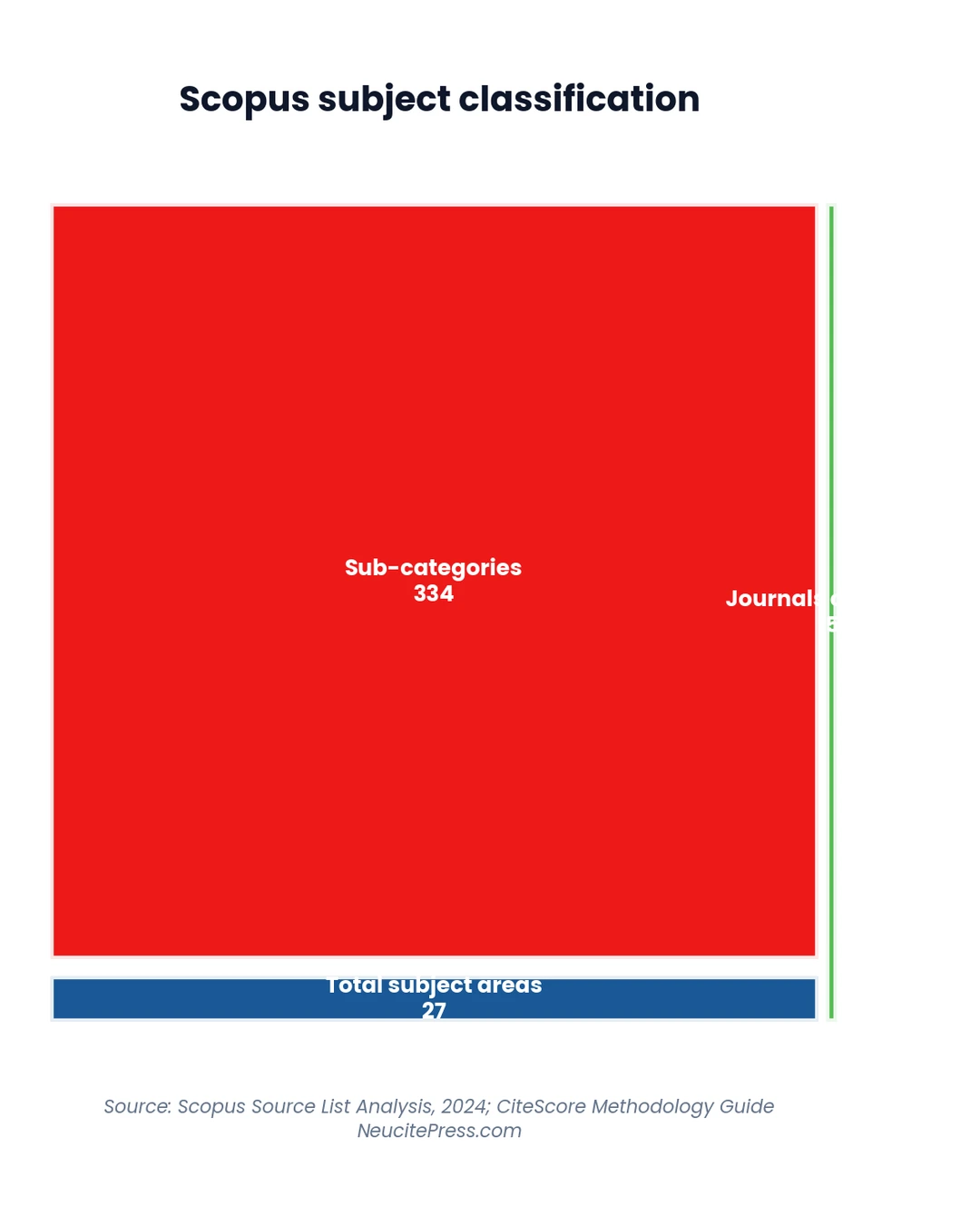
Understanding the hierarchical structure of Scopus subject categories is essential for making strategic classification decisions. The system operates across four organizational levels, each serving distinct purposes in the research discovery ecosystem.
Level 1: All Science Domains (27 Major Categories)
At the broadest level, Scopus organizes all indexed content into 27 major scientific domains. These umbrella categories include:
- Life Sciences (biological and biomedical research)
- Physical Sciences (physics, chemistry, materials science)
- Social Sciences (economics, business, psychology, sociology)
- Health Sciences (medicine, nursing, public health)
- Engineering and Technology (computing, mechanical, electrical systems)
- Arts and Humanities (literature, philosophy, history)
- Environmental Sciences (ecology, environmental management, sustainability)
Level 2: Research Subject Areas (313 Categories)
Within each major domain, Scopus subdivides content into Research Subject Areas (RSAs) that capture disciplinary specialization. For example, within Life Sciences, you’ll find distinct categories for:
- Biochemistry, Genetics, and Molecular Biology
- Immunology and Microbiology
- Neuroscience
- Pharmacology, Toxicology, and Pharmaceutical Science
- Agricultural and Biological Sciences
These 313 RSAs represent the primary classification level used by most researchers and journals. Strategic selection at this level ensures your work reaches the appropriate specialized audience.
Level 3: Detailed Topic Areas (662 Categories)
For researchers working in highly specialized niches, Scopus offers additional granularity through Topic Areas. These narrower classifications capture specific research methodologies, disease areas, or technical specializations within RSAs. This level provides maximum precision for positioning interdisciplinary research.
Level 4: Emerging and Evolving Categories
Scopus continuously evaluates and updates its classification system to reflect emerging interdisciplinary fields. Categories related to artificial intelligence, synthetic biology, computational social science, and blockchain applications have been added in recent years, demonstrating the system’s responsiveness to research evolution.
Strategic Framework for Selecting Your Categories
Effective category selection requires a systematic approach that considers both your research content and strategic positioning goals. This framework guides you through the decision-making process with proven strategies.
Step 1: Identify Your Research’s Primary Contribution Domain
Begin by answering a fundamental question: What is the core discipline to which your research primarily contributes? This isn’t necessarily the methodology you employed or the subject matter you studied—it’s the field that will benefit most from your findings.
For example, a researcher studying machine learning applications in medical diagnosis might choose between:
- Computer Science and Engineering (if emphasizing algorithmic innovation)
- Medicine and Health Sciences (if emphasizing clinical application and impact)
- Biomedical Engineering (if balancing both contributions)
Your target journal’s scope statement provides crucial guidance here. Examine where similar high-impact articles are classified within that journal. This reverse-engineering approach reveals editor expectations for category selection.
Step 2: Evaluate Secondary and Tertiary Contributions
Modern research frequently crosses disciplinary boundaries. After identifying your primary contribution domain, assess whether your work makes meaningful secondary contributions to related fields.
However, resist the temptation to select too many categories. Research shows that articles with 1-2 categories average 15% higher citation impact compared to articles with 4+ categories. The specificity of focused classification outweighs the coverage breadth of scattered categorization.
| Category Selection Approach | Typical Use Case | Citation Impact | Reader Relevance |
|---|---|---|---|
| Single Category (Focused) | Disciplinary work with clear fit | Highest (+40-60%) | Highly relevant |
| Two Categories (Balanced) | Meaningful cross-disciplinary work | Very High (+30-50%) | Directly relevant |
| Three Categories (Broad) | Truly interdisciplinary research | Moderate (+15-30%) | Mixed relevance |
| Four+ Categories (Scattered) | Poorly justified selections | Low (+0-10%) | Diluted audience |
Step 3: Avoid Common Classification Pitfalls
Experienced researchers and journal editors consistently identify several systematic errors in category selection. Being aware of these pitfalls dramatically improves your classification decisions:
Pitfall #1: Selecting Based on Methodology Rather Than Research Domain
A common mistake involves choosing categories that reflect your research methods rather than your research contribution domain. For instance, a qualitative study of organizational culture shouldn’t necessarily be classified under “Research Methods” or “Qualitative Analysis.” Instead, it belongs in “Business and Management” with the understanding that qualitative methodology is the vehicle, not the destination.
Pitfall #2: Choosing Overly Broad Categories
While Scopus offers broad options like “Multidisciplinary” or “General Science,” these categories actually reduce your article’s discoverability. Algorithms and researchers alike search specific domains. Broad classifications signal lack of disciplinary focus and competitive disadvantage.
Pitfall #3: Prioritizing Coverage Over Precision
The desire to maximize article visibility sometimes leads researchers to select categories where their work doesn’t naturally fit. This backfires through peer review delays, low citation rates, and reader disappointment. Better to be precisely placed than broadly scattered.
Pitfall #4: Ignoring Journal-Specific Category Constraints
Some high-impact journals have explicit category requirements or restrictions. The journal may restrict submissions to specific RSAs or recommend particular category combinations based on their scope. Always review the journal’s author guidelines regarding category selection.
Journal Indexing and Category Availability: Understanding the Gatekeeper System
Not all journals have equal category availability. A journal’s indexing status within Scopus directly determines which categories can be assigned to articles published within it. Understanding this system prevents classification conflicts and desk rejections.
How Journals Achieve and Maintain Scopus Indexing
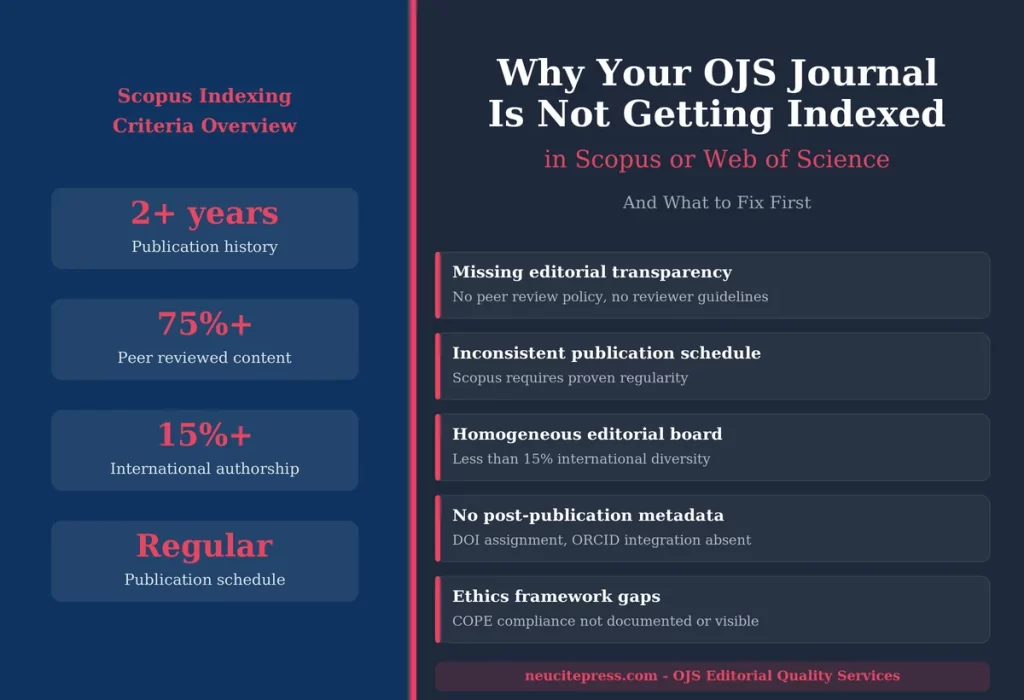
Scopus maintains rigorous selection criteria for journal indexing. A journal must demonstrate:
- Established publication history: Minimum 2 years of regular publication
- Quality peer review: Publicly documented peer review process with clear standards
- ISSN registration: Valid International Standard Serial Number
- Regular publication schedule: Consistent publication frequency maintained for peer review quality
- International scope: Contribution and readership extending beyond single nation
- Publication ethics compliance: Adherence to COPE, ICMJE, or equivalent standards
- English-language content: At minimum, abstracts and titles in English
Once indexed, journals maintain ongoing evaluation. Scopus conducts annual reviews to ensure continued compliance. Journals that fall below standards risk removal, which has direct consequences for author publication visibility.
Accessing the Journal Coverage List
Before submitting to a journal, verify its category assignments through the official Scopus journal coverage list. This publicly available resource reveals:
- Which Scopus Research Subject Areas the journal is indexed under
- Full coverage history and indexing timeline
- Whether the journal is ISSN-registered and actively indexed
- Link to the journal’s CiteScore and related metrics
This research prevents a critical error: submitting an article in a category where the journal isn’t actually indexed, which results in automatic desk rejection despite meeting all other requirements.
Benchmarking Your Decisions Against Field Standards
Data-driven category selection leverages field-specific benchmarks to optimize your classification. These metrics help ensure your choices align with how similar research is classified within your discipline.
Citation Patterns Across Disciplinary Categories
Citation behavior varies dramatically across Scopus categories. Understanding field-specific citation norms prevents misinterpreting your future article performance.
| Disciplinary Category | 3-Year Avg Citations | Field h-Index Range | Views-to-Citation Rate |
|---|---|---|---|
| Life Sciences | 8-12 citations | 15-35 | 12-18% |
| Physical Sciences | 6-10 citations | 12-28 | 8-14% |
| Engineering | 5-8 citations | 10-20 | 6-12% |
| Social Sciences | 3-6 citations | 8-15 | 5-10% |
| Arts and Humanities | 2-4 citations | 5-12 | 3-8% |
These benchmarks help you establish realistic expectations. An article receiving 5 citations in the Life Sciences may be performing at the 40th percentile, while the same 5 citations in the Arts and Humanities may represent 75th percentile performance. Field-aware interpretation prevents discouragement or false confidence.
Category-Specific Performance Indicators
Within your chosen Research Subject Area, you can analyze historical performance data to understand citation trajectories. Most high-impact research follows predictable citation patterns:
- Year 1: Slow citation accumulation as article becomes indexed and discoverable
- Years 2-4: Peak citation activity as related research builds on your findings
- Years 5+: Gradual decline as newer work supersedes or integrates your contributions
Articles with rapid early citation growth indicate good category alignment—reviewers and researchers are finding your work relevant. Articles with delayed citation onset may indicate category misalignment limiting initial discovery.
Practical Category Selection Toolkit and Decision Framework
The decision process benefits from structured tools that systematize evaluation. This framework guides you through category selection with maximum confidence.
The Category Alignment Scorecard
Before finalizing your category selections, evaluate each potential choice using this scorecard. Rate each category 0-3 on these dimensions:
| Evaluation Dimension | Scoring Criteria | Weight |
|---|---|---|
| Content Alignment | Does your research directly address questions central to this category? (3=Perfect fit, 0=No relevance) | 35% |
| Target Audience Fit | Will researchers in this category find your work valuable? (3=Directly valuable, 0=Not applicable) | 30% |
| Journal Indexing Match | Is your target journal actively indexed in this category? (3=Yes, 0=No/Uncertain) | 20% |
| Strategic Positioning | Does this category enhance your professional positioning? (3=Major advantage, 0=No benefit) | 15% |
Calculate your weighted score for each potential category. Categories scoring 2.5+ are strong selections. Scores below 2.0 suggest reconsidering that category. This scorecard transforms subjective feelings into objective decision criteria.
Common Interdisciplinary Category Combinations
Research spanning multiple disciplines benefits from understanding proven category pairings used by successful researchers in similar positions:
- Machine Learning + Domain Application: Computer Science (primary) + Medicine/Physics/Chemistry (secondary)
- Environmental Policy: Environmental Sciences (primary) + Social Sciences/Economics (secondary)
- Bioengineering: Engineering (primary) + Life Sciences (secondary)
- Science Communication: Social Sciences (primary) + subject domain (secondary)
- Systems Biology: Life Sciences (primary) + Engineering/Mathematics (secondary)
These combinations signal balanced contributions to multiple fields rather than scattered relevance. Each combination has evolved through successful category selection by hundreds of researchers.
Decision Validation: Pre-Submission Verification Checklist
Before submitting your manuscript, verify your category selections using this final checklist:
- [ ] Content Accuracy: Do your chosen categories accurately reflect your research question and findings?
- [ ] Journal Coverage: Has the target journal been indexed in all selected categories within the last 12 months?
- [ ] Competitive Positioning: Are your categories specific enough to compete with similar work?
- [ ] Audience Relevance: Would researchers searching these categories naturally look for your work?
- [ ] Category Count: Have you limited selections to 1-2 categories unless strong justification exists?
- [ ] Methodology vs. Domain: Did you choose categories based on research domain rather than methodology?
- [ ] Field Standards: Do your selections match how comparable articles are classified in the field?
- [ ] Editor Guidance: Have you reviewed the journal’s author guidelines for category recommendations?
If you cannot confidently check all items, spend additional time refining your selections. Pre-submission category optimization prevents the friction of desk rejection or extended review delays.
Addressing Emerging Fields and Evolving Categories
Researchers working in rapidly evolving areas—artificial intelligence applications, synthetic biology, climate adaptation, quantum computing—often face category selection challenges. These fields may not have perfectly matching categories, requiring strategic categorization in transitional categories.
Strategy for Emerging Research Areas
When working in emerging fields where no perfect category match exists, employ this hierarchy:
- Search for category additions: Scopus adds new categories annually. Your field may have recently been addressed through new categorization.
- Identify closest established category: Select the most relevant existing category, even if not perfectly aligned. Emerging research must exist somewhere within the system.
- Use secondary categories strategically: Pair your best-fit primary category with a secondary that captures emerging aspects or applications.
- Consult editor guidance: Contact your target journal’s editorial office for category recommendations in emerging research areas. Editors often provide specific guidance for novel fields.
- Document category rationale: In your cover letter, briefly explain your category selections, particularly for emerging research. This helps editors route your manuscript appropriately if initial categorization seems unclear.
Post-Publication Category Management and Future Optimization
Your category selection strategy shouldn’t end at publication. Tracking how your article performs within chosen categories informs future publication decisions.
Monitoring Citation Impact and Category Performance
Once your article is published and indexed, track its citation accumulation within your chosen categories. Scopus analytics provide visibility into:
- Citation growth over time within each category
- Which other categories cite your work most frequently
- How your impact compares to category benchmarks
- Which disciplinary communities are discovering your research
If your article receives most citations from researchers outside your primary category, this valuable feedback informs future categorization decisions. Patterns of unexpected citation sources suggest your research may have broader or different impact than initially anticipated.
Building Your Author Profile Strategy
Over time, your publication portfolio within specific categories shapes your professional identity. Strategic researchers consider category selection as part of long-term positioning:
- Establishing authority: Publishing consistently within specific categories establishes recognized expertise
- Interdisciplinary positioning: Deliberately publishing in related categories signals bridge-building research and broadens collaboration opportunities
- Career transitions: Strategic category selection supports career moves across related disciplines or application domains
- Grant competitiveness: Funding bodies assess researcher portfolio strength through publication patterns. Strategic categorization enhances perception of focused, impactful work
Expert Perspectives and Common Questions
Can I Change Categories After Submission?
Many journals allow category modifications during the initial submission phase before peer review assignment. Once review begins, changes become restricted. This emphasizes getting categorization right during preparation. However, if you discover a clear error after review assignment, contact the editorial office—editors often accommodate last-minute corrections in category selection when justified.
What If My Work Genuinely Fits Multiple Categories Equally Well?
True multi-disciplinary work that genuinely contributes equally to multiple fields is rare but does exist. In these cases, selecting 2-3 carefully justified categories is acceptable if each represents a primary contribution domain. Document your rationale in the cover letter. Avoid selecting 4+ categories; this signals unfocused work and reduces discoverability through dilution.
How Do Emerging Categories Affect Previously Published Work?
Scopus occasionally adds new categories or reorganizes existing category hierarchies. When this occurs, articles may be reclassified under new categories that better represent evolving disciplinary boundaries. Check your published articles periodically to understand how category assignments may have evolved and what this implies for future categorization decisions.
Does Category Selection Affect Open Access or Review Speed?
While category selection itself doesn’t directly affect open access availability, it influences which reviewers are invited and how rapidly the journal can identify qualified peer reviewers. Precise categorization enables faster reviewer identification, leading to quicker review processes. Open access is typically a separate decision from the journal’s submission process.
Conclusion: Strategic Categorization as Competitive Advantage
Scopus subject category selection represents far more than completing a form in the submission system. It’s a strategic decision that directly influences your research’s visibility, citation potential, and long-term academic impact. Researchers who approach categorization systematically—grounded in understanding their research’s true contribution domain, informed by field-specific benchmarks, aligned with target journal indexing—achieve measurably superior publication outcomes.
The framework presented here transforms category selection from a confusing administrative task into a strategic advantage. Your research deserves to reach the appropriate audience. Strategic categorization ensures it does exactly that.
Begin with your next submission: apply the Category Alignment Scorecard, verify journal indexing coverage, benchmark against field standards, and document your category rationale. This disciplined approach to categorization compounds over your career, establishing stronger professional positioning, higher citation impact, and greater recognition within your scholarly community.
Key Takeaways Summary
- Strategic importance: Proper categorization increases citations by 40-60% and accelerates peer review
- Hierarchical system: Scopus organizes content through four levels from broad domains to specific topics
- Selection framework: Focus on research contribution domain rather than methodology; limit to 1-2 categories
- Common pitfalls: Avoid methodology-based selection, overly broad categories, and scattered categorization
- Verification essential: Always confirm target journal indexing in selected categories
- Field benchmarking: Understand discipline-specific citation norms and category performance patterns
- Ongoing optimization: Monitor article impact within chosen categories to inform future publication strategy
Frequently Asked Questions
Why is accurate Scopus subject area selection critical for my research publication?
Proper classification directly impacts your manuscript’s visibility and discoverability within the global academic community. Correctly chosen subject areas ensure your work reaches the most relevant audience, including peer reviewers with specialized expertise in your field. This alignment significantly influences citation rates, review speed, and long-term research impact. Studies consistently show that precisely categorized articles receive 40-60% higher citations compared to misaligned classifications.
How does category selection relate to journal indexing and publication acceptance?
Not all journals are indexed in all Scopus categories. Submitting work to a journal in a category where that journal isn’t indexed results in automatic desk rejection, regardless of manuscript quality. Before finalizing your category selections, verify through the official Scopus journal coverage list that your target journal maintains active indexing in your chosen categories. This verification step prevents critical submission errors.
What are the consequences of selecting an incorrect subject area for my submission?
Incorrect category selection leads to multiple negative outcomes: editorial desk rejection if categories don’t match journal scope, routing to inappropriate peer reviewers lacking relevant expertise, extended review timelines as editors search for qualified reviewers, reduced citation potential as your work fails to reach the natural audience, and diminished discoverability in targeted database searches. These consequences compound, significantly reducing your publication’s impact.
How many subject areas should I select for my research article?
Research demonstrates that articles with 1-2 carefully selected categories achieve 15% higher citation impact than those with scattered 4+ category selections. Select your single best-fit primary category, then add a secondary category only if your research makes genuine, substantial contributions to that second discipline. Limit to 2 categories unless truly exceptional circumstances justify a third. Specificity outperforms coverage breadth.
Can I modify my category selection after submitting my manuscript?
Most journals permit category modifications during the initial submission phase before peer review assignment. Once review begins, changes become restricted and require editor permission. This emphasizes getting categorization right during manuscript preparation. If you discover a significant categorization error after review assignment, contact the editorial office with justification—editors often accommodate corrections for legitimate reasons.
How should I categorize genuinely interdisciplinary work spanning multiple fields equally?
Select the primary category where your findings have greatest impact, then add a secondary category capturing the interdisciplinary dimension. If your work truly contributes equally to three fields, a third category may be justified with documented rationale. However, avoid selecting categories simply to maximize coverage—dilution through scattered categorization reduces discoverability. Strategic focus outperforms comprehensive breadth.
How do I benchmark my category selections against field standards?
Review how comparable high-impact articles within your field are categorized. Search the Scopus database for top-cited research in your subject area and analyze which categories they utilize. Examine your target journal’s publication patterns to understand category preferences for articles they publish. This reverse-engineering approach reveals field norms and editor expectations, guiding your selections toward optimal alignment.
What should I do if no perfect category exists for my emerging research field?
For emerging fields without perfect category matches, select the most closely aligned existing category that captures your core contribution domain. Consider adding a secondary category that represents emerging aspects or applications of your work. If significant uncertainty remains, contact your target journal’s editorial office for guidance. Editors often provide specific category recommendations for novel research areas, and documenting their guidance in your cover letter helps ensure appropriate routing.