
Conference Budget Template Excel 2026: Complete Planning Guide with Cost Estimates
Conference budget planning is non-negotiable for event success. Industry data reveals that 68% of event organizers experience budget overruns, with the average overage reaching 22% of initial projections. This persistent challenge demonstrates why structured financial planning transforms chaotic spending into strategic resource allocation.
Reviewed by the NeucitePress Editorial Board — PhD academics, peer-reviewed journal editors and medical communication specialists.
A conference budget template provides the foundation for financial discipline. Rather than managing scattered spreadsheets and unclear cost tracking, event professionals need a centralized system that automatically calculates expenses, monitors revenue streams, and identifies budget variances in real-time.
Why Conference Budget Planning Matters: The Financial Reality
Successful conference execution depends on three critical pillars: compelling content, engaged attendees, and financial sustainability. Financial planning isn’t merely accounting—it’s strategic decision-making that determines whether your event achieves its mission and generates resources for future initiatives.
The Cost of Poor Budget Planning
Conferences without structured financial oversight face predictable challenges. Costs spiral as vendors exploit last-minute negotiations. Marketing spend grows unchecked without ROI analysis. Catering budgets expand without attendance confirmation. Registration income projections fail to materialize as attendee acquisition costs exceed targets.
The accumulated result: events that barely break even or operate at a loss. Research from the Event Management Institute found that 34% of conference organizers couldn’t accurately report their final profit or loss, indicating fundamental tracking failures.
How Budget Templates Drive Event Success
Conference budget templates solve these challenges by creating accountability and visibility. They establish:
- Centralized tracking: All expenses and revenue streams monitored in one location prevents budget blind spots
- Real-time calculations: Automatic formulas instantly update totals, variances, and profit/loss figures as data changes
- Scenario planning: Test different attendance levels, pricing structures, and vendor costs before committing resources
- Variance analysis: Compare projected versus actual spending to identify problem areas early
- Decision support: Clear financial data enables confident decisions about cost-cutting, sponsorship targets, and pricing adjustments
Complete Conference Budget Breakdown: All Major Cost Categories
Comprehensive budget planning requires understanding every expense category specific to conferences. We’ll detail 2026 cost benchmarks based on recent market data for conferences ranging from 200 to 1,000 attendees.
Venue and Facilities Costs
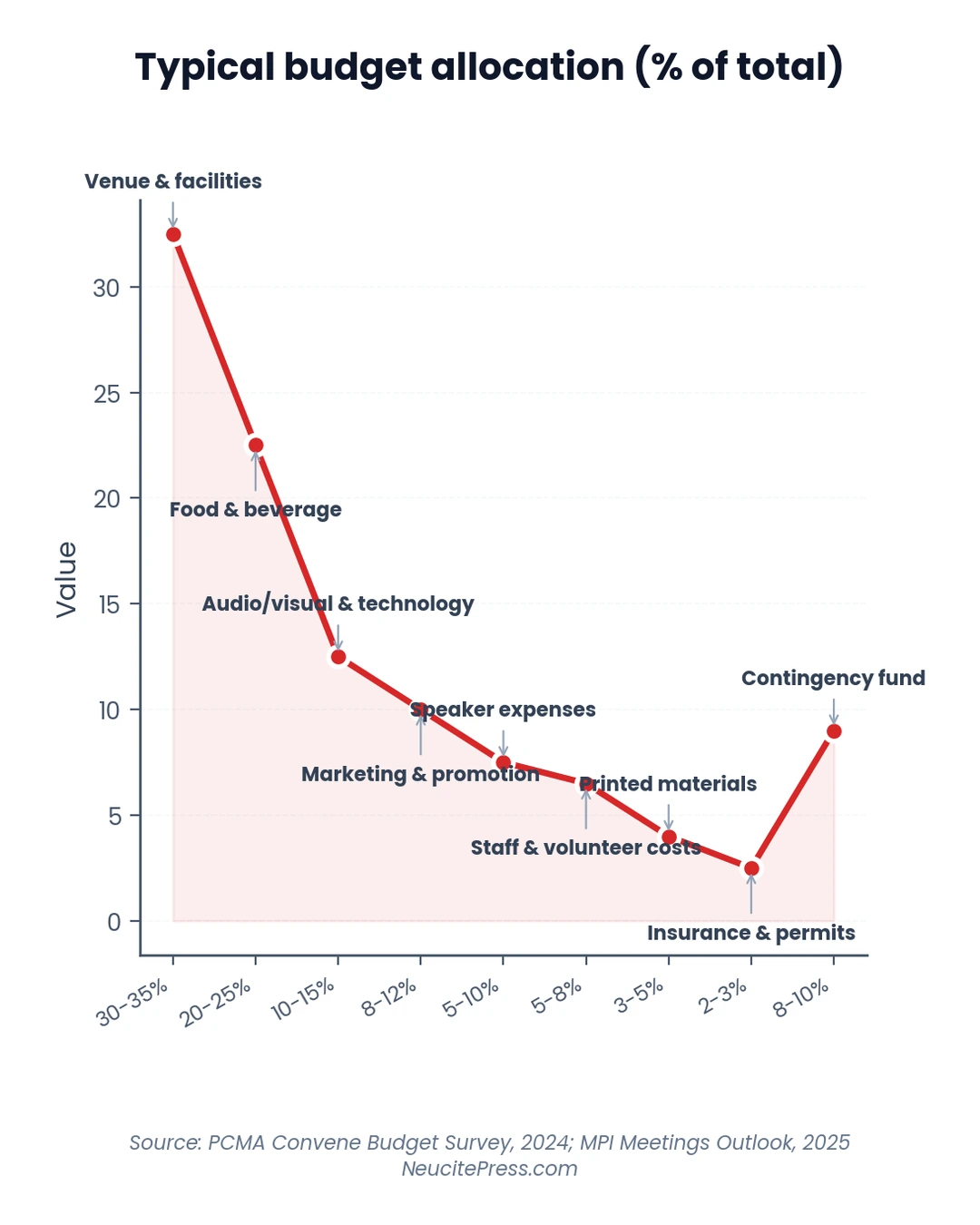
Venue expenses typically represent 20-30% of total conference budgets. This category extends beyond simple room rental.
Primary venue costs include:
- Room rental: $3,000-$15,000+ depending on location, capacity, and duration (2026 estimates)
- Setup and breakdown: Labor for arranging furniture, installing signage, and equipment placement: $800-$2,500
- Security deposits: Typically 10-20% of venue cost, refundable upon satisfactory conclusion
- Parking and access: Attendee parking facilities and venue access logistics: $1,000-$3,000
- Meeting room setup: Breakout session spaces, registration areas, sponsor exhibition: $500-$1,500
- Furniture and equipment rental: Tables, chairs, podiums if not included: $1,200-$3,000
Hidden venue costs often surprise event organizers. Internet bandwidth upgrades, electrical service increases, and exclusive catering requirements can add 15-25% to apparent venue costs. Request itemized quotes and clarify all-inclusive policies before signing agreements.
Catering and Food Service
Food and beverage represents the second-largest expense category, averaging 25-35% of total budgets. Catering costs scale directly with attendance, making this the most predictable variable expense.
2026 catering cost benchmarks:
- Continental breakfast: $12-$18 per attendee (pastries, coffee, juice, fruit)
- Morning break refreshments: $4-$6 per person (coffee, tea, snacks)
- Lunch: $18-$28 per person (buffet with protein, sides, salad, dessert)
- Afternoon break refreshments: $4-$6 per person
- Reception (optional): $12-$22 per person (appetizers and beverages)
- Dietary accommodations: Additional 10-15% for gluten-free, vegetarian, vegan, and allergen-specific options
- Service charges and gratuities: 18-22% automatic gratuity plus 2-3% service charge
Total per-attendee food cost for a full-day conference with lunch and breaks: $40-$60 in 2026. Multiply by expected attendance minus a 15-20% no-show factor for accurate projections.
Audio-Visual and Technology Infrastructure
Professional AV systems, presentation technology, and live-streaming capabilities now represent 10-15% of conference budgets. This category is essential for modern event delivery.
AV and technology cost components:
- Projection systems: Projectors, screens, and display equipment for multiple rooms: $2,000-$5,000
- Sound systems: Microphones, speakers, and audio mixing for keynote stage and breakouts: $1,500-$4,000
- Live streaming: Technical crew, encoding, platform hosting for hybrid attendance: $2,000-$6,000
- Recording and editing: Professional video recording and post-event content production: $1,500-$4,000
- WiFi capacity: Enhanced bandwidth for 500+ simultaneous users plus streaming: $500-$1,500
- Event app or platform: Registration, agenda, networking features: $1,000-$3,000
- Technical support staff: On-site technicians managing equipment and troubleshooting: $1,200-$2,500
Negotiating with venue-approved vendors often results in bundled pricing, reducing costs by 15-20% compared to independent contractor rates.
Speaker Honorariums and Travel
Speaker expenses vary dramatically based on speaker caliber and geographic distribution. Budget 10-15% of total costs for speaker-related expenses.
Speaker cost breakdown:
- Keynote honorariums: $2,000-$10,000+ for nationally recognized speakers; local experts: $500-$2,000
- Breakout session speakers: $0-$1,000 honorariums for established professionals; often based on speaker relevance to sponsors
- Panelist honorariums: Typically 30-50% of keynote rates due to reduced preparation time
- Speaker travel: $500-$2,000 per speaker (airfare, ground transportation, 1-2 nights hotel)
- Speaker meals and accommodations: Premium hotel rates and meal allowances: $150-$250 per person daily
- Speaker preparation calls: Professional video producer creating speaker intro videos: $300-$800
- Speaker gifts and materials: Branded materials, gifts, or honorariums for local speakers: $50-$200 per speaker
Leverage your network: 60-70% of conference speakers are often willing to present without honorariums if the event aligns with their professional goals. Reserve honorariums for marquee speakers who drive attendance.
Marketing and Promotion
Marketing represents 8-12% of conference budgets. Effective promotion directly impacts attendance and sponsorship revenue, making this investment essential rather than discretionary.
Marketing budget allocation:
- Digital advertising: LinkedIn, Google Ads, industry publications: $1,500-$4,000
- Website and landing pages: Design and hosting: $800-$2,000
- Email marketing campaigns: Platform fees and design: $300-$800
- Social media content creation: Graphic design, copywriting, scheduling: $500-$1,500
- Printed materials: Flyers, brochures, posters: $400-$1,200
- PR and media outreach: Press release distribution, journalist coordination: $500-$1,500
- Sponsorship prospect materials: One-sheets, prospectuses, pitch decks: $300-$800
- Pre-event communications: Save-the-date cards, registration reminders, speaker announcements: $400-$1,000
Early marketing (90+ days before the event) costs substantially less than last-minute campaigns. Budget aggressively for early-bird awareness building to maximize registration velocity.
Registration and Ticketing Systems
Modern registration platforms handle ticketing, payment processing, data collection, and attendee communication. Budget $500-$2,000 depending on platform sophistication and transaction volume.
- Registration platform: Monthly fees for platforms like Eventbrite, Splash, or specialized conference software: $200-$800
- Payment processing fees: 2.5-3.5% of all ticket sales automatically deducted by payment processors
- Fraud prevention: Advanced validation and security features: $100-$300
- Data management: CRM integration, attendee database tools: $200-$500
- Customer support: Technical support for registration issues: included or $100-$300
Insurance and Risk Management
Liability insurance is non-negotiable for conferences. Budget 2-4% of total expenses.
- General liability insurance: $1,000-$3,000 for general coverage of bodily injury and property damage claims
- Cyber liability insurance: Covers data breaches and attendee information security: $500-$1,500
- Speakers and performers insurance: Additional coverage for speaker-specific risks: $300-$800
- Weather or cancellation insurance: Covers losses if conference must be postponed or cancelled: $1,000-$2,500
Administration and Staffing
Labor costs for planning, coordination, and on-site management typically represent 8-15% of budgets.
- Event coordinator salary/contract: $2,000-$8,000 for planning and execution (varies by event size and organizer experience)
- On-site staff: Registration desk, information booth, session monitors: $500-$2,000
- Volunteer management: Coordination, training, and appreciation: $300-$800
- Administrative software: Project management, communication, file sharing: $100-$300
Step-by-Step Conference Budget Template Walkthrough
Implementing a budget template requires systematic approach. Follow this sequence to establish accurate financial tracking.
Step 1: Define Event Fundamentals
Begin by establishing core event parameters that influence all subsequent calculations:
- Event name and date: Identify your specific conference
- Expected attendance: Start with target audience size (adjust later if projections change)
- Duration: Half-day, full-day, multi-day format impacts catering and facility costs
- Format: In-person, hybrid, or virtual determines major cost categories
- Registration fee: Establish early to understand revenue potential
- Sponsorship goal: Define target sponsorship revenue
Step 2: List All Fixed Expenses
Fixed costs remain constant regardless of attendance fluctuations. Document each amount precisely:
- Venue rental deposit
- Event coordinator salary/contract
- Insurance premiums
- License and permits
- Software platform subscriptions
- Keynote speaker honorariums
Step 3: Establish Variable Expense Categories
Variable expenses scale with attendance. Create formulas linking them to your expected attendance figure:
- Catering (per-person calculations)
- Printed materials (name badges, programs)
- Event app licenses (per-user or volume-based)
- Attendee gifts or materials
- Payment processing fees (percentage of registration revenue)
Step 4: Calculate Break-Even and Profitability Scenarios
Determine minimum attendance needed to cover fixed costs. Use this formula:
Break-Even Attendance = Fixed Costs / (Registration Fee – Variable Cost Per Attendee)
If fixed costs are $30,000, registration fee is $299, and variable cost per attendee is $60, you need approximately 115 registrations to break even.
Step 5: Build Scenario Models
Create three attendance scenarios:
- Conservative: 70% of target attendance (adjust expectations if marketing underperforms)
- Target: Your baseline expectation
- Optimistic: 130% of target attendance (best-case scenario)
Calculate profit/loss for each scenario to understand financial risk. This enables confident decisions about cost-cutting triggers if registrations fall short of targets.
Cost-Saving Strategies: Reduce Expenses Without Sacrificing Quality
Strategic negotiation and smart vendor selection reduce expenses by 15-30% without diminishing attendee experience. Implement these proven tactics:
Venue Negotiation Techniques
- Off-peak timing: Sunday-Thursday events and off-season dates (January, August, September) offer 20-30% discounts compared to prime dates
- Multi-year commitments: Venues offer 15-25% discounts for committing to 2-3 annual events
- Complimentary room hours: Negotiate free setup time the evening before; request complimentary post-event breakdown time
- In-kind contributions: Request free WiFi upgrades, complimentary meeting room, or AV equipment as part of rental package
- Attrition clauses: If attending fewer rooms than contracted, negotiate reduced payments rather than forfeiting rental amounts
Catering Cost Reduction
- Simplified menus: Select 2-3 entrees instead of buffet variety; reduces labor and waste by 10-15%
- Budget-tier catering: Box lunches and lighter fare cost 30-40% less than full-service buffets with identical perceived value
- Venue catering requirements waived: Negotiate the right to bring outside caterers; independent caterers typically charge 15-25% less than venue providers
- Reduced beverage service: Offer coffee/tea and water only during sessions; reserve full bar for optional evening reception attendee-pays model
- Mid-morning snack elimination: Replace with fresh fruit and nuts; reduces costs by 40% with minimal attendee dissatisfaction
Speaker Sourcing Strategies
- Local speaker prioritization: Eliminates travel costs while building community relationships; offers 50-70% savings per speaker
- Sponsor speaker partnerships: Offer sponsorship opportunities tied to speaking slots; sponsors often provide expert speakers while funding event costs
- Academic partnerships: University faculty often present for free when event aligns with institutional missions
- Recorded keynotes: Feature pre-recorded presentations from premium speakers, eliminating travel and hotel costs
Technology and AV Cost Management
- Venue AV bundles: Included AV often costs 30-50% less than independent contractor pricing
- Simplified presentation setup: Standard projector and screen costs $500-$1,000; premium 4K projection doubles costs without meaningful ROI
- Limited live-streaming: Single camera/audio feed costs 60-70% less than multi-camera professional production
- DIY event app: Self-hosted agenda solutions cost $100-$300 versus $1,000-$3,000 for full-featured commercial platforms
Sponsorship Revenue Planning: Building Your Funding Model
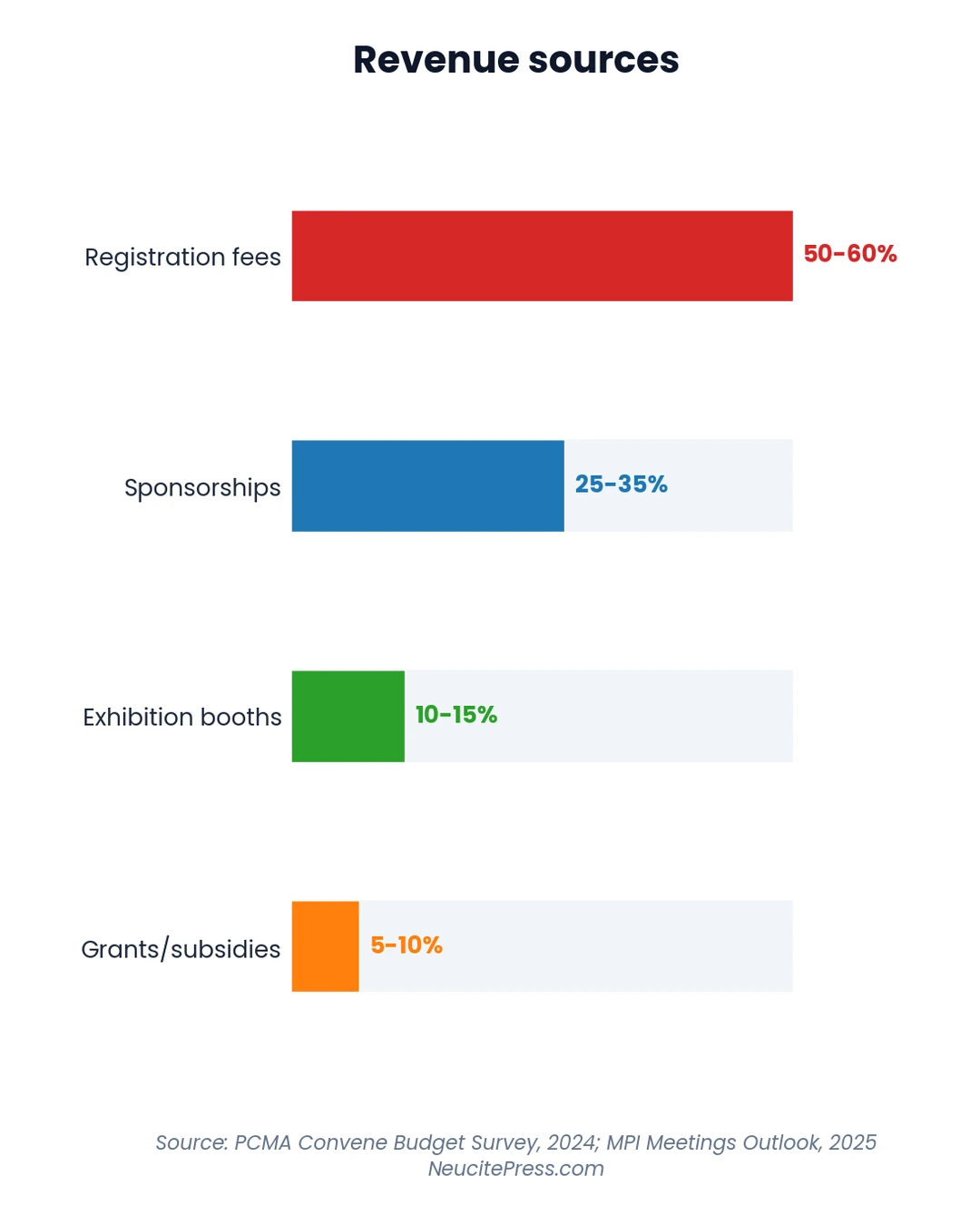
Sponsorships offset 30-60% of conference expenses for effective programs. Strategic sponsorship selling requires clear value propositions aligned with sponsor objectives.
Sponsorship Tier Structure
Create tiered sponsorship packages offering increasing visibility and benefits:
- Platinum: $25,000-$50,000 (keynote naming rights, prominent branding, 10+ tickets, booth space, dedicated networking session)
- Gold: $15,000-$25,000 (breakout session sponsorship, 6 tickets, booth space, program advertising)
- Silver: $8,000-$15,000 (coffee break sponsorship, 4 tickets, program advertising)
- Bronze: $3,000-$8,000 (registration or website sponsorship, 2 tickets)
- In-kind: Goods or services valued at $1,000-$5,000 (AV equipment, catering, printing, awards)
Target realistic sponsorship goals. Aim to raise 50% of fixed costs through sponsorships; the remaining costs and operating margins come from registration revenue.
Sponsor Prospect Identification
Identify sponsors whose products/services align with your attendee base:
- Direct beneficiaries: Vendors selling products to your industry (software, equipment, consulting services)
- Talent acquisition: Companies seeking to recruit from your attendee population
- Brand awareness: Non-competing companies seeking market exposure
- Educational mandate: Non-profit foundations supporting professional development in your field
Contingency Planning: Preparing for the Unexpected
Professional event management requires contingency reserves protecting against inevitable uncertainties. Budget 10-15% of total expenses for contingencies.
Common Contingencies and Mitigation Strategies
- Lower-than-expected registration: Implement cost-cutting triggers at 70% and 50% of target attendance (reduce catering, eliminate optional speakers)
- Venue price increases: Lock venue pricing in writing immediately; avoid percentage increases tied to actual attendance
- Vendor price escalation: Secure written quotes with price-hold guarantees for 90+ days
- Last-minute cancellations: Establish speaker replacement protocols and maintain backup speaker list
- Technology failures: Invest in backup WiFi hotspots ($50-$100 each), portable power banks, and redundant streaming equipment ($300-$500)
- Weather disruptions: For in-person events, maintain weather insurance or virtual backup capability
- Unexpected health or safety requirements: Reserve funds for enhanced sanitation, medical personnel, or accessibility accommodations
Post-Conference Financial Reporting: Closing the Budget Cycle
Professional financial management doesn’t end when attendees leave. Complete final accounting within 30 days of the event.
Final Expense Reconciliation
- Reconcile all invoices against budget projections
- Document variance explanations (price increases, scope changes, emergency costs)
- Collect payment receipts and account statements
- Verify all vendor final bills match estimates
- Confirm sponsor payments received or outstanding
Revenue Verification
- Total registration revenue minus refunds and cancelled registrations
- Sponsor payments and in-kind contribution valuations
- Exhibitor booth fees and ancillary revenue (merchandise, premium sessions)
- Late or deferred sponsorship payments
Creating Historical Records
Document final results for future reference:
- Actual attendance figures by registration category
- Final revenue and expense by category
- Profit/loss summary
- Return-on-investment calculations for sponsorships and marketing spend
- Attendee satisfaction and learning outcomes data
- Lessons learned and improvement recommendations for next cycle
These historical records become invaluable for planning subsequent events. Accurate historical data reduces budgeting forecast errors by 20-30% in subsequent years.
Downloadable Conference Budget Template: Your Complete Solution
Our comprehensive conference budget template includes pre-built formulas, expense categories tailored to professional conferences, automatic variance calculations, and scenario planning capabilities. The template accommodates conferences of 100 to 2,000+ attendees with full customization flexibility.
Template includes:
- Event parameters setup section with automatic scaling calculations
- Detailed expense tracking with fixed/variable cost classification
- Revenue tracking for registrations, sponsorships, and ancillary income
- Real-time profit/loss summary with conditional formatting alerts
- Multiple scenario planning tabs (conservative, target, optimistic)
- Historical comparison data for tracking year-over-year changes
- Automatic invoice reminder system for vendor payment tracking
- Post-conference reconciliation worksheet for final accounting
Access the template immediately without registration requirements. Download directly to Excel or use the cloud-based version for real-time team collaboration across planning committees.
Conclusion: Transforming Conference Budget Anxiety Into Strategic Clarity
Conference budget planning determines whether your events become sustainable, profitable programs or financially strained initiatives requiring escalating resources. The difference lies not in event scale but in financial management rigor.
Implementing a professional budget template eliminates guesswork from financial planning. Real-time tracking provides the visibility necessary for confident decisions about cost management, pricing adjustments, and sponsorship strategies. Scenario modeling protects against attendance variability by establishing decision points triggering automatic cost-cutting measures.
Begin your next conference planning cycle with structured financial discipline. The investment of 2-3 hours establishing your budget template repays itself many times over through eliminated overruns, improved sponsorship success rates, and enhanced organizational profitability.
FAQ
What is the most important expense category in conference budgeting?
Venue costs and catering typically represent 50-65% of total conference budgets, making these categories critical to manage. However, the largest variable expense depends on your event format and attendance size. For in-person conferences, per-attendee catering costs scale directly with registration volume, while venue rentals remain relatively fixed. Virtual conferences flip this dynamic, with technology and streaming costs dominating fixed expenses while catering eliminates entirely.
How much should I allocate for contingencies?
Professional event planners recommend reserving 10-15% of your total conference budget for contingencies. This reserve covers unexpected vendor price increases, emergency equipment replacements, last-minute speaker cancellations, technology failures, and other inevitable surprises. Higher-risk events (new venues, compressed planning timelines, untested speaker lineups) warrant 15-20% contingency allocations. Conservative planning prevents contingency depletion while allowing flexibility for strategic adjustments.
What’s the break-even attendance for a 500-person conference?
Break-even attendance depends on your specific cost structure, but typical calculations work as follows: If fixed costs total $40,000, registration fee is $349, and variable cost per attendee is $75, your break-even point is approximately 138 registrations. Most conferences target 200-250 registrations to comfortably exceed break-even and achieve 20-30% operating margin for organizational sustainability.
How can I reduce speaker costs without compromising quality?
Strategic speaker sourcing reduces costs by 40-60%. Prioritize local experts and academics who eliminate travel expenses while building community relationships. Partner with sponsors to provide speaker honorariums in exchange for sponsorship benefits. Consider recorded keynotes from premium speakers, eliminating travel and accommodation costs while allowing schedule flexibility. Your breakout sessions can feature subject-matter experts from sponsor companies who present for free as marketing opportunities.
Should I use a conference budget template or hire a professional event planner?
Professional event planners add value for organizations planning multiple annual conferences or mega-events exceeding 1,000 attendees. For organizations planning occasional conferences with 100-500 attendees, a structured budget template provides 80% of the planning infrastructure at 20% of the cost. Templates work best when your planning committee includes at least one financially-oriented member committed to monthly budget reviews and variance analysis.
What’s the most common conference budgeting mistake?
Underestimating per-attendee variable costs represents the most prevalent error. Event planners typically forecast catering, printing, materials, and technology costs conservatively, then discover actual vendor invoices exceed projections by 15-25%. Counter this by obtaining written quotes from all vendors 60+ days before the event. Build 5-10% contingency buffers into each variable cost category, not just overall budget reserves.
