Copyediting Tips for Academic Manuscripts: A Complete 2026 Style Guide Checklist
Reviewed by the NeucitePress Editorial Board — PhD academics, peer-reviewed editors and subject-matter specialists.
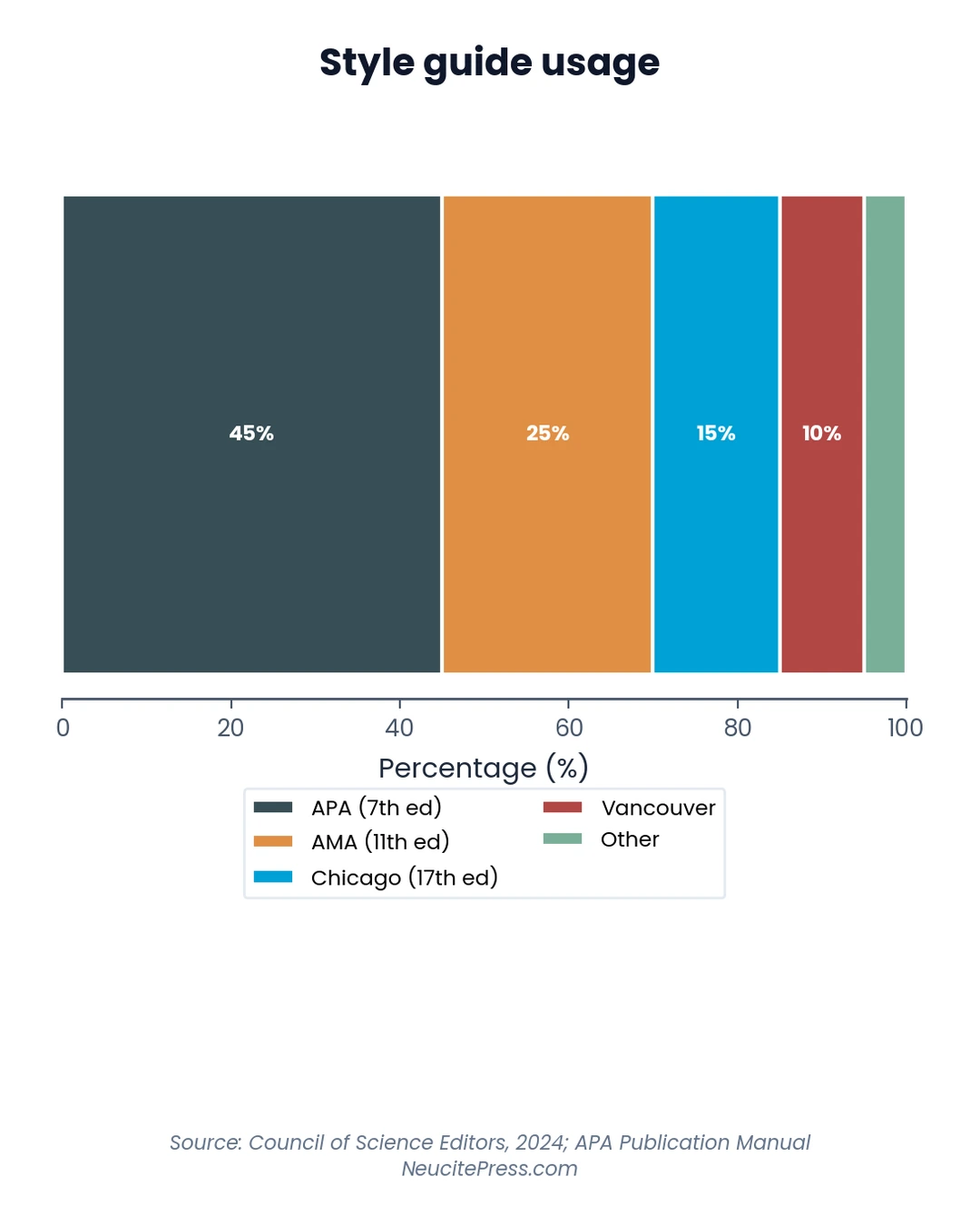
Chart showing copyediting-tips-academic – Stacked Bar visualization
Whether you’re preparing a journal article for submission, finalizing book chapters, or polishing a dissertation, copyediting tips grounded in established style guides can mean the difference between a swift acceptance and a frustrating desk rejection. Academic copyediting goes far beyond spell-checking. It is a meticulous process that addresses grammar, punctuation, citation accuracy, internal consistency, and adherence to the specific style manual required by your target publication.
According to the Chicago Manual of Style (CMOS), copyediting is “the final editorial stage of preparing a manuscript for publication—a meticulous read for technical errors, style, and internal consistency.” In this comprehensive guide, we share practical, evidence-based copyediting tips drawn directly from the most widely used academic style guides, including APA, AMA, CMOS, and MLA, so you can submit cleaner, more professional manuscripts every time.
What Every Academic Author Must Know About Copyediting
Critical Copyediting Hits and Misses
✓ Copyediting Best Practices
Match every in-text citation to its reference list entry—and verify the reverse
Define abbreviations at first use in each section (abstract, body, tables separately)
Use multiple editing passes—one for grammar, one for citations, one for formatting
Maintain a style sheet documenting all editorial decisions for consistency
Confirm your target publication’s style guide (APA, AMA, CMOS, MLA) before starting
Verify cross-references (Table 2, Figure 5, Chapter 3) after any content reordering
✗ Copyediting Mistakes to Avoid
Relying solely on spell-check—won’t catch “affect” vs. “effect” or “principal” vs. “principle”
Mixing style guide rules—e.g., APA references in an AMA-style manuscript
Inconsistent number formatting—spelling “ten” in one paragraph and “10” in another
Overcorrecting the author’s voice—copyediting is about clarity, not rewriting
Skipping front and back matter—acknowledgments and appendices need attention too
Forgetting to renumber citations after moving paragraphs (especially in AMA style)
Why Copyediting Matters in Academic Publishing
A well-copyedited manuscript signals professionalism and attention to detail—qualities that peer reviewers and journal editors notice immediately. Copyediting is distinct from developmental editing (which restructures arguments and content) and proofreading (which catches surface-level typos after typesetting). The copyediting stage sits between these two, focusing on sentence-level corrections such as grammar, punctuation, spelling, formatting, and citation accuracy while also ensuring that the manuscript reads consistently from start to finish.
Poor copyediting can lead to tangible consequences. Manuscripts with frequent grammatical errors, inconsistent formatting, or citation mismatches may be returned before review—a practice called a “desk rejection.” Editors at high-impact journals have limited time, and a polished manuscript demonstrates that the author respects the editorial process. By investing time in proper copyediting or hiring a professional, you significantly increase your chances of a smooth peer review and timely publication.
📊 Key Finding: According to the AMA Manual of Style, editing citations alone can take 1.5 times longer than editing the main text. Starting your copyedit with the reference list helps identify missing information early and saves significant time.
APA Style Copyediting Tips (7th Edition)
The American Psychological Association (APA) style dominates across psychology, education, social sciences, and counseling. The 7th edition (2019) introduced several important updates every copyeditor should know.
Heading Hierarchy and Formatting
APA 7th edition uses five levels of headings, each with specific formatting rules. Level 1 headings are centered, bold, and in title case. Level 2 headings are flush left, bold, and in title case. Many rejections occur because authors mix heading levels inconsistently. Create an outline of all headings and verify that each one follows the correct level formatting.
In-Text Citations and Reference Matching
One of the most critical APA copyediting tasks is ensuring that every in-text citation has a corresponding reference list entry. APA uses the author-date system (e.g., Smith, 2024), and common errors include misspelled author names, mismatched years, and missing page numbers for direct quotations. Citation management software like Zotero, Mendeley, or EndNote can help, but always review auto-generated citations for formatting errors.
Abbreviations and First-Use Requirements
APA requires that abbreviations be defined at first use in the text, in the abstract (separately), and in tables and figures (independently). Each section is treated independently. During copyediting, search for all abbreviations and verify that each one is properly introduced the first time it appears in each context.
Bias-Free Language Standards
The APA 7th edition expanded guidance on inclusive and bias-free language significantly. This includes using person-first language (e.g., “people with disabilities” rather than “disabled people”), respecting gender identity by using the singular “they” when appropriate, and avoiding language that implies bias related to age, race, ethnicity, or socioeconomic status.
AMA Style Copyediting Tips (11th Edition)
The American Medical Association (AMA) style is the standard for biomedical and health sciences publishing, used by JAMA and hundreds of medical journals. The 11th edition (2020) brought significant updates that every medical copyeditor must understand.
Superscript Citation Numbering
Unlike APA’s author-date system, AMA uses superscript Arabic numerals for in-text citations, numbered sequentially in order of first appearance. A common copyediting error occurs when authors rearrange paragraphs during revision but forget to renumber citations. Verify that every superscript number appears in sequential order and corresponds to the correct reference list entry.
Numbers and SI Unit Formatting
AMA style requires digits for numbers rather than spelling them out, except at the beginning of a sentence. All measurements must use SI (Le Système International d’Unités) units with a space between the number and the unit (e.g., “5 mg” not “5mg”). Search for spelled-out numbers and convert them to digits where AMA requires it.
Author Listing and Journal Abbreviations
AMA references list authors using their surname followed by first and middle initials without periods (e.g., “Smith JA”). When there are more than six authors, list the first three followed by “et al.” Journal names should be abbreviated according to the National Library of Medicine database, without periods after abbreviations.
⚠️ Critical Error: Many authors use APA-style reference formatting in manuscripts intended for AMA-style journals. Always confirm the target journal’s required style before beginning to avoid reformatting the entire reference section.
Chicago Style Copyediting Tips (18th Edition)
The Chicago Manual of Style, now in its 18th edition (September 2024), is the go-to reference for book publishing and humanities scholarship. Often called “the editor’s Bible,” CMOS provides exhaustive guidance on virtually every editorial question.
Notes-Bibliography vs. Author-Date Systems
CMOS offers two distinct citation systems. The notes-bibliography system uses footnotes or endnotes paired with a bibliography, preferred in literature, history, and the arts. The author-date system, similar to APA, is preferred in sciences and social sciences. A critical copyediting step is ensuring consistent use of one system throughout.
Serial Comma and Punctuation Standards
CMOS strongly recommends the serial (Oxford) comma—the comma before “and” or “or” in a series (e.g., “lions, tigers, and bears”). Inconsistent comma usage throughout a manuscript signals carelessness. Pick a comma style and apply it uniformly.
Capitalization and Number Rules
CMOS follows specific capitalization conventions. Job titles are generally lowercase unless they immediately precede a name. Numbers are spelled out from one through one hundred and for large round numbers, which differs from both APA and AMA.
2024 Updates in the 18th Edition
Notable changes include omitting publication locations from citations, expanded guidance on citing AI-generated text and images, and broader scope for using the singular “they.” If copyediting for the latest CMOS standards, ensure references reflect these updates.
MLA Style Copyediting Tips (9th Edition)
The Modern Language Association (MLA) style is used primarily in literature, languages, and cultural studies. The 9th edition (2021) simplified many formatting requirements and introduced more flexibility in citation.
Core Elements System for Citations
MLA 9th edition uses a “core elements” system: author, title of source, title of container, contributors, version, number, publisher, publication date, and location. Not every source has all elements, requiring careful judgment. Verify that each works-cited entry includes all applicable core elements in the correct order.
In-Text Citation Format (Author-Page)
MLA uses author-page citations in parentheses (e.g., Smith 45), without a comma between author and page number. Watch for authors who inadvertently insert commas, include “p.” or “pp.” before page numbers (which MLA does not use), or omit page numbers for direct quotations.
Chart showing copyediting-tips-academic – Stacked Bar visualization
Universal Copyediting Techniques for All Style Guides
Regardless of which style guide your manuscript follows, certain copyediting principles are universal and applicable across all academic disciplines.
1. Perform Multiple Copyediting Passes
Professional copyeditors do not attempt to catch every type of error in one reading. The recommended approach includes at least two distinct passes: one focused on grammar, punctuation, and sentence-level mechanics, and a second focused on citations, formatting, and internal consistency. Some editors add a third pass specifically for tables, figures, and their in-text references.
2. Create and Maintain a Style Sheet
A style sheet documents all editorial decisions made during copyediting, from preferred spellings of technical terms to capitalization choices for specific phrases. This is especially important for book-length manuscripts where consistency across chapters is essential. Your style sheet should include sections for spelling, hyphenation, abbreviations, number treatment, capitalization, and author-specific conventions.
3. Verify All Abbreviations at First Use
Every style guide requires that abbreviations be defined at first use. Compile a list of every abbreviation in the manuscript and verify that each is introduced properly. Watch for abbreviations that are used only once—most style guides recommend spelling out the term entirely rather than introducing an abbreviation that appears only a single time.
4. Check Cross-References Systematically
Manuscripts frequently refer to “Table 2,” “Figure 5,” or “Chapter 3.” A common copyediting error is failing to update these cross-references after content has been added, removed, or reordered. Verify that every cross-reference points to the correct table, figure, section, or chapter. This is particularly important in book manuscripts where revision fatigue can lead to overlooked numbering errors.
5. Identify and Correct Homonym and Commonly Confused Words
Spell-check software will not flag words that are spelled correctly but used incorrectly. Common culprits in academic writing include “affect” vs. “effect,” “principle” vs. “principal,” “complement” vs. “compliment,” “discrete” vs. “discreet,” and “ensure” vs. “insure” vs. “assure.” Create a personal checklist of commonly confused words and search for them explicitly during copyediting.
6. Standardize Number Treatment
Number formatting varies significantly across style guides. APA spells out numbers below 10 and uses numerals for 10 and above. CMOS spells out numbers from one through one hundred. AMA uses numerals for almost all numbers. Identify the correct rule for your style guide and apply it consistently, paying special attention to the beginning of sentences where most guides require numbers to be spelled out.
7. Verify Table and Figure Formatting and References
Tables and figures must be cited sequentially in the text, numbered correctly, and formatted according to the applicable style guide. APA requires specific table note formats. AMA requires explanatory notes and full citations within tables. CMOS is more flexible but still demands consistency. Confirm that every table and figure is referenced in the text and that numbering matches.
8. Perform Technical Cleanup Before Submission
Before submitting your manuscript, perform a technical cleanup that includes removing double spaces, checking for consistent use of em dashes vs. en dashes vs. hyphens, verifying that all hyperlinks and DOI links work, and ensuring that special characters display correctly. This final pass catches formatting issues that cause problems during typesetting.
Common Copyediting Mistakes to Avoid
Inconsistent hyphenation is one of the most frequent errors. Is it “decision-making” or “decision making”? The answer depends on whether the term is used as an adjective before a noun (hyphenated) or as a predicate (usually open). Whatever you decide, apply the rule consistently and record it on your style sheet.
Overcorrecting the author’s voice is another common mistake. The goal of copyediting is to ensure clarity, correctness, and consistency—not to rewrite the manuscript in the editor’s preferred prose style. The best copyeditors serve the text and the author, not their own stylistic preferences.
Ignoring front and back matter can also cause problems. Tables of contents, contributor lists, acknowledgments, and appendices all require the same attention to consistency and accuracy as the main text. In multi-author book projects, front matter errors—such as misspelled contributor names or incorrect affiliations—can be particularly embarrassing.
Forgetting to update all references after manuscript revisions is another common oversight. If you move a paragraph, table, or figure, every related reference must be updated throughout the document. This includes cross-references, citation numbers (in AMA style), and table/figure captions.
Essential Copyediting Tools and Resources for 2026
Citation management software such as Zotero, Mendeley, and EndNote helps maintain reference consistency, but always review auto-generated citations for formatting errors. Grammar and style checkers like Grammarly, ProWritingAid, and built-in Microsoft Word tools can flag potential issues, but they should be used as a first-pass supplement rather than a replacement for manual review. Track Changes in Microsoft Word remains the industry-standard tool for copyediting, allowing editors to make visible edits that authors can review and accept or reject.
Keep digital bookmarks for official online resources of your primary style guide. The APA Style website offers free guidance on common formatting questions. CMOS Online provides a searchable Q&A where editors answer reader questions. The AMA Manual of Style Online includes quizzes and a blog (AMA Style Insider) for staying current with medical publishing conventions.
Style Guide Comparison Quick-Reference
Feature
APA (7th)
AMA (11th)
CMOS (18th)
MLA (9th)
Citation System
Author-date
Numbered superscript
Notes-bib or author-date
Author-page
Number Treatment
Spell out below 10
Use digits (almost always)
One through one hundred
One through one hundred
Serial Comma
Required
Required
Required
Required
Singular “They”
Endorsed
Accepted with care
Expanded in 18th ed.
Accepted
Primary Disciplines
Social sciences, education
Medicine, health sciences
Humanities, book publishing
Literature, languages, arts
Reference Formatting Best Practices
Reference formatting is one of the most error-prone aspects of academic copyediting, yet it deserves careful attention because citation accuracy directly impacts your manuscript’s credibility. Each style guide requires a specific format for citing books, journal articles, websites, and other sources, and mixing formats within a single reference list is a common rejection trigger.
In APA style, the reference list must be arranged alphabetically by author’s last name. Every reference cited in the text must appear in the reference list, and vice versa. Journal names should be in title case and italicized. The publication year should immediately follow the author name in parentheses.
In AMA style, the reference list is numbered in the order citations appear in the text, not alphabetically. Author names use initials without periods. Journal names are abbreviated according to the National Library of Medicine Index Medicus abbreviations, with no periods after abbreviations. All authors up to six should be listed; if more than six, list the first three followed by “et al.”
In CMOS style with notes-bibliography, the reference list (called a “bibliography”) is typically arranged alphabetically. Full publication information should be included in the first note of each source; subsequent references to the same source use shortened notes. This system allows for rich contextual information in footnotes while maintaining a clean bibliography.
Figure and Table Editing Checklist
Tables and figures are central to academic manuscripts, but they often receive less copyediting attention than the main text. Create a systematic checklist to ensure all tables and figures meet your style guide’s requirements:
Numbering: Are all tables numbered sequentially (Table 1, Table 2) and all figures numbered sequentially (Figure 1, Figure 2)? Have they been renumbered if content was reordered?
Captions: Does every table and figure have a clear, descriptive caption? Do captions follow your style guide’s formatting requirements (e.g., APA uses “Table 1” in bold followed by a title)?
In-text references: Is every table and figure referenced in the text? Do the references use the exact numbering as the tables and figures?
Abbreviations: Are all abbreviations in tables and figures defined in a table note or figure legend, or were they defined in the main text?
Source attribution: If a table or figure is reproduced from another source, is the citation complete and formatted correctly?
Data formatting: Are numbers within tables consistently formatted (decimal places, significant figures) and aligned properly?
Abbreviation Management in Academic Writing
Abbreviations in academic manuscripts require careful management to avoid confusion and maintain consistency. The general rule across all style guides is that an abbreviation should be introduced in parentheses immediately after the full term at its first use: “The Centers for Disease Control (CDC) has released new guidelines.”
However, certain abbreviations are so well-established that they do not require definition. These include common terms like “USA,” “PhD,” “DNA,” and “COVID-19.” Consult your style guide for exceptions, as these can vary.
A critical copyediting step is creating a complete list of all abbreviations used in your manuscript and verifying that each one is defined at first use. Pay special attention to abbreviations that appear in titles, abstracts, tables, or figures—these may need to be defined independently if they do not appear in the main text first.
Proofreading Techniques for Final Polish
Proofreading differs from copyediting in both scope and timing. While copyediting addresses substantive issues with grammar, consistency, and formatting, proofreading is the final check for surface-level errors like typos, spacing issues, and formatting glitches. Proofreading typically occurs after the manuscript has been typeset by a publisher, though you can also proofread your own manuscript before submission.
Effective proofreading techniques include reading the manuscript aloud (which forces you to slow down and catch errors), reading backward to focus on individual words rather than meaning, using a ruler to track your place line by line, and enlisting a second pair of eyes. Many professional proofreaders use digital tools like Find & Replace to search for common error patterns (e.g., double spaces, inconsistent spacing around punctuation).
Professional vs. Self-Editing Strategies
While self-editing is a valuable skill, it has inherent limitations. Authors are often too close to their own writing to catch every error, particularly inconsistencies in logic, phrasing, or formatting that have become invisible through familiarity. Professional copyeditors bring fresh eyes, specialized style guide knowledge, and the objectivity needed to ensure your manuscript meets publication standards.
If you opt for self-editing, implement a systematic approach: allow time to pass between drafting and copyediting (at least several days, ideally a week or more), then perform multiple passes focusing on different types of errors. Use a detailed checklist tailored to your style guide to ensure you catch all critical issues before submission.
For high-stakes publications—journal submissions, book chapters, or funded research reports—professional copyediting is a worthwhile investment. Professional academic copyeditors bring specialized knowledge of style guides, subject-area expertise, and objectivity that can significantly improve your manuscript’s chances of acceptance.
Frequently Asked Questions About Academic Copyediting
Q: What’s the difference between copyediting and proofreading?
Copyediting involves a thorough review of grammar, punctuation, style guide compliance, citation accuracy, and internal consistency. It typically occurs before typesetting. Proofreading is a lighter, final check for surface-level errors (typos, formatting glitches) after the manuscript has been designed in its final format. Think of copyediting as the deep clean and proofreading as the final polish.
Q: Which style guide should I use for my manuscript?
The choice depends on your discipline and target publication. APA is standard in psychology, education, and social sciences. AMA is used in medicine and health sciences. CMOS is preferred in humanities and book publishing. MLA is common in literature, languages, and cultural studies. Always check your target journal or publisher’s author guidelines.
Q: How long does it take to copyedit an academic manuscript?
Time varies based on length, complexity, citation density, and editing level needed. A skilled copyeditor typically processes 5 to 10 pages per hour for academic content. A 30-page journal article might take 3 to 6 hours, while a 300-page book could require 30 to 60 hours or more.
Q: Can I effectively copyedit my own work?
Self-editing is possible as a first step, but authors are often too close to their own writing. Professional copyeditors bring fresh eyes and specialized style guide knowledge. At minimum, have a colleague review your manuscript before submission for an additional layer of quality control.
Q: What are the most common copyediting errors in academic writing?
Most frequent errors include mismatched citations, inconsistent heading formatting, incorrect number treatment, undefined abbreviations, homonym confusion, inconsistent hyphenation, and missing DOI links. Use a systematic checklist tailored to your style guide to catch these before submission.
Conclusion: Elevating Your Academic Manuscript
Effective copyediting is both a science and an art. The science lies in knowing the rules—understanding the specific requirements of APA, AMA, CMOS, MLA, or whichever style guide governs your publication. The art lies in applying those rules with judgment, maintaining the author’s voice while ensuring clarity, consistency, and correctness.
By following the copyediting tips outlined in this comprehensive guide, you can significantly improve the quality of your academic manuscripts, reduce the risk of desk rejections, and present your research in the most professional light possible. Remember that good copyediting is not a luxury—it is an essential step in the scholarly publishing process that protects your reputation and amplifies the impact of your work.
Whether you are self-editing or engaging a professional copyeditor, the investment in careful, systematic copyediting will pay dividends through faster peer review, higher likelihood of acceptance, and ultimately, greater visibility and impact for your research.
Ready to Perfect Your Academic Manuscript?
Our team of experienced academic copyeditors specializes in all major style guides and disciplines. Let us help you prepare your manuscript for publication success.
We use cookies to ensure that we give you the best experience on our website. If you continue to use this site we will assume that you are happy with it.