Copyright vs Plagiarism: Critical Differences Every Author Must Know
Thousands of authors face professional and legal challenges each year due to fundamental misunderstandings about intellectual property. The confusion between copyright vs plagiarism book writing represents a critical knowledge gap with serious implications.
Reviewed by the NeucitePress Editorial Board — PhD academics, peer-reviewed journal editors and medical communication specialists.
Many creators mistakenly believe these terms are interchangeable. In reality, one constitutes a legal violation while the other represents an ethical breach. This distinction carries significant consequences across academic, journalistic, and creative fields.
The 2014 case of a CNN editor demonstrates real-world repercussions. This professional lost their position after 128 documented instances of improper content use over six months. Such cases highlight how ethical violations can destroy careers beyond academic settings.
We designed this guide to clarify these complex concepts. Our mission is to help researchers, academics, and writers navigate these critical distinctions with confidence. Understanding these principles protects your work and respects others’ intellectual contributions.
This resource draws from authoritative sources including comprehensive research on academic integrity. We balance technical accuracy with practical guidance suitable for all experience levels.
Key Takeaways
- Copyright infringement is a legal violation, while plagiarism is primarily an ethical breach
- Professional consequences for plagiarism extend far beyond academic environments
- Understanding these distinctions protects your reputation and intellectual property
- Proper attribution practices prevent both legal and ethical complications
- Clear guidelines exist for navigating fair use and proper citation standards
- These principles apply equally to students, researchers, and professional writers
- Knowledge of these differences is essential for career longevity and credibility
Understanding the Legal and Ethical Dimensions
Two distinct but interconnected systems safeguard the integrity of scholarly and creative output across disciplines. We examine how statutory protections and moral standards work together to preserve intellectual honesty.
Exploring Copyright Law and Its Protections
Legal statutes provide automatic protection for creative expressions fixed in tangible forms. This framework grants creators exclusive control over reproduction, distribution, and adaptation of their original works.
The system protects specific expressions rather than underlying ideas or facts. This distinction ensures information remains accessible while rewarding creative effort.
| Aspect | Legal Framework | Ethical Framework |
|---|---|---|
| Nature | Statutory rights enforceable in court | Moral standards enforced by institutions |
| Enforcement | Government agencies and legal systems | Academic honor codes and professional standards |
| Consequences | Financial penalties and legal injunctions | Reputation damage and career limitations |
| Purpose | Economic incentives for creation | Maintenance of intellectual honesty |
The Ethics Behind Plagiarism in Academic and Professional Settings
Ethical standards require proper attribution of others’ intellectual contributions. These principles maintain trust within academic and professional communities.
Violations can result in severe career consequences regardless of legal status. Institutions enforce these standards through honor codes and professional conduct policies.
Both frameworks serve complementary roles in protecting creative works and maintaining professional integrity. Understanding their distinctions prevents costly misunderstandings.
Decoding “copyright vs plagiarism book writing”
Legal definitions often create confusion for creators navigating intellectual property boundaries. We clarify these concepts through precise terminology and practical illustrations.
Defining Key Terms and Legal Definitions
Copyright infringement represents unauthorized use of protected material. This violation occurs when someone reproduces or distributes work without permission.
In contrast, plagiarism involves presenting others’ ideas as one’s own. This ethical breach focuses on attribution rather than legal status.
Real-world Examples and Case Studies
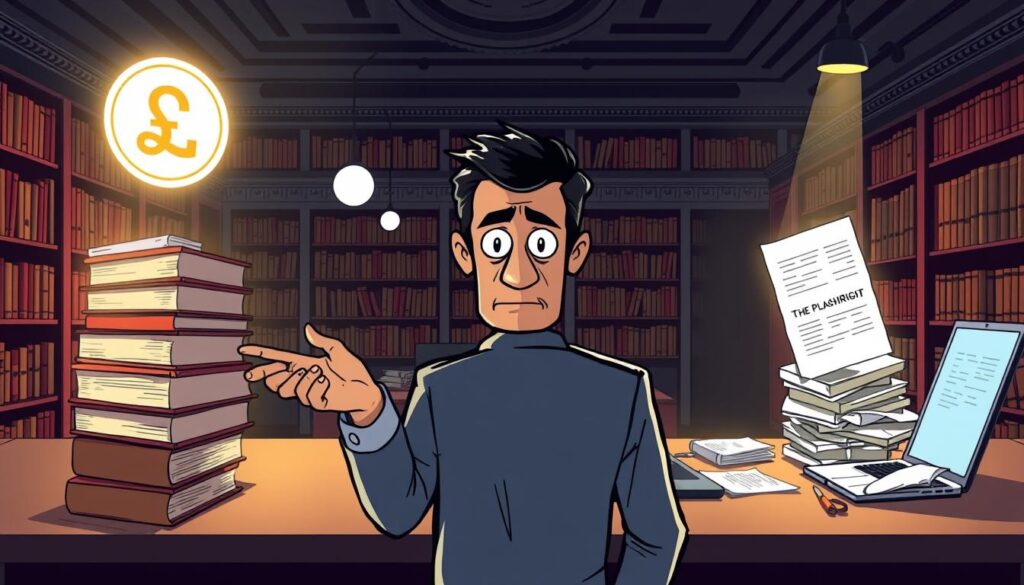
Consider a student using sentences from a nature guide without citation. This constitutes plagiarism but may qualify as fair use educationally.
Another scenario involves proper attribution of an entire text. Here, citation avoids plagiarism but copying the complete work still infringes rights.
The most severe case combines both violations. Submitting another’s novel as original work demonstrates simultaneous ethical and legal breaches.
Even public domain materials require honest attribution. Claiming historical texts as personal creation remains professionally unacceptable.
Comparison of Plagiarism and Copyright Infringement
Effective content creation demands understanding how permission and attribution function independently. These concepts represent distinct violation categories with different consequences.
Core Distinctions in Violation Types
We present a framework clarifying the fundamental differences between these concepts. The table below demonstrates key contrasts every professional should recognize.
| Aspect | Copyright Infringement | Plagiarism |
|---|---|---|
| Definition | Using protected material without authorization | Using others’ ideas or expressions without credit |
| Nature | Legal violation | Ethical violation |
| Requires Copyright | Yes | No |
| Enforcement | Legal action | Institutional policies |
The permission versus credit framework reveals critical distinctions. Infringement occurs when using protected work without authorization, regardless of attribution. Conversely, plagiarism involves failing to credit sources, even with permission.
This distinction extends to public domain materials. Ethical obligations require attribution regardless of legal status. Our comprehensive terms of service provides detailed guidance for navigating these complexities.
Understanding these differences protects professionals from severe consequences. Legal actions can involve substantial penalties, while ethical violations damage reputations permanently.
Best Practices to Avoid Violations and Ensure Integrity
Practical tools and clear frameworks empower authors to navigate complex attribution requirements confidently. We provide actionable systems that protect your professional reputation while respecting others’ intellectual contributions.
Actionable Checklists and Decision Frameworks
Begin each project with our comprehensive decision framework. Determine whether you’re creating entirely original content, building upon existing ideas with proper attribution, or incorporating protected expressions requiring both permission and citation.
Our plagiarism prevention checklist includes maintaining detailed research notes distinguishing your ideas from sources. Use quotation marks for exact words copied, even in drafts. Paraphrase substantially rather than making minor word substitutions.
For copyright compliance, identify whether sources remain protected or have entered the public domain. Obtain written permission from owners for substantial use beyond fair use scope. Document all permissions with dates and terms.
Utilizing Detection Tools and Citation Generators
Advanced detection technologies scan manuscripts against billions of published works. These tools identify not only exact matches but also paraphrased passages that too closely mirror source material.
Citation generators automatically format references according to specific style guidelines. They eliminate formatting errors while ensuring consistency throughout long manuscripts. This saves substantial time during revision processes.
Professional Disclaimer: This guidance reflects established principles but doesn’t constitute legal advice. Consult qualified intellectual property attorneys for specific questions or complex scenarios.
Download our comprehensive compliance checklist today. Subscribe for updates on intellectual property developments affecting creators. Share this essential information with your professional network to maintain both legal compliance and ethical integrity.
Conclusion
The professional integrity of every creator depends on mastering the critical distinctions between statutory rights and moral responsibilities. Understanding when permission is required versus when proper attribution suffices protects your career and reputation.
We reinforce that legal compliance and ethical standards serve complementary but separate functions. Our comprehensive guidance on plagiarism and copyright principles provides the framework needed for confident content creation.
Take immediate action to safeguard your work. Download our compliance checklist, implement detection tools, and subscribe for ongoing updates about intellectual property developments affecting creators.
Share this essential information with colleagues who would benefit from these critical distinctions. Mastering these concepts ensures you contribute to the global conversation with both confidence and integrity.
FAQ
What is the fundamental difference between plagiarism and copyright infringement?
The core distinction lies in the nature of the violation. Plagiarism is primarily an ethical breach involving the unattributed use of someone else’s ideas or words, presenting them as your own. Copyright infringement is a legal violation that occurs when you reproduce, distribute, or adapt a protected work without the owner’s permission, regardless of whether you give credit.
Can I use a short quote from a novel in my academic paper without permission?
Yes, this is often permissible under the “fair use” doctrine. Using a limited excerpt for purposes like criticism, commentary, or scholarly research typically does not require permission. However, you must always provide a proper citation to the original author and source to avoid committing plagiarism.
If an idea is in the public domain, can I still plagiarize it?
Absolutely. Public domain status means the work is no longer under copyright protection, so you can use it freely without legal restriction. However, if you copy the specific expression of that idea—the exact words or unique structure—without attribution, you are committing plagiarism. Ethical writing requires crediting the source of the ideas and expressions you build upon.
How can I protect my own original work from being stolen?
In many countries, your work is automatically protected by law the moment it is fixed in a tangible form, like a saved document. For enhanced protection, especially for significant projects like a manuscript, you can formally register it with the national copyright office. This creates a public record and strengthens your position in any legal dispute.
What are the potential consequences of plagiarism in a professional setting?
The repercussions can be severe and lasting. They often include formal retraction of published work, irreparable damage to your professional reputation, loss of employment or academic standing, and legal action from the original creator. Upholding integrity is paramount for a successful career.