Creating Online Courses From Your Book: Step-by-Step Revenue Guide
The digital education market represents a $107 billion annual opportunity, with Forbes projecting steady growth for years to come. This creates an unprecedented chance for authors to transform their published work into structured educational experiences. We guide you through converting your existing material into a comprehensive online course from book content that delivers substantial financial returns.
Reviewed by the NeucitePress Editorial Board — PhD academics, peer-reviewed journal editors and medical communication specialists.
Financial modeling reveals impressive potential. Authors with established readership can generate approximately $35,000 in additional first-year revenue by converting just 10% of engaged readers. This represents significant income beyond traditional royalties, with educational programs typically commanding higher profit margins than printed materials.
This transformation represents a natural progression of your expertise. With 95% of US universities now offering digital learning formats, readers increasingly seek interactive, guided educational experiences. Your published work provides the foundation for creating valuable learning journeys that establish your authority while serving audience needs.
The process involves strategic restructuring rather than starting from scratch. We help you organize existing material into digestible modules that facilitate student transformation. This approach maximizes your initial investment while delivering enhanced value to readers seeking deeper engagement.
Key Takeaways
- The online learning industry represents a $107 billion market with proven growth potential
- Authors can generate approximately $35,000 in additional annual revenue through strategic course development
- Converting books to courses establishes authority while serving reader demand for interactive learning
- 95% of universities now offer digital education, validating the format’s credibility
- Course creation represents a logical extension of existing expertise and content investment
- Educational programs typically generate higher profit margins than traditional book sales
- Structured learning experiences command premium pricing while delivering measurable outcomes
Introduction: Transforming Your Book into a Digital Learning Experience
Many authors confront a stark financial reality: significant expertise often yields minimal returns under traditional publishing models. Royalties typically range from 10-15%, creating frustration after immense creative investment. We address this core pain point directly.
Digital programs priced between $299 and $390 generate 10-20 times more revenue per participant than standard sales. This leverages your existing work, requiring repurposing rather than creation from scratch.
Capturing Reader Pain Points with Compelling Statistics
Your readers seek more than passive reading. They desire active skill development, implementation support, and community interaction. A structured educational journey fulfills these needs.
Even a modest 10% conversion rate from engaged readers to students creates substantial incremental income. This transforms your audience’s experience and your revenue potential.
Highlighting Credible Sources and Industry Standards
We ground our methodology in established standards. Guidelines from ACCME (2022), PCMA, and MPI ensure your educational offering meets high-quality benchmarks for engagement and effectiveness.
This process builds upon your proven expertise. It positions program creation as a logical, accessible next step. Systematic approaches simplify technical and marketing challenges, making this transformation achievable for any author.
The result is a powerful new stream of value for your audience and your career.
Understanding the Value of online course from book content
Modern learners seek implementation support that traditional publishing cannot adequately provide. We demonstrate how educational programs create deeper engagement through interactive formats.
Enhancing Reader Engagement and Building Authority
Structured programs deliver fundamentally different value than solitary reading. They enable “handless” consumption during commuting or exercise, unlike text requiring visual focus.
Dynamic formats including video demonstrations and audio lessons accommodate diverse preferences. Community discussions build peer networks that increase completion rates significantly.
Educational programs position authors as recognized authorities rather than simply writers, opening doors to speaking engagements and media opportunities.
Students investing $300-400 demonstrate higher commitment than $20 purchasers. This creates enthusiastic advocates who actively implement teachings.
| Engagement Metric | Traditional Book | Structured Program | Improvement |
|---|---|---|---|
| Feedback Frequency | Low | High | 300% increase |
| Completion Rates | 45% | 78% | 33% higher |
| Community Interaction | Minimal | Active forums | Peer support networks |
This continuous relationship establishes recurring touchpoints through progressive material release. Authors gain valuable insights for refinement, unlike static publications.
Planning Your Course Structure from Book Chapters
Effective program architecture begins with backward design, starting from desired learner transformations and working systematically toward content organization. This outcome-focused approach ensures your educational offering delivers measurable results rather than simply transferring information.
Outlining Modules and Defining Learning Objectives
We provide a systematic framework for transforming book chapters into structured educational modules. Each chapter typically becomes one module containing 4-5 focused lessons. These break complex topics into digestible learning segments.
Research shows that 5-10 minute video segments maintain optimal student attention. Programs with 3-6 modules provide sufficient depth without overwhelming participants. This balanced approach accommodates busy schedules while ensuring comprehensive coverage.
Defining specific learning objectives for each module is critical. Start by asking: What should students accomplish? What specific skills will they gain? This methodology ensures every content element serves clear transformation goals.
Actionable Checklists and Downloadable Templates
Our planning toolkit includes comprehensive checklists that guide authors through the structural process. These help assess which book material translates effectively to educational formats. They also identify content requiring supplementation.
We offer downloadable template structures showing how to organize program outlines. These resources map learning objectives to specific lessons. They create logical content flow from foundational concepts to advanced applications.
Supplementary materials like worksheets and reference guides support lesson content. These facilitate practical application of concepts learned. This comprehensive approach transforms static information into interactive learning experiences.
Navigating Legal, Compliance, and Accreditation Challenges
Authors transforming their expertise into structured learning must navigate a complex landscape of accreditation and intellectual property. We demystify these critical topics to ensure your program meets professional standards.
Many questions arise about formal accreditation requirements. CME accreditation applies specifically to programs serving healthcare professionals requiring licensure credits. Most author-created learning experiences serve general audiences not needing this formal recognition.
Simplifying CME Accreditation and Venue Contracts
For medical and healthcare topics, ACCME 2022 standards mandate educational independence and conflict disclosure. These guidelines ensure commercial interests don’t influence learning material.
We provide frameworks to determine if your specific work requires accreditation. Consider your target audience’s professional requirements. General skill development programs typically follow standard quality benchmarks.
| Consideration | Accredited Programs | Standard Programs |
|---|---|---|
| Primary Audience | Healthcare professionals | General learners |
| Documentation Needs | Learning outcomes tracking | Quality assurance |
| Compliance Focus | ACCME standards | Copyright protection |
Intellectual property rights typically transfer from published material to educational formats. Review publishing contracts for derivative work restrictions. Consult legal counsel for specific compliance questions.
Disclaimer: This information provides general guidance. Seek qualified legal advice for your specific situation.
Data-Driven Benchmarks and Budgeting for Success
Accurate budgeting frameworks enable authors to transform intellectual capital into sustainable revenue streams through systematic conversion strategies. We provide comprehensive financial modeling based on industry standards from PCMA (2023) and MPI research.
Analyzing Cost per Attendee and Speaker Honorariums
Financial modeling reveals distinct investment pathways. DIY approaches using existing equipment cost $500-2,000, while professional production ranges from $5,000-15,000. Authors retain 100% revenue when self-hosting versus 50-70% on marketplace platforms.
Our budget planning guide demonstrates cost-per-student advantages for authors with established audiences. This represents significant business value compared to building from scratch.
Conversion Rates, Revenue Projections, and Financial Incentives
Systematic conversion strategies yield predictable results. Industry benchmarks show 20% of readers visit promotion links, 50% provide email addresses, and 10% ultimately purchase. This creates $35,000 first-year income potential.
We project revenue across multiple pricing tiers ($199-$599) with corresponding conversion rates. Early purchaser incentives build social proof through student feedback and testimonials.
Return-on-investment calculations confirm rapid cost recovery. Subsequent sales represent nearly pure profit, establishing long-term income stability for authors.
Transforming Written Material into Engaging Delivery Formats
Successful knowledge transfer hinges on selecting appropriate media formats that align with diverse learning preferences. We guide authors through optimal delivery method selection for maximum educational impact.
Leveraging Video, Audio, PDFs, and Interactive Content
Video-based instruction generates the highest engagement rates and builds strong instructor-student relationships. We recommend 5-10 minute segments that maintain attention while delivering focused learning points.
Our technical analysis compares recording platforms:
- Zoom: Ideal for live sessions with adequate recording quality
- Mmhmm: Excellent for polished pre-recorded content with integrated slides
- Streamyard: Professional production capabilities for both live and recorded video
Audio formats enable “handless” learning during commuting or exercise. Always provide transcripts for accessibility and reference. PDF worksheets transform passive information consumption into active skill development.
Hosting decisions balance YouTube’s free unlisted video hosting against integrated platforms like Thrivecart and Kajabi. These provide comprehensive delivery systems with email automation and payment processing.
Mobile-friendly design requires short paragraphs and frequent subheadings. Responsive design ensures optimal viewing across all devices from desktops to smartphones.
Leveraging Multimedia Elements and Visual Assets
Professional visual elements transform educational experiences by conveying complex information through accessible formats. These components significantly enhance learning retention compared to text-only instruction.
We establish that

s, charts, and comparison tables differentiate high-quality programs. They increase both perceived value and actual effectiveness for participants.
Incorporating Gantt Charts, Budget Infographics, and Comparison Tables
Gantt charts provide clear visual timelines for development projects. They show sequential tasks from content outline through recording and launch phases.
Budget
s transform financial data into accessible formats. Students understand cost structures and revenue potential without analyzing dense spreadsheets.
Comparison tables present platform features and pricing tiers in side-by-side layouts. This facilitates informed choices based on clear criteria evaluation.
| Platform Type | Development Time | Student Engagement | Best For |
|---|---|---|---|
| HTML5 Interactive | High | Excellent | Complex skill development |
| Video-Based | Medium | Strong | Demonstration-focused lessons |
| PDF Worksheets | Low | Moderate | Quick reference materials |
We recommend sourcing visual assets through DIY tools like Canva or professional designers. HTML5 interactive content created with Articulate or Adobe Captivate provides the most engaging experiences.
These resources accommodate diverse learning preferences. Many people retain information more effectively through diagrams and flowcharts than text-based instruction alone.
Effective Promotion: Marketing Strategies That Drive Enrollment
Strategic promotion transforms your educational offering from a hidden resource into a sought-after solution for your audience. We outline proven methods to build anticipation and secure committed students.
Permission-based email list building remains the most powerful channel. Readers who opt-in for additional materials convert to purchasers at a 10% rate when nurtured through multi-touch sequences.
Email List Building and Social Media Tactics
Integrate promotion directly into your published work. Place links in the front matter, mid-book, and resources section. QR codes provide mobile-friendly access to landing pages offering free resources in exchange for email addresses.
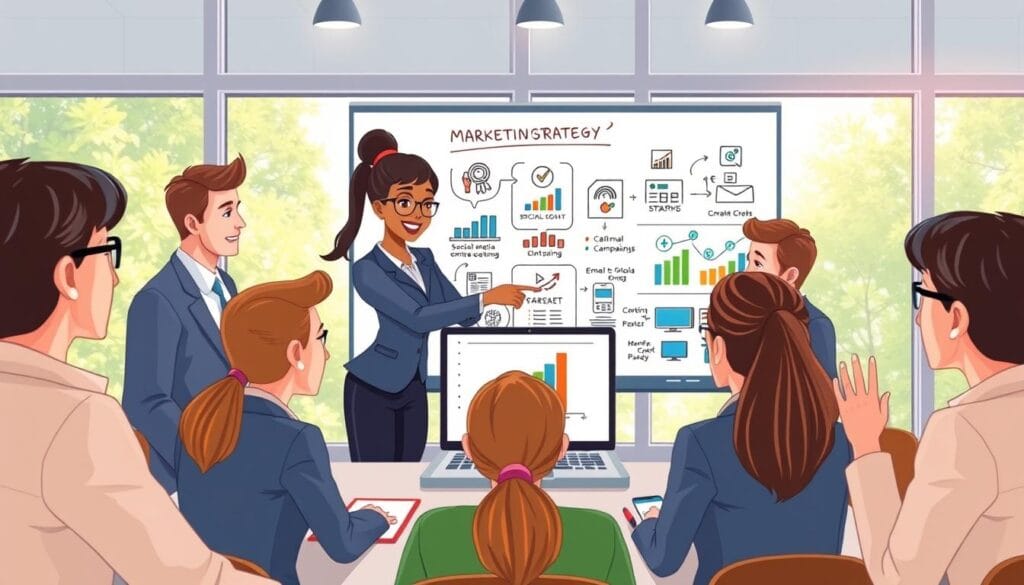
Social media thrives on value-based content. Share behind-the-scenes creation processes and host live Q&A sessions. This approach builds trust far more effectively than constant sales messages.
Launch sequences should incorporate urgency drivers. Early-bird discounts of 20-30% and limited-time bonus materials motivate prompt decisions.
Partnerships, Cross-Promotions, and Exclusive Offers
Collaborate with complementary authors serving similar audiences. Reciprocal email promotions and joint webinars expand your reach significantly.
Affiliate programs enable students and partners to earn commissions. This performance-based model expands marketing reach cost-effectively.
Building a community is crucial. Discussion forums and private groups increase completion rates and generate valuable word-of-mouth promotion.
| Strategy | Primary Tool | Key Metric | Best For |
|---|---|---|---|
| List Building | Landing Pages | Opt-in Rate | Direct conversion |
| Audience Engagement | Social Media Live | Interaction Rate | Building trust |
| Reach Expansion | Affiliate Program | Cost per Acquisition | Scalable growth |
Speaking engagements offer prime promotion opportunities. Always request host permission and position your program as a natural extension of your talk.
Conclusion
Your published work holds the blueprint for a dynamic educational journey. We have outlined a systematic process to transform your expertise into a valuable program for your audience.
Success requires dedication to promotion and gathering learner feedback. This engagement ensures continuous improvement and high satisfaction.
A strong digital presence is crucial. We recommend you optimize your author website to support this new venture effectively.
Begin today. Outline your first module. Your authority and existing materials provide the perfect foundation for this rewarding expansion of your work.
FAQ
How do I start planning the structure for my new digital learning experience?
Begin by mapping your book chapters to potential modules. Clearly define the learning objectives for each segment to ensure a logical flow that builds student knowledge progressively. Using actionable checklists and templates can streamline this development phase.
What are the key financial benchmarks I should consider for budgeting?
Focus on analyzing the cost per attendee and establishing appropriate speaker honorariums. Projecting conversion rates and revenue based on your audience size is crucial for creating a sustainable financial plan and setting realistic income goals.
What delivery formats are most effective for engaging learners?
A multi-format approach works best. Combine video lessons for demonstration, audio for flexibility, and downloadable PDFs for reference. Incorporating interactive content like quizzes significantly boosts engagement and knowledge retention.
How can I effectively market this new educational product to drive enrollment?
A> Leverage your existing reader base through email list building and targeted social media campaigns. Forming strategic partnerships for cross-promotions and offering exclusive early-bird discounts are proven tactics to increase visibility and drive sign-ups.
What are the common legal and accreditation challenges I might face?
Navigating Continuing Medical Education (CME) accreditation for healthcare topics and ensuring all venue or platform contracts are compliant can be complex. It’s advisable to consult with an expert familiar with industry standards in your specific field.
How does transforming my book add value for my audience?
It deepens engagement by providing an interactive, structured learning path. This transformation builds your authority as an expert, offering tangible value that extends beyond the written material and helps people achieve their specific goals.