CrossRef DOI Registration: Complete Setup Guide for Journals
Reviewed by the NeucitePress Editorial Board
— PhD academics, peer-reviewed journal editors and medical communication specialists.
Last updated: July 2026 • Reviewed by the NeucitePress Editorial Board • Reading time: 8 minutes
A Digital Object Identifier (DOI) is the single most important piece of infrastructure a modern academic journal can attach to its articles. Without one, an article is far harder to cite reliably, harder to track, and effectively invisible to the citation-linking systems that underpin scholarly discovery. Crossref is the nonprofit agency that most journals rely on to register these identifiers. This guide walks through what Crossref actually is, how to become a member (or work through a sponsor), what metadata you need to prepare, how the technical deposit process works, and the ongoing maintenance that keeps a DOI program healthy.
What Is Crossref and Why DOIs Matter
Crossref is a not-for-profit membership organization that operates as an official DOI Registration Agency under the International DOI Foundation. It does not publish content itself; instead, it maintains the infrastructure that links scholarly metadata records to persistent identifiers, and it operates the citation-matching service commonly known as Cited-by. When a publisher registers a DOI with Crossref, that identifier resolves permanently to the article’s current location on the web, even if the journal’s platform, domain, or hosting provider changes later.
For a journal, DOIs matter for several concrete reasons:
- Persistent citability — a DOI never changes, so citations to an article remain valid indefinitely, even after a URL migration.
- Discoverability — Crossref metadata feeds into search engines, reference managers, library discovery layers, and aggregators like Google Scholar.
- Citation tracking — the Cited-by service links an article to every other Crossref-registered work that cites it, which is a prerequisite for many citation-count tools.
- Indexing eligibility — as discussed below, several major indexing databases treat consistent DOI registration as a baseline signal of publishing maturity.
Crossref Membership vs. Using a Sponsoring Publisher
There are two main paths for a journal to start registering DOIs with Crossref.
Direct membership. The journal (or its publisher) joins Crossref directly, pays the annual membership fee, and deposits its own metadata — either manually, through a hosting platform’s built-in plugin, or via a third-party DOI-registration agent. This path gives the journal full control over its Crossref account and metadata but requires someone on staff to understand the deposit workflow.
Sponsored membership. Many small or early-stage journals instead register through a Crossref-approved sponsoring organization. A sponsor holds its own Crossref membership and deposits DOIs on behalf of multiple affiliated journals, typically for a service fee that is lower than the cost of full independent membership. The Public Knowledge Project (PKP), which develops Open Journal Systems (OJS), is a well-known Crossref sponsor and has offered this route since 2014, with particular support for publishers in lower-income countries under Crossref’s Global Equitable Membership program. Sponsorship is a practical option for journals that lack the administrative capacity to manage a Crossref account directly, or that want to test DOI registration before committing to full membership.
Either path results in the same outcome for readers: a resolvable DOI and a Crossref metadata record. The difference is purely administrative — who holds the membership and who is responsible for keeping the metadata current.
The Membership Application Process
Journals applying for direct Crossref membership generally go through the following stages:
- Eligibility check. Crossref membership is open to organizations that publish scholarly or professional content, not to individual researchers.
- Application submission. The publisher submits an application through Crossref’s membership portal, providing organizational details and the titles it intends to register.
- Fee tier assignment. Crossref assigns an annual membership fee based on the size of the organization’s publishing operation. Crossref restructured its fee tiers in January 2026 to reduce complexity and improve equity — the lowest tier, for organizations with minimal publishing revenue or expenses, dropped to a modest flat annual fee, while larger publishers pay progressively higher tiers. On top of the annual fee, most content types carry a small one-time registration fee per DOI deposited (some fee categories, such as certain grant-record registrations, have been reduced or temporarily waived as part of ongoing Crossref pricing reforms). Because these figures are periodically revised, journals should always confirm current pricing on Crossref’s official fees page before budgeting.
- Account setup. Once approved, the publisher receives Crossref credentials (a member ID and password) used to authenticate metadata deposits, and selects a DOI prefix that will appear in every DOI it registers (e.g., 10.xxxx/).
- First deposit. The publisher submits a test or initial batch of metadata to confirm the account and prefix are working correctly before registering a full backlog of articles.
Required Metadata for DOI Deposit
Every DOI registered with Crossref must be accompanied by a metadata record. Crossref’s deposit schema distinguishes between required elements (submission is rejected without them) and recommended elements (submission is accepted, but the record is considered incomplete). At minimum, a journal article deposit should include:
- Article title and journal title, volume, issue, and page range or article number.
- Author names, listed in order, ideally with affiliations.
- ORCID identifiers for authors where available — strongly recommended, since ORCID linkage improves author disambiguation and feeds Crossref’s broader identifier network.
- Publication date (print and/or online).
- Abstract — recommended, and increasingly expected by discovery services.
- Reference list — each cited work listed in a structured citation_list element. Including references is technically optional but strongly encouraged, because it is what powers the Cited-by service: without registered reference lists, other publishers’ articles cannot be automatically linked as “cited by” your journal’s content, and your own articles’ citation counts elsewhere will be less complete.
- License and funding information — recommended for compliance with funder open-access mandates.
Where a cited reference itself has a DOI, including that DOI in the reference markup produces the most reliable Cited-by matching; Crossref will otherwise attempt to match references algorithmically using title, author, and journal text, which is less precise.
The Technical Deposit Process
Metadata is deposited with Crossref as XML formatted according to the Crossref metadata deposit schema (the current recommended version is 5.5.0). There are three common ways journals actually generate and submit this XML:
- Manual XML submission. Technical staff (or a vendor) build the XML file by hand or with a script and upload it through Crossref’s deposit interface or via an HTTPS POST to Crossref’s deposit endpoint.
- Journal management system plugins. Journals running Open Journal Systems (OJS) can use the built-in Crossref/DOI plugin, which is developed jointly by PKP and Crossref. Once configured with the journal’s Crossref credentials, prefix, and depositor details, the plugin can automatically generate and submit XML metadata whenever a new article is published — including an option for fully automatic deposit as issues go live, removing the need for manual XML handling entirely.
- Third-party DOI registration agents. Larger publishers sometimes use commercial platforms that manage metadata deposit across multiple registration agencies (including Crossref and DataCite) from a single dashboard.
It is worth noting that Crossref is one of several DOI registration agencies; DataCite is another, more commonly used for datasets, software, and research outputs outside traditional journal articles. Journals publishing conventional peer-reviewed articles overwhelmingly use Crossref, since its infrastructure (Cited-by, similarity-check integration, and the wider citation graph) is built specifically around scholarly journal content.
Step-by-Step Setup Checklist
| Step | Action | Owner |
|---|---|---|
| 1 | Decide between direct Crossref membership and a sponsored membership | Editor-in-chief / publisher |
| 2 | Submit membership application and confirm fee tier | Publisher / admin staff |
| 3 | Select and register a DOI prefix | Publisher |
| 4 | Configure deposit method (OJS plugin, manual XML, or vendor) | Technical/production editor |
| 5 | Standardize author metadata collection, including ORCID capture | Editorial office |
| 6 | Submit a test deposit and verify DOI resolution | Technical/production editor |
| 7 | Register DOIs for backlog issues (if applicable) | Production team |
| 8 | Enable automatic deposit for every future article/issue | Technical/production editor |
| 9 | Add reference lists with DOIs to enable Cited-by linking | Copyediting/production |
| 10 | Schedule periodic metadata audits and corrections | Editorial office |
Ongoing Responsibilities After Registration
Registering a first batch of DOIs is only the starting point. Crossref membership carries continuing obligations:
- Deposit a DOI for every new article as it is published, ideally through an automated workflow rather than manual batch uploads that can lag behind the publication schedule.
- Keep metadata current — correcting author names, updating URLs after a platform migration, and issuing metadata updates when errata or corrections are published.
- Maintain reference linking by including reference lists (with DOIs, where known) in every deposit so the Cited-by service can keep citation graphs accurate.
- Pay annual membership fees and per-DOI registration charges on schedule to keep the account in good standing.
- Monitor deposit reports for rejected or failed submissions, which can otherwise silently leave articles without DOIs.
Common Setup Mistakes
- Skipping reference deposits. Journals that register only basic bibliographic metadata and omit reference lists lose most of the citation-tracking value of Crossref membership.
- Inconsistent author name formatting across issues, which fragments author identity in Crossref’s system and in downstream indexes.
- Not configuring automatic deposit in OJS or another journal system, leading to articles being published online without a DOI for weeks or months.
- Forgetting to update metadata after a domain or platform migration, which can break DOI resolution to the correct current URL.
- Treating DOI registration as a one-time task rather than a continuous editorial-production responsibility owned by a specific role on the team.
- Confusing Crossref with DataCite and registering the wrong content type with the wrong agency, which can complicate later metadata management.
How This Ties Into Scopus and Web of Science Indexing
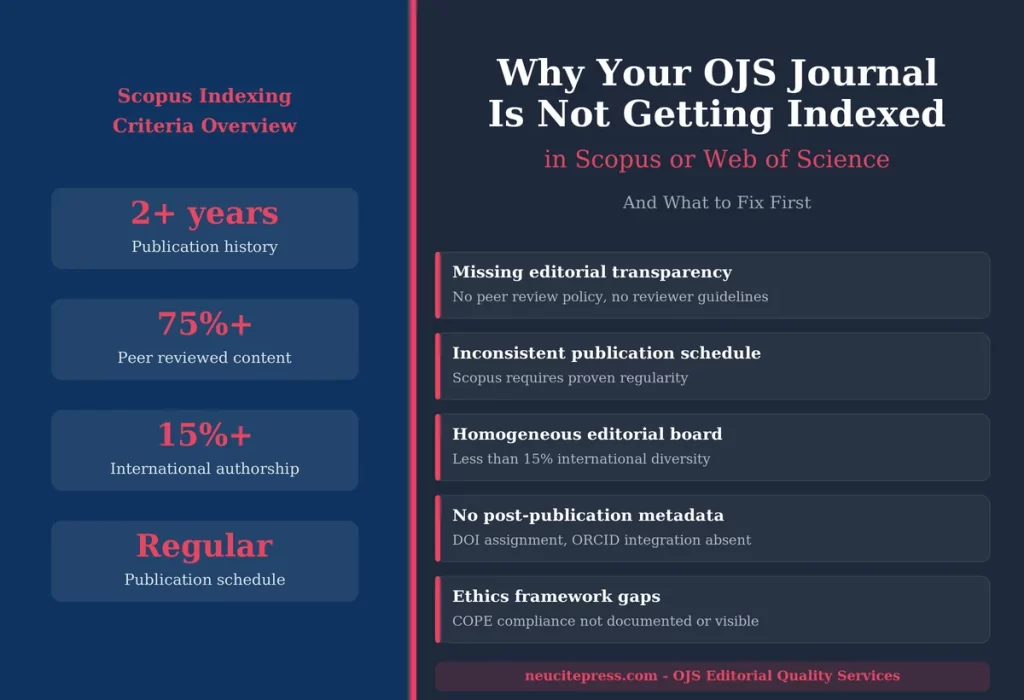
Neither Scopus nor Web of Science requires Crossref membership as a formal, published eligibility criterion, but consistent DOI registration functions as a strong practical signal during their evaluation processes. Both databases assess journals partly on operational and technical rigor — regular publication schedules, complete bibliographic metadata, functioning reference linking, and stable, persistent article URLs. A journal that registers DOIs for every article, maintains clean author and reference metadata, and supports Cited-by linking demonstrates exactly the kind of production discipline these indexing evaluators look for. In practice, many indexing rejections cite metadata inconsistency or unstable article URLs as contributing factors — issues that a well-maintained Crossref DOI program directly prevents. Journals preparing an indexing application should treat DOI and metadata hygiene as part of the broader case they are building, alongside editorial board credentials, peer-review rigor, and citation performance.