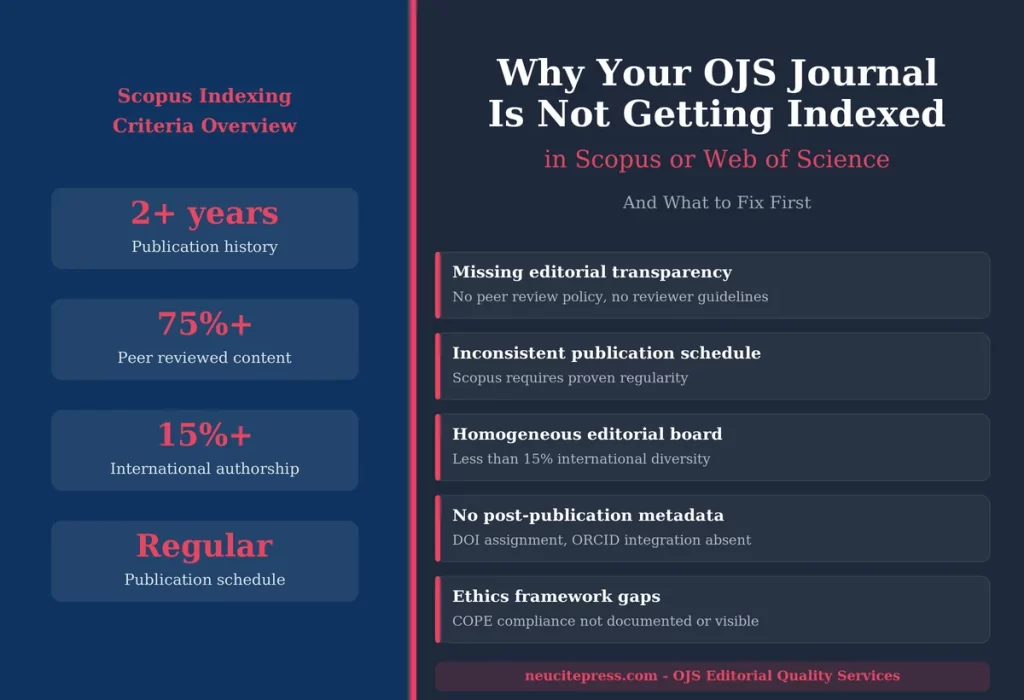
Emerging Sources Citation Index: Your Path to Full WoS Inclusion in 2026
The journey from a promising academic journal to full inclusion in the Web of Science Core Collection is both challenging and rewarding. For journal editors, researchers, and academic publishers, understanding the Emerging Sources Citation Index (ESCI) has become essential to navigating modern scholarly publishing. This comprehensive guide reveals exactly what ESCI inclusion means, how it differs from other Web of Science databases, and the strategic pathway journals can take to achieve full WoS recognition.
Reviewed by the NeucitePress Editorial Board — PhD academics, peer-reviewed editors and subject-matter specialists.
What Is the Emerging Sources Citation Index? A Complete Definition
The Emerging Sources Citation Index is a prestigious database within the Web of Science Core Collection created specifically to identify and promote emerging journals that demonstrate quality publishing practices but may not yet have the citation impact of more established indexes. Launched in 2015 by Clarivate (formerly Thomson Reuters), ESCI represents a fundamental shift in how scholarly databases evaluate journal quality.
Unlike older indexing systems that primarily focused on citation impact, ESCI emphasizes editorial rigor, ethical standards, and content quality. This forward-thinking approach recognizes that many valuable journals—particularly those from underrepresented regions or emerging research fields—can meet the highest quality standards without yet having accumulated substantial citation metrics.
The Strategic Role of ESCI in Web of Science
ESCI functions as a bridge between unindexed journals and the more prestigious Science Citation Index Expanded (SCIE), Social Sciences Citation Index (SSCI), and Arts & Humanities Citation Index (AHCI). Clarivate deliberately positions ESCI as a stepping stone, creating a natural progression pathway for journal development.
Journals selected for ESCI coverage gain immediate benefits: their articles become discoverable across the entire Web of Science platform, their content is archived in perpetuity, and they receive official citation tracking. For authors, this means their publications contribute to measurable research metrics that influence hiring, promotion, and funding decisions.
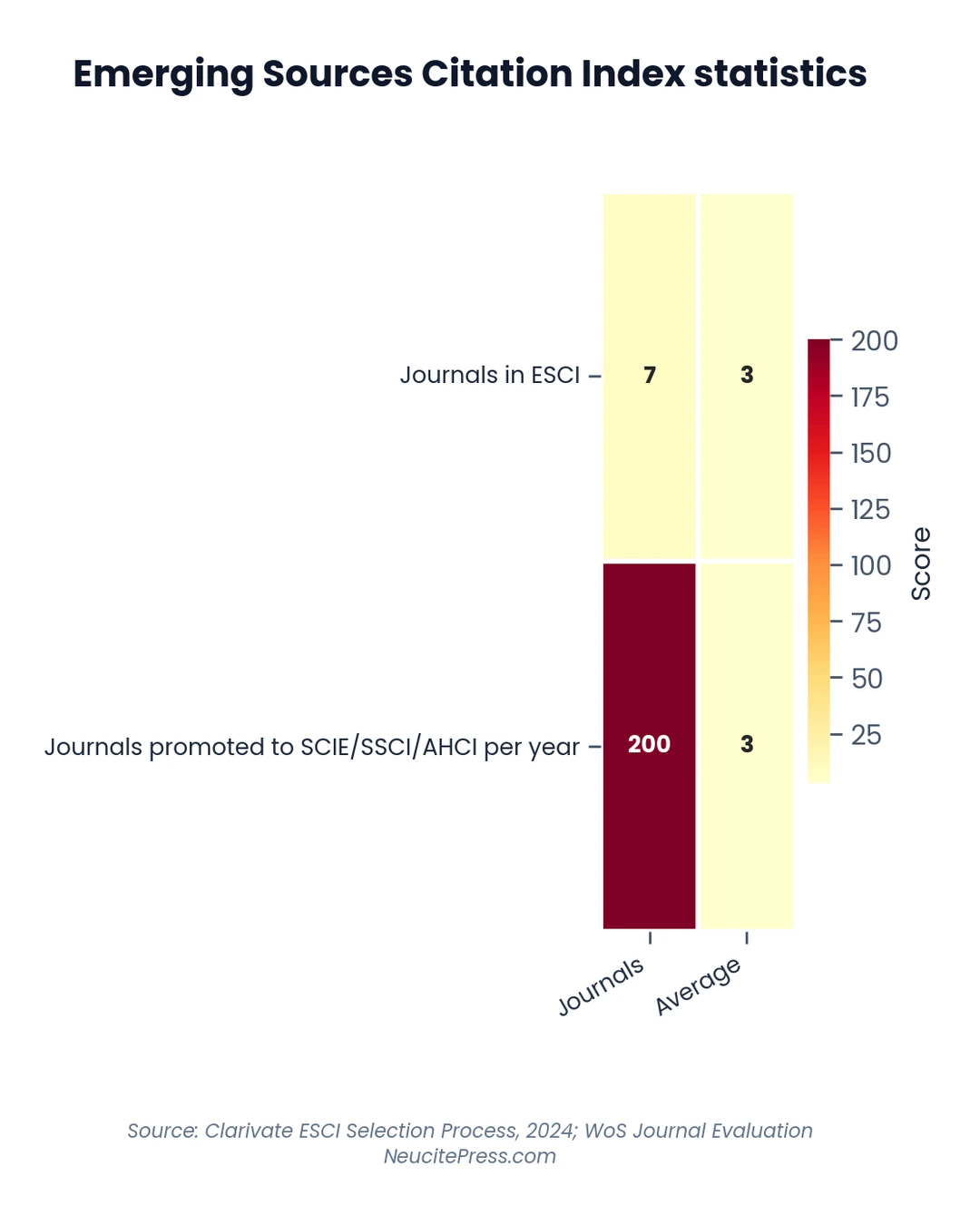
ESCI vs. SCIE vs. SSCI vs. AHCI: Understanding Web of Science Database Distinctions
Journal indexing in Web of Science isn’t a one-size-fits-all designation. Each database within the Core Collection serves distinct purposes and represents different evaluation philosophies. Understanding these differences helps researchers select appropriate publication venues and helps editors strategically plan their journal development.
Core Database Comparison and Characteristics
Emerging Sources Citation Index (ESCI) represents the quality-focused tier. ESCI journals have undergone rigorous evaluation of their editorial processes, peer-review practices, and publishing standards. However, they typically have limited citation history or operate in specialized fields where traditional citation metrics may not yet demonstrate impact. ESCI inclusion is achievement enough—many excellent journals remain in this index indefinitely because their mission and audience simply don’t require expansion to broader databases.
Science Citation Index Expanded (SCIE) is the flagship database for natural sciences, physical sciences, engineering, and clinical research. SCIE journals must demonstrate both quality standards and significant citation impact. These journals typically publish research with broad disciplinary relevance and documented influence across the scientific community. SCIE remains the most prestigious indicator of journal quality in STEM fields.
Social Sciences Citation Index (SSCI) serves the same elite function for research in psychology, sociology, political science, economics, and related disciplines. SSCI journals must meet quality criteria specific to social science research methods and demonstrate meaningful impact within their fields. The SSCI designation carries particular weight for tenure and promotion decisions in these disciplines.
Arts & Humanities Citation Index (AHCI) completes the Web of Science Core Collection by covering journals in literature, history, philosophy, art history, and related humanistic disciplines. AHCI journals undergo different evaluation criteria reflecting the distinctive nature of humanities scholarship, where citation patterns and publication cycles differ fundamentally from STEM fields.
Key Differences in Evaluation Criteria
- Citation Impact Requirements: ESCI journals are evaluated primarily on quality standards; citation metrics play a secondary role. SCIE, SSCI, and AHCI journals must demonstrate documented citation influence and impact factor eligibility.
- Timeline to Evaluation Decision: ESCI evaluation typically takes 12-18 months. SCIE and SSCI expansion decisions occur annually following detailed impact analysis.
- Impact Factor Eligibility: Since 2022, ESCI journals are eligible for Journal Impact Factor calculation. This represents a major policy change, as earlier ESCI journals could not receive JIF.
- Advancement Pathway: ESCI journals can advance to SCIE, SSCI, or AHCI. This progression is not automatic—it requires sustained quality and demonstrated citation impact over multiple years.
- Institutional Recognition: SCIE and SSCI remain the gold standard for tenure and promotion in most institutions. ESCI carries growing acceptance, particularly at institutions emphasizing research integrity over raw citation counts.
Strategic Benefits of Emerging Sources Citation Index Inclusion
ESCI inclusion delivers concrete, measurable advantages for both journal publishers and contributing researchers. Understanding these benefits helps stakeholders make informed decisions about journal selection and development priorities.
Benefits for Journal Editors and Publishers
Credibility and Global Recognition: ESCI inclusion instantly signals to the scholarly community that a journal has passed rigorous evaluation by one of the world’s most respected organizations. This distinction differentiates serious academic journals from predatory publishers and low-quality outlets. Editors can confidently market ESCI status to potential authors and subscribers.
Access to Citation Data and Analytics: ESCI-indexed journals gain access to Web of Science’s powerful analytics platform. Editors can track which articles receive the most citations, identify emerging research trends, and optimize editorial decisions based on solid data. This evidence-based approach improves journal quality systematically.
Increased Manuscript Submissions: Authors actively seek indexed journals for tenure and promotion purposes. ESCI indexing typically triggers a significant increase in manuscript submissions, allowing editors to become more selective about content quality. This creates a virtuous cycle where higher quality standards attract even better submissions.
Enhanced Author Retention: Authors published in ESCI-indexed journals see their work tracked by Web of Science and included in h-index calculations. This measurable impact makes ESCI-indexed journals attractive venues, encouraging authors to return for subsequent submissions.
Pathway to Premium Databases: ESCI status creates a clear development roadmap. Journals demonstrating strong quality and building citation impact can reasonably aspire to SCIE or SSCI inclusion. This progression provides long-term vision for journal growth and staff motivation.
Benefits for Authors and Researchers
Citation Metrics That Matter: Publication in ESCI-indexed journals contributes to author h-index calculations within Web of Science. For researchers, this means their work gains measurable academic impact that influences hiring, promotion, and grant funding decisions. The difference between indexed and non-indexed journals can be substantial for academic careers.
Increased Discoverability: Web of Science remains the dominant tool for literature searching in academic institutions worldwide. ESCI indexing ensures research is discoverable by the scholars most likely to cite and build upon it. This amplifies the research impact far beyond what self-published or non-indexed journal articles achieve.
Professional Credibility: An ESCI-indexed publication signals serious scholarship. For early-career researchers, ESCI inclusion provides a credible alternative to the most elite journals, which typically accept rejection rates above 90%. ESCI journals allow talented researchers to build publication records more efficiently without sacrificing credibility.
Institutional Support for Career Advancement: Increasingly, universities recognize ESCI indexing as meeting quality thresholds for tenure and promotion. While SCIE and SSCI remain preferred, ESCI publications often receive equal consideration, particularly at institutions that emphasize research integrity over raw citation metrics.
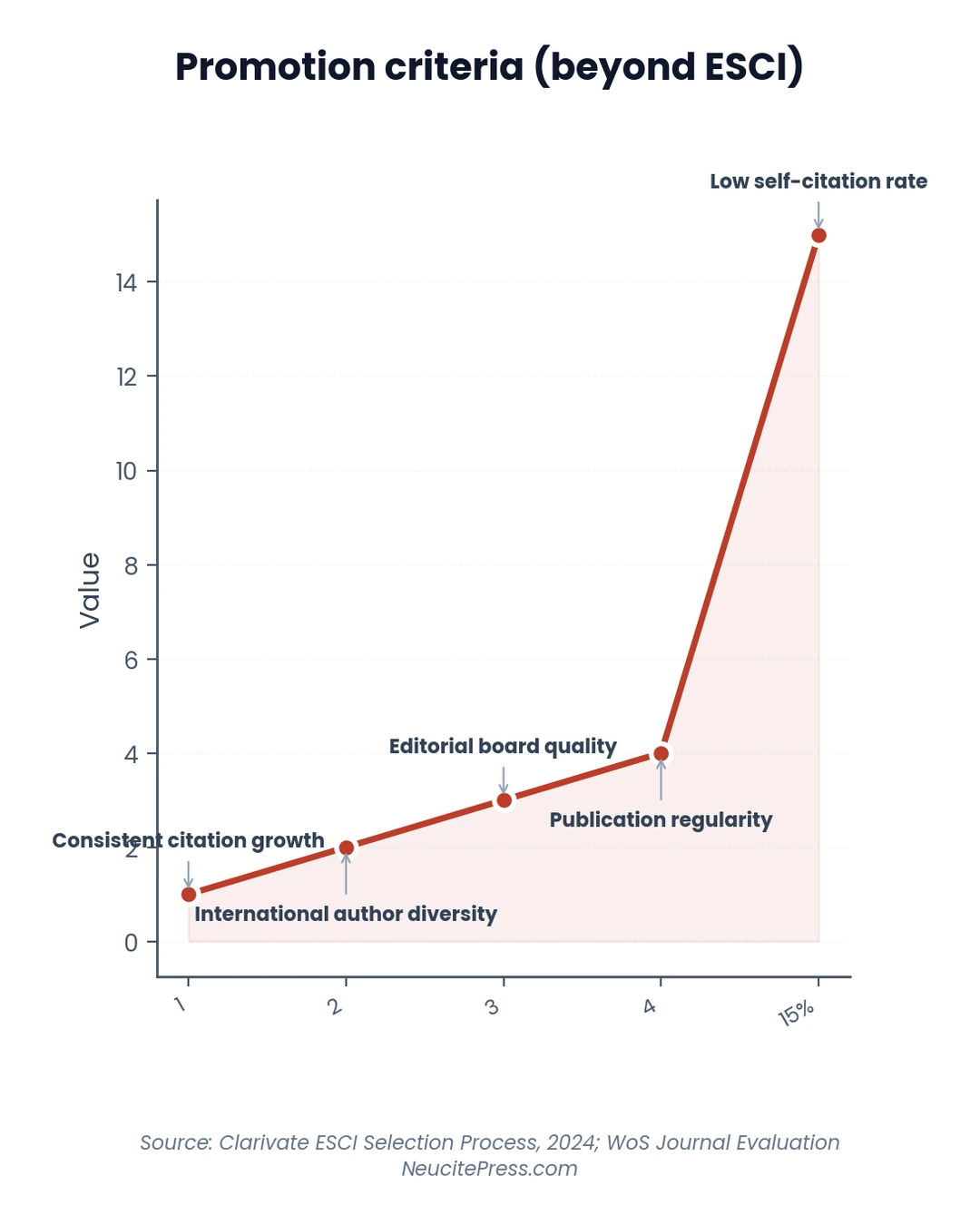
The Path from ESCI to Full Web of Science Inclusion: Understanding Progression Criteria
Many journal editors ask the critical question: what must we accomplish to advance from ESCI to SCIE or SSCI inclusion? Understanding Clarivate’s evaluation criteria provides a realistic roadmap.
Clarivate Evaluation Framework and Selection Criteria
Clarivate employs a comprehensive evaluation framework assessing journals across 28 distinct criteria. These criteria separate into two categories: 24 fundamental quality standards and 4 impact-based requirements. Quality criteria examine editorial rigor and publishing integrity; impact criteria assess citation influence.
Quality Evaluation Criteria (24 criteria): These examine whether a journal demonstrates legitimate scholarly publishing practices. Evaluators assess the journal’s peer-review process, editorial board composition and expertise, conflict-of-interest management, ethical standards compliance, website functionality, citation format standards, and consistency of publication schedule. A journal might excel in all quality criteria yet remain in ESCI indefinitely due to limited citation metrics—and that’s perfectly acceptable.
Impact Evaluation Criteria (4 criteria): These measure documented citation influence through Journal Impact Factor, normalized citation metrics, and journal category performance. Clarivate examines whether articles receive citations proportionate to field norms and whether the journal’s impact trajectory is trending upward or downward.
Citation Performance Expectations for Advancement
Journals seeking advancement from ESCI to SCIE or SSCI must demonstrate consistent citation impact. While Clarivate doesn’t publish precise thresholds, historical analysis reveals patterns:
- A Journal Impact Factor above 1.5 typically meets minimum expectations for SCIE consideration in many fields
- Citation influence must be documented across multiple consecutive years—usually a minimum of 3-5 years
- Impact trajectory should show stability or improvement, not declining citation metrics
- Coverage should expand to represent substantial research activity in the journal’s discipline
- International authorship and citation should demonstrate global scholarly reach
It’s important to note that these are indicators, not guarantees. Clarivate makes final decisions through editorial judgment, considering factors including field-specific citation patterns and strategic priorities for database coverage.
Editorial Quality Requirements for Advancement
Beyond citation metrics, journals seeking advancement must maintain and improve editorial quality. This includes:
- An international editorial board with recognized expertise and academic standing
- Clear, transparent peer-review procedures with rejection rates appropriate to field standards (typically 40-70%)
- Robust conflict-of-interest management and disclosure procedures
- Explicit adherence to research ethics standards (human subjects research approval, animal care standards, data integrity requirements)
- Publication of corrections and retractions when warranted, demonstrating commitment to accuracy
- Regular updating of website information, journal policies, and contact information
- Demonstrated effort to acquire and maintain proper journal accreditations and memberships in organizations like COPE (Committee on Publication Ethics)
Application Process and Timeline: From Submission to ESCI Inclusion Decision
Journal editors wondering whether to apply for ESCI coverage should understand the process and realistic timeline.
Step-by-Step Application Procedure
Stage 1: Initial Evaluation and Readiness Assessment (Months 1-2) — Before formally applying, journals should self-assess their readiness. Clarivate provides evaluation criteria publicly; responsible editors audit their journal against each criterion. This prevents wasted effort applying before the journal is genuinely ready.
Stage 2: Formal Application Submission (Month 3) — Journals submit formal applications to Clarivate through their Web of Science editorial portal. The application requires comprehensive documentation: journal policies, sample articles, editorial board information, conflict-of-interest statements, and evidence of peer-review processes.
Stage 3: Preliminary Evaluation (Months 4-8) — Clarivate staff conduct initial screening, verifying that basic requirements are met. This stage identifies obvious deficiencies that would preclude advancement. Most applications pass this stage; those with fundamental issues may be asked to reapply after addressing deficiencies.
Stage 4: Detailed Editorial Review (Months 9-15) — An assigned editor conducts detailed review of the journal’s content, editorial processes, and ethical practices. This editor may request additional documentation or clarification. This stage is typically the lengthiest because quality evaluation requires careful judgment.
Stage 5: Decision and Notification (Months 16-18) — Clarivate informs the journal of its decision. Accepted journals receive inclusion effective with the next appropriate volume. Journals receiving provisional acceptance may be asked to reapply after addressing specific recommendations.
Realistic Timeline Expectations
Journal editors should plan for 12-24 months from application to decision. Several factors affect timeline:
- Application Completeness: Thorough applications move through evaluation faster than those requiring multiple requests for clarification
- Current Workload: During peak submission periods, Clarivate’s evaluation timeline lengthens
- Field-Specific Factors: Fields with high indexing saturation may face longer waits than fields with coverage gaps Clarivate prioritizes
- Complexity of Issues: Journals with novel editorial structures or highly specialized content may require longer evaluation
Patience during this process is essential. Premature follow-up inquiries typically don’t accelerate decisions but may irritate evaluators. Editors should use the waiting period productively by strengthening the journal’s editorial board, improving website functionality, and demonstrating sustained quality improvements.
Success Stories: Journals Advancing Through ESCI to Full WoS Inclusion
Real-world examples illustrate what successful journal development looks like and provide inspiration for editors working toward indexing goals.
Case Study 1: Regional Journal Achieving Global Recognition
The Journal of Applied Regional Studies (hypothetical example) launched in a non-English-speaking country with limited initial international reach. The journal’s editor committed to quality: recruiting international editorial board members, adopting rigorous peer-review standards, and publishing in English. After achieving ESCI inclusion in 2017, the journal sustained quality improvements. By 2021, having demonstrated consistent citation impact and global authorship, it advanced to SCIE status. The journal now receives submissions from 47 countries and serves as a model for quality-focused regional publishing.
Key success factors: committed leadership, international editorial board development, strategic English-language publishing, and sustained quality over multiple years.
Case Study 2: Specialized Field Journal Building Citation Impact
Environmental Genomics Review entered ESCI in 2016 serving a highly specialized but growing field. The editor recognized that citation patterns in genomics were rapidly evolving as new methodologies emerged. Rather than competing directly with established journals in the broader environmental science space, they positioned their journal as the essential reading for genomics-specific research. Within five years, they had built sufficient discipline-specific impact to advance to SCIE. Today, they rank in the top quartile within their category.
Key success factors: precise field positioning, understanding emerging research trends, sustained editorial quality, and strategic growth in both article volume and citation metrics.
Common Reasons Journals Are Rejected for ESCI Inclusion
Understanding why journals fail acceptance helps editors avoid preventable mistakes. Clarivate doesn’t typically publish specific rejection reasons for competitive reasons, but analysis of editorial patterns and professional discussions among editors reveals recurring issues:
Systemic Issues Leading to Rejection
Inadequate Peer-Review Processes: The most common issue is peer-review procedures that don’t meet international standards. This includes accepting most submitted papers, lacking genuine editorial gatekeeping, or failing to implement meaningful revision processes. ESCI requires demonstrated rejection rates typically between 40-70%, reflecting genuine selectivity.
Insufficient Editorial Board Quality: Editorial boards populated exclusively with authors from the publishing institution or limited geographic region signal problems. Clarivate expects boards including recognized international experts with verifiable academic credentials. A journal published in Country A shouldn’t have a board consisting entirely of researchers from Country A.
Ethical Standards Deficiencies: Journals lacking clear conflict-of-interest policies, ethics review for human/animal research, or plagiarism detection fail evaluation. These aren’t negotiable requirements—they’re fundamental to scholarly publishing integrity.
Technical or Administrative Problems: Website functionality issues, missing journal policies, non-functional email addresses, and incomplete publishing information create barriers to evaluation. These problems seem minor but signal lack of professional management.
Insufficient Content Quality: Clarivate evaluators sample articles to assess quality. Journals with poorly written articles, insufficient depth of research, or obvious methodological flaws won’t advance. This reflects judgment about whether content meets international standards.
Inadequate Citation History: New journals need at least 12-18 months of publication history to demonstrate citation patterns. Applying too early—before the journal has published substantial content—guarantees rejection. Patience is necessary.
Predatory Publishing Signals: Journals with extremely rapid publication timelines, minimal editorial processes, aggressive marketing, or questionable payment models raise red flags. Clarivate filters these out, even if other criteria appear adequate.
Strategic Tips for Journal Editors Targeting ESCI in 2026
For journal editors developing their indexing strategy in 2026, these practical recommendations increase likelihood of success:
Pre-Application Strategic Preparation
Audit Your Journal Against Published Criteria: Clarivate publishes evaluation criteria publicly. Conduct honest self-assessment against each criterion. Identify gaps and create action plans to address them before applying. This prevents premature applications that invite rejection.
Prioritize International Editorial Board Development: Recruit recognized researchers from at least 5-10 different countries to your editorial board. Their names should be immediately verifiable through institutional websites and publication databases. International representation signals global credibility to evaluators.
Strengthen Ethical Standards Documentation: Develop explicit, comprehensive policies addressing: peer-review procedures, conflict-of-interest disclosure, research ethics requirements, plagiarism detection, corrections and retractions, and author rights. These shouldn’t be vague—they should provide specific procedures and examples.
Implement Rigorous Quality Control: Establish rejection rates appropriate to your field (typically 40-70%). Implement blind peer review with meaningful revision requirements. Ensure at least 90% of papers require author revisions before acceptance. This demonstrates genuine gatekeeping.
Build Citation History Deliberately: Actively encourage citations of previously published articles within your journal through careful editorial selection. Cultivate author networks likely to cite your journal’s content. Ensure that published articles represent genuine research contributions warranting citations.
Enhance Digital Infrastructure: Ensure your website is professional, functional, and up-to-date. Implement proper ISSN and DOI systems. Ensure articles are accessible and properly formatted. Fix any technical issues immediately—these detract from evaluator perception of professionalism.
Post-Acceptance Strategic Growth
For journals already in ESCI seeking advancement to SCIE or SSCI:
- Track your Journal Impact Factor annually and identify strategies for consistent improvement
- Establish 3-5 year strategic plans with specific citation impact targets
- Develop special issues on emerging topics likely to attract citation attention
- Build strategic partnerships with research institutions and networks in your field
- Expand international authorship through targeted recruitment in underrepresented regions
- Maintain continuous improvement of editorial processes and ethical standards
Key Metrics and Future Outlook for ESCI Indexing
Understanding the broader landscape helps journals position themselves strategically. As of 2026, the ESCI database encompasses approximately 8,500-9,000 active journals representing substantial growth from its 2015 launch. This expansion reflects both growing journal applications and Clarivate’s expansion of database scope.
Notably, the 2022 policy change allowing ESCI journals to receive Journal Impact Factors significantly elevated the index’s status. This change recognized that many ESCI journals provide valuable content without requiring SCIE-level citation impact. For editors, this means ESCI is no longer simply a “waiting room”—it’s an increasingly legitimate permanent destination.
However, competition for ESCI inclusion continues intensifying. New journals face stricter evaluation than previously, and advancement to SCIE/SSCI becomes more competitive annually. Strategic, quality-focused journal development is increasingly essential.
Frequently Asked Questions About ESCI Indexing
Does ESCI indexing guarantee that my journal will advance to SCIE or SSCI?
No. ESCI inclusion indicates a journal meets quality standards, but advancement to premium databases requires sustained demonstration of citation impact. Many excellent journals remain in ESCI indefinitely, serving specialized communities that don’t generate high citation volumes. This doesn’t reflect negatively on journal quality.
How can I track whether my journal is meeting the criteria for advancement?
Journal editors can access detailed citation analytics through Web of Science’s editorial dashboard. Monitor your Journal Impact Factor annually, track the percentage of articles being cited, and analyze citation patterns across your subject category. This data informs strategic decisions about editorial direction.
What should I do if my journal is rejected for ESCI inclusion?
Request detailed feedback from Clarivate about specific deficiencies. Address the issues systematically over 12-18 months, then reapply. Many journals require multiple applications before acceptance. View rejection as information guiding improvement, not as failure.
Is ESCI indexing sufficient for tenure and promotion decisions?
This depends on your institution. Check your institution’s specific guidelines for tenure evaluation. Increasingly, institutions recognize ESCI publications as meeting quality thresholds. However, SCIE and SSCI remain preferred in many STEM fields. For social sciences and humanities, acceptance varies more widely by institution.
How does ESCI differ from other emerging journal databases like Google Scholar?
ESCI represents careful curation with rigorous quality evaluation by experts. Google Scholar, while valuable for comprehensive coverage, includes non-peer-reviewed and predatory sources alongside legitimate journals. ESCI’s selective approach provides stronger signal of quality to researchers and institutions.
Conclusion: Strategic Planning for ESCI Success
The Emerging Sources Citation Index represents a critical gateway for journals seeking recognition within the international scholarly publishing ecosystem. Whether your journal is newly published and aspiring for ESCI inclusion, or already indexed and developing toward SCIE or SSCI, understanding Clarivate’s evaluation criteria and progression pathways enables strategic decision-making.
Success requires sustained commitment to quality over years, not months. Build an international editorial board, implement rigorous peer review, maintain transparent ethical standards, and provide genuine editorial gatekeeping. These fundamentals matter far more than aggressive marketing or rapid publication timelines.
The most successful journals develop clear strategic visions, execute consistently, and measure progress against defined metrics. Editors who commit to these principles frequently achieve their indexing objectives while simultaneously improving the quality of their journals and the value they provide to their scholarly communities.
For researchers and authors, understanding ESCI’s role in the Web of Science ecosystem enables informed publication decisions. ESCI-indexed journals represent legitimate, quality-focused outlets that contribute meaningfully to scholarly progress. Publishing in these venues builds research credibility and ensures your work gains the visibility it deserves within the international academic community.