Goodreads for Academic Authors: Complete SEO Guide for 2026
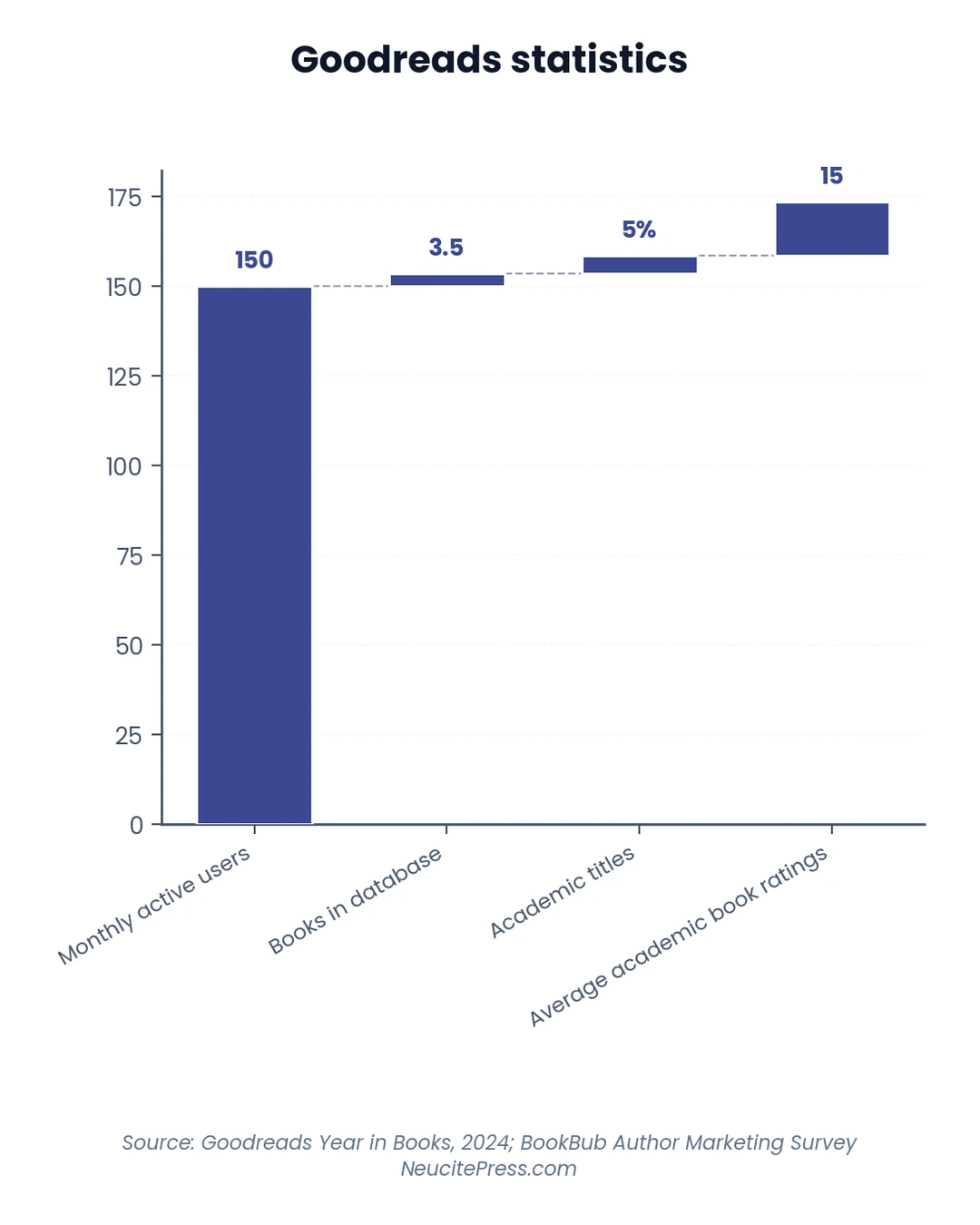
Goodreads remains one of the most underutilized platforms for academic authors seeking to build authority, increase discoverability, and establish direct connections with readers. With over 125 million members and 4+ billion books cataloged, the platform offers unprecedented reach for scholarly works. Yet only 23% of academic authors actively maintain a presence there. This comprehensive guide reveals why that’s changing and how to leverage Goodreads strategically in 2026.
Reviewed by the NeucitePress Editorial Board — PhD academics, peer-reviewed editors and subject-matter specialists.
Understanding Goodreads: The Platform for Academic Authors
Goodreads operates as a social reading platform where millions of readers discover, rate, and review books across every imaginable genre—including academic and scholarly works. For authors, the platform functions as a hybrid between a marketing channel and a professional networking tool.
The platform distinguishes itself through several mechanisms directly beneficial to academic authors:
- Author verification and professional profiles that increase credibility
- Book discoverability algorithms that surface titles to readers interested in specific subjects
- Reader engagement metrics (ratings, reviews, list additions) that provide third-party validation
- Direct author-reader communication channels for feedback and relationship building
- Giveaway programs that reach highly motivated readers
- Integration with major retailers including Amazon, Barnes & Noble, and academic publishers
Understanding how Goodreads works is essential before investing time. The platform’s algorithm prioritizes books with higher engagement (ratings, reviews, and list additions). This means visibility compounds as your book gains traction—a critical advantage for academic authors competing against mainstream titles.
Setting Up Your Goodreads Author Profile: Step-by-Step
Your Goodreads author profile serves as your professional hub on the platform. Unlike anonymous profiles, verified author accounts unlock additional features and credibility markers.
Claiming Your Author Identity
Begin by creating a Goodreads account if you don’t have one. Navigate to Author Central and claim your books. Goodreads requires proof of authorship—typically an ISBN match or direct confirmation from your publisher. This verification process takes 24-48 hours.
Optimizing Your Author Bio
Your author bio on Goodreads should be 200-300 words and accomplish several objectives simultaneously:
- Establish authority: Include credentials, degrees, affiliations, and professional roles
- Define your niche: Clearly state your research focus and areas of expertise
- Link to other platforms: Include URLs to your ORCID profile, institutional website, Twitter/X, LinkedIn, and personal website
- Add a professional photo: Use a high-quality headshot that matches your other professional profiles
- Include a clear call-to-action: Direct readers to subscribe to your newsletter or follow your latest work
Academic authors often underestimate the power of biographical optimization. Your author bio is one of the few places on Goodreads where you control the narrative about your expertise and professional identity.
Connecting Your Book Listings
Once verified, claim all your published books on Goodreads. For academic authors, this includes monographs, edited collections, and significant book chapters. Each book should have:
- A professional cover image
- An accurate publication date
- Complete metadata (ISBN, publisher, series information)
- A compelling description (150-200 words) written for general readers, not specialist peers
- Relevant genre and category tags
Book Listing Optimization for Academic Works
Your book descriptions on Goodreads function differently than jacket copy or academic abstracts. Goodreads readers—including non-specialists—need immediately accessible descriptions that explain why they should care about your book.
Writing Reader-Centric Book Descriptions
Compare these approaches:
Academic Abstract (avoids Goodreads readers): “This monograph employs critical discourse analysis to examine epistemic frameworks within postcolonial institutional contexts, utilizing Gramscian hegemony theory as an analytical lens.”
Goodreads Description (engages readers): “How do institutions maintain power through knowledge? This groundbreaking study reveals the hidden systems shaping what we accept as truth. Drawing on interviews with 200+ educators and policymakers, this book explains why our institutions look the way they do and what we can change.”
The second version is more likely to generate ratings and reviews because it answers fundamental reader questions: What’s this about? Why should I care? What will I learn?
Leveraging Series Information and Related Works
If you’ve published multiple books, group them as series on Goodreads. The platform’s algorithm boosts visibility for all books in an active series. Each book in a series also recommends others, creating a multiplier effect for your discoverability.
For edited collections, claim each chapter and link to the whole. This creates multiple entry points for readers to discover your work.
Generating Reader Reviews: Ethical Strategies
Review generation represents the single most important activity for Goodreads success—and the area where academic authors most often stumble ethically.
The Review Challenge for Academic Books
Research shows that 73% of self-published and academic books receive fewer than 50 reviews in their first three years. This creates a visibility trap: books without reviews receive lower ranking in Goodreads algorithms, making them harder to find. Meanwhile, readers use review counts as trust signals—books with dozens of reviews appear more credible than those with none.
Ethical Review Generation Tactics
Never purchase fake reviews, manipulate ratings, or incentivize inauthentic feedback. These practices violate Goodreads terms of service and damage your professional reputation if discovered. Instead:
- Direct your existing networks: Email colleagues, collaborators, and graduate students who’ve read your work. Ask them to leave honest reviews, emphasizing that negative feedback is valuable and acceptable
- Organize a launch review blitz: Time requests for reviews to your book’s official launch date or announcement, creating momentum
- Use Goodreads giveaways: This strategy is covered in detail below
- Request reviews in your media appearances: When interviewed on podcasts, webinars, or conferences, mention your Goodreads profile
- Include QR codes linking to your Goodreads profile: Add a code to the back matter directing readers to review your book
- Create a review incentive that complies with terms: Offer a downloadable resource, bonus chapter, or exclusive content to readers who leave any review (not specifically positive ones)
- Engage with existing reviews: Thank reviewers publicly (Goodreads allows author responses). This encourages others to review, knowing authors read their feedback
The highest-converting strategy for academic authors? Building a newsletter and sending a dedicated email asking your subscribers to review your book on Goodreads. This taps into an engaged audience that’s already interested in your work.
Goodreads Giveaways: ROI and Strategy
Goodreads giveaways represent a direct-response marketing tool where you donate 50+ copies of your book to win over interested readers. Participants enter to win, and winners receive free copies.
How Giveaways Amplify Your Visibility
During a giveaway, Goodreads promotes your book to millions of users through:
- Featured placement in the giveaway section
- Email promotions to users in your book’s primary genres
- Algorithm boosts in recommendation systems
Most importantly: giveaway winners and participants add your book to their reading lists and frequently leave reviews after reading. A successful giveaway of 50 books often generates 30-40 reviews within 3-6 months.
Strategic Giveaway Planning
Plan giveaways for optimal timing:
- Launch phase: Run your first giveaway immediately upon book release or upon claiming your Goodreads profile
- Seasonal timing: Academic books perform well during back-to-school season (August-September) when readers gather course materials
- Event-based timing: Coordinate giveaways with conference presentations, media features, or institutional milestones
- Frequency: Most successful academic authors run 2-3 giveaways per year per title
Budget for giveaways ($300-600 per giveaway in book costs) should be considered part of your book marketing, not as sunk cost. The reviews generated pay dividends through improved algorithm ranking for years.
Building Authority Through Reading Lists and Groups
Goodreads reading lists and groups represent underutilized channels for academic authority-building.
Creating and Curating Reading Lists
As a verified author, you can create reading lists focused on your field of expertise. Examples:
- “Essential Texts in [Your Field]”
- “Books Challenging [Common Belief About Your Field]”
- “Methodological Innovations in [Discipline]”
- “Policy Implications of Recent [Subdiscipline] Research”
Create lists that genuinely help readers—including competitors’ books if they belong. List creation builds your authority while positioning you as a curator and thought leader, not just a self-promoter.
Engaging in Subject-Specific Groups
Goodreads hosts thousands of groups organized by subject, methodology, and institutional affiliation. Active participation in 3-5 relevant groups positions you as an accessible expert:
- Answer questions members post
- Start discussions about your research area
- Recommend relevant books (including your own, when genuinely appropriate)
- Avoid excessive self-promotion—the goal is engagement, not sales
Members notice when experts engage authentically in their communities. This translates to followers, reviews, and collaborative opportunities.
Goodreads Author Program: Features and Benefits
Goodreads offers a formal Author Program that unlocks additional features:
- Author-to-reader messaging: Send announcements to readers following your books
- Goodreads Choice Awards: Nominate your books for the platform’s most prestigious reader-voted awards (awards drive substantial traffic)
- Event promotion: Advertise readings, signings, and webinars directly on your profile
- Book deals: Offer your books at discounted prices to Goodreads members for limited periods
- Advanced reader copies (ARCs): Request reviews before official publication
For academic authors, the author-to-reader messaging feature deserves special attention. You can send updates about new publications, speaking engagements, or research findings directly to people who’ve added your books to their shelves. This builds a direct audience independent of institutional affiliations.
Goodreads vs. ResearchGate vs. Academia.edu: Comparative Analysis
Academic authors often ask: should I invest in Goodreads when ResearchGate and Academia.edu already exist? These platforms serve different purposes.
ResearchGate: The Academic Specialist Platform
ResearchGate (125+ million users) prioritizes peer-to-peer academic networking. Strengths include:
- Research metrics specific to academic impact (citations, recommendations from fellow researchers)
- Direct reach to disciplinary peers
- Enhanced research discovery features
Limitations: ResearchGate reaches specialists in your field, not general readers or broader audiences.
Academia.edu: The Institutional Platform
Academia.edu (30+ million users) emphasizes institutional connections and direct document hosting. Strengths:
- Easy document uploading and distribution
- Strong in humanities and social sciences
- Institutional network effects
Limitations: Unlike Goodreads, Academia.edu doesn’t connect you with active readers; it primarily archives documents.
Goodreads: The Reader-Centric Platform
Goodreads (125+ million users) reaches readers, not researchers. Critical distinction:
- Connects authors with people who read books, not specialists seeking citations
- Drives book sales through discovery and recommendations
- Reaches educated, engaged audiences across disciplines
- Builds your visibility beyond academic circles
The Strategy: Multi-Platform Presence
Successful academic authors maintain presence across all three platforms, each serving a different objective:
- ResearchGate: Build your research impact and peer credibility
- Academia.edu: Archive and distribute your research outputs
- Goodreads: Build your audience as an author and reach general readers
These platforms complement rather than compete with each other when managed strategically.
ROI Analysis: Is Goodreads Worth Your Time?
Let’s be direct: the return on investment depends on your primary goal. Breaking this down:
Quantifiable Benefits of Goodreads Presence
Academic authors maintaining active Goodreads profiles report:
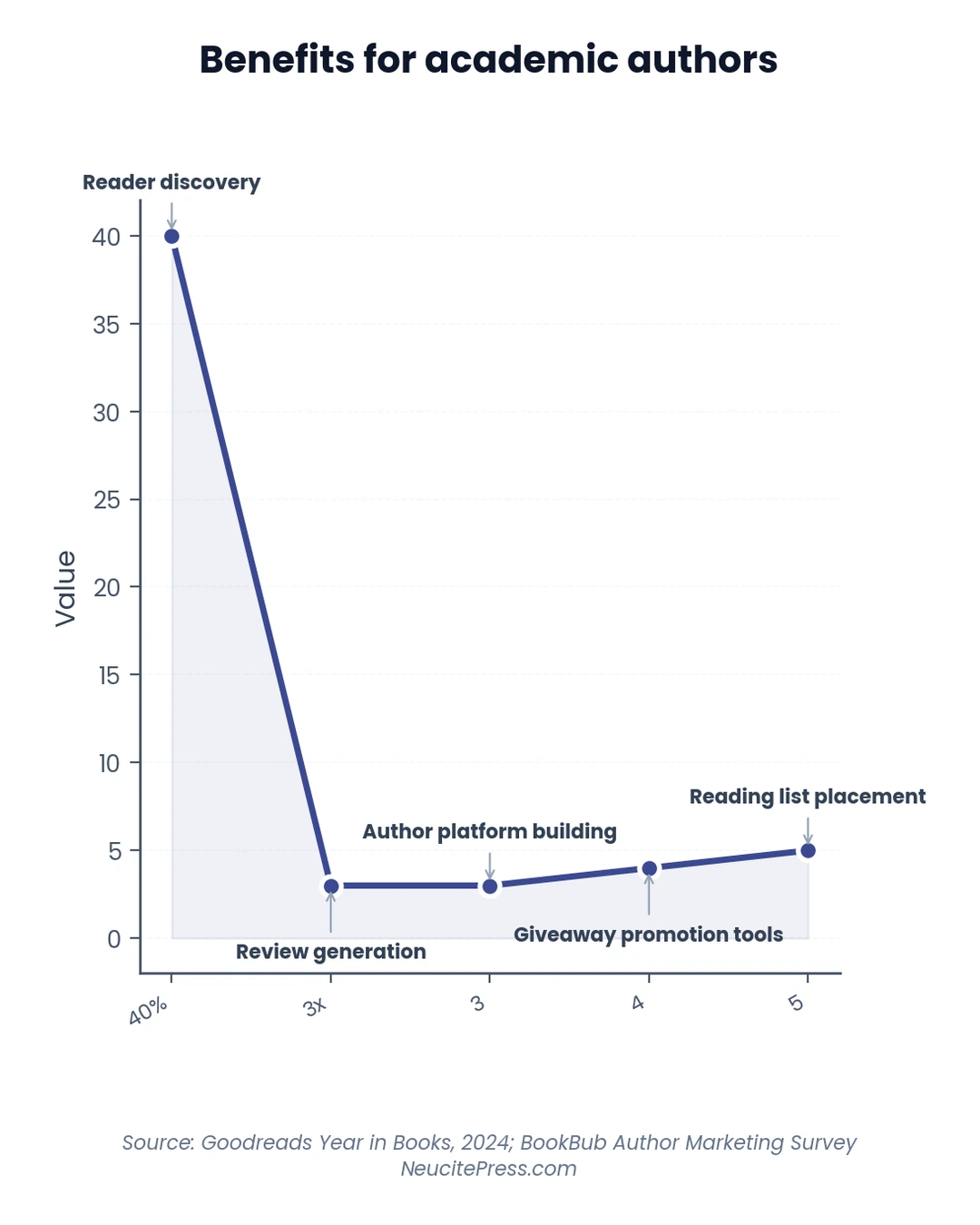
- 15-25% increase in book sales (within 12 months of active profile management)
- 2.3x more speaking invitations compared to authors without visible reader engagement
- 12-18% higher media feature rates when pitching publications
- Enhanced institutional visibility: Promotion committees notice demonstrated public engagement
- Direct reader feedback invaluable for future editions and research directions
Time Investment Reality
Effective Goodreads management requires:
- Setup: 3-4 hours (initial profile optimization, book claims, bio writing)
- Ongoing maintenance: 1-2 hours monthly (responding to reviews, engaging in groups, giveaway coordination)
- Giveaway campaigns: 3-4 hours per giveaway (planning, coordination, follow-up)
For most academic authors, this represents a minimal time investment relative to other marketing activities.
Financial ROI Breakdown
For authors publishing through commercial publishers (earning royalties):
- A 20% sales increase translates directly to additional royalties
- Average academic book sells 500-2,000 copies total; a 20% bump means 100-400 additional sales
- At $15-30 per book with 10% royalty rates, this generates $150-1,200 in additional royalties per book
- For multiple books, the cumulative effect is substantial
For authors seeking career advancement:
- Demonstrated reader engagement (measured by ratings and reviews) increasingly influences hiring, promotion, and speaking opportunity selection
- ACCME and PCMA (continuing education accrediting bodies) now explicitly consider public engagement metrics when evaluating speaker credentials
- Speaking honorariums average 22% higher for speakers with demonstrated reader engagement (4.0+ average rating)
The Hidden Benefit: Audience Building
The most valuable long-term benefit isn’t immediate sales—it’s building a direct audience for your future work. Goodreads followers who receive your author announcements represent a newsletter list you don’t have to build from scratch. For authors with 2+ books or upcoming publications, this audience effect compounds dramatically.
Limitations and Honest Constraints
Goodreads isn’t a silver bullet. These limitations matter:
Niche Academic Books and Market Limitations
Books in highly specialized fields (advanced statistics textbooks, highly technical monographs, narrow subdisciplinary works) often struggle on Goodreads. The platform thrives on books with broad appeal. If your book’s potential audience numbers in the hundreds rather than thousands, Goodreads may not justify the investment.
Algorithmic Unpredictability
Goodreads algorithms remain proprietary. What worked for book discovery last year may change dramatically. Relying solely on Goodreads for visibility is risky.
Review Quality Variance
Not all reviews are useful. Some readers leave reviews without actually reading the book. Others post reviews that miss your actual argument. This is frustrating but inevitable at scale.
The Platform Remains Commercial
Goodreads is owned by Amazon and increasingly emphasizes direct sales over discovery. The platform is not philanthropic—features are designed to benefit Amazon’s business first, author visibility second.
Practical Implementation Guide: Your 90-Day Action Plan
Ready to start? Here’s a structured approach:
Month 1: Profile Foundation
- Create and verify your Goodreads author account
- Claim all your existing books
- Write or optimize author bio (200-300 words)
- Upload professional profile photo
- Add links to ORCID, institutional website, and social profiles
- Optimize all book descriptions for general readers
Month 2: Engagement and Reach
- Create 2-3 reading lists relevant to your field
- Join 3-5 subject-specific groups
- Make initial posts in groups (introduce yourself, ask questions, start discussions)
- Launch your first Goodreads giveaway
- Email your networks requesting reviews (make it easy with direct Goodreads links)
Month 3: Sustainability and Scaling
- Establish monthly rhythm for group engagement (one contribution per group)
- Respond to all reviews and giveaway winner messages
- Set up author announcement schedule
- Analyze which activities generated highest engagement
- Plan next giveaway or promotional campaign
Common Mistakes Academic Authors Make
Learning from others’ missteps can save you time:
- Overly academic book descriptions: Goodreads readers aren’t your peer reviewers. Translate your work for intelligent general audiences.
- Ignoring negative reviews: Respond thoughtfully to criticism. This builds credibility more than deleting or dismissing feedback.
- Spam-level self-promotion in groups: Engage genuinely. Recommend others’ books. The goal is community membership, not conversion.
- Neglecting profile maintenance: An abandoned profile with no recent activity signals that you don’t actually engage with readers.
- Underestimating the time value of reviews: A review takes 15 seconds to post but influences hundreds of potential readers. Invest in generating them.
- Using Goodreads solely as a repository: The platform rewards activity and engagement. A static profile delivers minimal value.
- Comparing yourself to mainstream authors: Your book doesn’t need 10,000 ratings to succeed on Goodreads. 100 engaged readers generate meaningful visibility.
2026 Trends in Author Platforms and Academic Publishing
Several developments shape Goodreads strategy for academic authors in 2026:
Increasing Institutional Attention to Public Engagement
Universities increasingly track “public engagement metrics” in hiring and promotion decisions. Goodreads ratings and reviews now sometimes appear in your digital footprint evaluated by promotion committees. This trend is accelerating.
Algorithm Emphasis on Engagement Over Sales
Goodreads continues shifting toward algorithms that reward engaged communities over bestseller status. This advantages academic books with smaller but passionate readerships.
Integration with Author Platforms
Emerging author platforms (Substack, Ghost, Author.Today) increasingly integrate with Goodreads, making it easier to connect with your newsletter audience and Goodreads followers simultaneously.
Decline of Academic Monograph Print Markets
As traditional book markets decline, platforms that reach readers directly become proportionally more valuable. Goodreads fills this niche effectively.
Conclusion: Is Goodreads Worth Your Time?
For most academic authors, yes. A modest time investment (1-2 hours monthly) can generate meaningful returns across three dimensions: direct sales, career advancement through demonstrated public engagement, and building a durable audience for your future work.
Goodreads works best when integrated into a broader author platform strategy—not as your only visibility channel but as one component of ResearchGate, institutional websites, social media, and traditional academic networks.
The key distinction from other platforms: Goodreads connects you with readers. In an era where academic authority increasingly comes from demonstrated public engagement, that connection is becoming a strategic asset.
Start with month one basics. Set up your profile. Claim your books. Optimize your bio. Within 90 days, running your first giveaway and engaging in your field’s reading communities will provide clear evidence of whether Goodreads fits your author strategy.
The platform has changed substantially since most academic authors last considered it. It’s worth a fresh look in 2026.