How to Hire a Research Assistant for Your Book Project: Complete 2026 Guide
Writing a book is demanding enough. Adding intensive research to your workload can paralyze even the most dedicated author. Many writers spend more time gathering sources than actually writing—and that’s where the right research assistant makes all the difference.
Reviewed by the NeucitePress Editorial Board — PhD academics, peer-reviewed editors and subject-matter specialists.
In 2026, finding qualified research support has become easier than ever, but knowing who to hire and how to manage that relationship takes strategy. This comprehensive guide walks you through every step of hiring a research assistant for your book project, from identifying your needs to managing the ongoing partnership.
Why Authors Need Research Assistants: The Numbers
Let’s start with the reality. Industry studies consistently show that authors dedicate approximately 60% of their total project timeline to background investigation, fact-checking, and administrative duties—not writing. For some genres, that percentage climbs even higher.
Research-heavy projects like historical non-fiction can allocate 65-70% of total time to investigation alone. Meanwhile, the writing portion—your actual creative work—gets squeezed into 25-30% of the timeline. This imbalance frustrates authors and delays publication.
A skilled research assistant changes this equation dramatically. By delegating investigation work, authors report completing projects 40-60% faster while maintaining higher quality standards. That’s not just about saving time; it’s about preserving your sanity and your writing momentum.
When Research Assistants Make the Most Impact
| Book Genre | Research Time | Ideal for Assistant? | Expected Time Savings |
|---|---|---|---|
| Historical Non-Fiction | 65% | Essential | 50-60% |
| Academic Publication | 60% | Essential | 45-55% |
| Biography/Memoir | 55% | Highly Recommended | 40-50% |
| Scientific Documentation | 70% | Essential | 50-65% |
| Literary Fiction | 20-30% | Optional | 15-25% |
Understanding What a Research Assistant Actually Does
Before you start interviewing candidates, you need a clear picture of what a research assistant brings to your project. Many authors confuse this role with a ghostwriter, virtual assistant, or editor—but they’re distinctly different.
A research assistant specializes in the systematic acquisition, verification, and organization of information. Their core work includes:
- Literature reviews that identify relevant sources and synthesize existing research
- Source verification that confirms facts across multiple databases and publications
- Data organization through annotated bibliographies and research summaries
- Primary source identification for interviews, archives, and historical documents
- Fact-checking that verifies claims before they enter your manuscript
- Citation formatting ensuring consistency with your chosen style guide
Research Assistant vs. Other Author Support Roles
| Role | Primary Function | Cost Range | Your Creative Control |
|---|---|---|---|
| Research Assistant | Gathers verified information | $30-75/hour | 100% retained |
| Ghostwriter | Writes manuscript content | $20,000-100,000+ | Shared or delegated |
| Virtual Assistant | Administrative tasks | $15-30/hour | N/A |
| Editor | Refines completed work | $40-150/hour | Final approval required |
The key distinction: you remain the author. Your voice, vision, and creative decisions stay intact. The assistant provides the raw materials you need to write confidently and comprehensively.
Assessing Your Book Project’s Research Needs
Not every book needs the same level of research support. Before you start hiring, honestly evaluate your specific requirements.
The Research Needs Assessment Framework
Answer these questions to determine your assistant needs:
- Genre and subject matter: How research-heavy is your topic? (Historical events require more work than contemporary narrative fiction.)
- Timeline urgency: Do you need the book completed in 6 months or 2 years? (Tight deadlines require more assistant hours.)
- Your expertise level: Are you writing in a familiar field or learning entirely new material?
- Audience expectations: Does your readers demand academic-level rigor or journalistic standards?
- Source complexity: Will you need database access, primary documents, or expert interviews?
For example, a historical non-fiction author covering 1920s America needs extensive archive research, multiple historical databases, and cross-referencing of primary sources. A contemporary fiction writer exploring modern workplace dynamics might only need current industry practices verified.
Calculating Your Research Hours
Estimate total research hours based on your book’s scope:
- 20,000-30,000 word project with light research: 30-50 hours
- 40,000-60,000 word project with moderate research: 60-100 hours
- 80,000+ word project with heavy research: 120-200+ hours
This estimate helps you budget and understand the scale of support you actually need.
Where to Find Qualified Research Assistants
In 2026, the talent pool for research support has expanded dramatically. You have access to professionals across platforms, expertise areas, and experience levels.
Best Platforms for Hiring Research Assistants
Start with professional networks. LinkedIn’s search function lets you find people with specific expertise and experience. Search for:
- “Research assistant + author”
- “Book researcher” + your subject area
- “Academic researcher” + freelance
Check their recommendations, endorsements, and activity level. Current profiles indicate active professionals. Review their posts and articles to assess their knowledge depth.
Specialized Freelance Platforms
Websites like Upwork, Fiverr, and Reedsy host research professionals with portfolios. Look for:
- Detailed client reviews and project history
- Specialization in your subject area
- High ratings for accuracy and communication
- Relevant portfolio examples
These platforms offer protection through escrow systems and dispute resolution. Start with smaller projects to test compatibility before full commitment.
Author Service Communities
Organizations like the Society for Authors, Writer’s Digest networks, and genre-specific author communities often have referral lists. Ask published authors in your genre for recommendations—personal referrals are gold.
University Networks
Graduate students and recent PhDs need research work. Contact university writing centers, graduate programs in your subject area, or library reference departments. These candidates often bring advanced research training.
Publishing Associations
Groups like the Author’s Guild and genre-specific associations (mystery writers, romance authors, etc.) maintain member directories. These professionals understand author workflows and industry standards.
Red Flags When Researching Candidates
Watch out for these warning signs:
- Profiles with no portfolio samples or client references
- Vague descriptions of past work or methodology
- Poor written communication in profile or initial contact
- Pricing that seems impossibly cheap or no discussion of rates
- Unwillingness to discuss their process or answer questions
- No mention of confidentiality agreements or professional standards
Evaluating and Interview Candidates Effectively
Finding a name is just the start. The interview and evaluation process determines whether you’re hiring the right person for your project.
Key Skills to Assess
During interviews, evaluate these core competencies:
- Methodological expertise: Can they articulate their research process? Do they understand proper citation methods?
- Source evaluation: Can they distinguish between credible and questionable sources? Do they understand peer review and academic standards?
- Organization: How do they handle large volumes of information? What systems do they use for tracking sources?
- Communication: Can they explain complex information clearly? Will they communicate regularly about progress?
- Subject matter knowledge: Do they have experience in your genre or subject area?
- Technical proficiency: Are they comfortable with databases, project management tools, and collaborative software?
Interview Questions That Matter
Go beyond “Tell me about yourself.” Ask specific, revealing questions:
- “Walk me through your process for fact-checking a claim you encounter during research.”
- “Describe a time you found conflicting information from two sources. How did you handle it?”
- “What’s your experience with [your specific subject area]?”
- “How do you stay organized when managing research for multiple books simultaneously?”
- “What citation formats are you comfortable with? How do you keep citations consistent?”
- “If I request information in a specific format or organization, how do you handle that?”
- “What’s your typical turnaround time for research requests?”
- “Have you worked with authors before? What was that experience like?”
Checking References Properly
Don’t skip this step. Contact previous clients and specifically ask:
- Was the research accurate and thorough?
- Did they meet deadlines consistently?
- How was their communication and responsiveness?
- Would you hire them again for another project?
- What surprised you about working with them (positive or negative)?
Trust your gut. If a reference sounds lukewarm, keep interviewing.
Understanding Compensation: Pricing Models and Rates
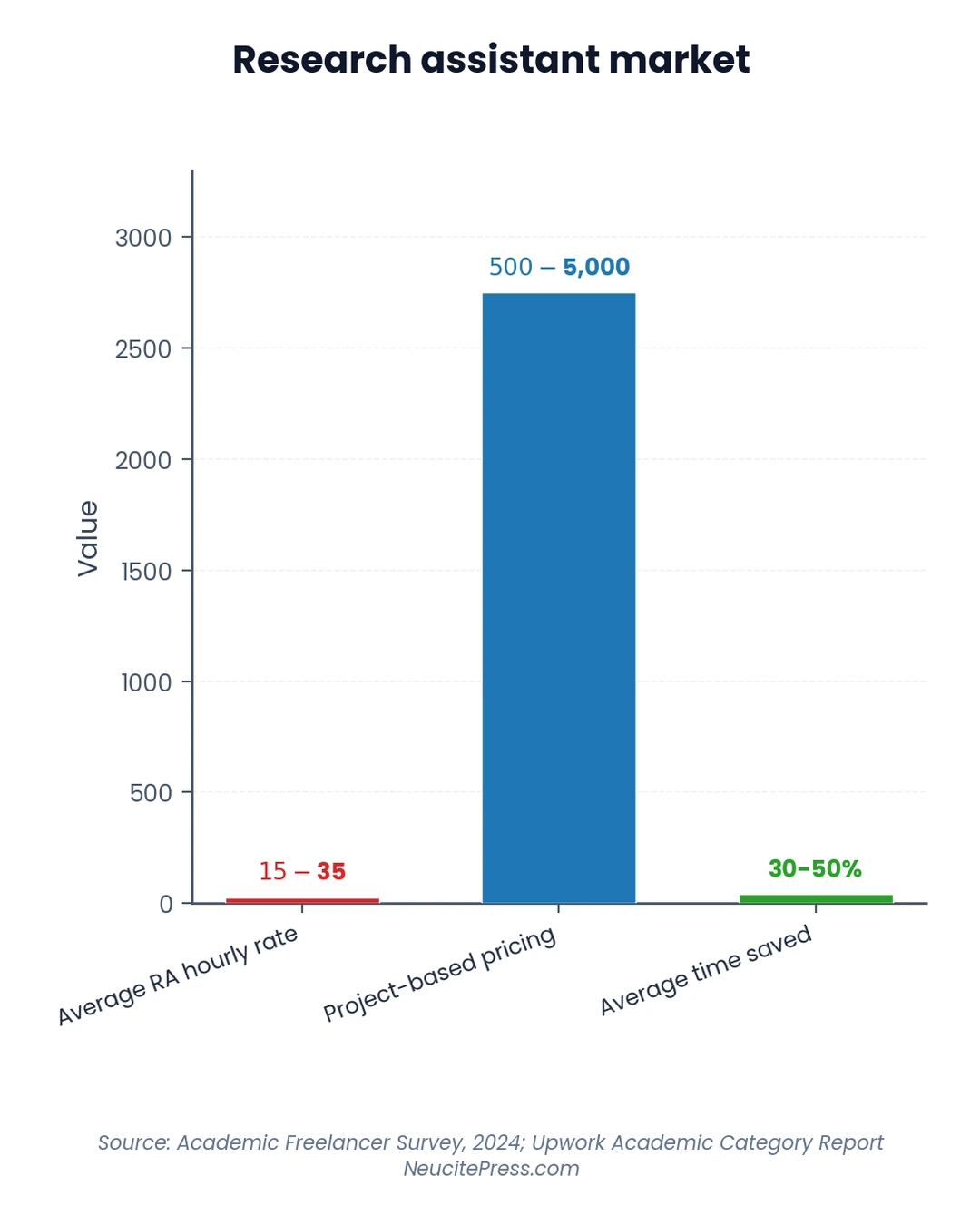
Research assistant costs vary widely based on experience, expertise, location, and project complexity. Understanding pricing models helps you budget accurately.
Common Pricing Structures
Hourly Rates
Most research professionals charge hourly rates:
- Emerging professionals: $25-40/hour
- Experienced assistants: $40-60/hour
- Subject matter experts: $60-100+/hour
Hourly rates work well for variable project scopes where you don’t know exact research requirements upfront.
Project-Based Fees
Some assistants offer fixed project rates:
- Complete literature review: $500-2,000
- Primary source research (20-40 hours): $1,000-3,000
- Full book research (80-120 hours): $3,000-8,000
Project fees work best when you have a clear scope and timeline.
Retainer Models
Monthly retainers provide predictable costs:
- 10 hours/month: $300-600
- 20 hours/month: $600-1,200
- 40 hours/month: $1,200-2,500
Retainers work for long-term projects where you need consistent support.
Factors That Affect Pricing
- Subject matter expertise: Specialists in medicine, law, or science cost more than general research assistants
- Geographic location: US and UK professionals typically charge more than those in other countries
- Experience level: PhDs and veteran researchers command premium rates
- Specialized database access: Some research requires expensive subscriptions
- Timeline urgency: Rush projects typically cost 20-30% more
- Language requirements: Research in multiple languages increases cost
The ROI on Hiring
Calculate the financial case for hiring. If research support costs $3,000 and saves you 60 hours of research time, that’s $50/hour value. If you typically earn $75-150/hour from your writing, the math makes sense. You’re freeing yourself to do higher-value work.
Virtual vs. In-Person: Which Model Works Better?

The remote work revolution has made virtual research assistants the norm, but some authors still prefer in-person collaboration. Let’s examine both models.
Virtual Research Assistants: The Modern Standard
Advantages:
- Access to global talent pool—find the perfect fit regardless of location
- Cost efficiency—no overhead for office space or equipment
- Scheduling flexibility—easier to find overlap for async collaboration
- Technology-enabled—seamless file sharing and project management
- Proven effectiveness—remote research work is just as thorough as in-person
Challenges:
- Timezone differences can complicate real-time communication
- Requires reliable digital infrastructure and tools
- Less personal rapport than in-person collaboration
- Depends entirely on written communication clarity
In-Person Research Assistants
Advantages:
- Face-to-face communication reduces misunderstandings
- Immediate collaboration on complex discussions
- Direct oversight of work and processes
- Shared physical workspace can enhance relationship
Challenges:
- Geographic limitations—only find candidates in your area
- Higher costs due to location and commute
- Scheduling conflicts and commute time
- Less flexibility for both parties
The recommendation for 2026: Virtual assistants offer clear advantages for most authors. The technology is mature, the talent pool is deep, and the cost-benefit is favorable. Reserve in-person collaboration for authors with highly complex visual research or those in the same geographic area.
Setting Clear Expectations and Defining Responsibilities
Once you’ve hired your research assistant, the next critical step is establishing crystal-clear expectations. Vague agreements lead to misunderstandings, missed deadlines, and frustration.
Essential Elements of Your Working Agreement
Document these items in writing, even if you’re working with a friend:
- Scope of work: Exactly what research tasks will they handle?
- Compensation: Rate, payment schedule, expenses covered?
- Timeline: Project duration and weekly hour expectations?
- Deliverables: What format will research be provided? How organized?
- Communication protocol: How and when will you check in?
- Revisions: How many revision rounds are included?
- Confidentiality: Will the manuscript be under NDA?
- Intellectual property: You own the book; assistant retains no rights
- Feedback mechanism: How will you provide feedback if work doesn’t meet expectations?
Establishing Research Standards
Be specific about what “quality research” means for your project:
- Citation style: Chicago, APA, MLA, or Harvard?
- Source credibility requirements: Peer-reviewed only? Trade publications acceptable?
- Minimum number of sources per claim: One source? Two independent confirmations?
- Handling conflicting information: Should they resolve it or present both sides?
- Currency requirements: How recent must sources be?
- Organization preferences: Spreadsheets? Annotated documents? Research summaries?
Communication Framework for Success
Set up structured communication from day one:
- Weekly check-in calls (even 15 minutes helps alignment)
- Dedicated project management tool (Asana, Trello, or similar)
- Clear process for research requests (submit through the tool, not random emails)
- Defined turnaround times for different types of requests
- Monthly progress reviews to assess what’s working
Protecting Your Book and Your Partnership: NDAs and IP Agreements
You’re sharing your unpublished manuscript with someone. Protect it properly.
Confidentiality and Non-Disclosure Agreements
For unpublished work, use a simple NDA covering:
- Manuscript remains confidential during development
- No sharing with third parties without written permission
- Confidentiality survives even after the working relationship ends
- Assistant cannot claim authorship or ownership rights
- Defines what happens to materials after project completion
Many freelance platforms provide standard NDA templates. Have a lawyer review if your book involves sensitive information (proprietary business details, personal stories, etc.).
Intellectual Property Clarity
Make this crystal clear in writing:
- You own the completed manuscript and all work product
- Assistant can acknowledge the role in your acknowledgments (if you choose)
- Assistant cannot republish research or claim contributor status
- You retain publication rights to all gathered information
This protects both parties and prevents future disputes.
The Art of Delegation: Getting the Most From Your Partnership
Hiring the right person is only half the battle. How you work together determines whether the relationship thrives or struggles.
Effective Delegation Practices
- Be specific with requests: “Find information about 1950s shoe manufacturing techniques” is better than “Research shoes.”
- Provide context: Explain why you’re asking for specific information and how you’ll use it
- Give feedback promptly: If research isn’t meeting expectations, address it quickly
- Appreciate good work: Acknowledge when your assistant excels
- Trust their expertise: If they recommend a better research approach, listen
- Keep them informed: Share manuscript changes that affect their work
Common Delegation Mistakes to Avoid
- Micromanaging: Check results, not methods. Trust their process
- Moving goalposts: Changing requirements mid-project without discussion
- Vague requests: Assuming they’ll understand what you mean without explanation
- Neglecting communication: Disappearing for weeks creates uncertainty
- Underpaying: Cheap assistants deliver cheap work
- No appreciation: Taking good work for granted leads to declining quality
Working With Graduate Students and Academic Researchers
Graduate students and academic researchers bring special advantages but require understanding their context.
Why Graduate Students Make Excellent Research Assistants
- Advanced training: They understand research methodology at a high level
- Subject expertise: Grad students in your field understand the nuances
- Cost efficiency: Often less expensive than established professionals
- Recent knowledge: Current with latest research and sources
- Academic standards: Familiar with rigorous citation and documentation
Considerations and Best Practices
- Timing: Grad students have semester schedules. Plan accordingly
- Workload: They may have limited hours during academic periods
- Supervision: They may need more direction than experienced professionals
- Communication: Email may be more reliable than phone for scheduling
- Professional experience: This might be their first independent contract work
- Growth opportunity: You’re potentially mentoring a future colleague
Find graduate students through:
- University research centers in your field
- Graduate program departments
- University job boards and listservs
- Faculty recommendations in your subject area
- Conference and networking events
Technology and Project Management Tools
The right tools transform collaboration from chaotic to seamless. Choose platforms both you and your assistant are comfortable using.
Recommended Project Management Platforms
- Asana: Excellent for detailed task tracking, progress visibility, and deadline management
- Trello: Simple Kanban boards work great for research workflow visualization
- Monday.com: Good for collaborative timeline projects with integrated communication
- Notion: Perfect if you want research notes and project management integrated
- Google Workspace: For shared documents and real-time collaboration on research notes
Communication and File Sharing
- Email: Use for formal communications and project kickoff
- Slack: Daily check-ins and quick questions
- Google Drive/Dropbox: Secure file sharing with version control
- Zoom: Weekly calls for complex discussions
Pro tip: Combine tools strategically. Use the project tool for structured work tracking, Slack for quick communication, and Google Drive for document collaboration.
Maintaining Quality and Data Integrity Throughout Your Project
Quality control is ongoing, not something you check at the end. Build it into your process.
Quality Checkpoints
- Initial sample review (week 1-2): Evaluate a small sample of research to confirm understanding of your expectations
- Mid-project review (week 4-6): Assess methodology, organization, and accuracy. Adjust expectations if needed
- Final verification (before completion): Spot-check sources and verify accuracy before you incorporate into manuscript
Source Verification Best Practices
Insist your assistant:
- Cross-references facts across multiple sources when possible
- Notes source quality (peer-reviewed vs. journalistic vs. anecdotal)
- Flags conflicting information rather than choosing one version
- Includes full citations and URLs for every source
- Notes when information is from primary vs. secondary sources
- Identifies potential biases in sources
Documentation Standards
Require:
- Full citations in your chosen format
- Page numbers or timestamp references
- Brief notes about each source’s relevance
- Organized by chapter or topic
- Consistent formatting throughout
Advanced Considerations: Remote Work and Compliance
For specialized projects (medical, legal, financial), additional considerations apply.
When Professional Credentials Matter
If your book involves regulated industries, verify credentials:
- Healthcare/medical writing: Experience with HIPAA considerations
- Legal topics: Understanding of legal research databases and citation
- Financial/investment content: Awareness of regulatory guidelines
- Scientific research: Familiarity with peer review and research methodology
Asking appropriate questions during interviews helps identify qualified candidates.
Data Security for Sensitive Projects
- Use encrypted file sharing for sensitive information
- Discuss data deletion after project completion
- Verify they won’t keep copies of your manuscript
- Consider requiring background checks for highly sensitive work
Pricing, Budgets, and Long-Term Collaboration
Plan for research support as a line item in your book budget, just like editing or cover design.
Sample Budget Scenarios
- Small project (30,000 words, light research): $800-1,500 (30-50 hours @ $30-40/hr)
- Medium project (60,000 words, moderate research): $2,400-4,000 (60-100 hours @ $40-50/hr)
- Large project (90,000+ words, heavy research): $5,000-12,000 (100-200 hours @ $50-75/hr)
Building Long-Term Partnerships
Consider ongoing relationships after your first book:
- Experienced assistants become faster and better with each project
- They learn your preferences and standards over time
- You avoid repeated hiring and onboarding cycles
- Loyalty often leads to more flexible arrangements
- Regular work creates relationship stability
Many authors hire the same research assistant for multiple books, creating a true partnership.
Real-World Examples: How Authors Successfully Hire Research Assistants
Learning from other authors’ experiences saves time and prevents mistakes.
Case Study: Historical Non-Fiction Author
Sarah, writing a 95,000-word history of women in WWII, needed extensive primary source research. She hired a graduate student in history ($45/hour) for 120 hours over 6 months. Cost: $5,400. Result: 800+ verified sources organized by chapter, saving her 4 months of research time and enhancing manuscript credibility.
Case Study: Science Writer
Marcus, updating a technical guide on renewable energy, needed current research from the past 18 months. He hired a science journalist ($65/hour) for 40 hours. Cost: $2,600. Result: 150+ recent peer-reviewed sources, regulatory updates, and expert interview suggestions that strengthened his manuscript significantly.
Case Study: Multiple Genre Author
Jennifer, writing both fiction and non-fiction, built a retainer relationship with a virtual assistant ($50/hour, 15 hours/month). Cost: $750/month or $9,000/year. Result: Consistent research support, faster manuscript completion, and the ability to take on more projects annually.
Conclusion: Your Path to Faster, Better Book Projects
Hiring the right research assistant transforms your author life. You’ll write faster, worry less about accuracy, and actually enjoy the research portions of your project instead of drowning in them.
The process—from identifying your needs through hiring, onboarding, and collaborating—takes intention and clarity. But the payoff is substantial: faster book completion, higher quality work, and the ability to maintain your creative momentum.
Start by assessing your specific project needs. Then move through the hiring process systematically, checking references and conducting thorough interviews. Set clear expectations in writing, invest in good collaboration tools, and maintain quality standards throughout.
The right research assistant becomes an invaluable partner in bringing your book to life. In 2026, with access to global talent and proven remote collaboration methods, finding that partner is easier than ever.
FAQ
How much does it cost to hire a research assistant for a book?
Research assistants typically charge $30-75 per hour, or $1,000-12,000+ for a complete project depending on scope and complexity. A 60,000-word non-fiction book with moderate research might run $2,500-5,000. Factor this into your publishing budget like you would editing or cover design.
What’s the difference between a research assistant and a ghostwriter?
A research assistant gathers and verifies information. A ghostwriter writes the actual manuscript content. With research support, you retain 100% creative control. With a ghostwriter, they’re writing your book. Choose research assistance if you want to write it yourself.
Can virtual assistants effectively research for a fiction book?
Absolutely. Even fiction needs research for accuracy—historical details, professional settings, scientific facts. Virtual assistants excel at verifying these details quickly. They’re just as effective as in-person for most research work.
How many hours per week should I budget for a research assistant?
It depends entirely on your project. Start by estimating total research hours needed (light projects: 30-50 hours, moderate: 60-100 hours, heavy: 120-200+ hours), then spread across your writing timeline. Many authors use 5-15 hours per week for 4-6 months.
Where’s the best place to find research assistants?
LinkedIn, Upwork, and Reedsy are excellent starting points. For subject-specific expertise, try university networks, graduate programs, and author communities. Personal recommendations from other authors are often your best source.
What questions should I ask when interviewing candidates?
Ask about their research process, source evaluation methodology, organization systems, experience with your subject area, citation familiarity, and references. Ask for specific examples of how they’ve handled challenging research tasks. Listen for clear, articulate answers.
Should I sign a contract with my research assistant?
Yes, even for casual relationships. Document compensation, timeline, scope, confidentiality, and intellectual property ownership. This protects both parties and prevents misunderstandings. Standard freelance contracts are available online.
How do I know if a research assistant is actually qualified?
Check references from previous clients, review portfolio examples, verify subject matter expertise, assess their ability to explain research methodology clearly, and look for evidence of continued professional development in their field.
Can I hire a research assistant for just one chapter?
Yes! Some assistants offer project-based rates. You could hire for a specific chapter or research topic. This is a good way to test the relationship before committing to a full book.
What project management tools work best for this collaboration?
Asana, Trello, Monday.com, and Notion all work well. Choose based on your preference for complexity vs. simplicity. Combine with Slack for communication and Google Drive for document collaboration. The best tool is one you’ll both actually use consistently.