Journal Retraction Policy: COPE-Compliant Template and Guide
Retraction rates in scholarly publishing have increased by over 400% in the past decade. This alarming trend highlights the critical need for a robust journal retraction policy that protects academic integrity. Trust in scholarly communication depends on transparent protocols when research concerns arise.
Reviewed by the NeucitePress Editorial Board — PhD academics, peer-reviewed journal editors and medical communication specialists.
We understand the complex challenges editors and publishers face. Determining whether an article requires full retraction versus correction can be difficult. Institutional and reputational implications add further complexity to these decisions.
Our framework aligns with standards from Wiley, Sage, and the National Library of Medicine. We provide comprehensive guidance for handling post-publication amendments. This includes protocols for retractions, withdrawals, and expressions of concern.
Disclaimer: While we offer expert guidance on publication ethics, specific legal matters should be reviewed with qualified counsel. Our templates provide industry best practices but require customization for your specific context.
Download our COPE-compliant template today to strengthen your editorial processes. Subscribe for ongoing updates in publication ethics and join our community of publishing professionals committed to research integrity.
Key Takeaways
- Retraction rates have increased significantly over the past decade
- Clear protocols are essential for maintaining trust in scholarly publishing
- Editors face complex decisions when research integrity concerns arise
- Our framework aligns with major publisher standards including Wiley and Sage
- Professional legal counsel should review specific compliance requirements
- Downloadable templates provide practical implementation tools
- Ongoing updates help maintain current best practices
Introduction: The Impact of Retraction on Academic Integrity
When published studies contain unreliable data, the entire scholarly ecosystem suffers from cascading effects that undermine research credibility. A 2023 analysis by Nature revealed that each retracted article influences an average of 17 subsequent studies that cited the flawed work.
This creates a domino effect throughout academic literature. The integrity of scientific communication depends on timely correction of unreliable findings.
Retraction serves as a protective mechanism, not punishment. It ensures that misleading information doesn’t perpetuate through the research pipeline.
We analyze how different retraction causes affect the scholarly community. The table below compares key distinctions:
| Retraction Type | Primary Cause | Average Resolution Time | Community Impact |
|---|---|---|---|
| Misconduct-Based | Data fabrication, plagiarism | 3.2 years | Severe reputational damage |
| Honest Error | Calculation mistakes, experimental errors | 2.1 years | Moderate citation disruption |
| Ethical Violations | Authorship disputes, redundant publication | 2.8 years | Variable institutional consequences |
Transparent communication maintains reader trust during these processes. Proper protocols protect all stakeholders in the publication ecosystem.
Our framework addresses these complex challenges with evidence-based approaches. We prioritize both scientific accuracy and fair treatment of authors.
Understanding COPE Guidelines and Ethical Standards in Scholarly Publishing
The Committee on Publication Ethics sets the international benchmark for handling research integrity concerns. These guidelines establish clear protocols across diverse disciplines and publisher platforms.
Insights from Wiley, Sage, and NLM
Leading publishers implement COPE principles through dedicated structures. Wiley’s Integrity Assurance team follows Best Practice guidelines updated in March 2025.
Sage investigates all concerns through established complaints procedures. This protects both authors and editorial integrity throughout the process.
| Organization | Primary Framework | Key Implementation | Indexing Impact |
|---|---|---|---|
| Wiley | COPE Best Practice Guidelines | Dedicated Integrity Assurance Team | Global database compliance |
| Sage | COPE & Internal Policies | Transparent Appeals Process | Cross-platform discoverability |
| NLM | ICMJE & COPE Standards | PubMed Indexing Requirements | Major database credibility |
Demystifying Complex Accreditation and Compliance Terms
NISO’s CREC standards ensure amendments remain permanently accessible. These technical requirements affect how content appears in major indexes.
Understanding these publication ethics frameworks is essential for editorial teams. They intersect with institutional review boards and data protection regulations.
Proper implementation builds reputation as trustworthy venues for rigorous research. This supports long-term credibility in the scholarly ecosystem.
Compliance and Correction Processes in Scholarly Publishing
The scholarly publishing ecosystem relies on precise protocols for handling different types of publication amendments. We distinguish four primary categories to address varying severity levels of concerns.
Retractions, Withdrawals, and Errata Explained
Retractions address fundamental flaws that invalidate article conclusions, while corrections fix errors affecting data interpretation without undermining research validity. This distinction helps editorial teams determine appropriate responses.
| Amendment Type | Primary Purpose | Typical Circumstances | Impact Level |
|---|---|---|---|
| Retractions | Address invalid conclusions | Data fabrication, serious errors | High impact |
| Corrections | Fix interpretation errors | Calculation mistakes, minor data issues | Moderate impact |
| Withdrawals | Remove content entirely | Privacy violations, legal requirements | Variable impact |
| Expressions of Concern | Flag ongoing investigations | Unresolved integrity questions | Temporary impact |
Ensuring Accuracy Through Post-Publication Amendments
We implement corrections differently based on publication stage. Early View articles may be corrected directly online, while published issue content requires separate correction statements.
Proper classification of amendments maintains both scientific accuracy and reader trust. Each correction type serves a distinct purpose in preserving research integrity.
Sage issues corrigenda for author errors and errata for publisher errors. All amendments must appear in citable form with proper pagination for database indexing. Minor copyediting errors typically don’t warrant formal corrections.
The version record receives strong protection under STM guidelines. Withdrawals apply mainly to exceptional circumstances affecting public safety or legal compliance.
journal retraction policy: Best Practices for Editors and Authors
Effective investigation protocols form the foundation of trustworthy academic publishing. We establish clear entry points for raising concerns about published articles through dedicated channels.
Editorial Investigation and Resolution Protocols
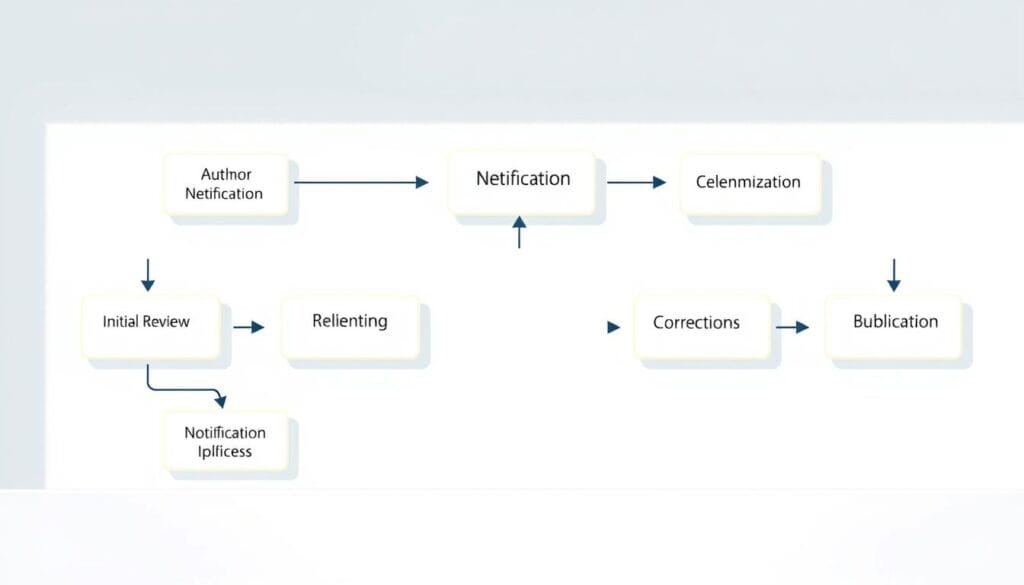
Our framework outlines comprehensive workflows for handling integrity questions. Editors begin by gathering evidence and notifying the author of the concern.
The table below compares key investigation approaches across major publishers:
| Publisher | Submission Channel | Investigation Timeline | Author Involvement |
|---|---|---|---|
| Wiley | Research Integrity Form | 30-60 days | Required response |
| Sage | Publication Ethics Email | 45-90 days | Comment opportunity |
| NLM | Editor discretion | Case-dependent | Varied participation |
We distinguish between errors requiring correction versus those warranting full retraction. Major flaws invalidating conclusions demand stronger action.
Thorough investigations, while demanding, safeguard the scholarly record and protect future research from building on unreliable findings.
Industry-Standard Guidelines and Expert Quotes
Authors maintain specific rights during proceedings. Sage provides comment opportunities but doesn’t require approval for final decisions.
Retraction notices must clearly identify the initiating party and reasons. This transparency maintains trust in the publication process.
We help editors navigate complex cases involving authorship disputes or plagiarism concerns. Our protocols ensure consistent, fair outcomes.
Leveraging Data-Driven Frameworks and Ready-to-Use Templates
Data-driven frameworks provide measurable benchmarks for optimizing post-publication amendment processes. We transform complex ethical guidelines into practical implementation tools that editorial teams can immediately apply.
Actionable Checklists and Downloadable Template Resources
Our comprehensive template package includes decision-making frameworks based on Wiley’s correction standards. Editors receive systematic checklists for evaluating each article concern.
The downloadable resources guide teams through the entire review process. They help determine appropriate responses based on error severity and impact on research validity.
Visual Aids and Benchmark Metrics
We provide Gantt charts mapping typical investigation timelines from initial concern to resolution. Budget

s outline resource allocation for managing integrity cases.
Our comparison tables contrast amendment types with specific implementation criteria. Data-driven benchmarks show average investigation duration and common resolution patterns.
Download our complete template package today to streamline your editorial workflows. Subscribe for ongoing updates on emerging best practices in publication ethics.
Enhancing Transparency: Linking, Indexing, and Citation Practices
Modern scholarly publishing relies on sophisticated linking systems to maintain transparency when articles require post-publication amendments. The National Library of Medicine (NLM) creates bidirectional connections in PubMed between original content and related notices.
These systems ensure readers can easily discover complete publication histories. For example, a retracted article displays “Retraction in:” linking to the notice, while the notice shows “Retraction of:” linking back.
Integrating Crossmark and NLM Citation Guidelines
Sage’s Crossmark button provides real-time updates on article status. This clickable feature shows whether content is current, has amendments, or was withdrawn.
NLM uses specific Publication Type tags for different amendments. Errata receive Published Erratum [PT], while expression of concern notices get distinct indexing. This structured approach maintains clarity across databases.
Proper implementation requires careful attention to submission formats. Publishers must use standardized phrases like “Correction of:” and “Update in:” for consistent indexing.
These practices protect the research community by ensuring amendments remain discoverable. They provide crucial context for understanding publication histories and maintaining trust.
Conclusion
Upholding research integrity requires systematic frameworks that maintain scholarly trust. Our comprehensive approach protects all stakeholders through transparent processes.
Leading organizations like Wiley and NLM demonstrate commitment to permanent record-keeping. Their March 2025 updates reflect evolving best practices.
We provide actionable templates for editorial teams. These resources help implement COPE-aligned guidelines effectively.
Download our complete package to strengthen your publication standards. Subscribe for ongoing updates in research ethics.
Professional legal counsel should review specific compliance requirements. Our templates offer industry guidance rather than legal advice.
Join our community committed to excellence in scholarly communication. Share your experiences and help advance publication integrity together.
FAQ
What is the primary purpose of a journal retraction policy?
The main goal is to preserve the integrity of the scholarly record. When serious errors or misconduct are confirmed, removing or clearly labeling a published article protects readers and the research community from relying on invalid findings.
How do COPE guidelines influence a publication’s approach to corrections?
The Committee on Publication Ethics provides a vital ethical framework. We follow their standards to ensure our processes for handling expressions of concern, issuing corrections, and managing retractions are fair, transparent, and consistent across all cases.
What is the difference between a retraction and an expression of concern?
An expression of concern is a temporary notice alerting readers to potential issues with an article while an investigation is ongoing. A retraction is a permanent action taken when the investigation confirms that the article’s conclusions are unreliable.
Can authors request a retraction of their own work?
Yes, authors can and should request a retraction if they discover significant errors or misconduct in their own work. This proactive approach demonstrates a commitment to research integrity and helps maintain trust in the scientific process.
What happens to the original version of a retracted article?
The original text remains accessible online but is clearly watermarked as “Retracted.” This version-of-record preservation, coupled with a detailed retraction notice, ensures transparency. Readers can see what was published and understand why it was withdrawn.
How do tools like Crossmark improve transparency for readers?
Services like Crossmark provide a clickable badge on published articles. When clicked, it immediately shows readers if any updates, such as corrections or retractions, have been applied, ensuring they always access the most current and accurate information.