
Large Medical Conference Logistics: Managing 1000+ Attendees
Medical conferences with 1,000+ attendees represent some of the most complex logistical undertakings in the healthcare industry. From the HIMSS Global Health Conference drawing 30,000-40,000 participants annually to the RSNA Annual Meeting welcoming over 50,000 healthcare professionals, these gatherings demand meticulous planning across multiple operational dimensions. Successfully orchestrating events of this magnitude requires strategic coordination of venues, technology infrastructure, compliance frameworks, and stakeholder expectations—all while delivering measurable ROI and advancing patient care through professional education and innovation.
Reviewed by the NeucitePress Editorial Board — PhD academics, peer-reviewed editors and subject-matter specialists.
Understanding the Scope and Scale of Large Medical Conferences
The healthcare event landscape has transformed dramatically over the past decade. Major conferences now serve as critical platforms for knowledge dissemination, professional networking, and industry collaboration. Understanding the true scale of these events is essential for planning success.
Conference Size and Economic Impact
Top-tier healthcare conferences generate substantial economic impact across their host cities and the healthcare industry broadly. Consider these benchmarks:
- HIMSS: 30,000-40,000 attendees annually, generating approximately $500 million in economic impact
- RSNA Annual Meeting: 50,000+ professionals, representing all facets of radiology and medical imaging
- ASCO: 40,000+ oncologists, researchers, and healthcare leaders
- CES Digital Health Summit: 19,000+ participants focused on digital innovation
- DDW (Digestive Disease Week): 14,000+ gastroenterology professionals
These events create multiplier effects—attendees spend on accommodations, dining, transportation, and local entertainment. Venues invest in infrastructure upgrades to support such large gatherings, benefiting their communities for years afterward.
Attendee Demographics and Expectations
Large medical conferences attract diverse professional cohorts: clinicians seeking CME credits, researchers presenting cutting-edge findings, executives evaluating business opportunities, investors scouting innovation, policymakers monitoring industry trends, and support staff coordinating operations. Each segment arrives with distinct learning objectives and networking goals.
Modern attendees expect seamless experiences: intuitive registration, clear wayfinding, reliable technology, curated educational content, and structured networking opportunities. Hybrid attendance models have raised expectations further—virtual participants expect broadcast-quality production and interactive engagement equivalent to in-person attendance.
Critical Logistical Challenges in Large Conference Planning
Managing a conference for 1,000+ attendees involves navigating interconnected challenges that demand expert coordination. Each element influences overall success and attendee satisfaction.
Venue Selection and Space Allocation
Selecting appropriate facilities represents the foundation for successful execution. Major convention centers typically offer 200,000-500,000 square feet of flexible space—but allocating this space effectively requires sophisticated planning.
Key considerations include:
- Meeting Rooms: 50-100 breakout sessions require dedicated spaces with varying capacities (50-2,000 attendees per room)
- Exhibition Halls: 200-500 vendor booths need separate, high-traffic areas with dedicated entry/exit points
- Networking Spaces: Lounges, meal areas, and informal gathering spaces enhance professional connections
- Technology Zones: Registration, information desks, charging stations, and tech support require strategic positioning
- Accessibility Infrastructure: Elevators, restrooms, wheelchair access, and family services must accommodate diverse attendees
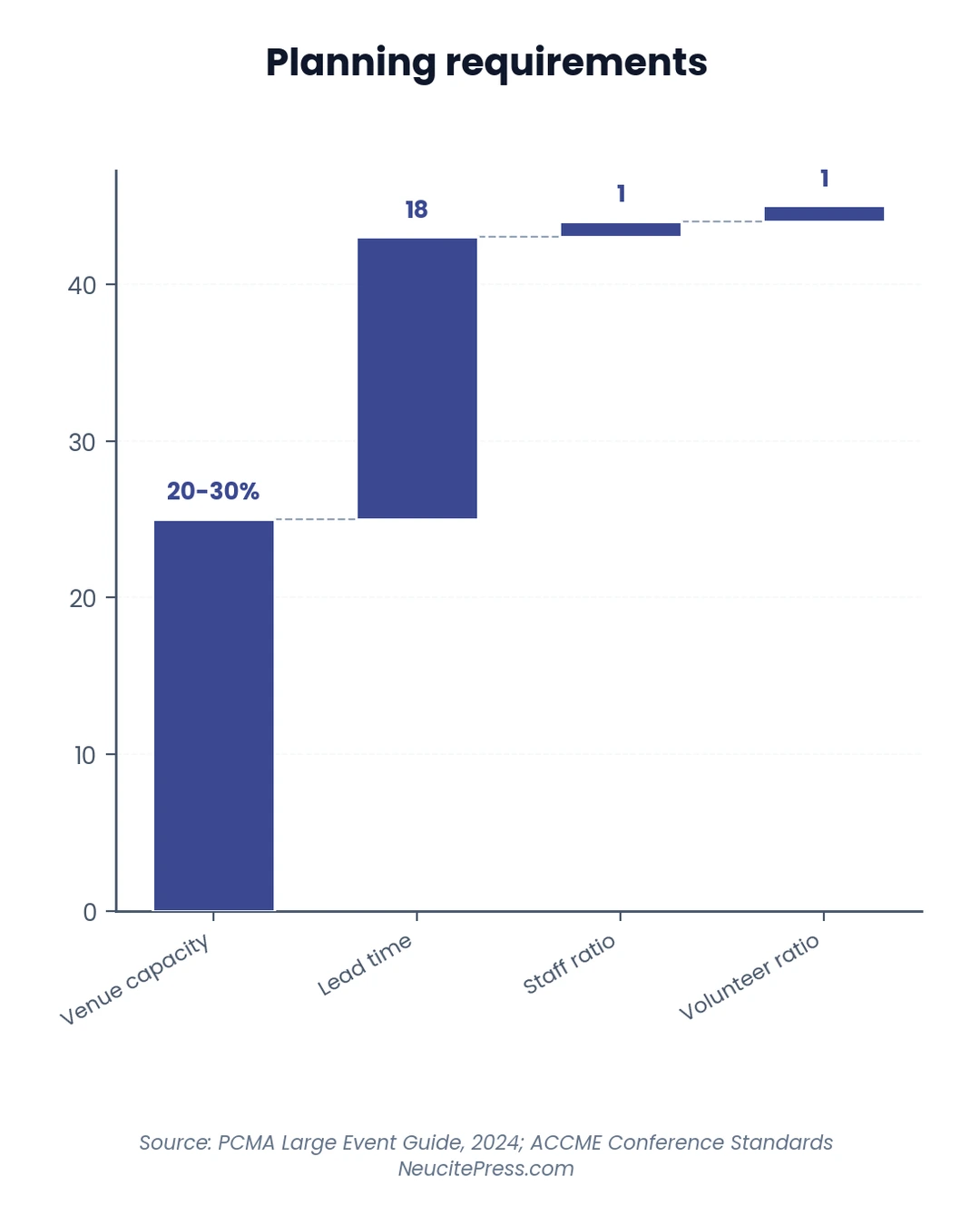
Venue contracts typically lock in pricing 18-36 months in advance. Major negotiation points include attrition clauses (penalties for lower-than-projected attendance), force majeure terms (cancellation flexibility), food and beverage minimums (often $50,000-$250,000), and insurance requirements ($2-5 million coverage standard).
Educational Programming and Speaker Management
Large conferences typically feature 300-600 educational sessions across 3-6 days. Coordinating this volume requires:
- Speaker recruitment 12-18 months prior to event
- Session scheduling optimizing time slots and room assignments
- Technical requirements management (AV equipment, presentation format standards)
- Speaker support: communication, travel arrangements, rehearsal coordination
- CME accreditation documentation for each educational activity
Speaker compensation varies significantly. Keynote presenters command $5,000-$25,000+, while session speakers typically receive $500-$2,500. Many academic speakers prefer alternative compensation models—conference fee waivers, travel stipends, or promotional opportunities for their research.
Hybrid Attendance Technology Infrastructure
Post-pandemic, hybrid models have become standard expectations. Supporting simultaneous in-person and virtual attendance requires robust infrastructure:
- Streaming Platform: Must handle 100+ concurrent streams with 99.9% uptime guarantee
- Internet Bandwidth: 1-5 Gbps capacity to prevent bottlenecks during peak sessions
- Audiovisual Systems: Professional-grade equipment in all meeting spaces (not consumer-grade setups)
- Backup Redundancy: Secondary power, internet connections, and equipment preventing single points of failure
- Interactive Features: Live polling, Q&A functionality, virtual networking lounges, chat moderation
Testing under load conditions is non-negotiable—failing to identify technical issues during full-capacity test runs invariably results in attendee frustration during the actual event.
CME Accreditation and Regulatory Compliance Framework
Healthcare professionals attend conferences primarily to earn continuing medical education (CME) credits. Meeting accreditation standards and regulatory requirements is not optional—it’s foundational to event success and participant satisfaction.
ACCME Accreditation Pathway
The Accreditation Council for Continuing Medical Education (ACCME) sets standards for CME providers. There are three primary accreditation models:
| Accreditation Model | Planning Timeline | Required Documentation | Credit Authority | Best For |
|---|---|---|---|---|
| Direct Accreditation (Full) | 6-8 months pre-event | Complete program validation with learning objectives | Organization awards credits directly | Established organizations with regular programming |
| Joint Accreditation | 8-12 months pre-event | Partnership agreements with accredited provider | Shared responsibility with partner | Organizations establishing accreditation infrastructure |
| Provisional Accreditation | 4-6 months pre-event | Preliminary review focusing on key standards | Limited initial credit authority | First-time accreditation seekers |
Each session must include documented learning objectives, faculty credentials, disclosure of conflicts of interest, and evaluation mechanisms. Educational activities must maintain independence from commercial interests—pharmaceutical companies cannot dictate content or speaker selection.
Regulatory Compliance Requirements
HIPAA Compliance: When researchers present clinical data, strict de-identification protocols apply. Patient information must be removed or rendered non-identifiable per HIPAA standards. Any breach exposes organizations to substantial penalties ($100-$50,000 per incident).
PhRMA Code Compliance: The Pharmaceutical Research and Manufacturers of America Code governs industry interactions with healthcare professionals. Key restrictions include:
- Entertainment cannot exceed $50 per meal equivalent
- Gifts are limited to branded items under $100
- Speaker payments must reflect fair market value
- Restrictions on company-sponsored travel for attendees
State Transparency Laws: Many states require reporting of payments to healthcare providers. Organizations must establish systems capturing and reporting all financial transfers.
Professional Disclaimer: While this guide provides educational context, organizers must consult qualified legal professionals and compliance specialists for definitive advice on regulatory requirements applicable to their specific event.

Venue Contracts and Hybrid Technology Implementation
Venue agreements and technology architecture form the operational backbone of successful large-scale conferences. Both require expert negotiation and sophisticated planning.
Venue Contract Negotiation Strategy
Convention center contracts typically exceed 50 pages with intricate financial and operational provisions. Critical negotiation points include:
| Contract Element | Typical Range | Negotiation Priority | Financial Impact |
|---|---|---|---|
| Venue Rental Rate | $5,000-$50,000/day | High | $50,000-$300,000 total |
| Food & Beverage Minimum | $50,000-$250,000 | High | Direct cost impact |
| Attrition Clause | 50-100% of expected attendance | Critical | Up to full F&B minimum |
| Cancellation Penalties | 50-100% of total costs | Critical | Catastrophic financial exposure |
| Insurance Requirements | $2-5 million coverage | Medium | $5,000-$15,000 annual premium |
| Technology Surcharges | 5-15% of venue rental | Medium | $2,500-$7,500 |
Force Majeure Terms: Recent pandemic experience has made force majeure negotiation critical. Ensure agreements explicitly address pandemic scenarios, natural disasters, and other unforeseen events—with defined rights to postpone, relocate, or convert to virtual formats without substantial financial penalties.
Advance Booking Requirements: Facilities typically require final commitment 18-36 months before events. This extended timeline creates financial risk—market conditions may change, attendance projections may need revision. Negotiate flexibility clauses allowing modest date shifts or room reductions without penalties.
Hybrid Technology Architecture
Implementing robust hybrid infrastructure involves layered systems and professional-grade equipment:
Streaming Platform Selection: Enterprise-grade platforms (not consumer streaming services) are essential. Vimeo, Telestream, or specialized conference platforms offer:
- Customizable branding and interface
- Interactive features (live polling, Q&A, chat moderation)
- Analytics tracking attendee engagement and session viewing
- Bandwidth optimization for diverse internet speeds
- On-demand replay availability with access controls
Audio-Visual System Design: Each meeting room requires dedicated AV systems managed by professional integrators:
- Main session halls: 4K cameras, professional lighting, lapel microphones
- Breakout rooms: Full HD cameras, wireless audio, slide presentation equipment
- Exhibition areas: Branded screens, real-time information displays
- Network operations center: Monitoring dashboards tracking all systems in real-time
Bandwidth and Network Infrastructure: Capacity planning must account for peak usage scenarios:
- 1,000+ attendees using WiFi simultaneously
- 100+ concurrent streams at HD quality (3-5 Mbps each)
- Backup connectivity (4G/5G, secondary ISP connection)
- Network segmentation isolating vendor WiFi from attendee networks
Comprehensive Budget Planning and Cost Benchmarking
Strategic financial planning transforms conference economics from guesswork into data-driven decision-making. Understanding cost structures enables organizers to optimize resource allocation while maintaining quality standards.
Cost Per Attendee Analysis
Research across industry benchmarks reveals cost per attendee typically ranges from $800 to $2,500 depending on event scope. This encompasses direct operational costs—not attendee registration fees, which represent separate revenue. Factors influencing costs include:
- Location Premium: San Francisco Bay Area and New York City venues command 30-50% premiums over regional markets
- Duration Impact: Multi-day conferences distribute fixed costs across more attendance days, improving per-attendee economics
- Venue Efficiency: Convention centers offer better per-square-foot pricing than hotels for large gatherings
- Technology Complexity: Hybrid events add $50-$150 per attendee in streaming and technical costs
Budget Allocation Framework
Successful events typically allocate budgets across these categories:
- Venue Rental: 25-35% (includes space rental and facility fees)
- Food and Beverage: 20-25% (meals, refreshments, networking receptions)
- Technology/AV: 15-20% (streaming, audiovisual, WiFi infrastructure)
- Staffing: 10-15% (permanent event team, temporary staff, contractors)
- Marketing/Promotion: 8-12% (advertising, promotion, attendee acquisition)
- Contingency/Miscellaneous: 5-10% (unexpected expenses, contingency reserve)
Speaker Compensation and Conversion Metrics
Speaker costs significantly impact conference budgets. Compensation structures vary:
- Keynote Speakers: $5,000-$25,000+ (typically 2-4 keynotes per event)
- Session Speakers: $500-$2,500 per speaker (may include 50-100+ speakers)
- Panel Moderators: $500-$1,500 per panel
- Academic Speakers: Often require fee waivers, travel reimbursement, or registration fee coverage instead of cash honorariums
Revenue metrics inform budgeting accuracy:
- Registration Conversion: Website visitors to registered attendees typically convert at 2-5%
- Early Bird Premium: Early bird pricing drives 15-25% registration increases compared to standard pricing
- Sponsorship Conversion: 10-20% of prospected sponsors typically commit to sponsorships
- Attendee Retention: Year-over-year attendees represent 40-60% of total registrations
Operational Planning: Checklists and Implementation Timelines
Successful conferences require phased execution across 18-24 month timelines. Breaking complex planning into structured phases with clear deliverables ensures nothing is overlooked.
Strategic Planning Phase (Months 0-6)
| Activity | Timeline | Responsible Party | Deliverable |
|---|---|---|---|
| Define conference objectives and themes | Month 1-2 | Executive Committee | Strategic objectives document |
| Establish budget framework and financial projections | Month 1-3 | Finance Team | Budget model with 3-year forecasts |
| Select event dates and venue candidates | Month 2-4 | Event Management | Venue comparison matrix |
| Negotiate venue contract and finalize dates | Month 4-6 | Legal/Management | Executed venue contract |
Program Development Phase (Months 6-15)
| Activity | Timeline | Responsible Party | Deliverable |
|---|---|---|---|
| Recruit keynote speakers and track thought leaders | Month 6-10 | Program Committee | Keynote speaker contracts |
| Issue speaker call and session proposal management | Month 8-12 | Program Staff | Complete session proposal database |
| Review proposals, select sessions, manage speaker coordination | Month 10-13 | Program Committee | Final session schedule and speaker roster |
| Develop CME accreditation documentation | Month 12-14 | Education Director | ACCME submission package |
Execution Preparation Phase (Months 15-24)
| Activity | Timeline | Responsible Party | Deliverable |
|---|---|---|---|
| Finalize technology platform selections and contracts | Month 15-17 | Technology Committee | Technology stack documentation |
| Conduct full hybrid technology testing and rehearsals | Month 20-23 | AV/Tech Teams | Test execution reports with issues resolved |
| Train staff on operational procedures and contingencies | Month 22-24 | Operations Director | Staff operational playbook |
| Finalize all logistics: signage, materials, staffing assignments | Month 23-24 | Operations Team | Complete operations manual |
Enhancing Attendee Experience and Maximizing Engagement
Modern conference success depends on delivering exceptional attendee experiences. This extends beyond educational content to encompassing networking, accessibility, and professional advancement opportunities.
Networking Infrastructure and Professional Connections
Top-tier conferences create environments facilitating meaningful professional connections. Strategic approaches include:
- Structured Networking Events: Hosted breakfasts, receptions, and networking lounges with clear themes and facilitation
- Matchmaking Platforms: Technology-enabled platforms connecting attendees with shared interests, research topics, or professional backgrounds
- Special Interest Groups: Dedicated networking spaces for specific professional roles or research domains
- Mentor Matching: Formal programs connecting early-career professionals with experienced mentors
- Social Media Integration: Hashtag campaigns and social platforms extending conversations beyond the physical event
Innovation Showcases and Emerging Technology Demonstrations
Healthcare professionals attend conferences to discover innovations advancing their practice. Effective innovation showcases include:
- Dedicated exhibition areas for startup companies and early-stage innovations
- Hands-on demonstration sessions with vendor representatives
- Pitch competitions highlighting breakthrough technologies
- Innovation forums and panel discussions on emerging trends
- Curated selection ensuring quality and relevance (not simple vendor booths)
Accessibility and Inclusive Design
Large conferences must serve diverse attendees with varying accessibility needs:
- Wheelchair accessibility for all spaces and facilities
- American Sign Language interpreters for major sessions
- Closed captioning for all streaming content and live sessions
- Accessible restrooms and family services (nursing mothers facilities, childcare)
- Dietary accommodation options for catered meals
- Mental health support spaces for attendee wellbeing
Measuring Success: Analytics and ROI Evaluation
Rigorous measurement transforms conference planning from art into science. Data-driven evaluation informs strategic improvements for future events.
Key Performance Indicators (KPIs)
Attendance Metrics:
- Total registered attendees versus actual attendance rates (typically 85-95% for paid registrations)
- Geographic distribution and international participation percentages
- Attendee retention rates (percentage returning from prior years)
- Demographic breakdown by profession, institution type, geographic region
Educational Impact Metrics:
- CME credit utilization rates
- Session attendance distribution and popularity scoring
- Speaker evaluation ratings (target: 4.0-4.5 out of 5.0)
- Post-event survey satisfaction scores (target: 85%+ satisfied or very satisfied)
Business Metrics:
- Revenue per attendee (registration fees plus sponsorship allocated)
- Sponsorship retention and expansion rates (year-over-year)
- Exhibitor satisfaction and booth sales performance
- Cost per attendee actual versus budget variance
Engagement Metrics (for hybrid events):
- Virtual attendance rates and session viewing patterns
- Virtual participant engagement (polling responses, Q&A participation, chat activity)
- On-demand content viewing statistics post-event
- Session recording completion rates
Post-Event Analysis and Improvement Cycle
Systematic post-event analysis drives continuous improvement. Effective frameworks include:
- Attendee Surveys: Quantitative and open-ended feedback on content, facilities, technology, and overall experience
- Sponsor/Exhibitor Feedback: Assessment of ROI, lead generation, and engagement opportunities
- Staff Debrief Sessions: Operational team input on what worked well and improvement opportunities
- Competitive Analysis: Benchmarking against peer conferences and industry best practices
- Financial Analysis: Detailed accounting of actual costs versus budgets with variance explanations
Emerging Trends and Future-Forward Planning
The conference landscape continues evolving in response to technological advances, attendee preferences, and global dynamics.
Hybrid and Virtual Evolution
The pandemic accelerated hybrid adoption, but sophistication continues advancing. Future trends include:
- Persistent virtual platforms extending engagement beyond event dates
- AI-powered recommendation engines matching attendees to relevant sessions
- Metaverse and immersive technology experiences for virtual participants
- Recorded content libraries providing on-demand access for years post-event
- Regional satellite events extending content delivery beyond single locations
Personalization and Data Analytics
Conferences increasingly leverage attendee data to customize experiences:
- Personalized schedules and session recommendations
- AI-matched networking introductions based on research interests and professional profiles
- Predictive analytics identifying high-value sponsorship opportunities
- Behavioral analytics optimizing facility layouts and navigation
Sustainability and Social Responsibility
Environmental and social responsibility increasingly influence conference planning:
- Carbon offset programs for attendee travel and operations
- Sustainable catering with local, organic, plant-based options
- Digital-first materials reducing paper consumption
- Diversity and inclusion initiatives in speaker selection and leadership
- Community engagement and charitable components advancing healthcare equity
Conclusion: Strategic Excellence in Large Conference Management
Successfully executing large medical conferences with 1,000+ attendees demands comprehensive mastery across multiple domains—from venue negotiation and technology architecture to CME accreditation and attendee experience design. The frameworks, benchmarks, and implementation strategies outlined in this guide distill decades of specialized expertise into actionable guidance.
The most successful conference organizers approach planning with systematic discipline, data-driven decision-making, and unwavering commitment to attendee value creation. By implementing these proven practices—rigorous budgeting, phased timelines, robust technology infrastructure, and continuous measurement—event professionals transform complex logistics into exceptional educational and networking experiences that advance healthcare delivery.
The healthcare industry depends on these gatherings as critical venues for knowledge dissemination, professional advancement, and innovation acceleration. Through strategic planning excellence, conference organizers enable healthcare professionals to stay current with cutting-edge research, connect with industry leaders, and ultimately deliver improved patient care.
Frequently Asked Questions
What timeline is needed to plan a 1,000+ attendee medical conference?
Effective planning typically requires 18-24 months from initial concept to event execution. Strategic planning and venue selection typically occur in months 0-6, program development in months 6-15, and execution preparation in months 15-24. Shorter timelines (12-15 months) are possible for organizations replicating proven conference models, but first-time events require the full 18-24 month cycle.
What is the typical cost per attendee for a large medical conference?
Cost per attendee typically ranges from $800 to $2,500 depending on venue location, event duration, technology complexity, and included services. This represents operational costs—not registration fees charged to attendees. Budget allocation typically follows: 25-35% venue, 20-25% food and beverage, 15-20% technology, 10-15% staffing, 8-12% marketing, with 5-10% contingency reserves.
How do we ensure CME accreditation compliance for 600+ sessions?
Partner with ACCME-accredited providers 6-12 months before the event. Each session must include documented learning objectives, faculty credentials, conflict of interest disclosures, and evaluation mechanisms. Establish standardized templates ensuring consistency across all educational activities. Dedicated education directors or CME coordinators typically manage this function for large events. Consider provisional or joint accreditation models if pursuing direct accreditation for the first time.
What technology infrastructure is essential for successful hybrid conferences?
Enterprise-grade streaming platforms capable of handling 100+ concurrent streams, 1-5 Gbps internet bandwidth with backup connectivity, professional audiovisual systems in all meeting spaces, backup power and redundancy preventing single-point-of-failure scenarios, and interactive features including live polling, Q&A functionality, and virtual networking capabilities. Full load testing 60-90 days before the event is non-negotiable.
How can we maximize networking value and ROI for attendees and sponsors?
Structure dedicated networking events with clear themes and professional facilitation. Implement technology-enabled matchmaking platforms connecting attendees with shared interests. Create special interest groups and mentor matching programs. Provide innovation showcase areas with demonstration opportunities. For sponsors, establish sponsor-specific networking lounges and lead capture systems. Post-event, analyze engagement data and provide sponsor ROI reports detailing attendee interactions and qualified lead generation.
What are the key regulatory and compliance considerations?
Primary considerations include ACCME CME accreditation standards, HIPAA compliance for clinical data presentations, PhRMA Code restrictions on entertainment and gifts, and state transparency reporting requirements for healthcare provider payments. Establish clear policies on speaker conflicts of interest disclosure, commercial bias prevention, and data protection. Consult legal professionals and compliance specialists for definitive guidance on requirements applicable to your specific event.
