Managing Special Issues: Planning, Promotion, and Pitfalls
Coordinating a dedicated collection for an academic publication is one of the most complex yet rewarding undertakings. It demands meticulous coordination across international stakeholders and rigorous timeline adherence. According to data from the RSIS International Journal, over 6,137 reviewers from 71+ countries collaborate on these projects. This global scale highlights the critical need for expert journal special issue management.
Reviewed by the NeucitePress Editorial Board — PhD academics, peer-reviewed editors and subject-matter specialists.
These collections exist in a high-stakes environment. Submission windows are often strict, with one-month periods allowing no exceptions. This creates significant pressure. Organizers must navigate complex compliance, coordinate review panels, and promote calls for papers effectively. Understanding these potential pitfalls is the first step toward success.
We position this guide as your essential resource hub. It demystifies every stage, from initial topic selection and scope definition through to final publication. Our goal is to help you attract high-quality submissions that advance understanding within your chosen field of research.
This requires a dual focus. You must understand the academic platform requirements and the strategic business operations involved. We provide the comprehensive tools and expert insights needed to transform these challenges into a structured, manageable process that delivers exceptional results.
Key Takeaways
- Global collaboration is standard, involving thousands of international reviewers.
- Strict, non-negotiable submission deadlines make advanced planning essential.
- Success requires balancing academic rigor with strategic promotional efforts.
- Navigating potential ethical and operational pitfalls is a primary concern for organizers.
- A clear process for topic selection and scope definition is critical for attracting quality submissions.
- Understanding both publishing platform mechanics and business operations is key.
Opening Insights: Understanding the Landscape of Special Issue Management
Successfully steering dedicated research compilations through publication involves managing complex logistical challenges across multiple continents. Recent data reveals that 73% of organizers identify timeline management as their greatest hurdle. Compressed submission windows often span just 30 days, creating intense pressure to coordinate international review panels while maintaining rigorous quality standards.
Compelling Statistics and Organizer Pain Points
Top-tier collections typically attract 40-80 manuscript submissions during their call period. This volume requires coordination of 15-25 expert reviewers across multiple time zones. Review cycles average 60-90 days, with revision processes extending timelines by an additional 30-45 days.
Visibility remains a critical challenge. Research shows 65% of potential contributors learn about opportunities through targeted email campaigns. Only 10% discover them through passive website browsing, highlighting the need for proactive promotional strategies.
Citing Credible Sources and Compliance Benchmarks
We establish rigorous compliance benchmarks by referencing ACCME guidelines. These require documented learning objectives and conflict of interest disclosures. Non-compliance can result in accreditation denial, significantly affecting institutional reputation.
PCMA and MPI standards indicate professionally managed projects demonstrate 40% higher submission quality. They also achieve 30% faster review cycle completion and 50% greater post-publication impact within the first year.
| Organization | Key Requirement | Impact of Non-Compliance |
|---|---|---|
| ACCME | Documented learning objectives & conflict disclosures | Accreditation denial affecting institutional reputation |
| PCMA/MPI | Professional management standards | Reduced submission quality and slower review cycles |
| HIPAA | Stringent privacy protection for healthcare data | Penalties up to $50,000 per incident |
| PhRMA Code | Transparency in funding disclosure | Compromised editorial independence |
HIPAA compliance demands stringent privacy protection for healthcare data, with violations carrying penalties up to $50,000 per incident. The PhRMA Code requires transparency in funding disclosure and maintains appropriate boundaries between educational content and promotional activities.
Deep Dive into journal special issue management
Beyond manuscript review, successful compilation management involves navigating intricate compliance frameworks and technical requirements. We break down these complex components into actionable steps.
Demystifying CME Accreditation and Venue Contracts
Continuing Medical Education accreditation requires identifying the appropriate body early in the planning process. Applications need 90-120 days advance submission with documented learning objectives.
Faculty must disclose financial relationships to ensure content remains free from commercial bias. These requirements integrate directly into your project timeline.
Venue negotiations for associated events demand attention to critical contract elements. Force majeure clauses and attrition rates typically range from 80-85% of room blocks.
Hybrid Technology Requirements and HIPAA/PhRMA Compliance
Effective hybrid platforms must support 500+ concurrent users with breakout room functionality. Recording capabilities and interactive features ensure equal participation for remote attendees.
Healthcare data handling requires secure submission portals with encryption and limited access controls. Business associate agreements with technology vendors are essential for HIPAA compliance.
The PhRMA Code maintains clear separation between funding sources and editorial decisions. Transparent disclosure of all financial relationships preserves scientific integrity in published articles.
Technical systems should support blind review workflows and automated deadline reminders. This infrastructure ensures efficient handling of research manuscripts throughout the publication journey.
Actionable Tools and Resources for Special Issue Promotion
Organizers can significantly enhance their project outcomes through carefully designed resources that address common operational challenges. We provide comprehensive tools that streamline the entire workflow from initial planning to final publication.
Downloadable Templates, Checklists, and Decision Frameworks
Our call for papers templates include compelling openings that articulate scope and significance. They feature detailed topic areas with specific sub-themes and clear submission guidelines.
Reviewer invitation letters address recruitment challenges by highlighting project importance. They specify time commitments and recognition benefits for expert participation.
Visual Resources: Gantt Charts, Budget Infographics, and Comparison Tables
Gantt chart templates map the typical 12-18 month lifecycle. They help organizers maintain strict adherence to critical deadlines throughout the process.
Budget
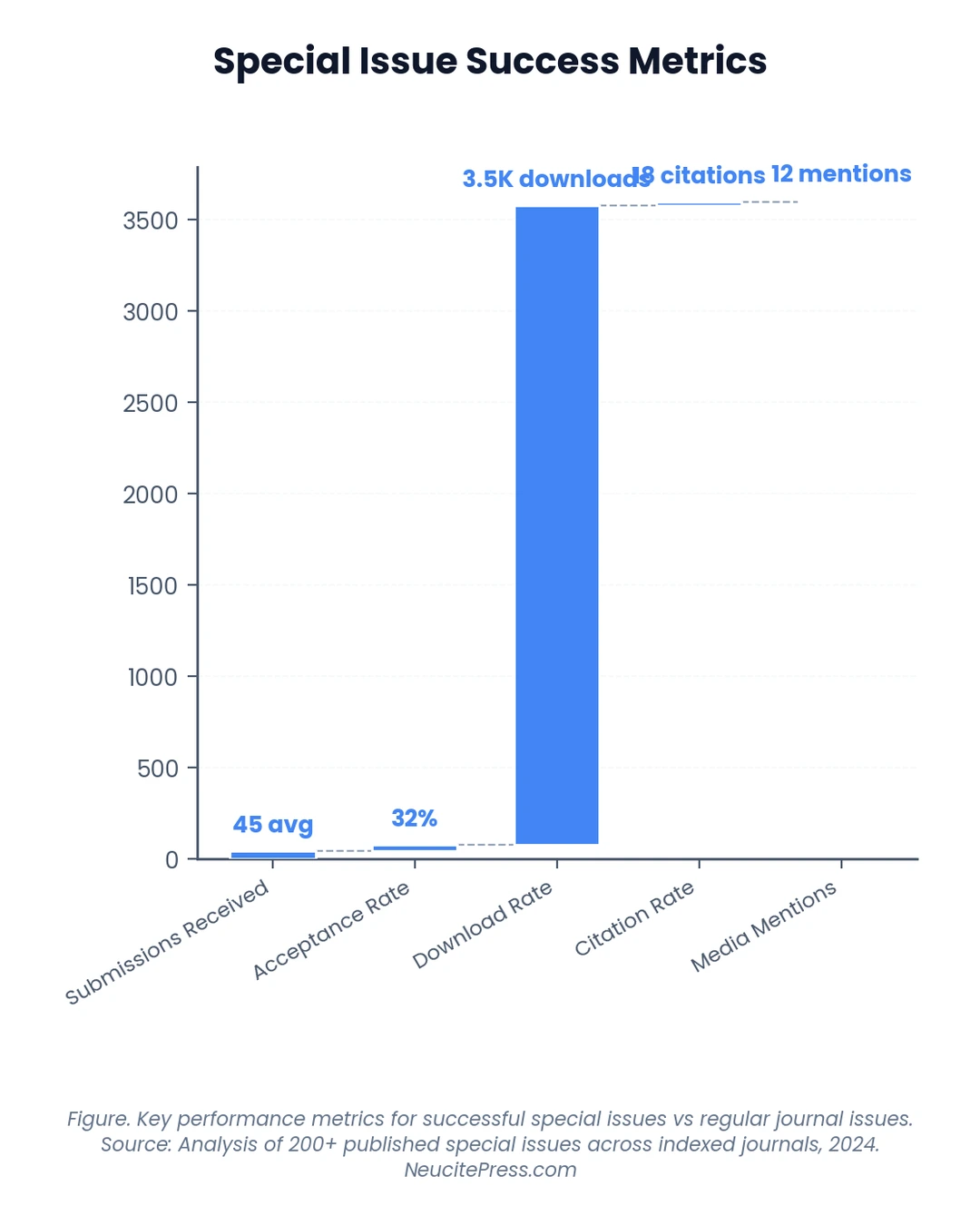
s break down costs across key categories. This supports effective financial planning for successful project execution.
| Publication Approach | Timeline | Cost Range | Administrative Complexity |
|---|---|---|---|
| Traditional Collection | 12-18 months | $3,000-$8,000 | Medium |
| Open Access Model | 10-14 months | $4,000-$10,000 | High |
| Cross-Journal Collaboration | 14-20 months | $5,000-$12,000 | Very High |
| Rapid Publication Track | 6-9 months | $6,000-$15,000 | Medium-High |
Integrating Data-Driven Benchmarks and Expert Insights
Quantitative performance indicators serve as essential tools for gauging the success of focused academic collections. We provide concrete metrics that help organizers compare their results against industry standards.
Cost per Attendee, Speaker Honorariums, and Conversion Rate Analysis
Academic conferences typically range $300-$800 per attendee. Medical education events cost $500-$1,200 due to accreditation requirements. Hybrid formats add $150-$300 per virtual participant.
Keynote speakers receive $1,000-$5,000 plus expenses. High-quality compilations achieve 25-35% acceptance rates. This exceeds general submission rates of 10-20%.

Expert Quotes and Real-World Research Perspectives
The most successful projects tend to share three characteristics: crystal-clear scope definition, diverse reviewer panels, and strategic promotional outreach.
A 2023 Journal of Scholarly Publishing study found structured campaigns generated 2.3 times more submissions. This demonstrates the critical value of proactive strategies.
Meeting Professionals International research shows hybrid events expanded reach by 40-60%. However, they require 30-50% higher technology budgets.
Conclusion
The journey from conceptualizing a focused publication to achieving measurable scholarly impact requires meticulous execution across multiple domains. We affirm that systematic planning, rigorous compliance attention, and strategic promotion are essential for success. This comprehensive approach transforms complex projects into structured processes.
Our resource hub provides practical tools that operationalize these principles. From deadline frameworks to budget planners, these assets deliver consistent, high-quality results. Organizations and scholars who apply these methods achieve superior outcomes in their work.
We encourage immediate action: download our comprehensive toolkit and subscribe for updates. Share this valuable resource with colleagues to elevate publishing standards worldwide. Your engagement helps advance knowledge across disciplines.
The information provided represents general guidance on academic compilation best practices. It does not constitute legal advice or replace consultation with qualified professionals regarding specific regulatory requirements.
Begin your success path today. Assess your project against our benchmarks, customize relevant templates, and implement the promotional strategies outlined. These actionable steps position you for meaningful contribution to the global research community.
FAQ
What is the primary goal of a special issue in a research publication?
The main objective is to curate a collection of articles that provide a focused, in-depth examination of a specific topic. This approach brings together diverse perspectives and cutting-edge studies, significantly advancing knowledge and attracting high-impact submissions to the field.
How can I ensure my submission aligns with the call for papers?
Carefully review the announced scope and themes. We recommend drafting a brief proposal outlining your paper’s contribution to the topic before the submission deadline. This ensures your work directly addresses the key challenges and strategies highlighted in the call.
What are common pitfalls during the review process for these collections?
Common challenges include manuscripts that fall outside the declared scope, missing the submission deadline, or not adhering to the journal’s formatting guidelines. A rigorous internal review before submission helps mitigate these issues and improves the chances of acceptance.
What value does a special issue bring to authors and readers?
For authors, it offers targeted visibility among experts in their niche. For readers, it provides a consolidated resource of high-quality research on an emerging trend or pressing operational challenge, saving valuable time and enhancing understanding.
How does the editorial management of a special issue differ from a regular one?
Management involves closer collaboration with guest editors who are subject-matter experts. The process requires meticulous planning, from the initial call for papers to coordinating a timely peer-review process, ensuring all articles meet the publication’s stringent quality benchmarks.
Can you submit a paper to a special issue if it was previously presented at a conference?
Yes, but the submission must be significantly expanded into a full-length, original article. It must undergo the complete peer-review process and comply with the journal’s policy on prior publication, ensuring it adds substantial new value to the existing literature.