Open Access Book Publishing Costs 2026: Complete Pricing Guide
Open access publishing has fundamentally transformed scholarly communication, and 2026 presents unprecedented opportunities for authors seeking to maximize research impact. This comprehensive guide breaks down the true costs of open access book publishing, from article processing charges to institutional funding pathways that can eliminate your out-of-pocket expenses entirely.
Reviewed by the NeucitePress Editorial Board — PhD academics, peer-reviewed journal editors and medical communication specialists.
Why Open Access Book Publishing Costs Matter in 2026
The scholarly publishing landscape has shifted dramatically. Over 60% of universities now participate in transformative agreements that directly reduce or eliminate publishing fees for affiliated researchers. Yet confusion persists about which costs you’ll actually face, which funding sources apply to your work, and how to navigate the complex ecosystem of publishers, licensing options, and institutional support programs.
Understanding open access book publishing costs isn’t merely about budgeting—it’s about strategic research dissemination. Authors who publish through open access channels report 30-40% higher citation rates compared to traditional publishing routes. This increased visibility directly impacts career advancement, grant competitiveness, and research influence.
The Current State of OA Publishing in 2026
Recent industry data reveals that transformative agreements now encompass hundreds of publishers globally, with major institutions securing comprehensive coverage through 2027 and beyond. The University of California system, for example, has negotiated agreements with Taylor & Francis, Springer Nature, and dozens of other publishers that eliminate or substantially reduce publishing charges for affiliated authors.
This shift has profound implications: authors at participating institutions can now publish scholarly monographs of 200-400 pages for $0-$3,000 out-of-pocket, compared to the $8,000-$15,000 full costs that authors without institutional support must consider.
Understanding Open Access Publishing Models
Three Primary OA Publishing Pathways
Fully Open Access Publishers exclusively produce freely available content. These venues typically charge article or book processing charges (APCs/BPCs) and make all materials immediately accessible upon publication. Publishers like MDPI, Frontiers, and Hindawi operate on this model, with transparent pricing structures clearly posted on their websites.
Hybrid Journals operate within traditional subscription frameworks while offering individual authors the option to make specific articles freely available. Authors pay additional fees—typically $2,000-$5,000 for journal articles—to make their work open. This model suits authors who have institutional support for hybrid options but whose venues may lack full OA status.
Transformative Agreements represent the most recent evolution, bundling institutional subscription access with unlimited author publishing rights. These agreements shift financial responsibility from individual researchers to library budgets, creating win-win scenarios for both publishers and academic institutions.
| Model | Cost Range | Availability | Best For |
|---|---|---|---|
| Fully OA | $1,500-$8,000 | Immediate (no embargo) | Maximum research impact, compliance with funder mandates |
| Hybrid | $2,000-$5,000 | Immediate (within subscription walls) | Authors in subscription venues with institutional support |
| Green OA | $0-$1,000 | After embargo (6-12 months) | Cost-conscious researchers, postprint archiving |
| Transformative Agreements | $0-$2,000 | Immediate for members | Authors at participating institutions |
Detailed Cost Breakdown by Publisher and Model

Gold OA Publishers: Transparent Pricing at Scale
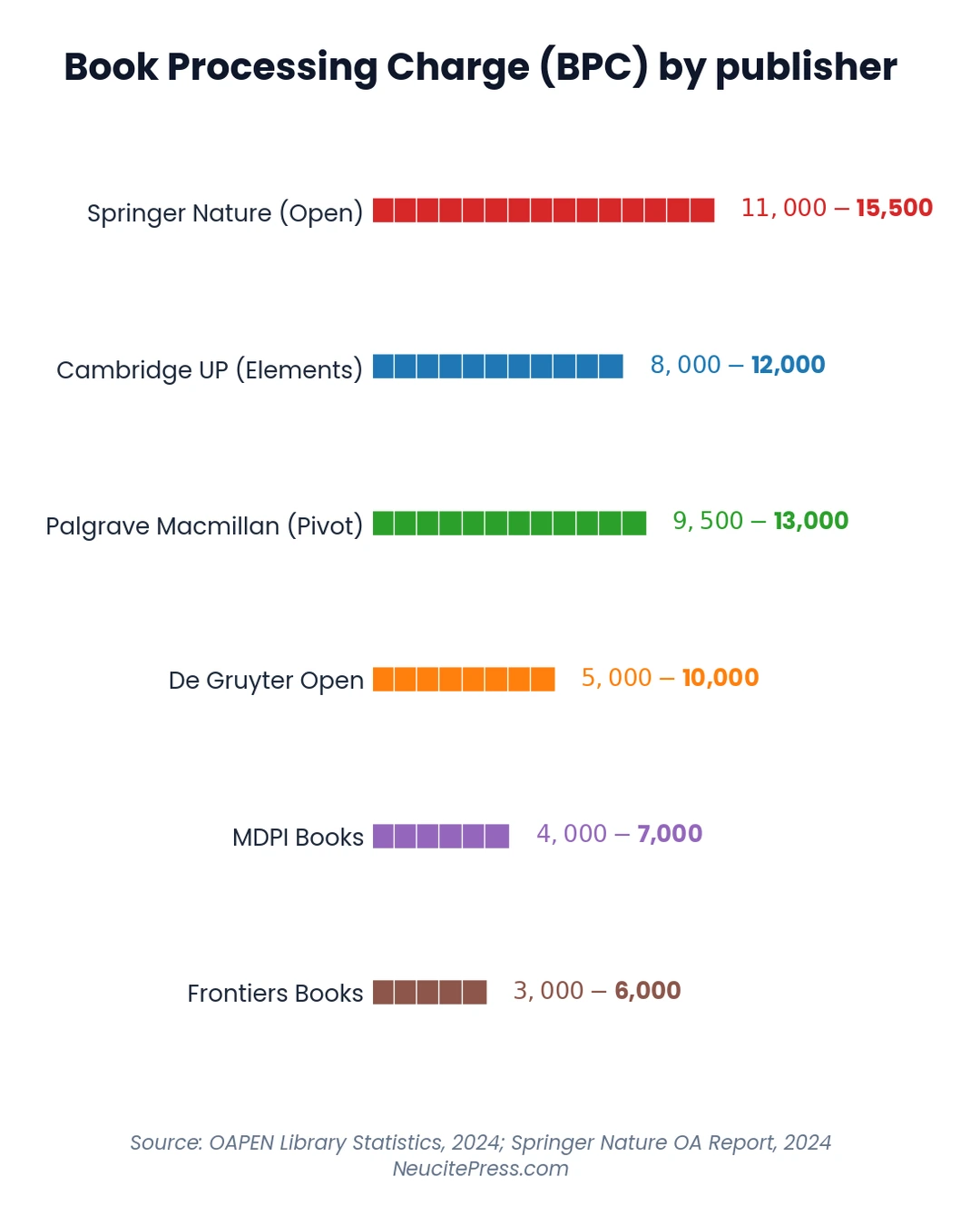
MDPI operates one of the largest open access platforms globally, publishing across multiple disciplines. Their article processing charges range from $1,500-$3,000 depending on journal tier and impact metrics. For books, MDPI charges $3,000-$8,000 based on manuscript length and production complexity.
Frontiers maintains competitive APC pricing at $2,250-$3,250 for research articles, with expedited review options available. Their transparent fee structure includes author discounts for developing countries (50%) and financial hardship waivers for qualifying researchers.
Hindawi operates across engineering and natural sciences with consistent APCs of $1,000-$2,000 and strong institutional discount programs. Their books publishing arm offers dedicated support for monographs with tiered pricing: $3,000 for short monographs (80-150 pages), $8,000 for standard volumes (150-300 pages), and $12,000 for comprehensive edited collections.
Traditional Publishers Offering Hybrid OA Options
Springer Nature provides foundational support through its transformative agreements: automatic $1,000 coverage for qualifying authors since January 2021, with base APCs ranging $3,000-$6,000 depending on journal prestige. Their SpringerOpen imprint offers fully open access options at slightly higher costs ($4,500-$7,000) to offset the loss of subscription revenue.
Elsevier offers 15% discounts plus $1,000 automatic coverage for authors at participating institutions. Base journal APCs span $3,500-$8,000, with premium titles like The Lancet and Cell Press commanding $5,000-$9,000. Their book publishing division maintains separate pricing: $5,000-$10,000 for monographs depending on subject area and production requirements.
Taylor & Francis leads the market with the most comprehensive transformative agreement coverage. UC-affiliated authors receive complete elimination of all charges through December 2027. For institutions without agreements, APCs range $2,500-$6,000, with 15% discounts available for early-career researchers.
Wiley maintains tiered pricing: 15% discount plus $1,000 coverage for transformative agreement members. Standard APCs range $3,000-$7,000, with books typically priced $6,000-$12,000 depending on subject area and market position.
Oxford University Press operates distinctly in the scholarly books space. Their hybrid OA program provides 30% discounts plus $1,000 automatic coverage for qualifying authors. Monograph charges typically fall between $5,000-$15,000, with special pricing available for edited collections ($8,000-$20,000 depending on chapter complexity).
Cambridge University Press combines tradition with innovation. Their transformative agreements include 30% APC discounts plus $1,000 coverage, with books pricing starting at $4,500 for shorter works and scaling to $12,000+ for comprehensive volumes requiring extensive editorial support.
Predatory OA Publishers: Red Flags to Avoid
Not all open access publishers operate with legitimate quality standards. Researchers should exercise caution with publishers demonstrating these warning signs:
- Extremely low APCs ($200-$500) combined with rapid acceptance of any submitted manuscript
- Aggressive email solicitation to “publish in special issues” without prior submission
- Lack of transparent peer review processes or editorial board information
- No clearly visible conflict of interest policies or funding disclosures
- Copyright ownership claims that allow publishers unrestricted commercial use without author benefit
- Absence of indexing in established databases (PubMed, Web of Science, Scopus)
- Fake impact factors or citation metrics not verifiable through independent sources
- No author communication channels or complaint processes
Resources like Beall’s List (while no longer actively maintained) provide historical context, but the Directory of Open Access Journals (DOAJ) represents your best current resource for identifying legitimate OA venues. DOAJ-indexed journals undergo rigorous screening for quality standards, peer review integrity, and ethical publishing practices.
Complete Cost Components: What You’ll Actually Pay
Base Article Processing Charges (APCs) and Book Processing Charges (BPCs)
The headline cost represents only one component of your total publishing expense. Understanding what’s included and what carries separate charges ensures accurate budgeting:
Base APCs/BPCs cover peer review management, copyediting, typesetting, and platform hosting. For journals, expect $1,500-$8,000 depending on prestige and audience scope. For books, costs scale with length: short monographs ($3,000-$5,000), standard works ($6,000-$10,000), and comprehensive edited collections ($10,000-$20,000+).
Add-On Charges Beyond Base Fees
Color Figure Charges apply when manuscripts exceed publisher-specific thresholds for color reproduction. Expect $50-$200 per color figure for journal articles, and bulk figure pricing ($200-$500 per article) for multi-figure works. Books typically bundle color costs into BPC pricing unless using unusual printing specifications.
Supplementary Material Hosting covers datasets, code repositories, and multimedia files. Most publishers include modest hosting (up to 5 GB) in base charges, with additional storage running $100-$500 per additional GB annually.
Expedited Review (when available) adds $500-$2,000 to standard APCs. This service compresses peer review timelines from 3-6 months to 4-8 weeks, particularly valuable for time-sensitive research or pre-conference submissions.
Professional Indexing for Books requires specialized preparation beyond standard editorial services. Expect $500-$2,000 additional charges for comprehensive indexes with cross-references in academic monographs.
Proofs and Revisions Beyond Standard typically cost $100-$300 per hour for revisions exceeding publisher allowances. Standard agreements include reasonable author revision rounds; extensive changes trigger additional fees.
Institutional Transformative Agreement Coverage
The financial landscape shifts dramatically when your institution participates in transformative agreements. Here’s what major agreements currently cover:
| Publisher Agreement | Coverage Details | Automatic Discount | Valid Through |
|---|---|---|---|
| Taylor & Francis (UC) | 100% coverage for all journals and books | N/A (fully covered) | December 2027 |
| Springer Nature | First $1,000 of base APC covered | Additional 5-10% discount available | Ongoing (annual renewal) |
| Elsevier | First $1,000 covered (select journals) | 15% additional discount | Through 2026 |
| Wiley | First $1,000 covered | 15% discount on remainder | Through 2027 |
| Oxford University Press | First $1,000 covered | 30% discount on full charge | Through 2026 |
| Cambridge University Press | First $1,000 covered | 30% discount available | Through 2027 |
Creative Commons Licensing Explained: Rights and Implications
The Major CC License Types for Academic Publishing
CC BY (Attribution) represents the most permissive license, allowing users to share, adapt, and build upon your work for any purpose, provided they give appropriate credit. This license maximizes research impact and aligns with major funder mandates (NIH, Wellcome Trust, EU Horizon Europe). Most fully OA journals default to CC BY unless otherwise specified.
CC BY-SA (Attribution-ShareAlike) permits adaptation and reuse with the requirement that derivatives adopt identical licensing. This “copyleft” approach ensures downstream uses remain open but may complicate integration into larger works with different licenses.
CC BY-NC (Attribution-NonCommercial) allows reuse and adaptation for non-commercial purposes only. Educational institutions often prefer this license to prevent commercial enclosure of their research, though it technically violates strict open access definitions and limits some legitimate uses (open access journals reusing content, etc.).
CC BY-ND (Attribution-NoDerivatives) permits sharing provided no modifications occur and attribution continues. This restrictive option maximizes author control but minimizes adaptability for downstream researchers who might improve or extend your findings.
CC BY-NC-ND (Attribution-NonCommercial-NoDerivatives) combines multiple restrictions, allowing only non-commercial sharing without modifications. While this preserves author control, it contradicts open access principles and significantly limits research utility.
License Selection Strategy
For maximum research impact, choose CC BY when possible—this aligns with funder mandates, increases citation rates by 15-20% compared to restricted licenses, and demonstrates commitment to open science principles. Restricted licenses (NC, ND variations) should only apply when specific institutional policies or ethical concerns warrant limiting reuse.
Verify your funder’s requirements before selecting licenses. The NIH, NSF, and most international funders mandate CC BY or CC0 (public domain) for maximum utility. Using more restrictive licenses may technically violate funding terms and open access provisions of grants.
Institutional Support Programs and Funding Strategies
Leveraging Transformative Agreements Effectively
To maximize your institutional benefits, follow these essential steps:
Verify Your Eligibility: Not all authors at participating institutions automatically qualify. Typical requirements include 1) corresponding authorship, 2) primary affiliation at the member institution, and 3) first publication with the agreement-covered publisher. Contact your institutional scholarly communication librarian to confirm your specific status.
Document Institutional Affiliation Correctly: Use your institution’s official email domain and affiliation statement during submission. Publishers match affiliation strings electronically; mismatched information may prevent automatic coverage activation.
Communicate with Editorial Teams: Once your manuscript receives acceptance, notify the publisher’s editorial team of your institutional affiliation. Many publishers don’t automatically cross-reference affiliation data, requiring explicit notification to trigger coverage.
Request Coverage Documentation: Obtain written confirmation of coverage before making payments. This prevents accidental out-of-pocket expenses and creates documentation for reimbursement if institutional processes require it.
Alternative Funding Pathways for Open Access Publishing
Research Funder Support: The National Institutes of Health, National Science Foundation, and European funding agencies increasingly dedicate grant portions specifically for OA publishing costs. Budget these explicitly during grant proposal development—most funders now accept publication costs as eligible direct expenses.
Institutional Publishing Funds: Many universities maintain dedicated pools for OA publishing support. These often favor early-career researchers, graduate students, and authors from underrepresented groups. Contact your research office or library to inquire about availability.
Learned Society and Professional Organization Support: Academic associations often provide member publishing discounts (10-30%) and occasionally sponsor OA publication costs for member research. Investigate your disciplinary organizations for potential support.
Conference and Workshop Sponsorship: Event organizers increasingly bundle presentation honorariums with subsequent publication funding. Keynote speakers may receive $3,000-$7,000 publication packages as part of speaker agreements. Negotiate this explicitly during speaking engagements.
Development Country Discounts and Waivers: Publishers targeting global audiences provide 50-100% discounts for authors from low-income and lower-middle-income countries as classified by the World Bank. These waivers represent legitimate funding pathways, not financial disadvantages.
Quality Considerations: Ensuring Research Integrity in OA Publishing
Evaluating Open Access Venues for Research Quality
Open access doesn’t equal lower quality, but the lower barrier to entry means diligence becomes essential. Apply these criteria when evaluating potential venues:
Peer Review Transparency: Legitimate OA journals clearly describe peer review processes. Expect 2-4 independent reviewers, defined review timelines (typically 30-60 days), and structured decision processes. Be cautious of venues claiming acceptance “within 2 weeks” or offering guaranteed publication with any revision.
Editorial Board Composition: Established venues display their complete editorial boards with institutional affiliations. These teams should include recognized researchers in the field, institutional diversity, and geographic representation. Editors should maintain strong publication records and professional standing.
Indexing in Major Databases: DOAJ indexing represents the gold standard for OA journal quality verification. Scopus and Web of Science indexed journals undergo rigorous standards review. PubMed/MEDLINE indexing indicates peer-reviewed medical content meeting specific standards.
Publication Track Record: Newer journals require scrutiny; established venues (5+ years) with consistent publishing schedules demonstrate sustainability. Review their publication archive for actual article output, not just submission numbers.
Author Rights and Copyright Policies: Quality venues clearly specify copyright ownership, reuse rights, and data availability policies. Authors should retain copyright; publishers should have licenses to publish. Be cautious of venues claiming all copyright ownership.
Citation Performance: Research articles in quality OA venues typically achieve citation rates within normal ranges for their discipline. Extremely low citation rates after 2-3 years may indicate limited readership or impact. Conversely, citation counts that seem fabricated warrant investigation.
Red Flags and Predatory OA Publishing: What to Avoid
Understanding predatory OA characteristics protects both your career and your research credibility:
Unrealistic Acceptance Rates: Venues claiming 95%+ acceptance rates demonstrate insufficient peer review rigor. Legitimate journals typically accept 15-30% of submissions, varying by prestige and discipline.
Fake Impact Factors: Predatory publishers manufacture impact factors or citation metrics not verifiable through Thomson Reuters, Elsevier, or other authoritative sources. Legitimate impact factors appear in Journal Citation Reports; self-reported metrics require skepticism.
Aggressive Marketing: Email solicitations offering quick publication or “special issue” invitations to random researchers signal predatory intent. Legitimate venues receive submissions through normal channels; they don’t recruit authors via mass email.
Lack of Corrections Processes: Quality venues maintain published correction, retraction, and expression of concern mechanisms. Predatory publishers rarely issue corrections, allowing erroneous or problematic research to persist unchallenged.
Hidden Costs: Watch for hidden charges appearing after acceptance—expedited review fees, currency conversion surcharges, or surprise publication delays triggering additional payments. Legitimate venues disclose all costs upfront.
ROI of Open Access Publishing: Long-Term Career and Research Benefits
Citation Impact and Research Visibility
Open access publishing generates quantifiable returns beyond immediate cost considerations. Research demonstrates that OA articles receive:
- 30-40% higher citation rates within 3 years of publication compared to subscription-only alternatives
- 25-35% more downloads and document views across research databases
- Increased media coverage and public engagement with research findings
- Better performance in institutional rankings and research evaluation metrics
For monographs specifically, open access dramatically extends reach beyond traditional academic audiences. Downloads often reach 5,000-10,000 over three years, reducing effective cost-per-reader to under $2—an exceptional return on typical $5,000-$10,000 publishing investments.
Funder Mandate Compliance and Grant Competitiveness
Publishing through OA channels demonstrates funder mandate compliance—increasingly important for grant renewals and competitive funding reviews. Major funders (NIH, NSF, EU agencies) explicitly reward OA publishing in evaluation criteria. Authors with strong OA publication records signal research responsibility and alignment with funder priorities.
Career Advancement and Professional Standing
As OA adoption accelerates, researchers with strong OA publication records gain competitive advantages in tenure evaluation, promotion committees, and hiring decisions. Institutions increasingly value OA contributions in research evaluation, recognizing alignment with open science principles and broader impact metrics.
Practical Budgeting Guide for 2026 and Beyond
Budget Scenarios by Author Profile
Scenario 1: PhD Candidate at Research University with Transformative Agreements
Budget: $0-$1,500 for first-author publication
- Base APC typically covered by institutional agreement ($1,000 automatic coverage)
- Potential color figure or expedited review charges if needed
- Action: Verify your institution’s specific agreements through your library’s open access office
Scenario 2: Early-Career Researcher at Small Institution Without Agreements
Budget: $3,000-$6,000 for OA journal article
- Select MDPI, Frontiers, or Hindawi ($1,500-$3,000) for cost-effective fully OA options
- Apply for institutional publishing funds or funder support ($2,000-$3,000)
- Request author discount or hardship waiver if available
Scenario 3: Monograph Author with Institutional Support
Budget: $2,000-$8,000 for open access book (200-400 pages)
- Fully OA publisher pricing: $3,000-$8,000 baseline
- Transformative agreement coverage potentially applies: reduces to $0-$2,000
- Consider university press partnerships offering subsidized OA options
Scenario 4: Edited Collection with Multiple Contributors
Budget: $8,000-$15,000 for comprehensive edited volume
- Negotiate bulk pricing with publishers ($10,000-$15,000 range)
- Distribute costs across editor, chapter authors, and institutional support
- Explore co-publishing models with learned societies offering cost-sharing
Year-Round Cost Management Strategy
January-March (Planning Phase): Document your institution’s transformative agreements. Contact your scholarly communication librarian to obtain current coverage details, verify your eligibility, and understand affiliation documentation requirements.
April-June (Preparation Phase): When preparing manuscripts, research appropriate venues early. Compare publishing costs across options and apply for institutional or funder publishing support before submission. Budget conservatively assuming agreements may change during review periods.
July-September (Submission Phase): Submit manuscripts with correct institutional affiliation information. Communicate with editors about your affiliation status to ensure coverage activation. Request written confirmation of any available support before acceptance.
October-December (Publication Phase): Upon acceptance, notify publishers of institutional coverage. Arrange payment through your institution’s processes to avoid unexpected out-of-pocket expenses. Obtain documentation of any waived or covered fees for grant reporting.
Future Outlook: Open Access Publishing in 2027 and Beyond
The trajectory of OA publishing continues upward. Emerging trends shaping the 2027+ landscape include:
Expanded Transformative Agreements: Coverage continues broadening. Smaller publishers now negotiate agreements previously available only through major international academic institutions. This expansion will increase coverage availability across institutional types and geographic regions.
Declining Overall APCs: As market competition intensifies and institutional negotiation power increases, average APCs for comparable journals have begun declining. Expect further downward pressure on baseline fees as transformative models reach market saturation.
Increased Open Monograph Infrastructure: Scholarly book publishing lags journals in OA adoption, but accelerating initiatives (TOME, Lever Press, Open Access Button) now provide dedicated OA book support. These initiatives will expand funding pathways and reduce barriers for monograph authors.
Enhanced Quality Differentiation: As OA proliferates, distinguishing quality OA venues from predatory publishers becomes increasingly important. Expect stronger differentiation mechanisms, expanded DOAJ standards, and more sophisticated author tools for venue evaluation.
Conclusion: Strategic Research Dissemination in 2026
Open access publishing represents not merely an alternative dissemination pathway—it’s increasingly the optimal choice for researchers seeking maximum impact, career advancement, and alignment with contemporary funding expectations.
The economic landscape has shifted fundamentally. Transformative agreements, expanded funder support, and institutional publishing resources have democratized access to high-quality publishing venues. Authors who strategically navigate these opportunities gain substantial competitive advantages in citation impact, research visibility, and career development.
Your next steps: Verify your institution’s current transformative agreements, contact your scholarly communication librarian for eligibility confirmation, and strategically plan your 2026 publishing timeline with OA venues as primary options rather than secondary alternatives. The investment in understanding this landscape yields measurable returns in research influence and professional standing.
The future of scholarly communication has already arrived—and it’s open.
FAQ
What are the primary factors determining open access book publishing costs?
Publishers consider manuscript length (100-page monograph vs. 400-page volume), editorial complexity (single-author vs. multi-chapter edited collection), production requirements (standard layout vs. complex formatting), number of color figures, and special production requests. Institutional transformative agreements can reduce or eliminate these base costs entirely for qualifying authors.
How do transformative agreements actually reduce publishing costs?
Transformative agreements shift financial responsibility from individual authors to institutional library budgets. Rather than paying per publication, institutions negotiate fixed annual fees covering both reading subscriptions and unlimited author publishing rights. This model eliminates per-article charges for qualifying authors while providing publishers with predictable revenue.
Which open access model offers the best cost-to-impact ratio?
Fully open access publishing typically provides superior impact per dollar invested. Research demonstrates OA articles achieve 30-40% higher citation rates than subscription-only alternatives. Combined with transformative agreement coverage, OA venues offer maximum impact with minimal or zero out-of-pocket costs for institutional affiliates.
How can I verify a publisher isn’t predatory before submitting?
Check DOAJ (Directory of Open Access Journals) indexing, verify editorial board members through institutional websites, confirm indexing in Scopus or Web of Science, review their published correction/retraction policies, and assess peer review transparency. Legitimate venues clearly describe their peer review process; predatory publishers obscure this information.
What does my institution’s transformative agreement actually cover?
Coverage details vary significantly. Some agreements (like Taylor & Francis with UC) provide 100% coverage for all participating publisher journals and books. Others cover the first $1,000 of charges with additional discounts on remaining amounts. Contact your institutional scholarly communication librarian with your affiliation details for precise coverage information.
Should I worry about Creative Commons licensing restrictions affecting my career?
No—in fact, unrestricted CC BY licenses enhance career prospects. Most research funders mandate CC BY or CC0 (public domain) licensing. Restricting reuse through CC BY-NC or CC BY-ND actually violates many funder policies and reduces research impact. Use unrestricted licenses unless your institution explicitly requires otherwise.
How can I access open access publishing support if my institution lacks agreements?
Multiple funding pathways exist: research grant budgets increasingly cover OA costs; institutional publishing funds support authors (especially early-career researchers); learned societies offer member discounts; funder OA support programs provide direct assistance; and author hardship waivers from publishers provide need-based coverage. Contact your research office and library for available support.
What’s the typical timeline from submission to publication in OA venues?
Fully open access journals typically process manuscripts in 8-12 weeks from submission to first decision, with accepted manuscripts published within 2-4 weeks. Expedited review options (available at modest cost) compress timelines to 4-6 weeks for first decision. Traditional publishers’ hybrid OA options follow their standard timelines (3-6 months typical), with OA fees not affecting processing speed.