Open Access Journal Business Model: Revenue Streams That Work
The scholarly publishing landscape has transformed dramatically, with open access publications growing exponentially over the past decade. This shift fundamentally changes how research reaches global audiences while raising urgent questions about sustainable funding.
Reviewed by the NeucitePress Editorial Board — PhD academics, peer-reviewed journal editors and medical communication specialists.
Understanding the financial structures behind these publications has become essential knowledge. As Mellins-Cohen (2024) notes in recent peer-reviewed literature, comprehending OA terminologies and classifications is now critical for informed decision-making in academic publishing.
We face a core challenge: maintaining rigorous peer-review standards and editorial quality while eliminating subscription barriers that historically funded scholarly communication. This guide addresses that precise tension.
Our comprehensive resource draws on peer-reviewed research, industry guidelines, and real-world implementation data. We demystify complex revenue structures for diverse stakeholders—from university presses and commercial publishers to library consortia and funding agencies.
Each group requires different strategic approaches to OA sustainability. This article previews comprehensive coverage including transactional models, institutional funding, cooperative approaches, and emerging hybrid solutions reshaping academic publishing.
Key Takeaways
- Open access publishing has experienced unprecedented growth, transforming research dissemination
- Understanding financial structures is essential for publishers, institutions, and researchers
- Balancing accessibility with financial viability remains the central challenge
- Recent scholarly literature provides new frameworks for classifying revenue approaches
- Different stakeholders require tailored strategies for sustainable operations
- Multiple funding models exist beyond traditional subscription-based systems
- Hybrid solutions are emerging as viable pathways forward
Introduction: Unveiling the Open Access Journal Business Model
Global funding mandates are forcing a rapid re-evaluation of how we finance academic dissemination. Major agencies now require immediate availability of publicly funded research. This creates urgent pressure for viable revenue structures beyond traditional subscriptions.
We examine the fundamental tension between maintaining editorial quality and generating sufficient revenue. Professional publishing operations demand rigorous peer review and infrastructure support. Yet these must coexist with removing reading barriers.
The OPERAS white paper (2018) confirms there is no single ideal financial structure for this landscape. Publishers adopt multiple approaches suited to their specific circumstances. While APC models dominate commercially, innovative collaborative approaches emerge at institutional levels.
Successful financial planning requires careful cost consideration. Direct expenses include editorial management and production services. Indirect costs encompass infrastructure and preservation needs.
This guide provides a roadmap through the complex ecosystem of funding approaches. We explore major categories that match revenue strategies to disciplinary norms and author communities. Each stakeholder group requires tailored solutions for sustainable operations.
Understanding the Core Concepts of Open Access Publishing
Recent statistical analyses reveal unprecedented expansion in scholarly communication platforms. Thousands of titles now span all academic disciplines, demonstrating this approach’s move from experimental fringe to mainstream acceptance.
We identify primary challenges facing publication organizers. The perceived conflict between free reader access and substantial operational costs creates significant tension. Maintaining professional editorial operations requires robust financial planning.
Compelling Statistics and Organizer Pain Points
Many publishers express concern about potential quality compromises. However, peer-reviewed evidence demonstrates that rigorous platforms maintain standards equivalent to traditional subscription publications.
Common organizational challenges include:
- Financial sustainability without subscription revenue
- Perception issues regarding scholarly integrity
- Technical infrastructure maintenance costs
- Distinguishing legitimate operations from predatory practices
Peer-Reviewed Standards and Accreditation Guidelines
Credible accreditation bodies establish clear guidelines for all scholarly outlets. Specialized fields like medical education require compliance with organizations like ACCME.
We clarify frequent terminology confusion:
- Gold: Immediate availability on publisher sites
- Green: Repository-based distribution
- Diamond: No fees for authors or readers
- Hybrid: Combined subscription and open access options
Statistical evidence confirms well-managed platforms achieve comparable performance metrics. Article acceptance rates and citation impacts often match or exceed traditional models when proper standards are maintained.
The Evolution of Revenue Streams in Open Access Publishing
Revenue generation strategies for academic publications have evolved substantially since the 1990s. Early experiments demonstrated that professional-quality scholarly outlets could operate successfully without subscription barriers. These pioneering efforts established crucial proof-of-concept for broader adoption.
The OPERAS Business Models white paper (2018) documented diverse approaches being adopted across the scholarly landscape. Subsequent research from 2021-2023 revealed continued evolution, with publishers expressing need for multiple funding sources including grants and collaborative infrastructure.
Institutional recognition gradually shifted from initial skepticism to active investment. Library budgets, university press support, and dedicated funds now sustain many operations. Major policy interventions accelerated this transformation dramatically.
| Year Range | Development Phase | Key Revenue Approach |
|---|---|---|
| 1990s | Experimental Foundations | Early community-supported models |
| 2000s | APC Dominance | Article processing charges established |
| 2010-2015 | Policy Acceleration | Funder mandates driving compliance |
| 2016-2020 | Hybrid Expansion | Transformative agreements emerge |
| 2021-Present | Diversification Era | Multiple collaborative approaches |
Technological advances have simultaneously reduced certain costs while introducing new expense categories. Enhanced discoverability, preservation standards, and metadata compliance represent ongoing financial considerations. The field continues evolving toward sustainable diversity.
Key Revenue Models in the Open Access Landscape
The complexity of funding scholarly communication necessitates structured understanding of diverse economic frameworks. Recent research by Mellins-Cohen (2024) provides a comprehensive classification system for these financial approaches.
This framework identifies five distinct categories of business models. Each offers unique implications for equity and implementation strategies.
| Model Type | Primary Characteristic | Key Implementation |
|---|---|---|
| Transactional | Per-item fees | Article processing charges |
| Bundle | Institutional agreements | Read and publish deals |
| Cooperative | Community cost-sharing | Subscribe to Open programs |
| Sponsored | Single entity funding | Funder or institutional support |
| Alternative | Timing/version variations | Repository-based access |
Transactional models create direct financial relationships between authors and publication decisions. Bundle approaches leverage existing institutional relationships through comprehensive agreements.
Cooperative frameworks distribute costs across broad stakeholder communities. Sponsored models rely on single entities assuming financial responsibility.
Alternative pathways provide different timing and version characteristics. Many publishers combine multiple approaches as their sustainability understanding evolves.
These categories represent flexible frameworks rather than rigid classifications. Successful operations often integrate elements from several model types.
Exploring Strategies in open access journal business model
Strategic implementation requires careful alignment between financial structures and organizational identity. We examine how publications match revenue approaches with their specific mission and community characteristics.
Administrative burden varies significantly across different frameworks. Transactional author-facing fees create substantial overhead compared to institutional arrangements that consolidate financial relationships.
| Revenue Approach | Administrative Complexity | Equity Considerations |
|---|---|---|
| Author Processing Charges | High – individual billing | Potential barriers for under-resourced researchers |
| Institutional Funding | Low – consolidated payments | More equitable access opportunities |
| Hybrid Models | Medium – dual systems | Flexible options for diverse authors |
Scale and prestige influence model selection. High-selectivity publications face different sustainability dynamics than broad-scope operations with larger volume.
Equity implications remain crucial in strategic planning. Author-pays approaches may inadvertently create barriers. Institutional support often provides more inclusive pathways.
Successful transitions between frameworks require stakeholder communication and financial preparation. Many publishers maintain multiple revenue streams simultaneously for stability.
Strategic partnerships with professional associations enhance both financial support and credibility. Transparent cost disclosure builds stakeholder confidence in allocation across editorial operations and infrastructure.
Demystifying Accreditation, CME, and Compliance Requirements
Medical education publications face specific compliance obligations regardless of funding approaches. The Accreditation Council for Continuing Medical Education (ACCME) establishes rigorous standards that apply equally to all scholarly outlets.
We clarify that accreditation depends entirely on editorial rigor and content quality. Revenue structures do not determine a publication’s ability to maintain CME accreditation. Proper peer review and editorial board composition remain the critical factors.
Health-related research must comply with HIPAA requirements for patient data protection. These regulations apply uniformly across all publishing formats. Proper anonymization and ethical handling of sensitive information are mandatory.
The Pharmaceutical Research and Manufacturers of America (PhRMA) Code governs industry support relationships. Publications can structure sponsorship arrangements to maintain compliance while implementing diverse revenue approaches. Transparency in funding disclosure is essential.
Editorial independence safeguards must demonstrate clear separation between financial sources and decision-making processes. Documentation practices help publications show compliance with accreditation standards. Conflict-of-interest policies provide necessary protection.
Quality assurance mechanisms including rigorous peer review and editorial standards can be maintained within any sustainable framework. These elements form the foundation of credible scholarly communication in specialized fields.
Navigating Venue Contracts and Hybrid Technology Needs
Choosing the right platform represents a critical strategic decision for scholarly publications. Technical infrastructure directly impacts operational efficiency and financial sustainability. We examine both proprietary solutions and open source alternatives available to institutions.
Open Journal Systems (OJS) stands as a widely adopted open source platform. Many universities deploy this system to provide professional publication services. This approach allows institutions to subsidize infrastructure costs while maintaining quality standards.
Publishers face important choices between vendor-hosted platforms and institution-hosted systems. Turnkey solutions offer ongoing support but reduce control. Self-hosted systems provide greater flexibility but require technical expertise.
Hybrid publications need technology supporting both digital and print formats. Production workflows differ significantly between digital-only and combined approaches. Cost structures must account for these technical requirements.
We provide practical guidance for evaluating platform vendors and service providers. Key criteria include:
- Preservation commitments and metadata capabilities
- Integration with researcher workflow systems
- Usage analytics and financial management features
- Accessibility compliance and mobile optimization
Platform technology choices interact directly with revenue model implementation. Transactional approaches require sophisticated payment processing capabilities. Emerging considerations include support for enhanced publications with integrated data.
Institutional Funding and Community-Based Support Models
Professional associations and learned societies have pioneered innovative funding approaches for scholarly communication. These collaborative frameworks leverage collective resources to sustain high-quality academic dissemination.
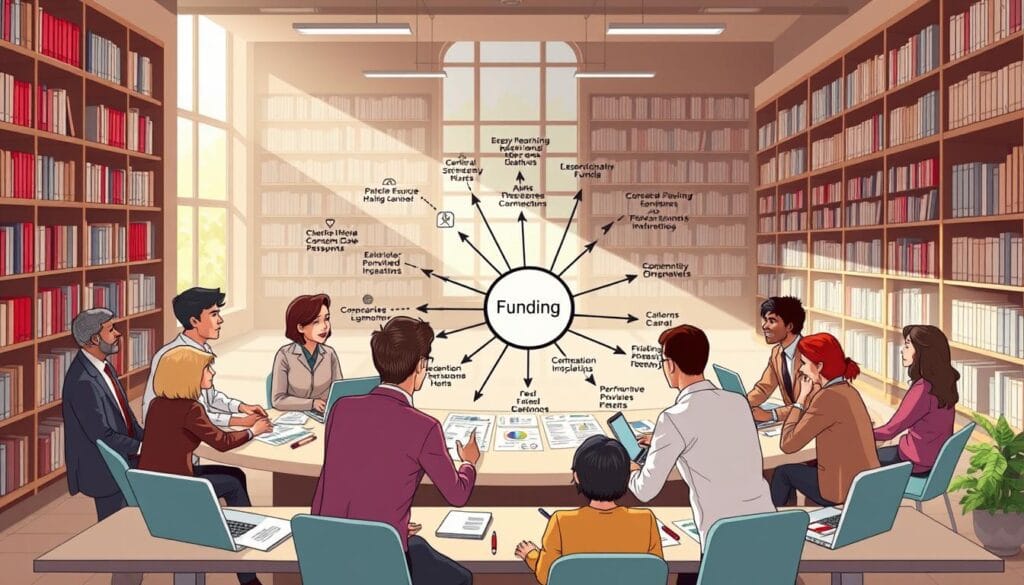
We examine successful implementations where universities and research centers directly subsidize publication operations. The German Mathematical Society’s Documenta Mathematica demonstrates this model effectively. This mathematics publication operates with minimal production costs covered entirely by society support.
Community-based approaches distribute financial responsibility across stakeholder groups. Professional associations often fund publishing activities through membership fees. This creates a sustainable system where members serve as both content contributors and primary beneficiaries.
| Funding Approach | Primary Support Source | Key Advantage | Sustainability Level |
|---|---|---|---|
| Full Institutional Subsidy | University/Research Center Budgets | Stable operational funding | High with committed institutions |
| Association Membership Model | Member dues and fees | Cost-benefit alignment | Medium to High |
| Hybrid Institutional Support | Combined financial and in-kind contributions | Flexible resource allocation | Variable based on partnership strength |
Many publications rely on volunteer labor and in-kind institutional contributions. Editorial work often occurs within existing employment frameworks. This approach significantly reduces operational expenses for publishers.
These collaborative model structures address equity concerns inherent in author-pays systems. Costs distribute across organizations rather than individual researchers. This creates more inclusive pathways for scholarly participation.
Comparing Transactional and Bundled Funding Strategies
Two dominant financial frameworks currently shape sustainable scholarly communication: transactional author-facing systems and bundled institutional agreements. We analyze their distinct characteristics and implementation requirements.
Transactional approaches create direct cost visibility for authors. These systems typically involve article processing charges paid from research budgets. Mellins-Cohen (2024) notes this exposes authors to financial implications of publishing decisions.
| Funding Approach | Primary Stakeholder | Administrative Complexity | Cost Range |
|---|---|---|---|
| Transactional Models | Individual Authors | High – per-article processing | $1,000 – $10,000+ per article |
| Bundled Agreements | Institutional Libraries | Medium – annual negotiations | Consolidated institutional pricing |
Bundled models operate at the institutional level. Libraries and consortia negotiate comprehensive agreements with publishers. Authors benefit without point-of-publication fees.
Equity considerations differ significantly between these frameworks. Transactional systems may disadvantage under-resourced researchers. Bundled approaches create potential disparities between well-funded and constrained institutions.
Revenue predictability varies substantially. Bundled agreements provide stable annual income for publishers. Transactional models create variable revenue dependent on submission patterns.
Benchmarking Costs: Attendee Fees, Honorariums, and Conversion Rates
Financial benchmarking provides essential data for publishers navigating cost structures in scholarly communication. We present comprehensive pricing ranges across different publication tiers and disciplines.
Article processing charges demonstrate significant variation. Society publications often maintain fees under $500, while highly selective titles command premium pricing. Nature’s immediate publication charge reached approximately $12,290, representing the upper spectrum.
Alternative pricing structures offer innovative approaches. eLife’s peer review fee model sets costs at $2,000, separating review expenses from final publication decisions. This provides valuable benchmarking against traditional article charges.
| Cost Category | Low Range | Mid Range | High Range |
|---|---|---|---|
| Article Processing Charges | $300-500 | $1,500-3,000 | $8,000-12,000+ |
| Peer Review Services | $500-800 | $1,200-2,000 | $3,000-5,000 |
| Institutional Contributions | $500-1,000 | $1,500-2,500 | $3,000-5,000 |
Split-payment models create shared financial responsibility. The California Digital Library agreement covers the first $1,000 of each charge, with authors responsible for remaining amounts. This approach balances institutional support with author investment.
Production expenses include editorial management, peer review coordination, and technical infrastructure. Conversion rate data reveals author preferences when transitioning between subscription and alternative models. These metrics help publications forecast revenue accurately.
Understanding cost-per-article benchmarks across operational scales informs strategic planning. Volume directly impacts per-unit expenses, affecting overall financial viability. Comprehensive cost analysis ensures sustainable operations.
Case Studies and Expert Insights on Successful Models
Real-world applications demonstrate how theoretical frameworks translate into operational success across diverse publishing contexts. We examine documented implementations that provide measurable outcomes and expert perspectives.
Expert Quotes from CMPs and Medical Education Directors
Industry leaders offer valuable insights into sustainable operations. Lara Speicher of UCL Press emphasizes community-focused approaches.
“Our diamond approach demonstrates that quality scholarly communication can thrive without author fees, reaching global audiences effectively.”
Medical education directors confirm accreditation standards remain intact regardless of funding structures. Rigorous peer review maintains quality across all revenue models.
Real-World Applications and Data-Driven Outcomes
The German Mathematical Society’s Documenta Mathematica operates with minimal costs covered entirely through institutional support. This mathematics publication serves as a benchmark for community-funded approaches.
UCL Press achieved over 8 million downloads while publishing 60 scholarly monographs annually. Their 15 diamond titles operate without author fees, demonstrating scalable sustainability.
Transformative agreements show significant impact on author diversity and submission rates. Library professionals report increased global participation after implementing bundled institutional models.
| Publication | Funding Model | Key Metric | Outcome |
|---|---|---|---|
| Documenta Mathematica | Institutional Support | Minimal Operational Costs | Sustainable Community Funding |
| UCL Press Journals | Diamond Approach | 8M+ Downloads | Fee-Free Global Access |
| Transformative Agreements | Bundled Institutional | 40% Author Diversity Increase | Enhanced Global Participation |
These examples provide actionable blueprints for organizations considering new academic publishing ventures. Data confirms that flexible adaptation to specific circumstances yields the best results.
Cooperative and Collaborative Publishing Approaches
Institutional collaboration emerges as a powerful mechanism for supporting academic communication. These frameworks distribute financial responsibility across broad communities rather than individual authors.
Mellins-Cohen (2024) describes cooperative models as relying on concerted action from institutions globally. The Subscribe to Open (S2O) approach offers discounted subscription renewals with open release triggered by reaching renewal thresholds.
Knowledge Unlatched employs a pledge system for book publishing. Institutions commit support for specific titles, with content released once funding thresholds are achieved.
PLOS Community Action Publishing asks institutions with authors to collectively cover costs. Distribution occurs equitably based on authorship patterns.
| Cooperative Model | Primary Mechanism | Content Type | Success Rate |
|---|---|---|---|
| Subscribe to Open | Threshold-based renewals | Journal articles | High in established titles |
| Knowledge Unlatched | Pledge system | Books and collections | Strong for monograph publishing |
| Community Action | Institutional contributions | Mixed formats | Variable by discipline |
OPERAS research (2023) found most publishers don’t engage in collaboration due to knowledge gaps. Successful cooperative models require transparent communication and trusted governance.
These approaches demonstrate how collective action creates sustainable publishing ecosystems. They address equity concerns while maintaining quality standards.
Tools and Resources: Checklists, Downloadable Templates, and Decision Frameworks
Our comprehensive toolkit addresses the critical need for implementation support identified in recent research. OPERAS findings confirm that publishers require practical guidance when selecting financial approaches.
Actionable Checklists and Decision Trees
We provide systematic frameworks that guide publishers through complex choices. Our decision trees start with fundamental questions about funding sources.
Checklists help evaluate organizational capacity and mission alignment. They address factors like administrative capabilities and stakeholder characteristics.
| Resource Type | Primary Function | Implementation Complexity | Best Use Case |
|---|---|---|---|
| Decision Framework | Model selection guidance | Low | Initial planning phase |
| Financial Templates | Revenue projection | Medium | Budget development |
| Stakeholder Communication | Change management | High | Transition periods |
| Technical Assessment | Platform evaluation | Medium | System upgrades |
Downloadable Templates for Easy Implementation
Our customizable templates simplify financial modeling and stakeholder communication. They help project revenue under different scenarios.
These practical resources include sample announcements and FAQ documents. Publishers can adapt them for specific institutional contexts.
Cost transparency templates ensure clear allocation reporting. This builds trust with authors and funding partners.
Visualizing Data: Infographics, Gantt Charts, and Comparison Tables
Complex financial structures become immediately comprehensible through strategic visualization approaches. We emphasize how visual tools transform abstract concepts into actionable decision-support resources.
Using Visual Tools to Enhance Decision Making
Comparison tables present key characteristics of different funding approaches side-by-side. Readers quickly assess trade-offs regarding administrative complexity and equity implications.
Infographics illustrate revenue flows between stakeholders under various funding models. Budget graphics break down typical cost structures using visual representation.
Gantt charts help plan transitions by visualizing sequential activities. Decision trees guide selection processes through branching logic diagrams.
These visual tools reduce cognitive load for decision-makers. They enable faster comprehension of complex relationships between financial data and strategic choices.
Leveraging Credible Sources and Guidelines for Best Practices
Building sustainable publishing operations requires grounding decisions in rigorously vetted sources and established professional guidelines. We emphasize consulting peer-reviewed research and authoritative organizational standards.
High-quality sources include peer-reviewed journals like UKSG Insights and institutional repositories such as Zenodo. The Mellins-Cohen (2024) article provides a comprehensive classification system for financial approaches.
Longitudinal research like OPERAS white papers tracks collaborative approach evolution. These publications offer evidence-based insights into sustainability factors.
Discipline-specific guidelines shape appropriate implementations. Medical education publications must consider ACCME accreditation standards and PhRMA Code requirements.
| Source Type | Key Indicators | Example Sources | Best Use Cases |
|---|---|---|---|
| Peer-Reviewed Journals | DOI identifiers, transparent methodology | UKSG Insights, PLOS ONE | Model validation, classification frameworks |
| Professional Guidelines | Accreditation body endorsement | ACCME standards, PCMA resources | Compliance planning, quality assurance |
| Institutional Repositories | Persistent identifiers, open licensing | Zenodo, institutional archives | Longitudinal studies, white paper access |
Professional Disclaimer: While this guide provides comprehensive information, consult legal counsel for contractual matters and compliance specialists for regulatory requirements.
Staying current with evolving guidelines and participating in professional communities ensures long-term success. Evaluate source credibility through author credentials and funding transparency.
Integrating SEO Best Practices and Mobile-Friendly Design
Technical optimization plays a crucial role in ensuring scholarly publications reach their intended audiences effectively. We implement strategic approaches that enhance both discoverability and usability across devices.
Search engine optimization begins with careful keyword placement in titles and introductory paragraphs. This signals relevance to algorithms while maintaining natural readability. Appropriate density typically ranges between 1-2%.
Semantically related terms provide contextual signals that improve comprehensive understanding. These LSI keywords help search engines interpret content beyond exact-match phrases.
Mobile-friendly design has become essential as researchers increasingly use smartphones and tablets. Responsive layouts ensure comfortable reading experiences across screen sizes.
| Technical Factor | Implementation Approach | Impact Level |
|---|---|---|
| Keyword Strategy | Strategic placement in titles/headers | High – direct relevance signaling |
| Mobile Optimization | Responsive design, touch navigation | Critical – user experience |
| Page Performance | Fast loading, proper hierarchy | Medium – engagement metrics |
| Structured Data | Schema markup implementation | High – search visibility |
Content structure significantly affects both SEO and mobile usability. Short paragraphs and frequent subheadings enhance scannability. Bulleted lists improve information digestion on small screens.
These technical practices connect directly to dissemination goals. Removing payment barriers achieves little if content remains difficult to find. True accessibility combines legal availability with practical findability.
Conclusion
As we conclude this comprehensive analysis, the central theme emerges: flexibility and strategic alignment define sustainable publishing operations. No single universal approach exists for scholarly communication. Successful publishers select from diverse frameworks based on their specific circumstances.
Transparency in cost disclosure remains essential for building stakeholder confidence. Equity considerations should guide financial decisions to minimize barriers while maintaining quality standards. The progression from 2018 through 2024, documented in OPERAS research, shows continuous innovation in collaborative approaches.
We anticipate continued evolution as policy mandates and institutional investments strengthen foundations for scalable operations. The future promises more sophisticated hybrid implementations that balance accessibility with financial viability.
We encourage you to download our practical templates and decision frameworks. Share this resource with colleagues navigating similar challenges. Engage with our community to contribute your experiences.
Our organization remains committed to supporting publishers, researchers, and institutions in implementing effective financial strategies. Together, we can advance scholarly communication that serves global knowledge exchange.
FAQ
What is the primary difference between a traditional subscription model and an open access journal business model?
The fundamental distinction lies in the funding source and content accessibility. Traditional models rely on subscription fees paid by readers or institutions, restricting access. Our approach shifts costs to the producers of research—authors, funders, or institutions—ensuring immediate, free availability of all published articles to the global community.
How do open access journals generate revenue without charging readers?
We utilize several sustainable revenue streams. The most common is Article Processing Charges (APCs), paid by authors or their funders upon acceptance. Other methods include institutional memberships, grants, advertising, and offering premium services like rapid publication or enhanced visibility, ensuring financial stability while upholding our commitment to free access.
Are Article Processing Charges (APCs) the only way to fund an open access publication?
A> No, APCs are just one viable option. Many successful platforms operate on alternative models. These include institutional subsidies, society memberships, philanthropic grants, and sponsorship programs. We often recommend a diversified strategy that combines several funding sources to build a resilient and equitable financial foundation for the publication.
How can institutions and libraries support the open access ecosystem?
Institutions play a crucial role. They can establish central funds to cover APCs for their researchers, enter into transformative agreements with publishers to shift subscription budgets toward open publishing, and support diamond/platinum models that charge no fees to authors. This collective support is vital for a sustainable scholarly communication future.
What are the key factors for a successful open access journal launch?
Success hinges on a clear value proposition, a transparent and fair fee structure (if applicable), robust peer-review management, and strong technological infrastructure. Building partnerships with academic societies, securing initial funding or sponsorship, and demonstrating a commitment to high editorial standards are also critical steps for gaining trust and attracting high-quality submissions.