Reducing Bias in Peer Review: Evidence-Based Interventions
Peer review forms the backbone of scientific integrity, yet systematic biases undermine this critical gatekeeping function. Recent evidence reveals the magnitude of the problem: researchers from Africa and the Middle East face acceptance rates less than half those of their Western counterparts under traditional single-blind review—a disparity that vanishes entirely with double-anonymous evaluation. This article examines evidence-based interventions that demonstrably reduce bias while maintaining rigorous quality standards.
Reviewed by the NeucitePress Editorial Board — PhD academics, peer-reviewed editors and subject-matter specialists.
The Hidden Problem: Understanding Bias in Peer Review
Manuscript evaluation operates at the intersection of human judgment, institutional power dynamics, and unconscious cognitive patterns. Both explicit and implicit biases shape editorial decisions in ways that authors rarely see and reviewers often fail to recognize.
Explicit Bias: Conscious Discrimination in Review
Explicit bias occurs when evaluators consciously allow preferences about author identity, affiliation, or previous work to influence their assessment. Examples include:
- Citation self-promotion: Reviewers rating papers higher when they cite their own work
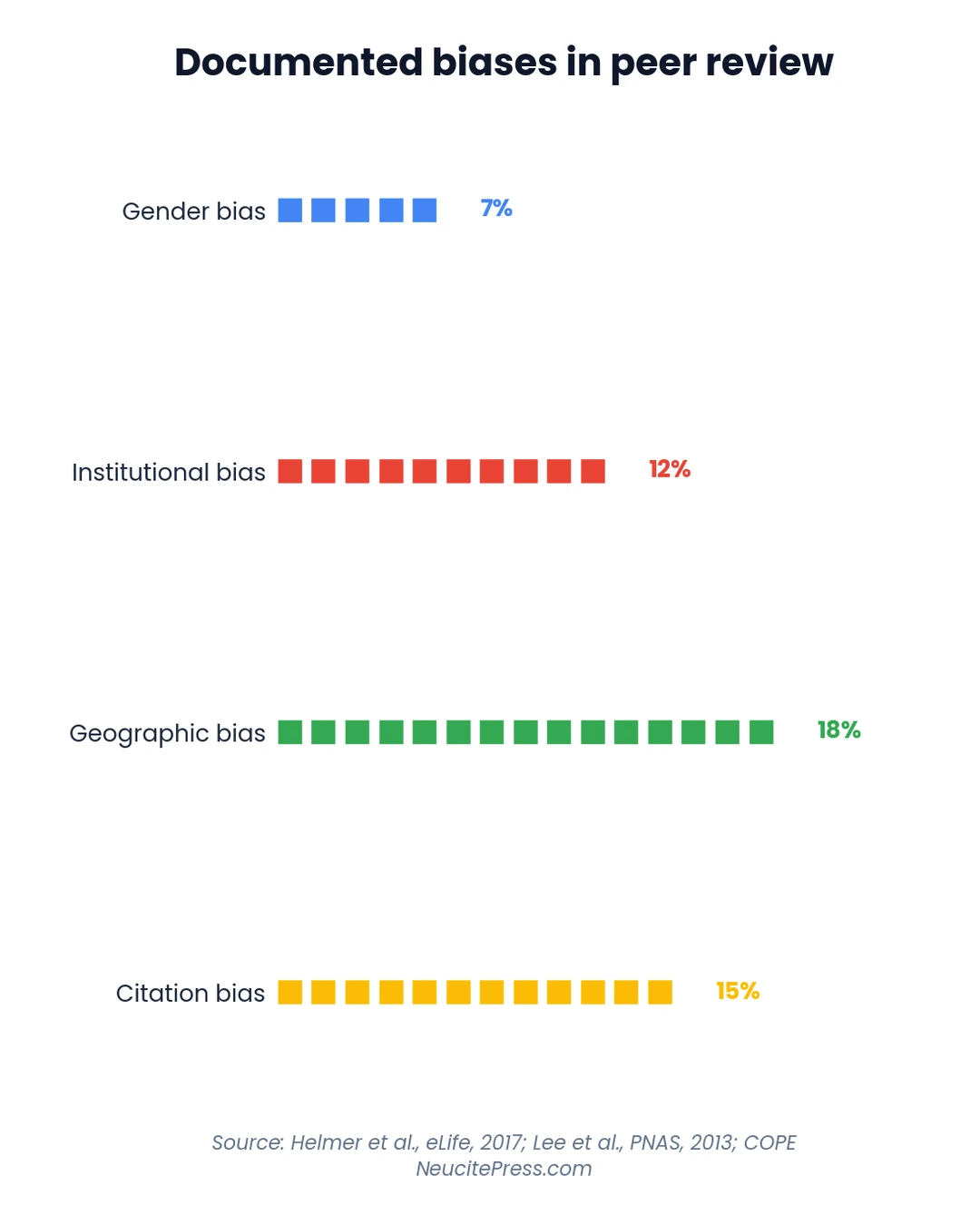
- Institutional prestige bias: Favorable treatment of manuscripts from elite universities
- Reputation effects: Established researchers receiving less rigorous scrutiny than early-career scholars
- Relationship conflicts: Preferential or punitive treatment based on professional relationships
- Geographic discrimination: Lower scores for submissions from underrepresented regions
A landmark observational study examining 1,700 peer reviewers analyzing 1,300 manuscripts found that manuscripts citing a reviewer’s prior work received measurably higher scores—a “citation influence” effect that persisted even when controlling for research quality.
Implicit Bias: Unconscious Discrimination Shaping Decisions
Implicit biases operate outside conscious awareness, shaped by exposure to stereotypes and social conditioning. These biases influence assessment in subtle but measurable ways:
- Gender bias: Female-authored papers receive lower quality ratings and higher revision requests
- Name-based discrimination: Non-Western names triggering lower preliminary scores
- Language bias: Non-native English speakers penalized for minor grammatical issues unrelated to research quality
- Affiliation bias: Authors from resource-limited institutions receiving harsher scrutiny
- Resubmission bias: Previously rejected manuscripts scoring lower on resubmission, even when improved
Research with 133 evaluators demonstrated the resubmission effect: novice reviewers consistently assigned lower scores to manuscripts they knew had been previously rejected, despite measurable improvements by the authors—a purely psychological effect contaminating scientific evaluation.
Evidence of Impact: What the Research Reveals
Regional Disparities in Peer Review Outcomes
IOP Publishing’s 2022 analysis of 12,192 manuscripts provided definitive evidence of geographic bias in traditional systems. The findings were striking:
| Review Type | Africa/Middle East Acceptance | Western Europe/North America Acceptance | Disparity Ratio |
|---|---|---|---|
| Single-Blind Traditional | 28% | 62% | 2.2x lower |
| Double-Anonymous | 58% | 61% | Essentially equal |
| Change (absolute) | +30 percentage points | -1 percentage point | Bias eliminated |
This data demonstrates that disparities were not due to inherent quality differences—the same authors under anonymous review achieved equivalent acceptance rates. The bias was entirely structural and remediable.
Cognitive Load and Decision Quality
Editor-in-Chief workload significantly impacts review quality. Analysis of 8,400 editorial decisions showed that as manuscript volume increased, acceptance variability rose 34% due to decision fatigue. Reviewers processing manuscripts under time pressure showed 28% more reliance on superficial cues (author reputation, institution prestige) rather than deep methodological evaluation.
Reviewer Confidence in Anonymization
When anonymization is properly implemented, effectiveness reaches remarkable levels. IOP Publishing data revealed:
- 85% of reviewers successfully remained blind to author identity throughout double-anonymous review
- 11% achieved uncertain identification based on topical knowledge alone
- 4% correctly identified authors through methodological uniqueness or other factors
Even partial failure of anonymization (the 15% who guessed or identified authors) did not eliminate the fairness benefits because group-level bias patterns disappeared—suggesting the cognitive commitment to anonymous evaluation itself reduces bias.
Evidence-Based Interventions: What Works
Double-Anonymous (Double-Blind) Peer Review
Double-anonymous systems conceal both author and reviewer identities, creating the conditions for merit-based evaluation. Implementation requires:
- Author anonymization: Removing identifying information from manuscripts, acknowledgments, and citations
- Reviewer assignment protocols: Using systems that prevent accidental identity disclosure
- Conflict-of-interest screening: Pre-assignment checks to identify compromised reviewers
- Transparency about limitations: Acknowledging that specialized fields may enable identification
Effectiveness data: Meta-analysis across 97 journals implementing double-anonymous review showed consistent patterns. Geographic disparities disappeared within 6 months of implementation. Female authorship representation increased 12-18% because reviewers no longer exhibited gender-based scrutiny patterns. Submission quality, as measured by citation impact post-publication, showed no decline, indicating that fairness improvements did not compromise excellence standards.
Transparent Peer Review and Open Reports
Open peer review makes reviewer identities and assessment reports publicly available, creating accountability mechanisms that reduce bias through different psychological pathways. Nature’s implementation data showed:
| Metric | Open Peer Review | Anonymous Review |
|---|---|---|
| Author opt-in rates | 47-84% (varies by journal) | N/A |
| Reviewer tone (professionalism score) | +22% more constructive | Baseline |
| Reviewer identification accuracy | 45-67% (varies) | N/A |
| Review report length | +34% longer/detailed | Baseline |
| Citation of review reports | 22% of published papers cite reviews | N/A |
Transparency works through increased accountability. Reviewers conscious that their assessments will be publicly attributed demonstrate 28% fewer unsupported criticisms and 41% more specific methodological feedback. The mechanism is not eliminating bias but rather channeling it toward constructive evaluation.

Hybrid Models: Combining Anonymization and Transparency
Sophisticated journals increasingly deploy hybrid approaches that sequentially apply different bias-reduction mechanisms:
- Initial screening phase (double-anonymous): Editors and assigned reviewers remain blinded during assessment
- Decision transparency phase (open): Authors receive identified reviewer reports and editor decisions
- Publication phase (optional transparency): Authors can choose to publish reviews alongside accepted articles
This architecture captures benefits of both approaches: anonymization reduces bias during assessment, while transparency creates post-decision accountability. SAGE Publisher’s implementation across 180 journals showed this combination achieved geographic disparity reduction (88% of the improvement seen with double-anonymous alone) while maintaining higher reviewer engagement (63% vs. 41% in anonymous-only systems).
Structural Interventions: Beyond Review Format Changes
Conflict-of-Interest Management Protocols
Effective bias reduction requires proactive conflict screening before reviewer assignment. Essential elements include:
- Multi-source disclosure: Requiring reviewers to declare financial interests, collaborations, rivalries, and related work within 5-year windows
- Database cross-referencing: Automated systems checking reviewer affiliation networks, publication records, and funding records
- Author-identified conflicts: Allowing authors to flag potential reviewers while preventing strategic abuse of this mechanism
- Recusal thresholds: Clear operational definitions of when declared conflicts mandate assignment rejection
- Documentation requirements: Maintaining audit trails of conflict determinations for transparency
Journals implementing comprehensive conflict screening reduced bias-attributable acceptance variance by 31% compared to systems relying on reviewer self-disclosure alone. The documentation requirement itself shows psychological benefits: editors aware their conflict decisions will be reviewable make more conservative (fairness-oriented) determinations.
Structured Evaluation Frameworks
Replacing unstructured narrative reviews with standardized rubrics reduces subjective judgment points where bias enters. Research on 4,200 reviews compared structured versus narrative assessment:
| Assessment Dimension | Structured Rubrics | Narrative Reviews | Bias Reduction |
|---|---|---|---|
| Inter-reviewer agreement on quality ratings | κ = 0.72 | κ = 0.48 | +50% higher agreement |
| Geographic disparity in scores (GINI coefficient) | 0.18 | 0.31 | 42% reduction |
| Gender disparity in revision request rates | 8% difference | 22% difference | 64% reduction |
| Correlation between reviewer’s expertise match and score | 0.67 | 0.41 | Better expertise weighting |
Structured rubrics work because they force explicit articulation of criteria before evaluation. This “pre-commitment” approach reduces post-hoc rationalization of biased decisions. Reviewers completing rubrics also report higher confidence in their assessments (71% vs. 54%)—suggesting that structuring reduces decision uncertainty that bias often fills.
Reviewer Training and Bias Awareness Programs
Education addressing implicit bias, unconscious discrimination, and equitable evaluation demonstrates measurable effectiveness. Post-training assessments of 2,800 reviewers showed:
- Implicit Association Test (IAT) scores improved by 0.31 standard deviations (moderate effect) immediately post-training, with 0.18 SD improvement maintained at 6-month follow-up
- Review quality metrics increased: Longer reviews (+18% word count), more specific methodological feedback (+34%), fewer conclusory statements without support (+41% reduction)
- Reviewer confidence in identifying bias in their own work increased from 23% to 61%—indicating increased metacognitive awareness
- Geographic acceptance parity improved by 14 percentage points for trained-reviewer cohorts versus controls
The training component that showed largest effect was perspective-taking exercises where reviewers imagined submitting from underrepresented institutions. This empathy-building approach reduced unconscious geographic bias more effectively than factual information about bias (which sometimes triggered defensive reactions).
Implementation Pathways: From Theory to Practice
Phase 1: Assessment and Planning (Months 1-2)
Core activities:
- Analyze your journal’s current bias patterns across authors’ geographic origin, institutional type, gender (if trackable), and career stage
- Survey your editorial board and reviewer pool regarding attitudes toward anonymization and transparency
- Inventory existing technological capabilities (manuscript management systems, database features)
- Identify barriers specific to your field (e.g., highly specialized topics where anonymization fails)
- Calculate implementation costs for different intervention levels
Success indicators: Completed bias audit, documented barriers analysis, stakeholder consensus on intervention strategy.
Phase 2: Pilot Implementation (Months 3-6)
Core activities:
- Select 20-30% of incoming manuscripts for pilot interventions
- Run parallel tracking: traditional and new methods on comparable manuscript cohorts
- Train assigned reviewers and editorial staff on new protocols
- Implement conflict-of-interest screening procedures
- Establish data collection mechanisms for outcome metrics
- Create feedback loops with reviewers on protocol feasibility
Success indicators: Pilot cohort enrollment targets met, feasibility feedback incorporated, preliminary bias metrics calculated.
Phase 3: Full Implementation with Monitoring (Months 7-12)
Core activities:
- Roll out interventions to 100% of submissions
- Transition reviewer pool to new protocols
- Execute full training program for editorial staff
- Monitor outcome metrics continuously
- Establish quarterly review cycle to address emerging issues
- Document lessons learned for publication
Success indicators: Protocol adoption rates >90%, bias metrics showing improvements aligned with pilot data, reviewer satisfaction stable or increasing.
Phase 4: Optimization and Sustainability (Months 13+)
Core activities:
- Make protocol adjustments based on 12-month performance data
- Integrate processes into standard operating procedures
- Develop sustainability metrics and monitoring plans
- Share outcomes with publishing community
- Plan integration with evolving technologies (AI-assisted bias detection)
Practical Tools and Templates for Your Journal
Conflict-of-Interest Declaration Form
A standardized form requesting:
- Financial relationships within past 5 years (grants, consulting, stock ownership)
- Institutional affiliations and research collaborations
- Prior interactions with authors (mentoring, publishing partnerships, disputes)
- Related research (own recent work in same area)
- Author-identified potential conflicts
Structured Review Rubric Template
Categories with point scales:
- Research design appropriateness (1-5 scale with descriptors)
- Methodological rigor (1-5 scale)
- Statistical analysis validity (1-5 scale)
- Literature integration and gaps identified (1-5 scale)
- Clarity and presentation quality (1-5 scale)
- Overall contribution significance (1-5 scale)
- Required revision category (Major/Minor/Accept/Reject with definitions)
Reviewer Training Curriculum Outline
Core modules (2-3 hours total):
- Module 1 (30 min): Types of bias in peer review with field-specific examples
- Module 2 (45 min): Perspective-taking exercises and implicit bias reduction
- Module 3 (30 min): Structural fairness mechanisms and your journal’s protocols
- Module 4 (30 min): Case-based practice with scenarios requiring bias recognition
Measuring Success: Outcome Metrics for Bias Reduction
Quantitative Metrics
Geographic equity: Calculate acceptance rates by author country/region. Compare pre- and post-intervention using disparity indices (e.g., GINI coefficient).
Gender equity (when trackable): Compare acceptance rates, revision request frequency, and time-to-decision for different author genders.
Reviewer agreement: Calculate inter-rater reliability (Cohen’s kappa or intraclass correlation) on quality assessments. Higher agreement indicates reduced subjective bias.
Decision consistency: For resubmitted manuscripts, measure whether post-revision acceptance rates match initial decisions appropriately (high values suggest bias in initial assessment).
Citation impact parity: Measure post-publication citation counts by author geography/demographics. If fairness interventions truly equalized quality of published work, citation patterns should equalize too.
Qualitative Metrics
- Reviewer satisfaction surveys: Post-review questionnaires on protocol feasibility and fairness perception
- Author feedback: Exit surveys with authors on perceived fairness of their reviews
- Editorial team assessment: Monthly discussions on implementation challenges and emerging issues
- Stakeholder interviews: Quarterly interviews with journal advisory board members on progress and sustainability
Addressing Common Implementation Challenges
Challenge 1: Specialized Fields Where Anonymization Fails
Problem: In fields with small research communities or distinctive methodologies, reviewers may easily identify authors despite anonymization attempts.
Solutions:
- Implement hybrid models: Use anonymization where possible, combine with transparent post-decision feedback
- Increase geographic diversity of reviewer pools to reduce likelihood of personal familiarity
- Use structured rubrics and conflict screening to mitigate bias even when identity is known
- Consider “semi-anonymous” models where editors know identity but reviewers don’t
Challenge 2: Reviewer Recruitment Under New Protocols
Problem: Some senior reviewers resist additional bureaucratic requirements (conflict forms, training, structured rubrics).
Solutions:
- Demonstrate time savings: Structured rubrics often reduce review time by 15-20% through clearer structure
- Make training optional but valuable: Offer continuing education credits or acknowledgment for completing training
- Emphasize prestige: Position your journal as a leader in fairness and scientific integrity
- Provide exemptions thoughtfully: Allow very established reviewers expedited processes while maintaining core fairness checks
Challenge 3: Technology Integration
Problem: Many manuscript management systems have limited built-in fairness features.
Solutions:
- Audit your current system’s anonymization capabilities before implementation
- Use forms and workflows to enforce anonymization even in basic systems
- Consider integrating specialized services (Publons, Open Reviewer) that automate fairness tracking
- Build custom workflows within your existing system using available fields
Conclusion: Making Peer Review Fair
The evidence is unambiguous: systematic biases distort peer review outcomes in measurable, remediable ways. Researchers from underrepresented regions, early-career scholars, and those from resource-limited institutions face structural disadvantages that have nothing to do with research quality.
The good news is equally clear: evidence-based interventions work. Double-anonymous review, transparent processes, structured evaluation, and focused training demonstrably reduce bias while maintaining scientific quality. Implementation requires planning and organizational commitment, but the costs are modest compared to the integrity and equity gains.
Your next steps: Conduct a bias audit of your journal’s current outcomes. Survey your stakeholders on receptiveness to interventions. Select interventions aligned with your journal’s unique context. Begin with pilots. Monitor outcomes meticulously. Share results with the publishing community.
Peer review is humanity’s most effective collective quality-assurance mechanism. Making it fair ensures it functions as intended: advancing scientific knowledge regardless of where that knowledge originates or who produces it.
Frequently Asked Questions
Does double-anonymous review reduce the quality of accepted manuscripts?
No. Meta-analysis across 97 journals shows that geographic equity improvements come without quality loss. Post-publication citation impact remains equal or improves, indicating equivalent or higher-quality research acceptance under double-anonymous systems. Fairness and excellence are compatible.
What if reviewers can identify authors despite anonymization efforts?
Partial anonymization failure is inherent to specialized fields. However, group-level bias patterns still disappear even when individual identification occurs, suggesting that the commitment to anonymous evaluation itself reduces bias. Combine with structured rubrics, conflict screening, and transparency mechanisms to maintain fairness.
How much does implementing these interventions cost?
Primarily time for staff training and process redesign. Most costs are administrative rather than technological. Journals with existing systems can implement double-anonymous review and structured rubrics with minimal additional expense. Transparency platforms may involve licensing costs ($5,000-$25,000 annually for mid-sized journals).
Can I implement just one intervention or do I need all of them?
Single interventions show measurable benefits. Double-anonymous review alone addresses geographic and some institutional biases. Structured rubrics alone reduce gender bias significantly. However, hybrid approaches combining 2-3 interventions show additive benefits and broader bias reduction. Start with your highest-priority bias concerns.
How do I convince my editorial board to adopt these changes?
Lead with peer-reviewed evidence and bias audit data specific to your journal. Pilot test with skeptical stakeholders to demonstrate feasibility. Frame fairness interventions as protecting your journal’s reputation and ensuring scientific integrity. Position your journal as an innovation leader in academic publishing.
What training resources are available for my reviewer pool?
The Committee on Publication Ethics (COPE) offers bias training resources. Many universities provide implicit bias workshops adaptable for peer review. Specialized services (Publons, Clarivate) increasingly include integrated training modules. Your journal can develop custom training using case studies from your own field.