Should You Start a Specialized Journal? Niche vs Broad Decision
Did you know the academic publishing industry often achieves higher profit margins than tech giants like Apple and Amazon? This surprising reality makes the prospect of starting a specialized academic journal a significant financial consideration.
Reviewed by the NeucitePress Editorial Board — PhD academics, peer-reviewed journal editors and medical communication specialists.
Researchers face a clear paradox. They contribute their work without payment, while universities pay large fees to access the final publication. This system creates a pressing need for new, equitable models.
This guide addresses the critical choice between a niche-focused publication and one with a broad scope. Your decision here impacts everything from attracting editors to ensuring long-term sustainability.
We explore the growing momentum of open access initiatives. These models can remove costs for both authors and readers, offering a powerful alternative to traditional subscription systems.
Our expertise provides a clear roadmap for academics and scholarly societies. We cover essential factors like market demand, funding, and building a strong editorial team for a successful launch.
Key Takeaways
- Academic publishing generates exceptionally high profit margins, creating a compelling financial opportunity.
- The traditional publishing model presents a paradox where authors donate work and institutions pay high access fees.
- The choice between a niche or broad journal scope is a foundational decision affecting long-term success.
- Open access publishing is a growing, viable alternative that can benefit both authors and readers.
- Successful journal creation requires careful planning in areas like market analysis and team development.
- This guide offers a comprehensive roadmap for navigating the entire process from conception to sustainability.
Introduction: The Decision to Launch an Academic Journal
Escalating challenges within conventional academic publishing systems are prompting researchers to explore independent journal creation. We analyze the critical factors driving this movement toward new publication models.
Hook with Compelling Statistics and Pain Points
Established publications often impose prohibitive waiting periods. These delays can stretch for months or even years, hindering timely research dissemination.
Early-career scholars face disproportionate disadvantages. They require published work for tenure and professional advancement in their field.
According to Columbia University faculty who launched the Journal of Clinical Education in Physical Therapy, “limited publishing opportunities are particularly detrimental for younger scholars.” In physical therapy education, only one publication existed with extensive waiting lists.
Institutions bear significant financial burdens. They pay escalating subscription fees while faculty contribute free labor through writing and peer review.
Accessibility remains a critical concern. Valuable research stays locked behind paywalls, limiting access for practitioners and independent researchers.
Successful journal development requires substantial planning. Most launches demand over a year of dedicated effort with consistent weekly meetings.
Market gap assessment identifies underserved research areas. This analysis creates compelling rationales for new journal creation.
We provide a decision framework to evaluate resources and community needs. This enables objective assessment of publication viability.
Assessing the Need: Identifying Gaps and Opportunities in Publishing
The viability of any scholarly publication hinges on accurately identifying unmet needs within existing dissemination channels. We provide systematic frameworks to evaluate genuine demand before resource commitment.
Analyzing Market Demand and Credible Data
Christopher Kevin Wong and Jean Fitzpatrick Timmerberg from Columbia University demonstrated that sufficient demand assessment represents the primary consideration. Their work in physical therapy education revealed critical publishing bottlenecks.
We outline proven methodologies for market evaluation:
- Comprehensive analysis of existing publication venues and acceptance ratios
- Author surveys quantifying unmet publishing requirements
- Geographic gap identification for underrepresented regions
- Subject-matter analysis of specialized subfields
Pain Points in Traditional Publishing Models
Traditional systems often create significant barriers. Restrictive copyright policies and slow review processes limit researcher accessibility.
Open access models can address these challenges effectively. The Columbia team expanded readership to faculty, students, and clinicians beyond professional associations.
Our decision matrix evaluates factors like publication wait times against required resources. This enables objective assessment of new publication viability.
Defining Journal Scope and Niche Focus
The foundational document that defines your scholarly publication’s identity is the aims and scope statement. This critical framework establishes clear boundaries for acceptable content and guides editorial decisions.
Crafting Your Aims and Scope Statement
According to the DOAJ Open Access Journals Toolkit, your statement should quickly convey primary goals, research topics, and intended audience. We provide downloadable templates covering essential elements like research topics and selection criteria.
Your publication’s differentiation factors matter significantly. These may include subject specialization, methodological focus, or innovative publishing approaches.
| Scope Type | Advantages | Considerations |
|---|---|---|
| Niche Focus | Establishes authority, attracts dedicated readership | Limited submission volume, specialized audience |
| Broad Scope | Higher submission rates, interdisciplinary impact | Competitive landscape, diluted focus |
| Hybrid Approach | Balanced growth, diverse content types | Complex editorial management, clear boundaries needed |
“Aiming at the level of a top specialist journal such as Combinatorica” to fill a gap for an “ethical combinatorics journal at that level not published by major commercial publishers.”
Clear boundaries regarding acceptable content help authors self-select appropriately. This streamlines editorial decision-making processes significantly.
We guide you in defining selection criteria that reflect your publication’s values. These may prioritize methodological rigor, practical application, or theoretical innovation.
Specifying content types beyond original research articles creates diversity. Case studies, review articles, and commentaries serve different community needs effectively.
Understanding Costs, Budgets, and Funding Strategies>
Budgetary considerations often determine the long-term viability of new publication ventures. We analyze financial frameworks that support sustainable scholarly dissemination.
Benchmarking Financial Data and Funding Models
Scholastica identifies seven primary open access funding approaches. These range from transactional models with article processing charges to Diamond OA where institutions cover all expenses.
Transactional models typically charge $500 to $3,000 per article. These fees cover essential services like copy editing and typesetting. Waiver programs ensure accessibility for underfunded authors.
Columbia’s Journal of Clinical Education in Physical Therapy demonstrates practical implementation. They charge modest processing fees while offering waivers for residents and fellows.
| Funding Model | Cost Coverage | Sustainability Factors |
|---|---|---|
| Transactional (APCs) | Per-article services | Submission volume, waiver programs |
| Diamond OA | Institutional support | Grant funding, endowment stability |
| Hybrid Approach | Multiple revenue streams | Diversified financial resources |
Start-up costs typically range from $10,000 to $50,000 for first-year operations. These investments cover technology infrastructure and editorial support.
Grant opportunities from organizations like the Virginia Apgar Academy provide crucial seed funding. Such resources help defray initial expenses during early development years.
“Our team secured foundation grants to subsidize processing fees for institutional members, ensuring equitable access while maintaining quality standards.”
We provide decision frameworks evaluating model sustainability over three-to-five-year horizons. These tools consider projected submission volume and community financial capabilities.
Steps for Starting a Specialized Academic Journal>
Implementing a structured development process transforms the complex task of journal creation into manageable phases. We provide systematic guidance for each critical stage of this journey.
Actionable Checklists and Decision Frameworks
Our comprehensive checklists break down the entire workflow into sequential actions. Each phase includes specific milestones and quality control measures.
We offer decision frameworks that help prioritize tasks based on resource availability. These tools identify which steps can run concurrently versus those requiring sequential completion.
Downloadable Templates and Best Practices
Access our collection of editable templates for policy documents and submission guidelines. These resources incorporate industry standards while allowing customization.
Best practice guides cover technical aspects like website setup and manuscript management. We detail platform options from basic website builders to specialized publishing systems.
The complete development timeline typically spans 12-18 months. Regular progress tracking ensures consistent momentum toward your launch date.
Building a Credible Editorial Board>
Editorial board member reputations often outweigh impact factors when authors evaluate new publications. Dennis Relojo-Howell, founder of Psychreg Journal of Psychology, confirms this reality: “When I started, potential contributors were only interested in who was on the editorial board. I have never been asked about the journal’s impact factor.”
Recruiting Experts for Enhanced Credibility
We recommend beginning with six core editorial board members who provide strategic direction. Supplement this foundation with associate editors handling manuscript management. Columbia’s successful model demonstrates this approach effectively.
James Williams from the International Journal of Music, Health and Wellbeing emphasizes diverse expertise: “We have editors with different areas of expertise and skillsets, including people who are familiar with copy-editing and academic publishing.” This multi-skilled approach strengthens your entire editorial team.
Effective recruitment leverages professional networks and clearly articulates your publication’s mission. Offer meaningful roles rather than honorary positions to attract established scholars. Define three-year appointments with clear responsibilities.
| Editorial Role | Primary Responsibilities | Recruitment Strategy |
|---|---|---|
| Core Board Members | Strategic governance, field expertise | Personal outreach to established scholars |
| Associate Editors | Manuscript management, peer review | Target specialists with publishing experience |
| Reviewers | Content evaluation, feedback | Early-career scholars seeking experience |
Geographic and professional diversity enhances credibility significantly. Follow COPE guidelines for transparent selection criteria. Balance experienced editors with fresh perspectives from various career stages.
Optimizing Peer Review and Publishing Processes>
The integrity of academic publishing rests heavily on robust peer evaluation methodologies. We establish frameworks that ensure quality while maintaining efficiency throughout manuscript handling.
Effective workflows transform complex evaluation into manageable stages. Our systems prioritize transparency and constructive feedback for all participants.
Streamlining Submission and Review Workflows
We implement structured approaches to manuscript evaluation. James Williams emphasizes personalized recruitment: “We approach academics who are working closely in the field of the article and send personal requests” for peer reviewers.
Columbia’s innovative model demonstrates progressive thinking. Their optional open peer review removes anonymity barriers, enhancing communication between authors and reviewers.
| Review Model | Identity Disclosure | Best Applications |
|---|---|---|
| Single-Blind | Reviewer concealed | Established publications |
| Double-Blind | Both identities concealed | Early-career author support |
| Open Review | All parties identified | Educational development |
Typical review timeframes span 2-4 weeks with 2-3 reviewers per manuscript. Plan S compliance requires annual statistics reporting for transparency.
Our workflow optimization strategies leverage manuscript management systems. These tools automate invitations and track progress for editorial teams.
Incorporating Accreditation, Compliance, and Legal Considerations>
Navigating the regulatory landscape is essential for establishing a credible and legally sound publication. We demystify key requirements to protect your publication’s integrity and its authors’ rights.
Proper licensing forms the foundation. Plan S funders often mandate Creative Commons CC BY licenses. This approach allows broad dissemination of research while protecting attribution.
Navigating CME, HIPAA, and PhRMA Guidelines
Medical and health sciences journals face specific rules. HIPAA requires strict de-identification of patient data in all case studies and original research.
For pharmaceutical content, the PhRMA Code dictates transparent disclosure of industry funding and author conflicts. Adherence to ethical marketing guidelines is non-negotiable.
Publications in medical education can align with ACCME standards. This supports educational quality, though formal CME accreditation is a separate process.
Leveraging Peer-Reviewed Studies and ACCME Standards
Establishing clear ethics policies is critical. These should address plagiarism, data integrity, and authorship disputes, following COPE guidelines.
Your copyright policy must be transparent. Specify if authors retain copyright or transfer it. Retention is standard in modern publishing.
Consider legal risks like defamation in peer review. Clear terms of use for your journal’s website are vital for limiting liability.
| Compliance Area | Key Requirement | Primary Impact |
|---|---|---|
| Copyright & Licensing | CC BY for open access | Author rights, funder mandates |
| Medical Data (HIPAA) | Patient de-identification | Privacy protection in articles |
| Industry Research (PhRMA) | Conflict of interest disclosure | Transparency and credibility |
Professional Disclaimer: This guidance provides a general overview. Consult qualified legal counsel for advice specific to your work, jurisdiction, and content area.
Leveraging Digital Platforms and Hybrid Technology>
Modern scholarly dissemination requires strategic technology selection to ensure sustainable publication operations. We demystify the technical requirements for establishing robust digital infrastructure.
Choosing the Right Publishing Software and OJS Options
Platform selection significantly impacts your publication’s workflow efficiency. Options range from general website builders to specialized systems like Open Journal Systems (OJS).
OJS provides integrated manuscript management without licensing fees. This open-source solution handles submission tracking and peer review coordination effectively.
James Williams demonstrates practical alternatives: “I use a spreadsheet to keep on top of submissions. It works fine.” Simple tools can manage modest submission volumes successfully.
| Platform Type | Primary Features | Technical Requirements | Cost Structure |
|---|---|---|---|
| Website Builders (Wix/Weebly) | Basic content presentation | Minimal technical knowledge | Monthly subscription fees |
| Open Journal Systems (OJS) | Full manuscript workflow | Server installation needed | Free open-source software |
| University Library Services | Comprehensive hosting support | Institutional partnership | Often subsidized or free |
Utilizing Gantt Charts, Budget Infographics & Comparison Tables
Visual planning tools clarify implementation timelines and resource allocation. Gantt charts identify critical path dependencies for website development.
Production workflows using Word and Adobe Acrobat achieve professional article presentation. Digital Object Identifier assignment through Zenodo provides permanent citation tracking.
Our frameworks balance upfront costs against long-term maintenance requirements. This approach aligns technology decisions with publication goals, as detailed in recent hybrid publishing research.
Utilizing Data-Driven Benchmarks and Expert Insights>
Establishing realistic expectations requires understanding typical performance indicators for emerging scholarly venues. We analyze quantitative metrics that guide successful publication development.
Conversion Rates, Cost per Attendee, and Impact Metrics
New publications typically receive 20-50 manuscript submissions in their first year. This volume depends on field size and marketing effectiveness.
Editorial board quality often matters more than traditional metrics for attracting initial submissions. Dennis Relojo-Howell confirms this reality: “When I started, potential contributors were only interested in who was on the editorial board. I have never been asked about the journal’s impact factor.”
Comprehensive publishing services cost $200-$800 per article. These expenses cover peer review management, copy-editing, and hosting.
| Performance Metric | Typical Range | Strategic Importance |
|---|---|---|
| Acceptance Rate | 20-60% of submissions | Directly impacts revenue for APC models |
| Article Downloads | 500-2,000 per article | Early indicator of reader engagement |
| Financial Sustainability | 30-50 articles annually | Required for APC-based self-sufficiency |
| Impact Factor Timeline | 3+ years minimum | Citation metrics require publication history |
David Crotty emphasized in a 2021 CHORUS Forum that sustainable models must generate surplus revenue. This allows organizations to thrive and develop additional services.
DOAJ requires five original research articles before indexing consideration. Alternative impact indicators include download statistics and social media engagement.
Maximizing Journal Visibility and Impact>
Digital discoverability serves as the critical bridge connecting valuable research with its intended global audience. We implement systematic approaches that transform quality content into widely accessible knowledge resources.
Enhancing SEO and Online Discoverability
Website optimization begins with fundamental SEO practices. Article titles and abstracts should incorporate relevant keywords to improve search engine rankings.
Structured data markup enables Google Scholar indexing effectively. Mobile-responsive design ensures accessibility for all readers across devices.
Unique, descriptive URLs for each piece of content enhance discoverability. Comprehensive metadata including author ORCIDs improves search engine performance.
The Directory of Open Access Journals requires five original research articles before indexing consideration. Dom Mitchell confirms they also need a fully confirmed ISSN registration.
| Indexing Platform | Primary Focus | Application Timeline |
|---|---|---|
| DOAJ | Open access verification | After 5 published articles |
| Discipline Databases | Field-specific relevance | 6-12 months post-launch |
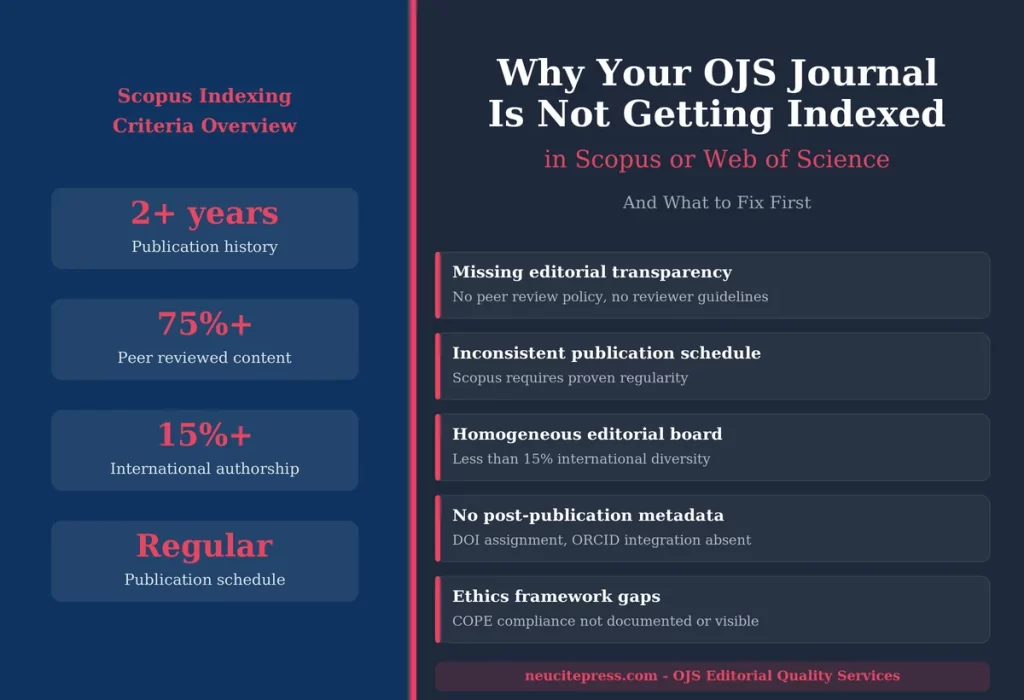
| Web of Science/SCOPUS | Multidisciplinary impact | 2+ years established track record |
Diverse article types attract different search queries and reader segments. Research papers, reviews, and commentaries expand your publication’s discoverability footprint.
Social media platforms and academic networks drive traffic effectively. Comprehensive indexing exponentially increases article visibility, as demonstrated in recent visibility studies.
Email marketing builds consistent readership through launch announcements and newsletters. These strategies collectively maximize impact for authors and services.
Engaging the Research Community and Promoting Open Access>
Building a vibrant research community requires strategic engagement that extends beyond traditional publishing channels. We implement comprehensive approaches that transform passive readers into active participants.
Tactics for Social Media Outreach and Community Engagement
Effective social media strategies begin with targeted platform selection. Twitter/X works well for article announcements, while LinkedIn reaches academic professionals. Facebook groups create discipline-specific discussion spaces.

Editorial board members serve as powerful ambassadors for your publication. Encourage them to share calls for papers within their professional networks. Personal invitations to colleagues build submission momentum effectively.
Author surveys provide critical insights into community needs. The American Physiological Society demonstrated this approach with their “Open Access: What Researchers Need to Know Now” webinar. Stacey Burke emphasized involving authors and members in ongoing dialogues about mandates.
| Engagement Strategy | Primary Benefits | Implementation Requirements |
|---|---|---|
| Professional Association Partnerships | Access to established networks, credibility enhancement | Relationship building, mutual value proposition |
| Conference Presentations | Direct researcher contact, visibility boost | Travel budget, presentation materials |
| Department Outreach | Targeted author recruitment, local community building | University contacts, customized messaging |
| Virtual Events & Webinars | Global reach, cost-effective engagement | Technical platform, content development |
Email marketing maintains consistent communication with potential contributors. Build targeted lists and craft compelling calls for submissions. Emphasize quick review times and comprehensive author support.
Subscribe today to receive updates and join our growing community of researchers advancing open scholarship. Share this resource with colleagues and comment below with your engagement strategies.
Conclusion
Creating a sustainable scholarly venue requires balancing ambitious vision with practical considerations of resource allocation and community engagement. This comprehensive roadmap demonstrates that successful publication development typically spans 12-18 months with substantial weekly commitments. The foundational choice between niche and broad scope fundamentally shapes every operational aspect.
Critical success factors include thorough market assessment, credible editorial board assembly, and transparent peer review processes. While the initial development phase demands full-time equivalent effort, the reward of advancing knowledge sharing justifies this investment. Treat early years as a pilot phase for refining operations based on community feedback.
Download our comprehensive launch templates including budget spreadsheets and policy checklists to accelerate your planning. Subscribe for ongoing publishing guidance and share this resource with colleagues. Professional Disclaimer: While this guide provides authoritative information, consult legal counsel for compliance matters specific to your circumstances.
FAQ
What are the primary differences between launching a niche versus a broad-scope journal?
A niche journal focuses on a highly specialized field, attracting a dedicated audience and often achieving faster recognition within that community. A broad-scope journal aims for a wider readership and a larger volume of submissions but faces stiffer competition. The decision hinges on identifying an unmet need and the potential for sustainable growth in submissions and readership.
How do we assess the genuine need for a new journal in a specific field?
We analyze credible data, including publication trends, gaps in existing literature, and feedback from researchers. This involves reviewing submission rates to related journals, conference themes, and funding patterns to confirm a sustainable opportunity and validate market demand before committing resources.
What are the typical costs involved in starting and maintaining an academic journal?
Initial and ongoing costs include publishing software licenses, editorial management tools, website hosting, marketing, and potential article processing charges for open access models. Funding strategies often combine institutional support, sponsorships, membership fees, and publication fees to ensure financial sustainability without compromising quality.
What steps are critical for building a credible editorial board?
Recruiting respected experts is paramount. We identify leading researchers in the field, invite them based on their publication records and standing, and clearly define roles. A strong board enhances the journal’s credibility, attracts high-quality submissions, and ensures a rigorous peer review process.
How can technology streamline the peer review and publishing process?
A> Utilizing robust platforms like Open Journal Systems (OJS) automates manuscript tracking, blind peer review, and communication. This software reduces administrative burdens, accelerates decision times, and maintains transparency, leading to a more efficient workflow for editors, reviewers, and authors.
What are the key legal and compliance considerations for a new journal?
A> Journals must establish clear policies on copyright, licensing (like Creative Commons), and ethical standards for publication. For specific fields, compliance with guidelines such as HIPAA for patient data or ICMJE recommendations for medical research is essential to maintain integrity and avoid legal issues.
How important is a Digital Object Identifier (DOI) for journal articles?
A> DOIs are critical. They provide a permanent link to each article, ensuring citability and long-term accessibility. Registering with Crossref to assign DOIs is a standard practice that significantly enhances the discoverability and professional standing of your publication.
What strategies maximize a journal’s visibility and impact factor potential?
A> Key tactics include strong search engine optimization (SEO) for your website, active social media engagement, indexing in major directories like DOAJ, and encouraging high-quality citations. Consistent publication of original research and promoting open access can rapidly increase readership and citation rates.