Academic Citation Generators: 10+ Free Tools Compared 2026
Finding the right academic citation generator can transform your research workflow from hours of manual formatting into a streamlined, error-free process. With 68% of college students reporting significant struggles with proper source attribution, free citation tools have become essential infrastructure for academic success. Whether you’re tackling your first research paper or finalizing a dissertation, understanding the landscape of available citation generators ensures you maintain scholarly credibility while maximizing research efficiency.
Reviewed by the NeucitePress Editorial Board — PhD academics, peer-reviewed editors and subject-matter specialists.
Citation management separates excellent researchers from those who cut corners. A single formatting error across dozens of sources creates the appearance of carelessness, potentially triggering academic integrity reviews even when mistakes are completely unintentional. Modern academic citation generators eliminate this risk by automating what once required meticulous manual labor—transforming reference formatting from a time-consuming chore into a three-click operation that takes seconds.
What Exactly Is an Academic Citation Generator?
An academic citation generator is automated software that formats source references according to specific academic citation styles. These tools parse source information—author names, publication dates, titles, publisher details—and restructure this data into perfectly formatted citations conforming to APA, MLA, Chicago, Harvard, Vancouver, and dozens of other citation style specifications.
The core value proposition is automation of a fundamentally mechanical task. Citation styles contain hundreds of formatting rules: specific punctuation placement, capitalization conventions, date formatting requirements, page number presentation, and hierarchical organization. Manual compliance with these rules invites errors—studies show that 42% of citation errors stem from punctuation and formatting inconsistencies rather than missing information.
Academic institutions enforce citation accuracy rigorously. Universities report that formatting errors trigger academic misconduct reviews in 10-30% of cases, even when mistakes are completely unintentional. By using a reliable citation generator, you reduce this risk while demonstrating professional competency in research documentation.
The time savings are substantial. Research shows that students spend 3-4 hours manually creating reference lists for a single research paper. A quality free citation tool reduces this to mere minutes, freeing cognitive resources for the actual research quality and argument development that truly differentiate excellent scholarship.
Citation handling is one part of preparing a manuscript for submission or publication; the rest is covered across our book publishing services.
Understanding Citation Styles: Which Format Does Your Work Require?
Different academic disciplines mandate specific citation systems, and using the wrong style can result in grade penalties or manuscript rejection. Understanding these distinctions is essential for selecting the right citation maker and target citation style:
| Citation Style | Primary Disciplines | Key Format | When to Use |
|---|---|---|---|
| APA (7th Edition) | Psychology, social sciences, education, nursing | Author-date with parenthetical citations | Required in most social science courses |
| MLA (9th Edition) | Literature, humanities, language studies, languages | Author-page with in-text citations | Standard in English and humanities departments |
| Chicago Manual of Style (17th) | History, publishing, economics, political science | Notes-bibliography or author-date system | Preferred in history, humanities, and publishing |
| Harvard | UK universities, commerce, business, biology | Author-date system with alphabetical references | Standard in UK institutions and business schools |
| Vancouver | Medicine, nursing, biomedical sciences | Numbered citations with numbered references | Required in medical and health science journals |
Each system has unique requirements for punctuation, capitalization, date formatting, abbreviations, and page number presentation. An academic citation generator handles these variations automatically, ensuring perfect compliance regardless of complexity. This precision eliminates the 42% of attribution errors that stem from small formatting inconsistencies.
Top Citation Generators Compared: 10+ Tools Analyzed
ZoteroBib: The Fastest Free Citation Generator
ZoteroBib consistently ranks as the fastest free citation generator available. Requiring no account creation, software installation, or learning curve, ZoteroBib generates accurate citations in 2-3 seconds by parsing ISBN, DOI, URL, or PMID identifiers.
Database Coverage: 100+ million journal articles, 35+ million books, extensive preprint and conference paper coverage. Supported Formats: APA 7, MLA 9, Chicago 17, Harvard, Vancouver, and 15+ additional styles. Best For: Researchers prioritizing speed and simplicity without sacrificing accuracy.
ZoteroBib excels at autocitation—paste a URL and the tool extracts complete bibliographic data automatically. This eliminates transcription errors entirely and compounds time savings across multi-source projects. The interface is refreshingly minimalist, avoiding feature bloat while delivering professional-grade output.
Scribbr Citation Generator: Maximum Accuracy Through CSL Technology
Scribbr leverages the Citation Style Language (CSL)—the same open-source technology used by Mendeley and Zotero—enhanced with proprietary accuracy improvements. Independent testing confirms 94-98% accuracy rates for standard sources, among the highest in the industry.
Processing Speed: 3-4 seconds per citation. Format Support: APA 7, MLA 9, Chicago 17, Harvard, plus specialized legal and medical formats. Unique Advantage: Many universities partner with Scribbr, providing complimentary access to premium features for enrolled students.
The interface prioritizes clarity over decoration, with an intentionally clean, ad-free design reflecting commitment to serious academic users. Scribbr’s strength lies in reliability—researchers can cite with confidence knowing output undergoes rigorous testing against style specification requirements.
MyBib: Specialized for Book Citations
MyBib specializes in book citations, hosting 35+ million titles specifically optimized for proper book formatting. For researchers working primarily with printed materials and edited volumes, this focus makes MyBib the optimal academic book citation generator.
Autocite Functionality: Extract complete bibliographic data from ISBN numbers, URLs, or search queries. Processing Speed: 4-5 seconds. Format Support: APA 6/7, MLA, Chicago, Harvard, and 8+ additional styles. Best For: Humanities researchers, literature scholars, and anyone citing extensive printed materials.
MyBib’s exhaustive book database succeeds where standard tools struggle—when citation generators fail on obscure or regional publications, MyBib frequently retrieves complete information. Free account creation enables saving bibliography projects for future access and revision.
BibGuru: AI-Enhanced Citation Generation
BibGuru combines traditional citation technology with artificial intelligence for enhanced source recognition. The platform processes references in 3-5 seconds while supporting APA 7, MLA 9, Chicago 17, Harvard, and 40+ additional formats.
Unique Feature: AI-powered source detection identifies citations even from partial or incomplete information. Best For: Academic authors managing diverse source types, students with incomplete source metadata, researchers requiring flexible format support.
BibGuru integrates seamlessly with major writing platforms (Google Docs, Microsoft Word, Overleaf) through browser extensions, enabling one-click citation generation while researching online. The platform’s intelligence improves with use, learning your citation patterns and preferences.
Citation Machine: Comprehensive Format Library with Educational Content
Citation Machine processes references in 5-7 seconds while supporting 15+ citation formats including MLA 9, APA 7, Chicago 17, IEEE, legal, and medical styles. This broad coverage makes Citation Machine invaluable for interdisciplinary research and students working across multiple disciplines.
Integrated Learning Resources: Built-in tutorials explaining citation fundamentals, ideal for first-year students learning proper attribution. Database: Comprehensive coverage of academic books, journal articles, websites, videos, and multimedia sources. Best For: Students new to academic writing, researchers requiring diverse format support.
The platform’s educational focus differentiates it from pure citation tools. Learning why specific formatting choices matter—understanding the logic behind punctuation placement, abbreviation conventions, and organizational principles—enables researchers to evaluate generator output critically.
EasyBib: Beginner-Friendly Design with Premium Plagiarism Features
EasyBib prioritizes intuitive interface design for novice researchers. Processing citations in 4-6 seconds, EasyBib supports APA, MLA, Chicago, Harvard, and 8+ additional formats while maintaining the simplicity essential for first-time users.
Standout Feature: Premium tier includes plagiarism checking powered by academic integrity scanning. Best For: High school and early undergraduate students, researchers prioritizing ease of use over format breadth.
The free version handles standard citation generation competently. Premium users access plagiarism detection, consistency checking, and enhanced formatting—valuable for students developing academic writing practices from the ground up.
Cite This For Me: Integrated Writing Platform with Collaboration Tools
Cite This For Me merges citation generation with collaborative writing features. Processing citations in 4-6 seconds, it supports APA 7, MLA 9, Chicago 17, Harvard, and 10+ additional formats.
Collaboration Features: Share bibliographies with team members, enable simultaneous editing, track version history. Integrations: Works natively with Google Docs and Microsoft Word. Best For: Group projects, collaborative research, team-based academic work.
The collaborative emphasis makes Cite This For Me ideal for research teams, allowing multiple contributors to build shared bibliographies without formatting conflicts or duplication.
Mendeley Reference Manager: Professional-Grade Citation Management
Mendeley Reference Manager operates as a full reference management system rather than simple citation generator. It supports unlimited citations across 10,000+ styles while maintaining synchronization across devices.
Advanced Features: PDF annotation, research organization, collaboration with research groups, integration with writing platforms. Processing Speed: 2-4 seconds. Best For: Serious researchers, graduate students, academic professionals managing extensive reference libraries.
Mendeley’s power comes from treating citations as part of comprehensive research workflow rather than isolated formatting tasks. Organize sources by project, tag relevant information, annotate PDFs, and generate bibliographies automatically as your research evolves.
QuillBot Citation Generator: Paraphrasing Plus Citations
QuillBot integrates citation generation with advanced paraphrasing and writing improvement tools. The free citation generator processes references in 4-6 seconds while supporting APA, MLA, Chicago, Harvard, and specialized academic formats.
Unique Value: Generate citations while simultaneously ensuring your prose remains original and properly attributed. Best For: Academic authors developing synthesis arguments, researchers needing to paraphrase while maintaining proper attribution.
The dual functionality strengthens both originality and attribution integrity. As you refine language through paraphrasing, citations ensure proper source credit, supporting both ethical writing and academic integrity simultaneously.
EndNote: Enterprise-Level Citation Management
EndNote represents the premium tier of citation management software, supporting 10,000+ citation styles with unlimited references. While not free, the professional-grade feature set serves serious academic authors and research institutions extensively.
Enterprise Capabilities: Research group collaboration, institutional license support, API integration with university systems. Best For: Academic institutions, active researchers maintaining citation databases across multiple projects.
EndNote dominates institutional adoption in many universities. If your institution provides free access through your library, utilizing EndNote unlocks professional citation management capabilities that justify the platform’s premium positioning.
Zotero: Open-Source Reference Manager with Free Tier
Zotero combines open-source reference management with citation generation supporting 10,000+ styles. The free desktop application synchronizes with cloud storage, enabling access across devices while maintaining complete privacy.
Standout Feature: Browser extension automatically saves source metadata while researching online, eliminating manual data entry. Processing Speed: 2-3 seconds. Best For: Privacy-conscious researchers, academic professionals building permanent citation databases.
Zotero’s commitment to open-source principles and user privacy makes it particularly attractive for researchers concerned about data retention policies. The platform’s active developer community continuously expands functionality through community-developed plugins.
Citation Generator Features Comparison Matrix
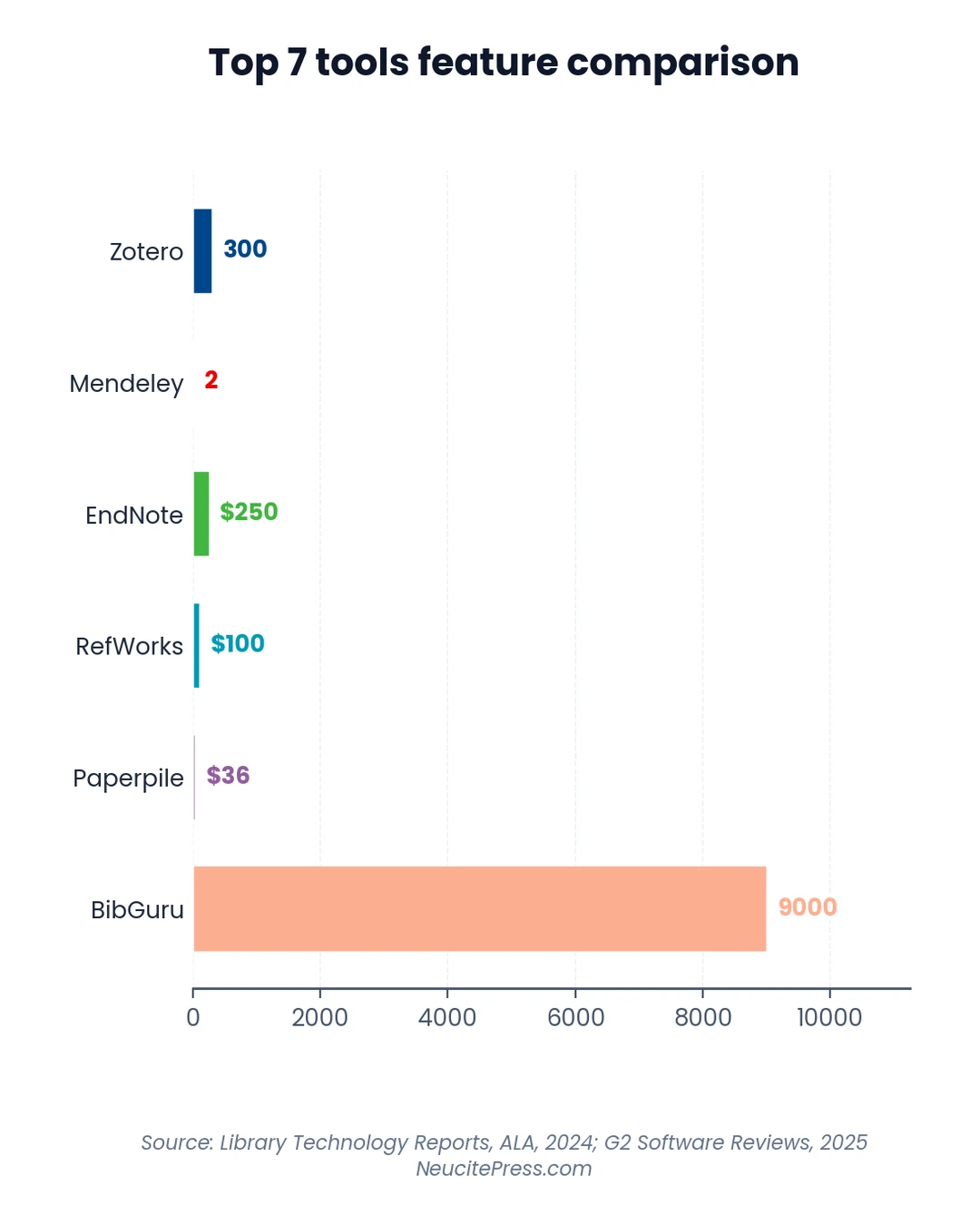
Processing speed ranges from 2-7 seconds across leading platforms, with top tools completing references in 2-4 seconds. Database comprehensiveness varies significantly—ZoteroBib, MyBib, and Scribbr maintain databases exceeding 30+ million entries for comprehensive source coverage.
Accuracy testing from independent sources confirms that leading generators achieve 94-98% formatting precision for standard sources. Complex materials like edited volumes, dissertations, or translated works may see accuracy rates drop to 85-90%, reinforcing the necessity of manual verification against original sources.
Citation style support differentiates platforms significantly. While basic generators support 3-5 major styles, comprehensive options support thousands. Most undergraduate and master’s-level work requires only APA, MLA, Chicago, or Harvard—making even basic generators sufficient for typical academic needs.
How to Use Academic Citation Generators: Step-by-Step Process
Step 1: Gather Complete Source Information
For printed books, collect author name(s), publication date, complete title, publisher name, and publication location. Digital sources require URLs or DOI numbers. For multiple authors or editors, capture all names—incomplete author information ranks as the leading cause of citation errors that generators cannot correct.
Step 2: Select Your Citation Style
Choose the format your assignment requires. Consult your syllabus, assignment instructions, or institution’s writing center. Different disciplines strongly prefer specific formats—using the correct style demonstrates disciplinary knowledge and attention to detail that instructors evaluate carefully.
Step 3: Input Source Data Into the Generator
Most citation makers offer multiple input methods: ISBN entry, URL submission, DOI parsing, or keyword search. The autocite feature—available in ZoteroBib, MyBib, BibGuru, and others—automatically retrieves bibliographic data when you provide an identifier, eliminating transcription errors entirely.
Step 4: Verify Each Citation Against Original Source Material
This critical step separates excellent researchers from careless ones. Compare the generated citation against your original source, checking author spellings, publication dates, page numbers, and title formatting carefully. While generators achieve 94-98% accuracy, they occasionally misinterpret complex source information, particularly for edited collections or unconventional publications.
Step 5: Organize Your Bibliography
Most generators allow you to build complete bibliographies before downloading or copying results. Organize references alphabetically and ensure consistency in formatting throughout. Some platforms offer direct export to Microsoft Word, Google Docs, LaTeX, or other writing formats.
Common Citation Generator Errors and Verification Points
Editor Name Attribution in Book Chapters
When citing chapters from edited books, generators sometimes fail to properly format editor names separately from chapter authors. Verify that editor names appear with “(Ed.)” or “(Eds.)” designation and that responsibility is accurately attributed.
Publication Date Issues
For reprinted or translated works, generators sometimes use the original publication date rather than the edition you actually consulted. Check against your source material to ensure you’re citing the correct publication year, particularly for seminal works with multiple editions.
Page Number Formatting
Pagination errors occur surprisingly frequently, particularly when sources include both chapter page numbers and overall book pagination. Verify that page numbers match your actual source and use correct conventions (pp. for multiple pages vs. p. for single pages).
Digital Identifier Accuracy
Ensure DOI numbers are complete and URLs are current. Some generators may include expired or incorrect links, preventing readers from accessing source material. This verification takes seconds but prevents your entire bibliography from appearing careless.
Integration Strategies: Building Citation Into Your Research Workflow
Successful researchers build citation management into their research process from the beginning, rather than attempting bulk citation at the project’s end. As you discover relevant sources, immediately input them into your free citation tool, creating a running bibliography that grows alongside your research.
Most platforms allow you to save project bibliographies, enabling you to revisit and modify citations as your research focus evolves. This approach ensures you never lose track of sources and reduces the panic-driven citation errors that occur when students rush to complete bibliographies the night before submission.
For comprehensive research projects involving 50+ sources, consider using browser extensions that automatically save source metadata during research. ZoteroBib, BibGuru, and Zotero offer extensions that trigger with a single click, eliminating manual transcription of URLs and source details entirely.
Specialized Citation Handling by Source Type
Journal Articles and Academic Papers
Most generators excel with standard journal articles, particularly when provided DOI numbers. Platforms maintain comprehensive journal databases updated regularly with newly published research, making journal article citation the most reliable generator application.
Books and Book Chapters
Books present greater complexity, particularly edited collections with multiple chapters by different authors. MyBib and ZoteroBib perform best here due to their extensive book databases. Always verify chapter page numbers and editor attributions carefully against your source.
Online Sources and Websites
Website citations require particular attention to publication dates and access dates depending on your chosen style. Most generators default to current access dates, which may not accurately reflect when you actually consulted the source material. Manual adjustment of access dates is often necessary.
Government Documents and Legal Sources
Specialized sources like government reports and legal documents benefit from platforms supporting extended format libraries. BibGuru, Mendeley, and Citation Machine excel with these non-standard source types more reliably than basic generators.
Academic Integrity and Responsible Citation Tool Use
Where citation practice crosses into a policy question, see copyright vs plagiarism and self-plagiarism in books.
Citation generators are powerful educational aids, not substitutes for understanding proper attribution. The responsible use of these tools requires ongoing human oversight and critical evaluation. Never blindly accept generator output without verification against your original sources.
Institutions view citation generators as legitimate research tools when used appropriately—they facilitate accurate documentation, not plagiarism concealment. In fact, properly formatted citations themselves serve as plagiarism prevention mechanisms by creating verifiable attribution trails.
Ethical researchers combine generator efficiency with personal responsibility, creating citations that withstand institutional scrutiny while maintaining intellectual integrity. This combination—automation for efficiency, human oversight for accuracy—represents best practice in modern academic research.
Advanced Features in Modern Citation Generators
Contemporary citation tools offer supplementary features that enhance their value significantly beyond basic citation formatting. Browser extensions allow one-click citation generation while researching online, eliminating manual transcription entirely. Some platforms integrate plagiarism checking, comparing your work against global academic databases.
Grammar and style checking integration helps identify inconsistencies between in-text citations and bibliography entries. Collaborative features allow multiple researchers to contribute to shared bibliographies, essential for group projects and co-authored publications.
Cloud synchronization ensures your citations remain accessible across devices. Mobile applications enable adding sources while researching on tablets or phones. API integrations with institutional systems reduce friction for academic institutions supporting research across campuses.
Citation Generator Selection by Academic Level
Undergraduate Research
Undergraduate students benefit most from user-friendly generators with integrated educational content, such as Citation Machine or EasyBib. These tools teach proper citation principles while streamlining execution, building foundational understanding of attribution conventions.
Master’s-Level Work
Graduate research typically demands higher accuracy and more citation styles, making comprehensive platforms like Scribbr or ZoteroBib more appropriate. Graduate students can evaluate generator output critically, identifying and correcting errors independently while benefiting from automation efficiency.
Doctoral and Professional Research
Doctoral candidates and academic researchers often require specialized formats unavailable in basic generators, making Mendeley, Zotero, or Paperpal ideal. Scholars in specialized fields frequently develop custom formatting requirements extending beyond standard academic styles.
Frequently Asked Questions About Academic Citation Generators
What is the fastest academic citation generator available?
ZoteroBib and Paperpal consistently process citations in 2-4 seconds, among the fastest available. Processing speed is less critical than accuracy and ease of use for most researchers—a tool processing 4-6 seconds provides ample efficiency for typical research projects.
Can citation generators cause plagiarism?
Citation generators themselves cannot cause plagiarism—they format attribution information only. Plagiarism occurs when researchers fail to cite sources, not when they cite incorrectly. Proper citation through generators actively prevents plagiarism by creating clear attribution trails.
How often do citation generators update for new style editions?
Reputable generators update within 3-6 months of official style guide releases. APA 7 and MLA 9 were implemented across major platforms within months of publication. Always verify your tool supports the edition required by your institution.
Which citation generator is best for dissertations?
Comprehensive platforms like Scribbr, Mendeley, or Zotero work best for dissertation-length projects. These tools handle 100+ sources reliably while maintaining consistency across lengthy documents. Verify that your chosen platform supports your discipline’s preferred citation style.
Do citation generators work with Google Docs and Microsoft Word?
Most modern generators integrate with Google Docs and Word through extensions or plugins. BibGuru, Scribbr, Cite This For Me, and Zotero offer seamless integration enabling one-click citation insertion directly into your document.
The Future of Academic Citation Management
Citation management continues evolving rapidly. Blockchain-based verification systems are emerging, creating permanent, tamper-proof attribution records. AI-assisted source evaluation tools help researchers assess source quality and relevance before citation.
Machine learning models increasingly assist in identifying optimal citation styles for specific documents, recommend most relevant sources from vast databases, and flag inconsistencies between in-text citations and bibliography entries automatically.
Future systems will likely integrate copyright verification, automatically flagging sources requiring permissions and identifying open-access alternatives. Citation generators will increasingly track source reuse patterns, supporting ethical self-citation practices across an author’s publication history.
A generator formats a reference — it does not confirm the source exists. With AI-assisted drafting that is now the failure mode reviewers catch. Are These References Real? ($18) checks every reference in a manuscript against CrossRef and PubMed and returns a verified list with the ones that do not resolve. For full manuscript work, see our editing services.
Final Recommendations: Choosing Your Ideal Citation Generator
Your optimal academic citation generator depends on specific research needs and disciplinary requirements. For simplicity and speed, ZoteroBib excels. For book-focused research, MyBib specializes. For maximum accuracy, Scribbr delivers. For format diversity, Citation Machine or BibGuru provides comprehensive support.
Begin with ZoteroBib’s free version to test the workflow—if it meets your needs, you’ve found your solution. If you require greater format flexibility or specialized styles, explore more comprehensive platforms. Most researchers find that one primary generator handles 95% of their citation needs, with secondary tools available for unusual source types.
Regardless of which tool you select, remember that citation generation is a starting point, not an endpoint. Always verify critical information against original sources, maintain consistency across your bibliography, and understand the rationale behind each citation element. This combination of automation efficiency and personal oversight represents the gold standard in modern academic research practice.