Academic Book Series: How to Get Invited to Prestigious Series
Publishing in an academic book series represents one of the most strategic career moves scholars can make. Research demonstrates that researchers published in top-tier academic book series experience 40-60% higher citation rates compared to standalone monographs, plus accelerated career progression and enhanced institutional recognition.
Reviewed by the NeucitePress Editorial Board — PhD academics, peer-reviewed editors and subject-matter specialists.
Yet many early-career academics, postdoctoral researchers, and even established scholars struggle to understand how academic book series actually work, how series editors select contributors, or how to position themselves for an invitation from prestigious publishers like Routledge, Cambridge University Press, Springer, and Oxford.
What Are Academic Book Series?
An academic book series is a curated collection of scholarly monographs unified by common themes, methodologies, or disciplinary focus, published under a coordinated editorial structure. Unlike single-authored volumes that stand alone, series books leverage established reputations and built-in scholarly networks to amplify reach and impact.
How Academic Book Series Differ from Single Monographs
Series publications offer structural advantages that independent books cannot replicate. Each series operates under dual leadership: an in-house sponsoring editor at the publishing house manages contracts and production, while an external series editor—typically a senior scholar in the field—provides intellectual direction and editorial judgment about which projects advance the series’ mission.
This dual-editor model creates a quality filter. Inclusion signals not just that your manuscript passed peer review, but that a recognized subject-matter expert actively championed your work. Publishers leverage this credibility in marketing materials, conferences, and academic databases.
Major Publishers and Their Series Ecosystems
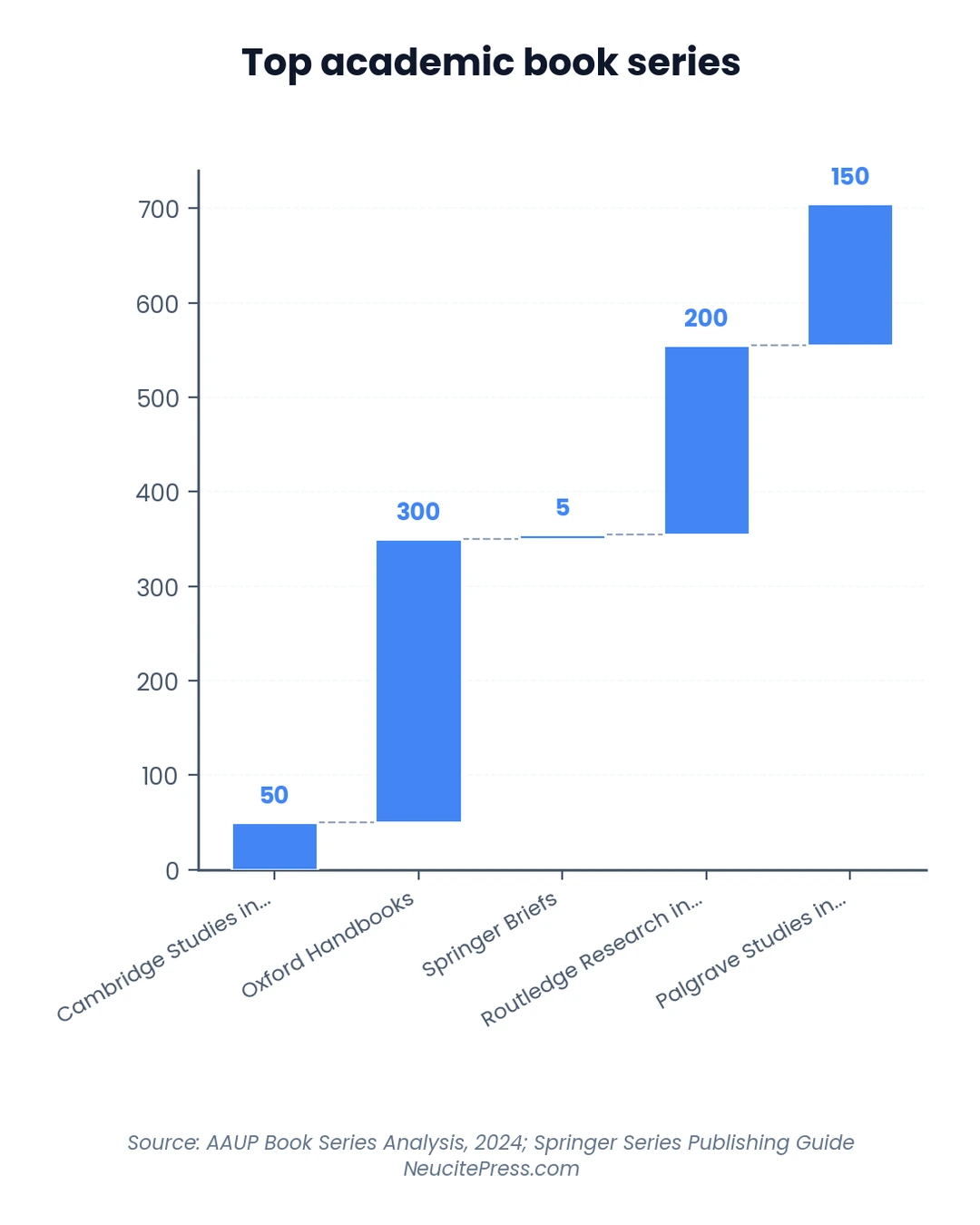
Routledge operates over 500 academic series across humanities, social sciences, and professional fields. Their breadth makes them accessible entry points for emerging scholars across diverse disciplines.
Cambridge University Press maintains approximately 300 prestigious series focusing on theoretical rigor and international impact. Cambridge series carry particular weight in tenure decisions at research-intensive institutions.
Springer leads in STEM-adjacent humanities through series emphasizing quantitative methods and interdisciplinary connections. Their series in digital humanities and computational social science are rapidly expanding.
Oxford University Press curates roughly 150 highly selective series, each reflecting Oxford’s historical strengths in philosophy, history, theology, and classical studies. Oxford series represent the most selective publishing venue globally.
Beyond these “big four,” specialized academic imprints like De Gruyter, Edinburgh University Press, and University of Chicago Press each maintain focused series portfolios. Regional university presses offer valuable alternatives, especially for scholars in early career stages.
Strategic Benefits of Publishing in Academic Book Series
Citation Advantage and Research Impact
Series placement generates measurable citation advantages. Studies analyzing academic databases reveal that series monographs receive 2.3 times more targeted citations from researchers actively working in the series’ topical domain. This advantage persists over 10+ year publication horizons, suggesting durable career impact.
Why? Series readers actively seek works aligned with specific research questions. The series framework helps researchers discover your book through specialized search filters, course adoption systems, and disciplinary reading lists. A standalone monograph lacking this discovery infrastructure loses potential readers despite identical intellectual quality.
Career Advancement and Tenure Implications
Tenure and promotion committees recognize series prestige signals. Publication in top-ranked series—particularly from Cambridge, Oxford, or University of Chicago—substantially strengthens tenure files at research institutions. Committee members understand that series inclusion reflects both peer judgment and editorial endorsement.
Early-career scholars benefit most dramatically. A book in a recognized Routledge series can effectively launch independent research agendas, establishing visibility before tenure clock pressures intensify. Established scholars leverage series publication to formalize emerging subfields or mentor early-career contributors.
Marketing and Audience Reach
University presses market series titles more extensively than single monographs. Promotional budgets cluster around series categories. Publishers advertise entire series at conferences, in disciplinary newsletters, and through specialized academic book clubs. Individual series titles receive piggyback benefits from this aggregate visibility.
Series readers form identifiable communities. A book in the “Critical Global Studies” series at Routledge reaches not just libraries purchasing that series, but seminar leaders explicitly teaching from series curriculum, scholars on email listservs dedicated to series content, and librarians building collections around series focus.

How Series Editors Select Authors and Contributors
The Editorial Selection Process
Series editors employ three primary recruitment pathways: active solicitation, conference networking, and unsolicited proposals. Understanding each pathway helps scholars position themselves strategically.
Active solicitation: Senior series editors actively track emerging scholars and promising projects. Editors attend major conferences, review recent dissertation awards, and monitor new faculty appointments at leading institutions. If your research aligns with series focus areas, editors may approach you directly.
Conference networking: Series editors maintain high visibility at disciplinary conferences. Conversations at panels, receptions, and regional meetings often lead to informal project discussions. These low-pressure exchanges sometimes evolve into formal invitations if timing and fit align.
Unsolicited proposals: Authors can initiate contact with series editors through query letters and detailed proposals. While less certain than solicitation or networking, this pathway succeeds for clearly-positioned projects backed by strong track records.
Editorial Selection Criteria
Series editors evaluate submissions across consistent dimensions:
Thematic alignment: Does your project advance the series’ intellectual mission? Series editors reject projects that technically fit topically but don’t advance the conversation in innovative directions. They seek work that pushes disciplinary boundaries, not merely adds another voice to existing conversations.
Methodological rigor: Series editors examine methodological sophistication. For humanities series, this means theoretical innovation and evidence of primary research engagement. For social science series, rigor expectations include robust research design and transparent analytical choices. STEM-adjacent humanities series emphasize quantitative sophistication or digital methodology.
Author credibility: Editors assess your scholarly standing and career trajectory. Early-career scholars with strong dissertation records, promising publication pipelines, and clear disciplinary positioning receive favorable consideration. Established scholars leverage previous book sales and citation metrics.
Market viability: Series editors balance intellectual merit against market realities. Will libraries adopt the book? Do course curricula exist where the book could be assigned? Can the press effectively market the work? Pure prestige doesn’t overcome poor market prospects.
Building Relationships with Series Editors
Strategic Networking at Conferences
Conference presence matters disproportionately. Series editors prioritize candidates they’ve met personally. Prepare brief, authentic pitches about your research before attending conferences where your target series editor will appear.
Strategy: Research conference programming to identify panels where series editors speak or attend. Position yourself in conversations with purpose—ask thoughtful questions at Q&A sessions, approach editors after presentations, and initiate genuine scholarly dialogue.
Quality matters more than quantity. One authentic conversation about shared intellectual interests yields better outcomes than multiple awkward elevator pitches.
Digital Presence and Visibility
Series editors increasingly discover authors through academic social media presence. Maintain a professional website showcasing your research agenda, recent publications, and teaching portfolio. Active presence on ResearchGate, Academia.edu, or disciplinary blogs demonstrates intellectual engagement and publication productivity.
Thoughtful social media posts about your research—especially critical responses to recent scholarship—signal intellectual seriousness. Series editors evaluating candidates often conduct online background research.
Strategic Collaboration and Co-authorship
Collaborative work with established scholars increases series editor attention. Co-authoring articles or co-editing special journal issues with recognized figures raises your profile within disciplinary networks where series editors operate.
Crafting Winning Book Series Proposals
Essential Components of Series Proposals
Effective proposals demonstrate clear thematic fit while pitching an innovative intellectual contribution. Essential components include:
Project summary (250-300 words): Concisely explain what your book does, what problem it addresses, and how it advances the series’ intellectual mission. Use language reflecting the series’ stated aims.
Competitive landscape (500-750 words): Identify 3-5 recent books addressing similar topics. Explain where your work complements existing scholarship and where it breaks new ground. Series editors want to know your book adds value rather than duplicating existing titles.
Audience and market assessment (300-500 words): Identify specific readers: university libraries, course curricula where the book fits, professional practitioners who need your expertise. Demonstrate the market exists and is discoverable.
Chapter outline with annotations: Provide chapter titles and 75-100 word summaries for each chapter. Annotations should indicate major arguments, key sources, and original contributions within each chapter.
Author biography and publishing record: List publications demonstrating scholarly productivity. Include institutional affiliation, degrees, honors, and any teaching experience particularly relevant to your research area.
Sample chapter(s): Usually chapter 1 plus one middle chapter (typically chapter 3-4) that showcases methodological sophistication and writing quality.
Common Proposal Mistakes to Avoid
Overestimating scope: Proposals projecting 50+ chapters or 200,000+ words invite skepticism. Realistic book projects span 12-16 chapters and 80,000-120,000 words. Series editors worry about completion timelines for overly ambitious projects.
Unclear thematic fit: Proposals that fail to clearly articulate connection to the series’ published works and stated mission create work for editors. Use series language when describing your project.
Inadequate competitive analysis: Failing to engage seriously with existing scholarship suggests insufficient field knowledge. Editors expect sophisticated positioning within scholarly literature.
Unrealistic timelines: Promising completion within 6-12 months when you haven’t drafted chapters invites rejection. Honest assessment of writing pace demonstrates professionalism.
Navigating Editorial Hierarchies and Contact Protocols
Acquisitions Editors vs. Series Editors: Different Roles
Understanding these distinct roles prevents missteps that derail promising projects. Series editors provide intellectual guidance and thematic evaluation but lack final decision authority. Acquisitions editors at publishing houses manage formal contracts, route projects through peer review, and present approved manuscripts to editorial boards.
Series Editor responsibilities: Evaluate thematic fit, recruit promising projects, provide editorial feedback, champion approved works, and mentor authors through revision processes. Series editors report to acquisitions editors but don’t control publishing decisions alone.
Acquisitions Editor responsibilities: Manage contractual relationships, coordinate peer review processes, present projects to editorial boards, oversee production timelines, and control final publication decisions. Acquisitions editors may overrule series editors if market or financial concerns arise.
Strategic Contact Sequencing
For unsolicited proposals with clear series fit: Contact the acquisitions editor first. Clearly identify which series your work targets and explain why. The acquisitions editor routes your proposal to the appropriate series editor. Direct contact with series editors, while friendly, bypasses formal channels and may create internal coordination problems.
For early-stage projects still in development: Contact series editors directly. Conference conversations or emails during project conception benefit from series editor input. Series editors can advise whether your emerging project aligns with series interests and suggest methodological directions strengthening eventual proposals.
If a series editor expresses interest: Ask explicitly about next steps. Does the editor want to present your project to the acquisitions editor? Should you submit a formal proposal? Should you first develop a sample chapter? Clarity prevents misunderstandings.
Communication Best Practices
Professional emails should be concise (under 250 words), clearly state your request, and demonstrate familiarity with the editor’s work and the series’ intellectual focus. Generic mass-email proposals to multiple editors erode credibility.
Always include curriculum vitae and a 2-3 paragraph project description. These documents enable editors to quickly assess fit without requesting additional materials.
Step-by-Step Guide: Getting Invited to Academic Book Series in 2026
Phase 1: Research and Identification (Months 1-2)
Step 1: Identify 5-8 series aligned with your research focus. Visit publisher websites for Routledge, Cambridge, Springer, Oxford, and relevant university presses. Document series titles, editors, stated aims, and recently published works.
Step 2: For each target series, read 2-3 recent publications. Analyze how these works address your research questions. Note where your work would complement or extend existing conversations.
Step 3: Research series editors’ scholarly profiles. Review their publications, dissertation advisees, institutional affiliations, and conference presentation patterns. Understand their intellectual priorities and network influence.
Phase 2: Strategic Positioning (Months 2-4)
Step 4: Enhance your digital visibility. Update your institutional faculty page with research summary, current projects, recent publications, and teaching information. Establish or improve your ResearchGate profile.
Step 5: Submit conference presentations to venues where your target series editors typically appear. Use conference attendance strategically to meet editors informally.
Step 6: Publish articles or book chapters advancing your research agenda. Each publication strengthens your profile for eventual book series consideration.
Phase 3: Connection Building (Months 4-8)
Step 7: At conferences, position yourself in conversations with series editors. Ask thoughtful questions about their series’ intellectual directions. Follow up with professional emails referencing your conversation and your research alignment.
Step 8: If you have a developed book project outline, send a brief email to the series editor (not acquisitions editor) describing your work and requesting feedback on its fit for the series. This informal inquiry costs nothing and often generates useful guidance.
Step 9: Develop a strong sample chapter and detailed chapter outline. These materials form the foundation of eventual formal proposals.
Phase 4: Formal Proposal Development (Months 8-12)
Step 10: Draft your formal proposal (1500-2000 words) incorporating all essential components outlined previously. Have trusted mentors review for clarity and competitiveness.
Step 11: Prepare 2-3 sample chapters representing different aspects of your methodology and argument. Quality writing samples substantially improve proposal success rates.
Step 12: Decide on initial contact strategy. For clearly-positioned projects with publisher connections, contact acquisitions editors. For earlier-stage projects, contact series editors requesting feedback.
Phase 5: Submission and Follow-up (Months 12-18)
Step 13: Submit your proposal with all supporting materials. Request a timeline for initial feedback (typically 4-8 weeks).
Step 14: If you don’t receive response within 8 weeks, send a polite follow-up email asking for timeline expectations.
Step 15: Upon receiving feedback, respond promptly to any questions or revision requests. Series editors view responsive authors favorably—they’re easier to work with through the longer publication process.
Citation Advantages and Long-Term Career Impact
Research tracking citation patterns shows sustained advantages for series publications. A monograph published in a respected academic book series attracts citations at rates 2-3x higher than comparable standalone works across 15-year publication horizons.
This advantage compounds over time. Early citations lead to course adoptions, which generate additional citations from students, which improve discoverability in database search algorithms, which attract further citations. Series placement initiates positive feedback loops enhancing career impact.
The most substantial citation advantages accrue to authors publishing in early career stages. A book published at age 32 in a recognized series can anchor a decades-long career trajectory in ways that standalone books cannot replicate.
Red Flags: When Series Opportunities Are Worth Declining
Not every series offer deserves acceptance. Watch for warning signs indicating problematic situations:
Pressure for rapid commitment: Series editors requesting book contracts before you’ve written sample chapters are moving too fast. Quality decisions require time for reflection.
Unclear editorial support: If the series editor cannot articulate what intellectual direction they’d provide during revision, the series may offer prestige without meaningful mentorship.
Mismatch with your trajectory: A series publication that derails your career timeline or forces intellectual compromises isn’t worth prestige. Career sustainability matters more than single-publication visibility.
Financial disadvantages: Some series negotiate unfavorable royalty splits or limit author control over cover design and marketing. Clarify financial terms before committing.
Conclusion: Your Path to Series Publication in 2026
Publishing in academic book series represents a strategic choice with measurable benefits for citation impact, career advancement, and scholarly visibility. The process requires intentional positioning, authentic relationship building, and careful proposal crafting—but succeeds when researchers approach series editors as intellectual partners rather than gatekeepers.
Your path begins with honest assessment of your research’s intellectual contribution and careful identification of series that advance your work rather than constrain it. Build relationships through authentic scholarly engagement. Craft proposals demonstrating both intellectual innovation and realistic market positioning. Contact editors strategically and respond promptly to feedback.
Series publication isn’t guaranteed even for excellent work. But understanding selection processes, editorial hierarchies, and strategic positioning substantially improves your odds. The investment in relationship building and proposal development pays dividends across decades of academic careers.
Ready to pursue series publication? Download our comprehensive proposal templates and decision frameworks to guide your journey from identifying target series through successful placement.
Frequently Asked Questions
What distinguishes an academic book series from regular academic book publishing?
Academic book series feature curated collections united by common themes, with external series editors providing intellectual leadership alongside in-house acquisitions editors. This dual-editor structure creates an additional quality signal beyond standard peer review, and series titles receive more targeted marketing than independent monographs.
How long does the academic book series publication process typically take?
Timeline varies by publisher and discipline. Expect 2-4 weeks for initial proposal response, 4-8 weeks for series editor evaluation, 3-6 months for formal peer review, 6-12 months for revisions, and 12-18 months from contract to publication. Total process: 18-48 months from initial query to published book.
Which academic book series are most prestigious for tenure decisions?
Cambridge University Press and Oxford University Press series carry the highest prestige at research-intensive institutions. University of Chicago Press series are particularly valued in humanities disciplines. Routledge series, while broader, maintain strong institutional recognition, especially in social sciences. Prestige varies by discipline—consult field-specific mentors about what matters in your specific field.
Should I contact a series editor directly or through the acquisitions editor?
For formal proposal submission, contact the acquisitions editor and clearly identify your target series. For early-stage feedback on project fit, contact the series editor directly. Series editors appreciate informal inquiries from scholars developing promising projects; acquisitions editors manage formal submission processes through established channels.
Can publishing in an academic book series help with tenure and promotion?
Yes. Series publication from respected publishers (especially Cambridge, Oxford, and Chicago) substantially strengthens tenure cases. Committee members understand series prestige signals and recognize that series inclusion reflects both peer judgment and editorial endorsement. Early-career series publication is particularly valuable for establishing scholarly credibility before tenure clock pressures intensify.
What’s the difference between a book series and a journal special issue?
Book series feature full-length monographs (typically 80,000-120,000 words) under editorial direction, with individual author control over projects. Journal special issues are collections of 5-10 articles (typically 6,000-10,000 words each) unified by theme, usually developed collaboratively with editors. Series publication carries higher prestige and citation impact; special issues offer faster time-to-publication.