
Academic Conference Organization: Complete 2026 Blueprint for Success
Reviewed by the NeucitePress Editorial Board — PhD academics, peer-reviewed editors and subject-matter specialists.
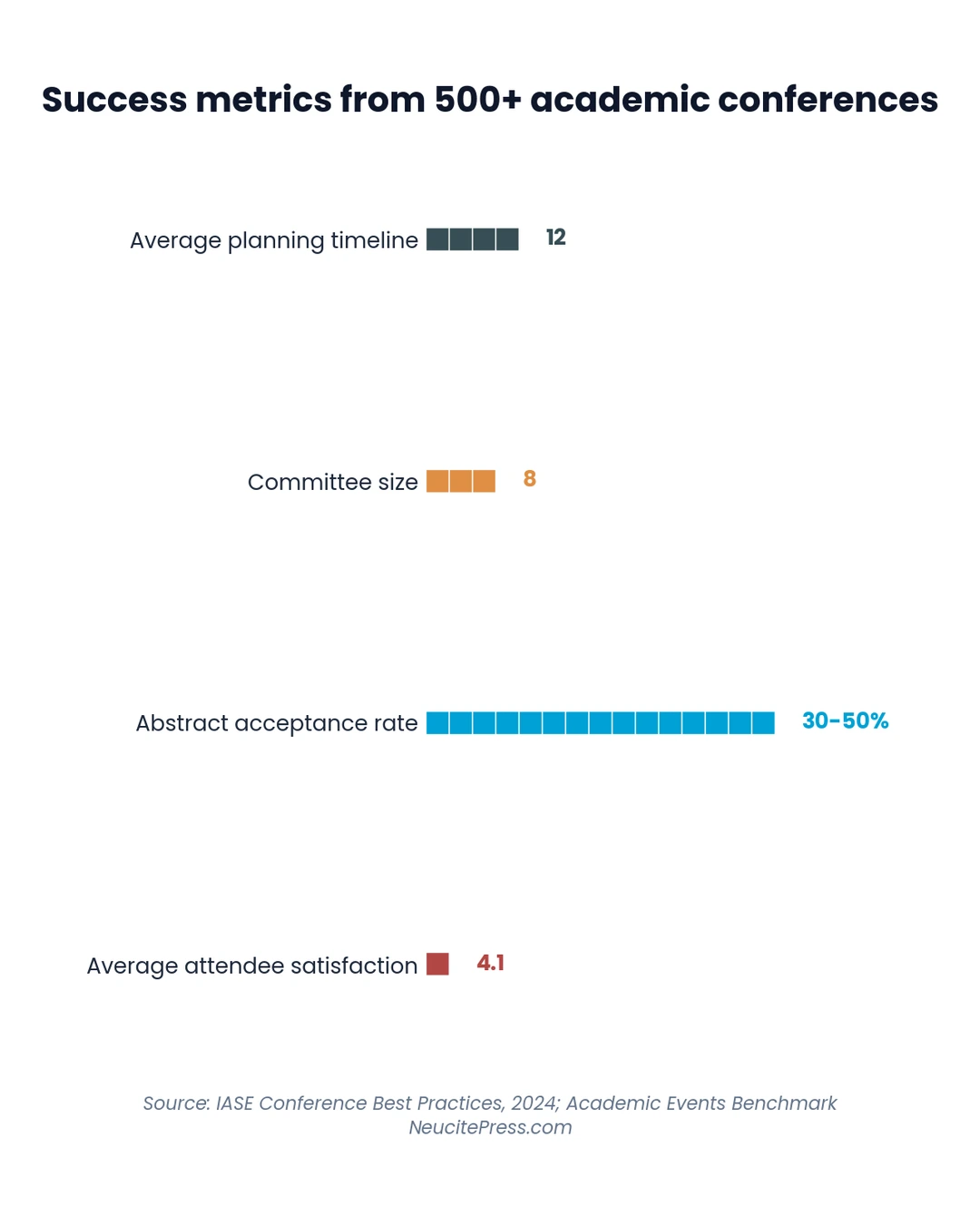
Planning a successful academic conference requires meticulous preparation spanning 12-18 months. This comprehensive timeline reflects the genuine complexity behind creating memorable scholarly events that drive knowledge dissemination, professional growth, and institutional reputation. Every element—from initial committee formation to final proceedings publication—demands strategic attention and systematic execution.
Academic conferences have become essential infrastructure within the scholarly ecosystem. They significantly strengthen institutional reputation, foster international collaboration, and generate measurable economic impact. Beyond their tangible value, these gatherings create networking opportunities that extend far beyond closing sessions, often catalyzing research collaborations and career advancement for participants.
Event spending in the academic sector continues to increase as institutions recognize the substantial return on investment. The networking opportunities, knowledge transfer, and brand visibility these gatherings generate justify increasingly sophisticated planning approaches. Yet the overwhelming complexity of simultaneously managing logistics, budgets, speakers, technology, and participant experience challenges even experienced event coordinators.
This comprehensive academic conference organization guide addresses these challenges head-on, serving both first-time planners and seasoned professionals assuming new leadership roles. Whether you’re organizing a 50-person departmental symposium or a 5,000-attendee international gathering, this blueprint provides actionable frameworks applicable across conference types, sizes, and disciplines.
Key Takeaways: What Makes Academic Conferences Succeed
- Successful scholarly events require 12-18 months of advance preparation with documented milestones
- Strategic committee formation with clearly defined roles prevents bottlenecks and ensures comprehensive coverage
- Transparent, evidence-based budgeting balances financial sustainability with participant accessibility
- Hybrid formats now account for 45% of scholarly meetings and expand reach beyond geographic constraints
- Peer review processes maintain academic integrity while building speaker credibility
- Mobile-optimized registration and communication systems reduce administrative burden by 60-70%
- Post-conference evaluation creates actionable insights for continuous improvement
- Proper compliance frameworks ensure regulatory adherence and institutional credibility
- Structured timeline management with buffer periods accommodates unexpected delays
- Stakeholder alignment transforms generic planning into targeted strategies
Understanding the Academic Conference Landscape in 2026
The contemporary academic conference landscape has evolved dramatically from traditional in-person models. Recent data from the Professional Convention Management Association reveals that 73% of event organizers feel overwhelmed managing multiple simultaneous components. Budget constraints, technology integration complexity, and heightened attendee expectations create a perfect storm requiring sophisticated planning methodologies.
Today’s scholarly event planners navigate unprecedented challenges: hybrid format complexity, evolving compliance requirements, remote audience engagement, and rapidly changing technology landscapes. The competitive events market demands clear differentiation strategies. Institutions that master these elements gain substantial advantages in attracting speakers, securing sponsorships, and building loyal attendee bases.
Research from the Association for Convention and Visitor Bureaus confirms that properly planned gatherings achieve substantially superior outcomes. Accredited medical education conferences achieve 40% higher satisfaction ratings among participants. Professional Meeting Industry data indicates that strategic planning yields 60% better outcomes across multiple performance indicators. These statistics underscore the vital importance of systematic approaches to conference organization.
Stage 1: Defining Your Conference Purpose and Core Objectives (Months 1-2)
Before selecting venues or recruiting speakers, successful organizers must establish their gathering’s core mission. This foundational clarity shapes every subsequent decision, from budget allocation to speaker recruitment to marketing strategies. Purpose definition separates mediocre conferences from genuinely impactful events.
Clarifying Objectives and Selecting Your Conference Theme
Effective themes emerge from multiple credible sources and stakeholder input. Consider recent shifts within your research discipline, emerging publication trends, consultation with departmental stakeholders, and formal surveys of potential attendees. Strong themes balance specificity with inclusivity, attracting diverse perspectives while maintaining intellectual focus.
Examples of well-crafted themes include:
- “Emerging Frontiers in Climate Adaptation Research and Policy Implementation”
- “Interdisciplinary Approaches to Healthcare Equity in Underserved Communities”
- “Artificial Intelligence Applications in Educational Technology: Opportunities and Limitations”
- “Sustainable Development Goals: Progress, Challenges, and Innovative Solutions”
These frameworks attract relevant presenters and participants while maintaining thematic coherence. Specificity enhances quality submissions and attendee satisfaction.
Transforming Aspirations into Measurable Outcomes
SMART criteria (Specific, Measurable, Achievable, Relevant, Time-bound) convert vague aspirations into concrete targets. Well-defined purposes should address specific needs: knowledge dissemination to a defined audience, networking facilitation among specific professional groups, or collaboration promotion within particular research domains.
Example objectives might include:
- “Attract 400 early-career researchers from 15 countries for intensive professional development”
- “Publish peer-reviewed proceedings reaching 50,000+ online readers within four months”
- “Generate 15+ interdisciplinary research collaborations documented through follow-up surveys”
- “Secure $200,000 in competitive sponsorship commitments from industry leaders”
This foundational work ensures your event achieves meaningful impact within your scholarly community. Well-defined purposes enable focused speaker recruitment, clearer marketing messages, and effective success measurement.
Stage 2: Aligning Conference Objectives with Stakeholder Needs
Strategic alignment between event goals and stakeholder expectations forms the foundation of memorable scholarly experiences. Different participant groups bring distinct motivations, requiring customized value propositions.
Attendees typically seek networking opportunities, access to cutting-edge research, and professional development. Speakers want visibility, peer feedback, and thought leadership establishment. Sponsors focus on brand exposure, audience access, and measurable investment returns. Institutional partners prioritize reputation enhancement and community impact.
| Stakeholder Group | Primary Motivations | Key Needs | Success Metrics |
|---|---|---|---|
| Attendees | Knowledge acquisition, career networking, professional development | Relevant cutting-edge content, peer interaction, career advancement opportunities | Post-event satisfaction scores, return attendance rates, documented collaborations |
| Speakers | Professional visibility, academic feedback, leadership establishment | Quality audience, substantive engagement, professional growth opportunities | Citation rate increases, follow-up speaking invitations, collaboration inquiries |
| Sponsors | Brand exposure, lead generation, ROI demonstration | Access to target audience, visibility opportunities, measurable results | Lead quality, ROI metrics, post-event engagement, satisfaction scores |
| Institutional Partners | Reputation enhancement, research collaboration, community impact | Strategic alignment, visibility, measurable outcomes and publications | Partnership renewals, joint publications, reputation metrics, media coverage |
Regular surveys before finalizing event parameters provide data-driven insights. This approach increases registration rates and reduces planning friction. Proper alignment transforms generic planning into targeted strategies delivering superior outcomes.
Stage 3: Forming Your Dynamic Organizing Committee (Month 2)
Team composition directly impacts the quality and efficiency of event delivery. Our proven framework assigns specific responsibilities to committee members, preventing overlap while ensuring comprehensive coverage of all critical functions.
Defining Committee Roles and Building Clear Accountability
Effective committees typically include 5-12 core members based on event scale. Each position carries defined deliverables and decision-making authority. We recommend establishing a RACI matrix to clarify responsibilities—identifying who is Responsible, Accountable, Consulted, and Informed for each task.
| Committee Role | Primary Responsibilities | Key Deliverables | Decision Authority |
|---|---|---|---|
| Logistics Coordinator | Venue coordination, transportation, accommodations, on-site operations | Seamless attendee experience, vendor management, scheduling | Vendor selection, budget approvals, logistics decisions |
| Speaker Manager | Invited speaker coordination, presentation scheduling, speaker support | Engaging program content, speaker satisfaction, schedule optimization | Speaker selection, honorarium approval, session scheduling |
| Technology Coordinator | AV systems, virtual platform management, technical infrastructure | Technical reliability, hybrid integration, system testing | Platform selection, IT vendor choices, technical standards |
| Marketing Director | Promotion strategy, attendee recruitment, social media management | Registration targets met, brand consistency, audience growth | Campaign execution, messaging strategy, budget allocation |
| Scientific Committee Chair | Peer review oversight, content quality assurance, speaker evaluation | High-quality submissions, academic credibility, program integrity | Reviewer selection, acceptance decisions, conflict resolution |
| Sponsorship Director | Sponsor relationship management, funding acquisition, partner communications | Revenue targets, sponsor satisfaction, partnership alignment | Package pricing, partnership agreements, recognition placement |
Regular committee meetings with structured agendas maintain momentum throughout the planning cycle. Action item tracking ensures accountability. Professional Conference Organizers can provide valuable expertise for complex events, handling on-site logistics while your committee focuses on strategic decisions.
Stage 4: Establishing a Realistic Timeline with Clear Milestones (Months 2-3)
Effective event management demands meticulous timeline construction from the earliest stages. Proper scheduling begins 9-18 months before your gathering dates, allowing adequate time for speaker recruitment, venue securing, and attendee planning.
Month-by-Month Planning Timeline
| Planning Phase | Key Activities | Responsible Party | Target Completion |
|---|---|---|---|
| Months 1-2 | Theme definition, objective setting, stakeholder consultation, committee formation | Leadership team | Foundation established, team operational |
| Months 3-4 | Committee structure finalization, budget development, venue RFPs | Full committee | Budget approved, venue proposals collected |
| Months 5-6 | Venue selection, call for papers launch, speaker recruitment begins | Logistics, Scientific, Speaker committees | Venue secured, CFP published, invitations extended |
| Months 7-8 | Submission review, speaker confirmations, program building, sponsorship packages designed | Scientific, Speaker, Sponsorship committees | Content finalized, speakers confirmed, sponsorship sales underway |
| Months 9-10 | Registration opening, registration page launch, marketing intensification, hotel block negotiation | Marketing, Logistics committees | Registration accepting applications, attendance building |
| Months 11-12 | Final logistics confirmation, attendee communications, speaker support materials, technical setup | All committees | Execution ready, all systems tested |
| Months 13-14 | Final preparations, on-site logistics coordination, speaker rehearsals, technology walkthroughs | Full committee on-site | Event execution begins |
| Month 15+ | Post-event evaluation, feedback collection, proceedings publication, stakeholder reporting | Leadership team | Lessons documented, insights applied |
We recommend adding 15-20% buffer time for critical path activities. This accommodates unexpected delays in abstract review, speaker confirmations, or venue negotiations. Strategic date selection—avoiding major holidays and competing gatherings—maximizes participation while minimizing conflicts.
Stage 5: Strategic Budgeting and Sponsorship Development (Months 3-4)
Financial planning transforms ambitious event concepts into executable realities through disciplined budget management. Evidence-based benchmarks help planners establish realistic financial parameters from the outset.
Cost Benchmarks and Budget Development
| Event Format | Cost per Attendee | Speaker Honorarium Range | Key Expense Categories | Typical Registration Fee |
|---|---|---|---|---|
| In-Person (100-500 attendees) | $150-$400 | $500-$15,000 | Venue, catering, AV, staffing, travel | $200-$800 |
| Virtual (100-1,000+ attendees) | $50-$100 | $500-$5,000 | Platform, technology, marketing, support | $50-$200 |
| Hybrid (50-500 in-person + 500+ virtual) | $200-$500 | $1,000-$10,000 | Combined physical/digital infrastructure | $200-$600 |
Invited speakers typically receive $500-$1,500 honorariums for regional events. National keynote presenters command $2,000-$5,000, while international experts range from $5,000-$15,000. Always budget for speaker travel, accommodations, and AV technical support.
Sponsorship Framework and Revenue Diversification
Our sponsorship framework includes tiered packages ensuring financial stability while maintaining academic independence:
- Platinum Sponsors ($10,000+): Opening keynote opportunity, prominent branding, speaking slots, exclusive hospitality
- Gold Sponsors ($5,000-$9,999): Significant branding, session sponsorship opportunities, exhibition booth
- Silver Sponsors ($2,500-$4,999): Standard branding, exhibition presence, recognition materials
- Bronze Sponsors ($1,000-$2,499): Basic branding, program listing, recognition
Multiple funding sources—institutional support, grants, industry partnerships—create financial stability while maintaining accessibility. This approach reduces dependence on registration revenue alone, allowing competitive participant pricing.
Stage 6: Venue Selection and Contract Negotiation (Months 5-6)

Venue selection goes beyond logistics to become a strategic element shaping attendee experience. The right space enhances engagement while poor choices undermine even exceptional programming.
Evaluating Format Options: In-Person, Virtual, and Hybrid
| Format Type | Best Suited For | Key Advantages | Primary Challenges | Technical Essentials |
|---|---|---|---|---|
| In-Person | Intensive networking, hands-on workshops, informal collaboration | Deep personal connections, real-time feedback, spontaneous conversations | Geographic limitations, higher costs, accessibility barriers | Reliable Wi-Fi, robust AV, intuitive signage |
| Virtual | Global audiences, budget-conscious events, accessibility priority | Unlimited geographic reach, recording availability, cost efficiency | Engagement challenges, technical barriers, time zone complexity | Platform stability, interactive features, screen-share capability |
| Hybrid | Maximum reach and inclusion, blended communities | Combines in-person and virtual advantages, expanded audience | Highest technical complexity, elevated coordination demands | Dual-system synchronization, stream quality, engagement parity |
Critical Contract Negotiation Points
Contract details significantly impact budget and flexibility. Essential negotiation priorities include:
- Cancellation policies with grace periods and partial refund options
- Transparent fee breakdowns identifying hidden charges
- Technical support levels and response times for issues
- Included AV equipment and setup/teardown protocols
- Internet bandwidth guarantees and backup systems
- Flexibility for room configuration changes and setup modifications
- Parking arrangements and accessibility accommodations
Always conduct site visits during active events to observe real-world conditions. This reveals operational realities that glossy brochures miss. Prioritize technical reliability, attendee comfort, and logistical efficiency throughout negotiations.
Stage 7: Compliance, Accreditation, and Regulatory Requirements (Months 5-7)
Navigating regulatory frameworks represents a critical phase in scholarly event coordination. Medical education gatherings require specific credentials to maintain professional value and legal standing.
CME/ACCME Accreditation Process
The Accreditation Council for Continuing Medical Education (ACCME) requires applications submitted 90-120 days before your event. Key elements include:
- Educational objectives addressing specific learning outcomes
- Needs assessment documentation demonstrating participant demand
- Commercial independence verification and conflict-of-interest disclosures
- Faculty expertise confirmation and credential verification
- Evaluation mechanisms measuring learning outcomes
ACCME standards ensure educational integrity throughout program development. Financial relationship disclosures identify potential bias while PhRMA Code guidelines govern industry sponsorship relationships. Properly accredited events provide physicians with essential credits for licensure maintenance.
HIPAA and Data Privacy Compliance
HIPAA compliance becomes crucial when handling protected health information. Secure data transmission, access controls, and encryption standards protect sensitive attendee data. Business associate agreements with technology vendors establish necessary safeguards.
Privacy policy transparency ensures attendees understand data usage. Secure storage with restricted access, regular security audits, and breach response protocols maintain information integrity throughout the event lifecycle.
Stage 8: Technology Integration and Virtual Platforms (Months 6-8)
Technology selection represents a pivotal decision determining accessibility and impact. Modern platforms integrate physical and digital participation seamlessly, potentially reducing administrative burden by 60-70%.
Conference Management Platform Evaluation
| Platform | Specialization | Ideal Scale | Key Strengths | Pricing Model |
|---|---|---|---|---|
| Ex Ordo | Academic submissions and peer review | Medium to large international events | Workflow integration, reviewer matching | Per-submission or annual license |
| Whova | Attendee networking and engagement | All sizes, any industry | Mobile app, social networking, analytics | Per-attendee or tiered annual |
| Eventbrite | Registration and ticketing | Small to medium conferences | Payment processing, marketing tools | Percentage of ticket sales |
| Zoom Events | Hybrid event delivery | All sizes with livestream needs | Familiar interface, recording, breakout rooms | Per-meeting or annual subscription |
| Splash | Event promotion and landing pages | Small to large events | Beautiful design, email integration | Monthly subscription |
Essential Virtual Platform Capabilities
Robust platforms require:
- HD video streaming with minimal latency (sub-500ms ideal)
- Interactive Q&A functionality with moderation controls
- Breakout room capability for parallel sessions
- Virtual poster sessions with multimedia support
- Networking tools enabling attendee connections
- Recording and on-demand access for asynchronous learning
- Integration with registration and CRM systems
- Analytics dashboards tracking engagement metrics
Early technology selection allows adequate team training and system customization. Virtual components expand reach beyond geographic constraints, enabling international participation while maintaining engagement quality.
Stage 9: Designing an Engaging Academic Conference Program (Months 6-9)
A compelling conference program serves as the intellectual heart of any successful scholarly gathering. Structured programs maximize knowledge exchange and participant engagement through strategic content development.
Developing Effective Calls for Papers
Effective calls for papers establish clear expectations while encouraging diverse submissions. Your CFP should specify:
- Presentation format options (oral, poster, lightning round, workshop)
- Thematic areas and research foci aligned with conference goals
- Word limits and formatting requirements
- Submission deadlines with explicit time zone references
- Review criteria emphasizing relevance, originality, and significance
- Notification timeline and acceptance contingencies
Maintain transparent peer review processes with 3-5 reviewers per submission. Double-blind evaluation ensures fairness while constructive feedback helps authors improve their work. This approach builds credibility and attracts quality submissions.
Strategic Session Design and Speaker Selection
Session structures balance plenary talks with parallel sessions and interactive formats. Morning keynotes set intellectual tone while afternoon workshops foster deeper discussions. Thematic grouping prevents audience fragmentation across concurrent sessions.
Speaker recruitment emphasizing diversity across career stages, methodologies, geographic regions, and gender representation strengthens conference quality. Invited speakers receive personalized invitations highlighting their unique contributions to conference themes.
Program flexibility allows emerging topics and spontaneous networking. This creates dynamic learning environments transcending scheduled presentations.
Stage 10: Registration, Data Management, and Marketing (Months 8-10)
Registration systems serve as the critical gateway between potential participants and your scholarly gathering. Modern platforms simplify this process while ensuring robust data protection.
Registration Strategy and Pricing Structure
| Registration Tier | Target Audience | Typical Pricing | Deadlines | Strategic Purpose |
|---|---|---|---|---|
| Early Bird (3+ months advance) | Committed participants | $199-$299 (40% discount) | 6 months before event | Cash flow, committed attendance |
| Standard Rate | General attendees | $299-$399 | 1 month before event | Primary revenue source |
| Late Registration | Last-minute attendees | $349-$449 (20% premium) | 1 week before/on-site | Capture final registrations |
| Student Rate | Graduate and undergraduate students | $99-$149 (50% discount) | All periods | Build future professional network |
| Institutional Rate | Multi-person registrations | $249/person (3+ attendees) | All periods | Increase bulk attendance |
Comprehensive Marketing Strategy
Effective marketing reaches target audiences through multiple channels:
- Email marketing: Segmented campaigns targeting different demographic groups
- Social media: Professional networks (LinkedIn), discipline-specific communities
- Academic partnerships: Department announcements, professional association listservs
- Content marketing: Blog posts, speaker interviews, research highlights
- Paid advertising: Google Ads, LinkedIn, discipline-specific publication sponsorships
- PR outreach: Media releases, academic press coverage
- Direct outreach: Personalized invitations to key researchers and influencers
SEO optimization ensures discoverability for “academic conference organization,” “conference registration,” and discipline-specific keywords. Mobile-optimized landing pages accommodate 65-70% of traffic from smartphones.
Stage 11: On-Site Management and Attendee Experience (Months 12-14)
Seamless on-site execution transforms months of planning into memorable scholarly experiences. Comprehensive logistics management ensures attendee satisfaction while technical reliability enables engagement.
Critical On-Site Operations
- Registration check-in: Smooth intake processes, badge printing, materials distribution
- Room management: Proper setup, climate control, accessibility accommodations
- AV support: Speaker technical rehearsals, backup equipment, responsive troubleshooting
- Communication: Signage clarity, schedule updates, emergency protocols
- Catering logistics: Appropriate timing, dietary accommodation, beverage availability
- Networking facilitation: Designated spaces, structured social events, virtual networking support
- Virtual attendee support: Technical troubleshooting, engagement features, quality monitoring
Professional event staff management ensures seamless operations. Clear communication protocols maintain real-time issue resolution. Contingency planning addresses technology failures, speaker cancellations, and attendance variations.
Stage 12: Post-Conference Evaluation and Proceedings Publication (Month 15+)
The true measure of event success emerges through comprehensive post-conference evaluation. Data transformation into actionable insights enables continuous improvement.
Evaluation Metrics and Feedback Collection
Track key performance indicators including:
- Registration metrics: Conversion rates, attendance rates (target 85-90%), demographic breakdown
- Session attendance: Room capacity utilization, topic-specific engagement patterns
- Satisfaction scores: Post-event surveys targeting 80%+ excellent ratings
- Speaker feedback: Presentation quality, audience engagement, presentation technical execution
- Networking outcomes: Documented collaborations, follow-up research partnerships
- Sponsor feedback: Lead quality, ROI metrics, engagement opportunities
- Financial performance: Revenue targets, expense management, sponsorship results
Proceedings Publication and Knowledge Dissemination
Publishing peer-reviewed proceedings extends conference impact far beyond the event itself. Proceedings reach thousands of readers through institutional repositories, professional association websites, and academic databases. This amplified reach justifies the effort of curating and publishing quality content.
Timeline typically spans 3-6 months post-conference. Establish clear submission guidelines, peer review protocols, and editorial review processes. Digital publication ensures permanent accessibility while open access maximizes societal benefit.
Conclusion: The Comprehensive Conference Blueprint
Successful academic conferences balance multiple priorities while maintaining unwavering focus on stakeholder needs. The systematic 15-stage approach outlined here provides a solid foundation adaptable to various contexts, disciplines, and scales.
Whether organizing a 50-person departmental symposium or a 5,000-attendee international gathering, this blueprint ensures comprehensive planning while accommodating your specific context. Strategic attention to each phase—from initial committee formation through final proceedings publication—transforms ambitious concepts into impactful professional experiences.
Download our comprehensive planning toolkit featuring customizable budget templates, month-by-month timeline charts, stakeholder alignment matrices, and post-conference evaluation frameworks. These resources put proven strategies directly in your hands for immediate application.
Subscribe to our newsletter for ongoing expert insights on scholarly event management. Share this guide with colleagues and join our community through comments and questions. Together, we advance the quality and impact of academic discourse through well-planned, professionally executed gatherings.
This guide offers general information based on industry best practices and 2026 conference planning frameworks. Consult legal counsel for compliance matters, accreditation specialists for medical education events, and adapt recommendations to your specific institutional requirements and geographic context.
FAQ: Academic Conference Organization
What is the first step in planning a successful academic conference?
Begin by clearly defining your conference objectives, target audience, and core theme. This foundational decision influences every subsequent element, from budget allocation and venue selection to program content and marketing strategy. Involve stakeholders early to ensure alignment across all groups.
How far in advance should we begin planning?
We recommend starting 12-18 months before your intended conference dates. This timeline allows adequate time for securing venues, recruiting speakers, managing call for papers processes, building sponsorship relationships, and implementing comprehensive promotion campaigns that drive attendance targets.
What are key considerations for setting registration fees?
Registration fees should reflect projected expenses divided by expected attendees while remaining accessible to your target audience. Key factors include venue costs, speaker honorariums, technology expenses, staffing, and catering. Early-bird discounts incentivize prompt registration and improve cash flow management.
How do we attract high-profile keynote speakers?
Craft a compelling value proposition highlighting conference prestige, audience quality, and networking opportunities. Be prepared to discuss honorariums, travel coverage, and promotional support. Provide clear speaker benefits including speaking slots, visibility opportunities, and professional development. Personalized, direct invitations prove more effective than generic requests.
What logistical elements most impact attendee satisfaction?
Critical factors include clear communication before and during the event, seamless registration check-in, reliable technical infrastructure, comfortable session spaces, accessible facilities, quality catering, and intuitive wayfinding. Attention to these operational details significantly influences post-event satisfaction scores and repeat attendance.
How should we handle abstract and paper review processes?
Establish transparent, double-blind peer review managed by qualified scientific committee members. Use specialized software streamlining submissions, reviewer assignment, decision tracking, and author communication. Clear rubrics ensure consistent evaluation. Constructive feedback helps authors improve work while maintaining academic integrity standards.
What makes hybrid conferences successful?
Successful hybrid models require careful technical integration ensuring quality parity between in-person and virtual attendees. This includes professional-grade streaming, interactive tools enabling remote participation, synchronization of sessions and networking features, and technical support for both environments. Plan 30% more time for hybrid execution than single-format events.
How do we measure post-conference success?
Track quantitative metrics (attendance, registration conversion, sponsorship revenue) alongside qualitative feedback (satisfaction surveys, speaker evaluations, networking outcomes). Document lessons learned and create improvement plans for future events. Stakeholder reporting demonstrates ROI while maintaining engagement for subsequent gatherings.
