
Scientific Symposium Planning: 15 Expert Tips That Guarantee Success
Planning a scientific symposium can feel overwhelming. A recent industry survey reveals that 67% of first-time organizers experience significant stress managing complex academic events. Between coordinating world-class speakers, navigating accreditation requirements, and engaging hundreds of attendees, the logistics quickly compound into what many describe as “controlled chaos.”
Reviewed by the NeucitePress Editorial Board — PhD academics, peer-reviewed editors and subject-matter specialists.
Yet here’s what separates successful events from mediocre ones: systematic planning. When teams follow proven frameworks, they reduce logistical complications by 42% and regulatory issues by 89%, according to peer-reviewed research published in the Journal of Continuing Education in the Health Professions (2023) and Academic Medicine (2023).
This comprehensive guide distills best practices from certified meeting professionals (CMPs), accreditation specialists, and academic event organizers. We provide 15+ actionable expert tips, detailed timelines, financial benchmarks, and decision-making frameworks used by leading institutions to deliver transformative scientific symposiums.
Disclaimer: While this guide provides expert recommendations based on industry standards, always consult with legal and compliance professionals regarding specific regulatory requirements for your event.
Quick Navigation: Your Symposium Planning Guide
- Understanding key terminology and event types
- Why systematic planning matters: the data
- 12-month planning timeline
- 15+ expert implementation tips
- Budget allocation and financial benchmarks
- Scientific committee and speaker selection
- Accreditation, compliance, and regulatory requirements
- Hybrid format technology and venue logistics
- Marketing, sponsorship, and registration strategies
- Post-event evaluation and follow-up
Symposium vs. Conference vs. Workshop: Understanding Event Types
Before diving into planning specifics, clarifying terminology matters. These three event types serve distinct purposes and require different organizational approaches:
Scientific Symposium
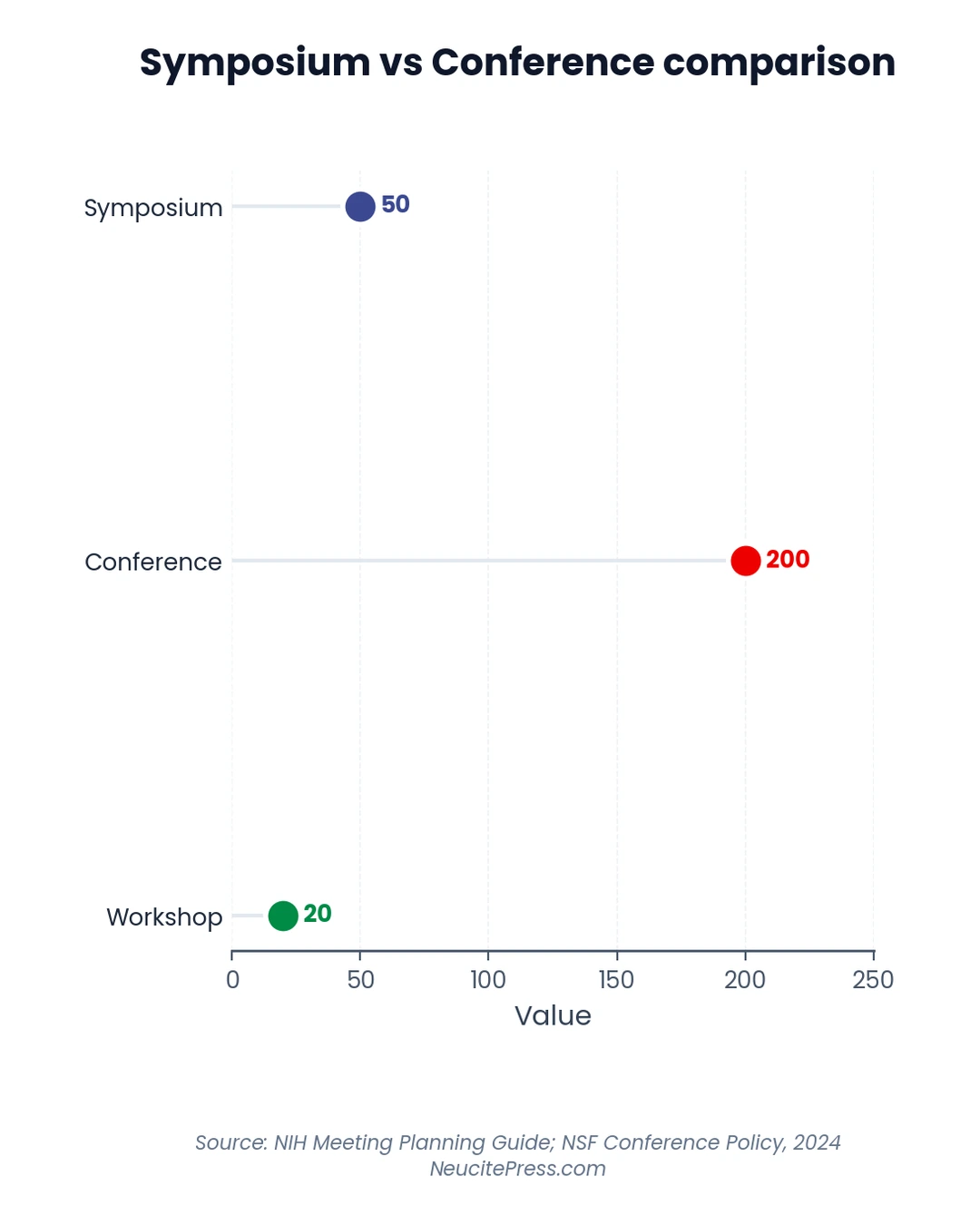
A symposium typically brings together 50-300 highly specialized researchers around a focused topic. The emphasis centers on in-depth exploration of emerging research findings through presentations, panel discussions, and collaborative dialogue. Duration: typically 1-3 days. Cost per attendee: $850-1,200 for single-day events.
Key characteristics:
- Narrow, specialized focus (e.g., “Advances in CRISPR Gene Editing”)
- Primarily plenary and invited presentations
- Limited abstract submissions
- Strong networking emphasis
- Typically single-track or two-track programming
Scientific Conference
Conferences accommodate larger audiences (300-2,000+ attendees) with broader subject matter. Multiple parallel sessions allow researchers to attend sessions matching their specific interests. Examples include annual meetings of major scientific societies. Duration: 2-4 days. Cost per attendee: $1,200-2,500 for regional events; $2,500-4,500 for international events.
Key characteristics:
- Broad disciplinary focus with multiple sub-topics
- Parallel programming across multiple sessions
- Large abstract submission numbers (200-2,000+)
- Mix of plenary, invited, and contributed presentations
- Substantial poster sessions
- Multiple networking venues
Scientific Workshop
Workshops emphasize practical skill development and hands-on learning. Typically 1-2 days with 20-100 participants, workshops feature interactive sessions, demonstrations, and collaborative problem-solving. Cost per attendee: $500-1,200.
Key characteristics:
- Applied, skills-focused objectives
- Small, engaged participant groups
- Hands-on activities and demonstrations
- Expert-led breakout sessions
- Direct interaction and mentoring
- Practical take-aways and tools
This guide focuses primarily on scientific symposiums and conferences, though many principles apply across all formats.
Why Planning Matters: The Data Behind Success
Consider these evidence-based statistics:
- 67% of first-time event organizers report feeling overwhelmed by complexity (2024 Academic Event Planning Survey)
- 73% of professionals struggle with budget management; 68% face speaker coordination challenges (PCMA 2023 Study)
- 61% experience difficulty integrating hybrid technology (MPI 2024 Report)
- 12-24 months required by first-time teams for major events vs. 12-15 months for experienced organizers
- 42% reduction in logistical issues for teams following formal planning frameworks
- 89% fewer regulatory complications with documented compliance processes
- 18-24 months typical accreditation process timeline (underestimated by 78% of first-time organizers)
The bottom line: systematic planning doesn’t just reduce stress. It directly improves participant experiences, enhances learning outcomes, and protects institutional reputation.
The 12-Month Strategic Planning Timeline
Success begins with a realistic timeline. The following framework assumes a major scientific symposium or conference.
Month 12: Foundation & Committee Formation
Primary objectives:
- Establish planning committee with clear roles (Scientific Chair, Program Manager, Finance Lead, Marketing Lead)
- Define event objectives using SMART framework (Specific, Measurable, Achievable, Relevant, Time-bound)
- Identify and secure keynote speakers
- Select and contract venue
- Establish preliminary budget
- Create preliminary marketing plan
Critical decisions:
- Event format: in-person only, hybrid, or fully virtual?
- Expected attendance: 75, 150, 500, 1,000+ participants?
- Geographic scope: regional, national, or international?
- CME accreditation needed? (impacts timeline by 6-9 months)
- Theme and scientific focus areas
Tip #1: Secure keynote speakers early. High-profile speakers book 12-18 months in advance. Early commitments signal event prestige and boost attendance.
Month 9: Marketing Launch & Abstract Submission Planning
Primary objectives:
- Launch event website with full branding
- Initiate social media campaigns (LinkedIn for academics, Twitter for real-time updates, Facebook for community)
- Announce keynote speakers prominently
- Begin email marketing campaigns (monthly cadence minimum)
- Publish call for abstracts/papers
- Recruit scientific reviewers (minimum 3-5 per abstract)
- Finalize sponsorship packages and outreach
Tip #2: Create a content calendar for marketing. Plan 36-48 weeks of promotional content: speaker highlights, research previews, past event testimonials, behind-the-scenes preparation, early-bird announcements, and CTAs.
Tip #3: Begin CME accreditation applications now if needed. ACCME reviews typically require 60-90 days. Submit 6-9 months before your event.
Month 6: Abstract Review & Program Development
Primary objectives:
- Close abstract submission (typically 4-6 weeks after opening)
- Conduct peer review (recommend minimum 3 independent reviewers per abstract)
- Communicate acceptance/rejection decisions with clear feedback
- Confirm speaker commitments and start collecting presentation titles, bios, AV requirements
- Design preliminary program schedule
- Finalize venue contracts and catering details
- Recruit session chairs and moderators
- Implement hybrid technology platform if applicable
Tip #4: Use structured abstract review processes. Clear evaluation criteria, defined rubrics, and anonymous review reduce bias and improve decision consistency. ACCME standards require documented review processes.
Tip #5: Balance program diversity. Ensure keynote speakers, invited presenters, and contributed papers represent diverse perspectives, geographic regions, career stages (emerging vs. established researchers), and institutional types.
Month 3: Final Execution Prep & Technical Setup
Primary objectives:
- Finalize detailed program schedule and publish to website
- Create mobile event app or digital program guide
- Conduct full technical rehearsals (AV, streaming, audio systems)
- Prepare attendee materials (agendas, speaker bios, networking guides)
- Confirm all speaker logistics: travel, accommodations, AV specifications
- Brief session chairs and moderators on roles and procedures
- Develop contingency plans (speaker cancellations, technical failures, etc.)
- Create post-event evaluation survey and feedback mechanisms
Tip #6: Always conduct full technical rehearsals for hybrid events. Test camera positioning, microphone levels, lighting, screen sharing, live Q&A functionality, and streaming bandwidth with actual participants.
Weeks Before Event: Final Confirmation & Coordination
Primary objectives:
- Send reminder emails to registered attendees (2 weeks, 1 week, 2 days out)
- Confirm attendance with all speakers and session chairs
- Prepare presenter support materials
- Set up registration check-in (physical or digital)
- Brief event staff on roles and contingency procedures
- Test all equipment one final time
- Prepare signage, materials, and name badges
Tip #7: Create comprehensive speaker/presenter toolkits. Include presentation guidelines, technical specifications, timing requirements, speaker notes on session flow, and contact information for technical support during the event.
15+ Expert Tips for Scientific Symposium Success
Building on the timeline framework, here are actionable strategies across key dimensions:
Tip #8: Establish Clear Learning Objectives
ACCME and institutional accreditation bodies require explicit learning outcomes. Before designing sessions, ask: “What specific knowledge, skills, or attitudes should participants gain?” Express objectives using action verbs (learners will be able to: identify, evaluate, apply, synthesize, etc.).
Example: Poor objective = “Learn about cancer immunotherapy.” Better objective = “Evaluate the efficacy of CAR-T cell therapies versus checkpoint inhibitor combinations in triple-negative breast cancer management.”
Tip #9: Implement Robust Conflict of Interest Management
ACCME, PhRMA, and institutional policies mandate conflict of interest (COI) disclosure. Require all speakers, planners, and committee members to disclose:
- Financial relationships with commercial entities within the past 24 months
- Research funding sources
- Patent interests or intellectual property
- Board positions or advisory roles
Tip #10: Develop a formal COI resolution policy. If speakers have significant conflicts, require mitigation strategies: balanced panel presentations, disclosure slides, or alternative speakers. Document all resolutions.
Tip #11: Design Engaging Session Formats
Avoid “death by PowerPoint.” Structure sessions to maximize learning and engagement:
- Plenary sessions (45-60 min): Keynote speakers or state-of-the-science presentations. Best for setting context and inspiring large groups.
- Panel discussions (45 min): 3-4 experts debating contemporary issues. Invites audience questions. Excellent for exploring controversies.
- Concurrent sessions (45-60 min): Parallel presentations allowing choice. Build schedule with “coffee breaks” between sessions to prevent back-to-back fatigue.
- Poster sessions (60-90 min): Visual presentations with direct presenter interaction. Ideal for emerging researchers. Schedule during networking meals for attendance boost.
- Hands-on workshops (90-120 min): Practical skill-building with facilitator guidance. Requires smaller groups (25-50 participants).
- Networking sessions (60 min): Structured mixing (themed tables, speed networking) beats unstructured socializing.
Tip #12: Schedule breaks strategically. A typical day structure: 90-min morning session → 15-min break → 90-min session → 75-min lunch → 90-min afternoon session → 15-min break → 60-min final session. Breaks prevent fatigue and facilitate informal networking.
Tip #13: Master the Abstract Submission & Review Process
Clear submission guidelines reduce confusion and improve review consistency. Specify:
- Word/character limits (typically 250-500 words)
- Required sections (background, methods, results, conclusions)
- Submission format (online form, specific template)
- Deadline with specific date and time zone
- Review timeline and decision notification date
- Presentation format options (oral, poster, both)
Conduct rigorous peer review using:
- Anonymous blind review (recommended)
- Standardized evaluation rubrics (5-point Likert scales minimum)
- Minimum 3 independent reviewers per abstract
- Conflict of interest checks (reviewers shouldn’t review direct competitors)
- Clear appeal process for contested decisions
Tip #14: Use abstract management software (Fourwaves, Ex Ordo, ConfTool) to streamline submissions, assign reviewers, track progress, and generate reports. Manual spreadsheet tracking introduces errors and delays.
Tip #15: Secure High-Quality Speakers Through Strategic Recruitment
Keynote speakers drive attendance. Recruitment strategy should include:
- Early outreach (12-18 months prior): Personal invitations from committee chairs to high-profile researchers
- Clear expectations: Presentation length, topic, target audience, travel logistics, honorarium range
- Reasonable honorariums: 2024 PCMA benchmarks suggest $3,000-10,000 for keynotes, $1,000-3,000 for invited session speakers
- Diverse speaker slate: Actively recruit women, underrepresented minorities, and international researchers
- Emerging researcher inclusion: Feature PhD students and early-career researchers to demonstrate career pathways
- Speaker support: Provide presentation guidelines, technical specifications, speaker notes on audience composition, and Q&A procedures
Tip #16: Create a speaker agreement template covering expectations, travel arrangements, IP/publication rights, cancellation policies, and technical requirements. Clear contracts prevent misunderstandings.
Tip #17: Optimize Venue Selection for Hybrid Feasibility
Modern scientific events frequently incorporate hybrid (in-person + virtual) participation. Venue selection should prioritize:
- Internet infrastructure: Minimum 1 Gbps fiber with dedicated bandwidth; backup connectivity required
- Audiovisual systems: Professional camera systems, directional microphones (lavalier for speakers), high-quality projectors, dual-output capability for streaming
- Flexible space: Modular room configurations, sufficient power outlets, staging for cameras
- Technical support: On-site AV technician (not just vendor availability)
- Breakout room access: Dedicated spaces for parallel hybrid sessions (simultaneous in-person and virtual presentations)
- Green room: Space for speaker prep, lighting tests, and technical rehearsals
- Backup power: Generators for critical systems
Tip #18: Contract specific bandwidth guarantees and include internet SLA (Service Level Agreement) clauses with financial penalties for downtime. Test internet stability 2-3 weeks before the event.

Budget Planning & Financial Benchmarks
Financial planning relies on industry-standard cost allocations and per-attendee benchmarks.
Typical Budget Allocation (as % of total budget):
- Venue & Logistics (35%): Facility rental, catering, AV, setup/teardown labor
- Speaker Fees & Travel (25%): Honorariums, flights, accommodations, ground transportation
- Marketing & Promotion (20%): Website development, social media advertising, email tools, printed materials, promotional videos
- Technology & Tools (15%): Abstract management, registration software, streaming platform, event app, analytics
- Contingency & Admin (5%): Unforeseen costs, insurance, staff coordination
Cost per Attendee Benchmarks (2024 data):
- Single-day symposiums: $850-1,200 per person
- Multi-day regional conferences: $1,200-2,500 per person
- International conferences: $2,500-4,500 per person (international travel, longer duration)
Speaker Honorarium Standards (2024 PCMA):
- Keynote speakers: $3,000-10,000 (depends on speaker prominence, travel distance)
- Invited session speakers: $1,000-3,000
- Contributed presenters (from abstract selection): Registration waivers valued at $400-800
- Poster presenters: Registration included
Registration Conversion & Early-Bird Strategy:
- Website visitor to registration conversion: 12-18% (typical for well-marketed academic events)
- Early-bird uptake: 35-45% of total registrations when offered 4-6 months before the event
- Early-bird pricing impact: Increases registrations by 20-30% if offered early enough
- Sponsorship revenue: Typically generates 40-60% of event revenue through tiered packages (Platinum, Gold, Silver, Bronze)
Tip #19: Create Tiered Sponsorship Packages
Sponsorship tiers should offer clear value differentiation:
- Platinum ($25,000+): Exclusive speaking slot, booth, signage throughout venue, listing in all marketing materials
- Gold ($10,000-15,000): Prominent booth, session sponsorship option, website logo
- Silver ($5,000-10,000): Standard booth, website listing
- Bronze ($2,000-5,000): Logo recognition, tote bag insertion option
Tip #20: Maintain sponsor independence. Ensure sponsorships don’t influence scientific content, speaker selection, or accreditation integrity. Document sponsor agreements and COI compliance.
Implementing Hybrid & Virtual Technology
Hybrid events have become standard. Success requires dedicated technology strategy:
Essential Technology Components:
- Streaming platform: Robust, scalable solutions (YouTube Live, Vimeo Live, platform-specific like Hopin, Airmeet, vFairs)
- Video quality: 1080p minimum for remote attendees. Redundant cameras for key presentations.
- Audio system: Directional microphones (lavalier for speakers), wireless handheld mics for audience Q&A, echo cancellation
- Interaction tools: Live chat, Q&A function, polling, virtual networking rooms
- Registration integration: Unified registration capturing in-person and virtual attendance
- Recording & archiving: Post-event access for registered participants (with speaker permission)
Tip #21: Ensure Equitable Remote Experience
Virtual attendees should have equivalent access to content and networking:
- Display speaker names and affiliations on-screen for virtual viewers
- Designate facilitators to monitor chat/Q&A and relay questions to speakers
- Create virtual networking events (timed breakout rooms, speed networking)
- Provide virtual attendees access to materials, slides, and speaker contact info
- Offer time-zone accommodating recording access for international participants
Accreditation, Compliance & Regulatory Requirements
Medical/healthcare symposiums face complex accreditation requirements. Plan accordingly:
ACCME Standards for CME Accreditation:
ACCME (Accreditation Council for Continuing Medical Education) governs CME credit for physicians. Key requirements:
- Clearly defined learning objectives using action verbs
- Disclosure and resolution of conflicts of interest for all planners, speakers, and content reviewers
- Commercial independence (commercial interests cannot control educational content)
- Evaluation of participant learning (post-event surveys minimum)
- Documentation of compliance and retention for 6 years
- 60-90 day review timeline minimum
Tip #22: Establish a formal planning committee including non-planning staff member to ensure compliance and independence. This committee should document all decisions regarding speaker selection, content review, and COI resolutions.
PhRMA Code Compliance (for Pharmaceutical Sponsorship):
If pharmaceutical companies sponsor, comply with 2024 PhRMA Code provisions:
- Meal cost limits ($25-50 depending on context)
- Entertainment restrictions (no lavish gifts or experiences)
- No direct payments to attendees
- Transparent disclosure of sponsorship relationships
- No speaker selection by sponsors
HIPAA Considerations (if discussing patient cases):
- De-identify all case presentations (remove patient identifiers)
- Secure data transmission for electronic materials
- Limit access to protected health information
- Obtain IRB approval if discussing research data
Tip #23: Consult legal and compliance professionals early. Compliance issues discovered post-event can jeopardize accreditation, damage institutional reputation, and create liability.
Scientific Committee Formation & Abstract Review
A strong scientific committee ensures content quality and diversity.
Scientific Committee Composition:
- Committee Chair(s): Senior researcher with topic expertise; sets direction and manages workflow
- Content experts: 3-5 researchers representing different perspectives, career stages, and institutions
- Diversity representation: Intentionally recruit women, underrepresented minorities, early-career researchers, and international members
- Committee size: 5-12 members optimal (larger committees create coordination challenges)
Peer Review Best Practices:
- Blind review: Reviewers don’t know author identities; reduces bias
- Structured rubrics: Define evaluation criteria clearly (scientific merit, novelty, relevance, presentation quality)
- Multiple reviewers: Minimum 3 independent reviewers per abstract reduces individual bias
- COI checks: Reviewers shouldn’t evaluate competitors or colleagues
- Calibration meetings: Committee meets post-review to discuss borderline cases and ensure consistency
- Transparent communication: Authors receive feedback explaining acceptance/rejection decisions
Tip #24: Use online abstract management systems (Fourwaves, Ex Ordo) to automate assignments, track reviews, prevent COI conflicts, and generate decision statistics. Manual tracking introduces errors.
Marketing, Sponsorship & Registration Strategy
Multi-Channel Marketing Timeline:
- Month 9: Website launch, initial press release, email list building
- Month 8-6: Social media content calendar (2-3 posts weekly), speaker announcements, targeted advertising
- Month 6: Call for abstracts launch, registration opening, increased email frequency
- Month 5-3: Early-bird deadline announcements, speaker highlights, testimonials from past events
- Month 3-1: Registration reminder campaign (increase email frequency to weekly), final speaker confirmations
- Final month: Attendee reminders, schedule releases, speaker Q&A previews
Effective Call-to-Actions (CTAs):
- “Register Today—Early-Bird Rates End [Date]” (creates urgency)
- “Download Our Planning Checklist” (provides immediate value, captures email)
- “See What Our Speakers Are Talking About” (builds interest)
- “Join 300+ Healthcare Leaders” (social proof)
- “Save Your Spot—Limited Virtual Attendance Available” (scarcity)
Tip #25: Use marketing automation (HubSpot, Klaviyo, ConvertKit) to segment audiences and deliver targeted messages. Academics interested in research methodology receive different communications than practitioners seeking clinical applications.
Post-Event Evaluation & Follow-Up Strategy
The event doesn’t end when attendees leave. Strategic follow-up maximizes impact:
Immediate Post-Event Actions (within 1 week):
- Send thank you emails: To speakers, volunteers, sponsors, and attendees
- Distribute event recordings/materials: For registered participants and to build future email list
- Survey respondents: Evaluation forms assessing learning outcomes, satisfaction, and improvement areas (required for CME accreditation)
- Collect attendee feedback: Net Promoter Score (NPS) question, open-ended feedback
- Thank speakers personally: Phone or video call from committee chair
Medium-term Follow-Up (1-3 months):
- Publish proceedings: Compile abstract or paper submissions, speaker slides, key learning points
- Share outcomes report: Attendance numbers, demographic breakdown, learning outcome data, speaker feedback
- Coordinate speaker publications: Encourage speakers to publish keynote presentations in professional journals
- Maintain engagement: Monthly email updates on related research topics or speaker activities
- Plan next year: Begin recruiting keynotes and committee members while event momentum remains high
Tip #26: Document Evaluation Metrics
Track quantitative and qualitative data:
- Attendance metrics: Total registrations, attendance rate, geographic/demographic breakdown, repeat attendees
- Learning outcomes: Pre/post knowledge assessments (if included), survey ratings on relevance and applicability
- Engagement metrics: Q&A participation rates, chat engagement, networking event attendance
- Satisfaction metrics: Net Promoter Score, would-recommend percentage, content quality ratings
- Financial metrics: Revenue, expenses, sponsorship uptake, early-bird vs. full-price registrations
- Follow-up metrics: Post-event email open rates, speaker publication success, registrations for next year
Use these metrics to improve future events and demonstrate ROI to stakeholders.
Key Takeaways: Your Symposium Success Checklist
Scientific symposium success requires systematic execution across multiple domains:
- Timeline: Begin major events 12-18 months in advance. Experienced organizers reduce this to 12-15 months through systematic processes.
- Committee structure: Establish clear roles across scientific, program, finance, and marketing functions.
- Speaker strategy: Recruit keynotes early (12-18 months), offer reasonable honorariums ($3,000-10,000), and ensure diverse representation.
- Abstract management: Use online systems with blind review, structured rubrics, and minimum 3 independent reviewers.
- Budget allocation: Allocate 35% to venue/logistics, 25% to speakers, 20% to marketing, 15% to technology, 5% to contingency.
- Compliance: Document all accreditation, COI, and regulatory processes. Consult legal professionals early.
- Hybrid technology: Invest in professional streaming, audio, and interactive tools. Ensure equitable remote experience.
- Marketing: Execute multi-channel campaigns (LinkedIn, Twitter, email) with clear CTAs and monthly content calendars.
- Venue selection: Prioritize internet infrastructure (1 Gbps minimum), professional AV, and technical support staff.
- Post-event follow-up: Distribute recordings, publish proceedings, and maintain engagement through regular communications.
Frequently Asked Questions on Scientific Symposium Planning
How far in advance should we begin planning a major symposium?
Start 12-18 months ahead for first-time major events. Experienced organizers can work within 12-15 months using systematic frameworks. CME accreditation requires starting 6-9 months before the event date.
What’s the most critical planning element?
Early keynote speaker recruitment (12-18 months out) directly impacts attendance projections, marketing effectiveness, and event prestige. Combined with clear learning objectives, these two elements create the foundation for success.
How should we price speaker honorariums?
2024 benchmarks recommend: Keynotes $3,000-10,000; invited speakers $1,000-3,000; contributed presenters receive registration waivers valued at $400-800. Consider speaker prominence, travel distance, and presentation duration.
What budget should we allocate to each area?
Venue/logistics: 35% | Speakers: 25% | Marketing: 20% | Technology: 15% | Contingency: 5%. Adjust based on your specific event type (single-day vs. multi-day, hybrid vs. in-person).
How can we reduce logistical complexity?
Use abstract management software (Fourwaves, Ex Ordo), event registration platforms with automation, and formal planning frameworks. Teams with documented processes experience 42% fewer logistical issues.
What’s required for CME accreditation?
Clear learning objectives, COI disclosure and resolution, documented compliance processes, participant evaluation, and commercial independence. Start the 60-90 day accreditation application 6-9 months before your event.
How do we attract high-quality speakers?
Recruit early (12-18 months), offer appropriate honorariums aligned with speaker prominence, communicate clear expectations, provide speaker support, and ensure event prestige through keynote announcements and marketing emphasis.
Should we do in-person, hybrid, or virtual?
Consider: audience preferences (surveys past attendees), technology capabilities (internet infrastructure, streaming platform), participant geography (international audiences prefer hybrid/virtual options), and budget (virtual reduces venue costs but requires stronger technology). Hybrid offers maximum reach but requires careful execution.
How do we ensure diverse speaker representation?
Actively recruit women, early-career researchers, underrepresented minorities, and international speakers. Set diversity targets in recruitment briefs. Committee members should nominate candidates from underrepresented groups. Track speaker demographics and aim for improvement year-over-year.
What’s a realistic cost per attendee?
Single-day symposiums: $850-1,200 | Multi-day regional conferences: $1,200-2,500 | International conferences: $2,500-4,500. Adjust based on venue costs, speaker honorariums, and marketing intensity.
How do we maximize registration rates?
Launch early-bird pricing 4-6 months before the event (increases registrations 20-30%). Expect 12-18% conversion from website visitors to registrations with well-executed marketing. Target 35-45% of total registrations during early-bird period.
Conclusion: Your Roadmap to Scientific Symposium Success
Planning a successful scientific symposium demands attention across multiple domains: strategic committee structure, clear timelines, rigorous content review, equitable speaker representation, robust compliance processes, and strategic marketing execution.
The evidence is clear: organizations that follow systematic frameworks experience significantly better outcomes. Teams using formal planning processes reduce logistical issues by 42%, regulatory complications by 89%, and achieve measurable improvements in participant learning outcomes and satisfaction.
Your next steps:
- Establish your planning committee today with clear roles and responsibilities
- Set a specific event date and work backward to create month-by-month timelines
- Identify and recruit keynote speakers immediately (12-18 months is optimal)
- Secure your venue contract with internet SLAs and technical support specifications
- Begin CME accreditation applications if required (6-9 months lead time)
- Launch your marketing website and social media presence
- Download the templates and checklists referenced throughout this guide
Successful scientific symposiums don’t just happen. They result from deliberate planning, clear communication, systematic processes, and commitment to excellence. The frameworks and expert tips provided here offer a proven pathway to deliver transformative events that advance your field and engage researchers for years to come.
Remember: Every element—from keynote speaker recruitment to post-event follow-up—contributes to attendee experience and professional impact. Invest the time in systematic planning, and your effort will translate into a symposium your colleagues remember and recommend for years.
Ready to plan your symposium? Download our comprehensive planning templates, speaker recruitment toolkit, and post-event evaluation guide. Access exclusive resources for systematic event management.
