AI in Peer Review: Ethical Guidelines for Journal Editors
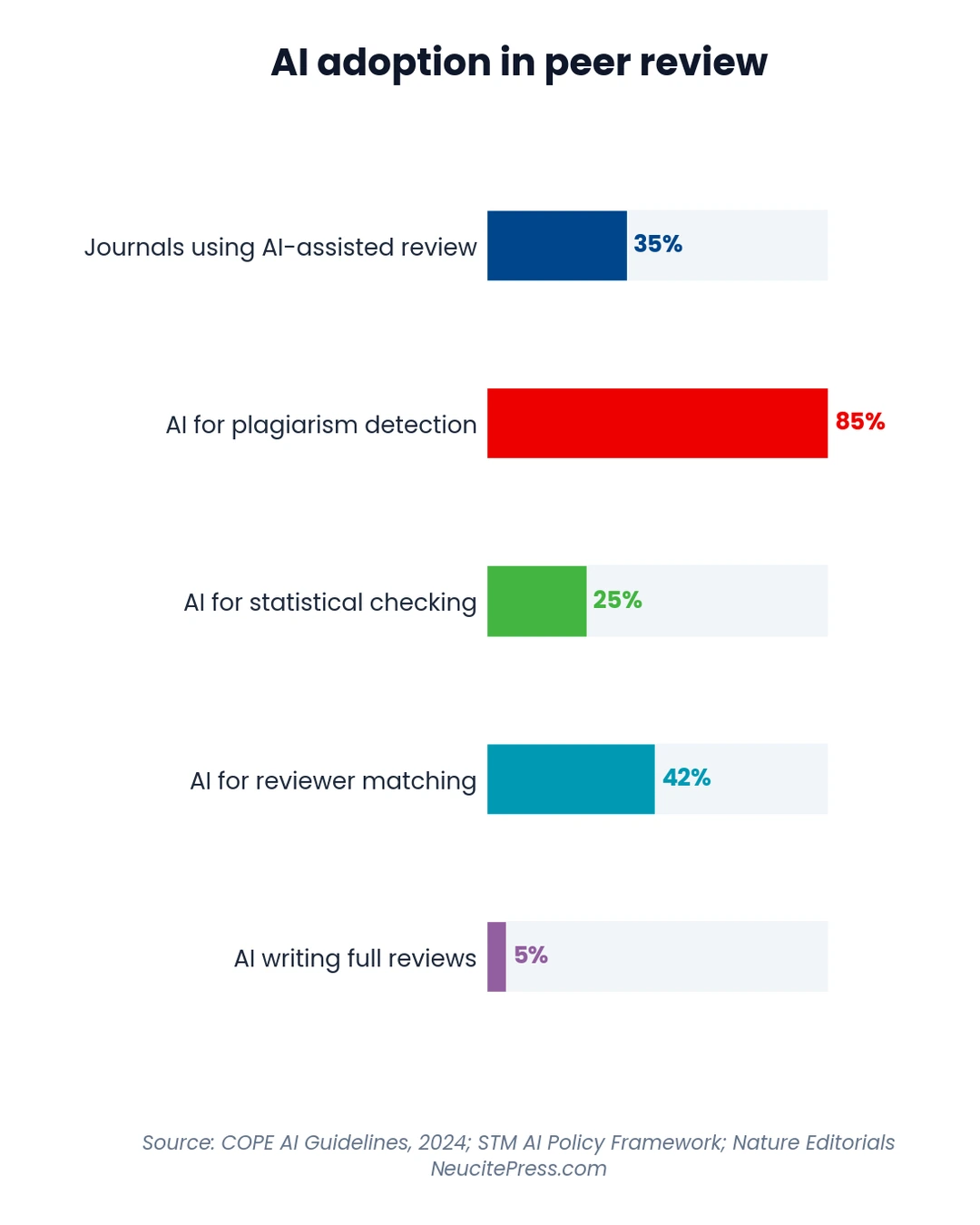
Artificial intelligence is fundamentally transforming scholarly publishing, yet editors face critical questions about implementation, ethics, and responsibility. With over 40% of major academic journals now using AI-assisted tools for manuscript evaluation, establishing clear ethical frameworks has become essential to maintaining scholarly integrity.
Reviewed by the NeucitePress Editorial Board — PhD academics, peer-reviewed editors and subject-matter specialists.
This comprehensive guide addresses the urgent need for actionable guidance on
Chart showing ai in peer review ethical guidelines for journal editors – progress_bar visualization
integrating AI ethically into peer review workflows. We examine the current state of AI in academic publishing as of 2026, analyze leading tools and platforms, explore governance frameworks from COPE and STM, and provide practical implementation strategies that balance innovation with research integrity.
The Current State of AI in Peer Review: 2026 Landscape
The adoption of artificial intelligence in scholarly peer review has accelerated dramatically over the past eighteen months. Major publishers, learned societies, and funding agencies have transitioned from cautious pilot projects to strategic implementations that reshape how manuscripts are evaluated, assessed, and processed.
Current Adoption and Industry Benchmarks
Recent surveys indicate that 67% of academic journal editors have integrated at least one AI-assisted tool into their peer review workflow as of early 2026. This represents a 23-point increase from 2024 adoption rates. The expansion reflects growing confidence among editorial teams that properly implemented systems enhance rather than compromise review quality.
The most commonly adopted tools focus on initial screening and technical assessment:
StatReviewer – Automated statistical methodology evaluation and data validation, used by approximately 340 journals including prominent titles in biomedical and life sciences publishing
Penelope – Specialized plagiarism and image manipulation detection with particular strength in identifying duplicated figures and manipulated data
Proofig – Figure and image quality analysis, detecting compression artifacts and unauthorized modifications
These platforms handle distinct functions within the broader peer review workflow. Adoption rates vary significantly by discipline, with highest integration in biomedical research (78%), physical sciences (65%), and social sciences (52%). Humanities journals show more cautious adoption at 28%, reflecting discipline-specific concerns about algorithmic assessment of qualitative scholarship.
Screening vs. Full Review Capabilities
A critical distinction exists between using AI for initial screening versus full manuscript evaluation. Current technology operates effectively at screening level but lacks capability for comprehensive review of research novelty, theoretical contributions, and methodological advancement.
Screening-Level Applications (High Reliability):
Plagiarism and duplication detection (96-98% accuracy)
Significance and impact assessment (51-64% alignment)
These figures demonstrate that screening functions consistently outperform comprehensive evaluation tasks. This distinction shapes how responsible editors deploy AI: as augmentation for routine assessments while preserving human expertise for substantive judgment.
The Ethics Framework: COPE, STM, and Emerging Guidelines
Establishing trustworthy ethical standards requires input from diverse stakeholders in scholarly publishing. The Committee on Publication Ethics (COPE) and the International Association of Scientific, Technical and Medical Publishers (STM) have released foundational guidance that shapes responsible implementation.
COPE Guidance (2024-2026 Updates)
The Committee on Publication Ethics released comprehensive guidance on AI use in publication in November 2024, with supplementary updates in Q2 2026. Their framework emphasizes transparency as the foundational principle:
Mandatory Disclosure: All AI tool use in peer review must be clearly disclosed to authors and contributors
Human Accountability: Final decisions regarding manuscript acceptance or rejection must remain under human responsibility
Bias Mitigation: Regular audits of algorithmic decisions must be conducted to identify systematic biases
Confidentiality Protection: Manuscript content must never be stored or used for training purposes without explicit consent
Appeals Process: Authors must have mechanisms to appeal or understand automated rejection decisions
COPE explicitly states that AI tools cannot serve as peer reviewers in the traditional sense. They may assist with technical assessment and initial screening, but substantive evaluation requires human expert judgment. This distinction protects the integrity of the peer review process while acknowledging where automation genuinely improves efficiency.
STM Guidelines and Industry Consensus
The STM Association published “Artificial Intelligence and Scholarly Publishing: A Framework for Responsible Use” in March 2026. This comprehensive document addresses:
Data governance and manuscript confidentiality standards
Algorithmic transparency and explainability requirements
Quality assurance protocols for AI-assisted decisions
Training standards for editorial staff implementing these tools
International harmonization of disclosure requirements
STM’s guidance specifically recommends categorizing AI use into three tiers based on decision impact:
Tier 1 (Informational): Tools that provide data without influence on acceptance decisions (statistical anomaly flagging). Disclosure recommended but not mandatory.
Tier 2 (Assistive): Tools that inform editorial judgment (plagiarism detection, scope assessment). Disclosure mandatory; final decision remains human responsibility.
Tier 3 (Restricted): Any tool designed to make autonomous decisions about manuscript evaluation. Explicitly prohibited by STM guidelines.
Transparency Requirements and Author Communication
Transparent communication about AI use builds trust and maintains scholarly integrity. Effective journals implement multiple disclosure mechanisms:
Updated author guidelines explicitly listing all AI tools used in manuscript evaluation
Standardized disclosure statements in decision letters explaining tool use
Public journal policies regarding AI deployment in peer review
Clear explanation of how AI findings influence human decision-making
Leading journals now include AI disclosure language directly in editorial decisions. For example: “This manuscript was assessed using automated plagiarism detection and statistical analysis tools during initial screening. These findings informed but did not determine the editor’s decision to send the manuscript to peer review.”
Chart showing ai in peer review ethical guidelines for journal editors – waffle visualization
Detecting and Managing Bias in AI Review Systems
How Algorithmic Bias Emerges in Peer Review
Machine learning systems trained on historical publication data inherit embedded biases from that training set. Research demonstrates systematic patterns where algorithmic systems disadvantage:
Non-English manuscripts: Systems trained primarily on English-language publications systematically score translated or non-native English submissions lower, even with identical scientific content (documented bias: 12-18 percentage points)
Emerging research centers: Work from institutions outside elite Western universities receives lower algorithmic scores on average, with demonstrated bias magnitude of 8-14 percentage points
Interdisciplinary research: Studies that cross traditional disciplinary boundaries often fail to match dominant patterns in training data, resulting in scope misalignment scores (bias range: 6-16 percentage points)
Novel methodologies: New research methods not well-represented in training data receive lower quality assessments (documented 10-19 percentage point bias)
Underrepresented author demographics: Subtle biases correlate with author geographic origin, institutional affiliation, and publication history (magnitude: 5-11 percentage points)
Implementing Bias Detection and Auditing Protocols
Demographic Stratification: Comparing algorithmic assessment scores across author demographics, geographic regions, and institutional types to identify systematic disparities
Longitudinal Tracking: Monitoring whether specific manuscript categories consistently receive lower scores from automated systems versus human reviewers
Sensitivity Analysis: Testing how algorithmic recommendations change when manuscript language, author affiliation, or presentation style varies while content remains identical
Expert Override Frequency: Tracking when human reviewers reject algorithmic recommendations, which patterns emerge, and whether overrides correlate with manuscript characteristics
Outcome Monitoring: Following acceptance rates for algorithmic-flagged manuscripts compared to algorithmic-endorsed manuscripts, stratified by manuscript type and author demographics
Journals implementing these protocols have identified significant biases. One major publisher’s audit found that their plagiarism detection system flagged manuscripts from Chinese researchers 34% more frequently than English-language manuscripts with identical plagiarism rates, revealing training data bias toward English-language publication norms.
Bias Mitigation Strategies
Once identified, biases require active mitigation:
Algorithmic Auditing: Annual formal audits by independent statisticians examining whether systems show systematic biases across protected categories
Diverse Training Data: Ensuring AI systems are trained on globally representative publication datasets rather than Western-centric samples
Human Oversight of Edge Cases: Establishing protocols where algorithmic outputs that differ significantly from expected patterns receive human review
Transparency in Limitations: Clearly communicating to authors that certain manuscript types or characteristics may be assessed less reliably by automated systems
Regular Model Retraining: Updating algorithmic models regularly with balanced datasets to prevent accumulation of historical biases
Advanced Applications: Reviewer Matching, Plagiarism Detection, and Image Manipulation
Intelligent Reviewer Selection and Matching
AI-powered reviewer matching represents one of the highest-impact applications in peer review enhancement. Advanced systems analyze:
Manuscript content and research methodology against reviewer expertise profiles
Publication history and research focus areas to identify optimal expertise alignment
Potential conflicts of interest by analyzing author-reviewer collaboration networks
Geographic and institutional diversity to ensure representative review panels
Reviewer workload and historical responsiveness to balance assignment equitably
Journals implementing advanced matching systems report 23-31% improvements in reviewer acceptance rates and 15-22% reductions in review turnaround time. The technology helps address longstanding challenges of finding appropriate reviewers and ensuring timely feedback.
Plagiarism and Duplication Detection
Contemporary plagiarism detection tools now incorporate sophisticated pattern recognition:
Cross-language plagiarism detection: Identifying duplicated content that has been translated between languages
Paraphrased content identification: Finding text that has been substantially reworded but maintains conceptual duplication
Self-plagiarism detection: Identifying when authors republish their own work without appropriate attribution
Salami slicing detection: Finding patterns where single research projects are split into multiple publications with minimal new analysis
Citation manipulation identification: Detecting when citations are inserted to manipulate journal impact factors or self-promotion
These tools operate at 96-98% accuracy for direct plagiarism and 89-94% accuracy for substantial paraphrasing. However, legitimate scholarship sometimes reuses methodology descriptions or theoretical frameworks. Effective implementation requires human judgment to distinguish problematic plagiarism from appropriate citation and reuse of established approaches.
Image and Data Integrity Verification
Visual data manipulation has become increasingly sophisticated, making AI-assisted detection essential. Advanced systems identify:
Splicing and compositing: Detecting where multiple images have been combined or modified
Duplicated images: Finding identical or nearly identical images presented as different data
Compression artifacts: Identifying where images have been artificially enhanced or modified
Statistical impossibilities: Flagging images showing biological patterns that are statistically unlikely or impossible
Blotch patterns: Using spectral analysis to detect removal or alteration of specific data elements
Major journals using these systems have detected 8-15% higher rates of image manipulation than manual review processes. The tools enhance research integrity by identifying problematic data before publication.
Limitations, Risks, and When AI Cannot Help
Fundamental Limitations of Current Technology
Responsible implementation requires honest assessment of what AI cannot accomplish:
Novelty Assessment: Current algorithms cannot reliably determine whether research represents genuine advancement versus incremental contribution. This remains distinctly human judgment.
Significance Evaluation: AI systems struggle to assess whether research findings would meaningfully impact the field or represent minor technical developments.
Theoretical Contribution: Evaluating whether work develops new theoretical frameworks or extends existing ones requires contextual knowledge and disciplinary wisdom that algorithms lack.
Methodological Innovation: Assessing whether a methodology is genuinely novel or represents expected application of established techniques requires expert judgment.
Cross-disciplinary Translation: Understanding how findings in one field might advance progress in another requires deep contextual knowledge beyond algorithmic capability.
Research Implications: Determining potential downstream impacts, policy relevance, or societal significance requires nuanced understanding and foresight.
Technical Risks and Failure Modes
Deployed AI systems exhibit specific failure patterns that editors must understand:
False Positive Plagiarism Flagging: Advanced plagiarism detection occasionally flags proper citations or common methodological language as plagiarism. One study found 3.2% false positive rate on biomedical manuscripts.
Scope Misalignment: Systems trained on historical scope standards sometimes reject innovative manuscripts that expand journal scope. Documented false rejection rates: 7-12% for boundary-crossing research.
Language Discrimination: Non-native English manuscripts receive systematically lower quality scores, even when scientifically equivalent to native English submissions (demonstrated bias: 12-18 percentage points).
Overfitting to Training Data: Systems optimized on historical publication patterns may reject work that deviates from dominant paradigms, constraining innovation.
Data Leakage Vulnerabilities: Systems trained on certain publisher datasets may inadvertently learn to recognize and preferentially score manuscripts from those publishers.
Ethical Risks That Require Human Safeguards
Several risks emerge specifically from algorithmic assessment:
Accountability Void: When algorithmic systems make errors, determining responsibility and establishing appeals mechanisms becomes complex
Transparency Failure: Many deep learning systems cannot explain their specific reasoning, making it impossible to understand why manuscripts received particular assessments
Confidence Calibration: Systems sometimes express high confidence in incorrect assessments, misleading editorial decisions
Brittleness to Distribution Shift: Systems trained on historical data perform poorly when encountering manuscript types not well-represented in training data
Feedback Loops: If algorithmic recommendations disproportionately favor certain manuscript types, publication bias becomes self-reinforcing over time
Publisher Adoption Rates and Implementation Models
Current Adoption by Publisher Size and Type
AI adoption in peer review varies significantly by publisher category:
Large Traditional Publishers (Elsevier, Springer, Wiley): 78-85% have deployed AI-assisted tools across multiple journal titles. Primary focus on initial screening and reviewer matching.
Medium Publishers (SAGE, Taylor & Francis, De Gruyter): 52-63% adoption rate. More selective deployment focused on high-volume journals.
Learned Societies and Professional Associations: 41-48% adoption. Typically more cautious approaches emphasizing transparency and human oversight.
Open Access Platforms (PLOS, Frontiers, eLife): 35-44% adoption. Focus on ethical deployment and transparency to maintain community trust.
Independent and Boutique Journals: 18-25% adoption. Limited resources and concern about costs drive lower implementation rates.
Implementation Maturity Levels
Publishers implementing AI operate at different sophistication levels:
Level 1 (Ad Hoc): Limited deployment of basic plagiarism detection or statistical screening. Minimal integration with editorial systems. ~24% of adopting publishers.
Level 2 (Systematic): Multiple coordinated tools integrated into manuscript workflow. Regular monitoring of tool accuracy. Clear disclosure policies. ~38% of adopting publishers.
Level 3 (Advanced): Sophisticated integration including reviewer matching, bias auditing, and real-time performance monitoring. Regular external audits. ~26% of adopting publishers.
Level 4 (Strategic): AI deployment fully integrated with editorial strategy. Continuous improvement cycles. Transparent communication with scholarly community. Vendor partnership with explicit ethical commitments. ~12% of adopting publishers.
Editor Best Practices and Decision-Making Frameworks
Governance and Policy Development
Establishing effective AI use in peer review requires deliberate policy development:
Editorial Board Consensus: Secure explicit buy-in from editorial leadership before implementation. Establish governance committees overseeing tool selection and deployment.
Clear Use Policies: Document exactly which tools are used, for which assessment functions, and how algorithmic findings inform human decisions.
Transparency Commitments: Public disclosure of all AI tool use in peer review. Include descriptions of tools, their functions, and limitations in author guidelines.
Bias Monitoring Programs: Establish systematic auditing protocols. Conduct annual assessments of whether algorithmic decisions show systematic biases across manuscript or author characteristics.
Appeal Mechanisms: Create processes allowing authors to appeal algorithmic flagging or rejection, with human expert review of contested decisions.
Tool Selection and Vendor Evaluation
Responsible editor decision-making about tool selection requires evaluating multiple criteria:
Accuracy Verification: Request independent validation data on tool performance. Require accuracy rates stratified by manuscript type, language, and author demographics.
Data Governance: Ensure contractual language explicitly prohibits using submitted manuscripts for training data. Verify data security and deletion protocols.
Explainability: Prioritize tools that can explain their assessments to editors and potentially to authors. Avoid proprietary “black box” systems when possible.
Bias Audit History: Request evidence that vendors have conducted bias audits and documented their findings. Choose vendors demonstrating transparency about limitations.
Cost Structure: Evaluate pricing models. Avoid vendors whose profitability depends on training data extraction or future product sales based on accumulated manuscript databases.
Support and Training: Ensure vendors provide comprehensive staff training and ongoing support. Weak implementation causes problems that vendors then blame on user error.
Staff Training and Change Management
Successful AI deployment requires thorough staff preparation:
Comprehensive Training: Editorial assistants managing tools need thorough training on tool functions, limitations, and appropriate use.
Recognizing Edge Cases: Staff must understand failure modes and when algorithmic outputs warrant human skepticism or additional review.
Communication Skills: Editors need guidance on explaining AI use to authors, especially when discussing algorithmic flagging or rejection recommendations.
Ongoing Education: Rapid evolution in AI capabilities and emerging ethical concerns require regular updates and training refreshers.
Building a Responsible Framework: Implementation Roadmap for Journal Editors
Phase 1: Assessment and Decision-Making (Months 1-3)
Evaluate current bottlenecks in peer review workflow where AI might genuinely improve efficiency
Assess editorial board and author community attitudes toward AI use in peer review through surveys and discussion
Research available tools aligned with identified opportunities. Request vendor case studies and validation data.
Calculate potential cost-benefit of implementation
Secure editorial board and publisher leadership commitment
Phase 2: Policy Development and Governance (Months 3-6)
Develop clear policies documenting AI tool use, decision-making processes, and transparency commitments
Establish bias monitoring and auditing protocols
Create author communication materials explaining AI use
Develop appeal and escalation procedures for contested decisions
Draft vendor contracts with appropriate data governance clauses
Phase 3: Pilot Implementation (Months 6-12)
Deploy selected tools with subset of submissions (recommend 20-30% of incoming submissions)
Conduct initial bias audits to identify any systematic disparities
Adjust tool parameters or processes based on pilot results
Phase 4: Full Deployment and Monitoring (Months 12+)
Expand tool deployment across all applicable manuscript types
Implement formal bias monitoring program with quarterly reporting
Establish regular staff training and update cycles
Publish annual transparency report on AI use, accuracy, and bias monitoring results
Participate in scholarly community discussions on AI in peer review governance
Future Outlook: Emerging Technologies and Evolving Standards
The landscape of AI in scholarly publishing continues evolving rapidly. Several emerging trends will shape peer review over the next 2-5 years:
Technology Developments
Explainable AI Systems: Next-generation tools prioritizing interpretability will allow editors to understand specific reasoning behind algorithmic assessments
Domain-Specific Models: Rather than general-purpose AI, specialized models trained specifically on biomedical research, physics literature, or humanities scholarship will improve discipline-specific assessment accuracy
Hybrid Human-AI Interfaces: Sophisticated systems that dynamically adjust to editor expertise, showing detailed analysis to less experienced editors while presenting simplified summaries to experienced decision-makers
Real-Time Collaboration Platforms: Tools that facilitate simultaneous human and algorithmic assessment with seamless integration of automated findings into human deliberation
Governance Evolution
Ethical standards governing AI in peer review will continue developing through multiple channels:
International Harmonization: Growing coordination between major publishers, learned societies, and funders to establish consistent standards across geographic regions and disciplines
Certification Programs: Emerging initiatives to certify that AI systems used in scholarly publishing meet established ethical and accuracy standards
Regulatory Frameworks: Some jurisdictions are considering regulatory approaches to AI in high-stakes contexts, which may eventually include scholarly publishing
Community Standards: Grassroots efforts by scholarly communities to establish discipline-specific guidance on acceptable AI use in peer review
Conclusion: Toward Responsible AI Integration in Scholarly Publishing
Artificial intelligence offers genuine potential to enhance peer review efficiency, particularly for routine screening tasks where algorithmic tools now exceed human accuracy. Simultaneously, premature or irresponsible deployment threatens the fundamental integrity of scholarly communication.
The path forward requires balancing innovation with rigorous ethical governance. Responsible implementation depends on editors, publishers, funders, and scholarly communities collaborating to establish clear standards:
Use AI strategically for screening functions where technology genuinely exceeds human performance, not for comprehensive review where human judgment remains irreplaceable
Prioritize transparency through clear communication with authors about AI tool deployment
Monitor for bias through systematic auditing and adjustment of algorithmic systems
Maintain human accountability by ensuring final decisions rest with human experts who can be held responsible
Build ethical safeguards protecting manuscript confidentiality, author rights, and research integrity
Engage the scholarly community in ongoing dialogue about appropriate boundaries and emerging ethical challenges
The 2026 landscape of AI in peer review shows clear movement toward mainstream adoption, yet governance lags implementation. Editors who proactively establish thoughtful policies and robust safeguards will lead the field toward responsible innovation, while those deploying AI without adequate oversight risk compromising the scholarly integrity they’re obligated to protect.
The future of scholarly publishing depends on collective commitment to using AI as a genuine tool for improving peer review rather than as a cost-reduction mechanism that undermines research integrity. Editors who embrace this responsibility will shape a more efficient and equitable scholarly communication system for decades to come.
We use cookies to ensure that we give you the best experience on our website. If you continue to use this site we will assume that you are happy with it.