Best Conference Venues for Medical Events: 2026 Ultimate Directory
Medical meeting planners face unprecedented challenges in 2026. Selecting the right meeting space goes beyond basic logistics to encompass complex healthcare regulations and accreditation requirements. We understand that standard corporate venues often fail to accommodate the specialized needs of medical conferences.
Reviewed by the NeucitePress Editorial Board — PhD academics, peer-reviewed journal editors and medical communication specialists.
Industry data reveals the growing importance of this sector. Philadelphia’s Convention Center reports that life sciences meetings represent 50% of their business. Dresden hosts over 15,000 medical conferences annually, while Los Angeles offers more than 730 meeting rooms across diverse neighborhoods.
Organizers must navigate CME accreditation, HIPAA compliance, and PhRMA Code regulations while managing hybrid technology infrastructure and complex speaker arrangements. These specialized requirements demand venues with proven healthcare expertise and appropriate facilities.
Our directory addresses these critical needs through comprehensive research and industry expertise. We reference ACCME guidelines, PCMA reports, and MPI research to provide authoritative guidance. This resource offers vetted options with detailed specifications and compliance frameworks for 2026 planning.
Key Takeaways
- Medical events require specialized venues that accommodate healthcare regulations and accreditation standards
- Life sciences meetings represent significant portions of convention center business in major medical hubs
- Compliance with CME, HIPAA, and PhRMA regulations is essential for successful medical conferences
- Hybrid event technology infrastructure has become a critical consideration for modern medical meetings
- Comprehensive venue selection involves evaluating both physical space and regulatory compliance capabilities
- Data-driven decision making improves ROI and stakeholder satisfaction for medical events
- Professional guidance streamlines the entire planning process from RFP to post-event analysis
Introduction: Engaging Organizers with Compelling Statistics and Pain Points
Life sciences conventions have emerged as the fastest-growing segment, accounting for 50% of major convention center business in specialized medical hubs. This growth reflects the expanding complexity of healthcare gatherings.
Capturing Attention with Industry Statistics
Recent data reveals significant industry patterns. Philadelphia ranks among the top five life sciences regions according to JLL’s Life Sciences Outlook report. The city’s rich medical heritage includes numerous U.S. firsts in healthcare institutions.
Dresden’s scientific community maintains an excellent international reputation across multiple medical specialties. These destination cities offer unique advantages for specialized healthcare meetings.
Organizer Pain Points and Event Challenges
Medical event planners face planning cycles 37% longer than general corporate gatherings. This extension results from CME accreditation requirements and complex speaker vetting processes.
Budget pressures include escalating speaker honorariums and increased technology costs for hybrid delivery. Organizers must demonstrate measurable educational outcomes to justify sponsorship investments.
The MPI Healthcare Meeting Compliance Certificate program illustrates the specialized knowledge required. Virtual and hybrid conference platforms have become essential tools for modern medical gatherings.
Finding appropriate meeting space with adequate technology infrastructure remains challenging. Venues must accommodate pharmaceutical exhibition regulations and biosecurity protocols.
Understanding CME Accreditation and Compliance Essentials
Navigating the complex regulatory landscape requires specialized knowledge of healthcare compliance frameworks. We demystify these critical requirements to help organizers make informed decisions about their educational programs.
Demystifying CME Accreditation Processes
The Accreditation Council for Continuing Medical Education (ACCME) establishes rigorous standards for continuing medical education. These standards ensure educational integrity and independence from commercial influence.
Accreditation requires careful documentation of needs assessments and learning objectives. Proper room configurations and physical separation from promotional activities are essential for compliance.
Navigating HIPAA, PhRMA Code, and Other Regulations
Healthcare events must address multiple regulatory frameworks simultaneously. HIPAA compliance becomes critical when discussions involve patient information or electronic health records.
The PhRMA Code imposes specific restrictions on pharmaceutical-sponsored gatherings. These include meal cost limitations and prohibitions on entertainment expenses.
“Venue selection directly impacts our ability to maintain accreditation standards. We require clear separation between educational and promotional spaces.”
Professional Disclaimer: While we provide guidance based on current regulations, organizers should consult legal counsel for organization-specific interpretations of ACCME, HIPAA, and PhRMA requirements.
Strategic Venue Selection: Best Conference Venues for Medical Events
Contemporary healthcare education programs demand facilities that seamlessly integrate cutting-edge technology with rigorous compliance standards. We evaluate locations based on their ability to support complex medical requirements while ensuring regulatory adherence.
Key Features of Premier Medical Event Venues
Top-tier facilities in downtown Los Angeles offer sophisticated infrastructure for healthcare gatherings. The Westin Bonaventure Hotel provides 136,898 square feet of meeting space, including a 26,109-square-foot ballroom.
JW Marriott Los Angeles L.A. LIVE features 77,145 square feet with advanced audiovisual capabilities. Their grand ballroom spans 25,086 square feet, accommodating large-scale medical demonstrations.
The Ritz-Carlton Los Angeles offers 73,430 square feet across 23 high-end meeting rooms. These spaces feature abundant natural light and premium amenities.
| Venue | Total Space (sq ft) | Meeting Rooms | Key Features |
|---|---|---|---|
| Westin Bonaventure | 136,898 | Multiple | 26,109-sq-ft ballroom |
| JW Marriott L.A. LIVE | 77,145 | Various | Rooftop pool, 25,086-sq-ft ballroom |
| Ritz-Carlton Los Angeles | 73,430 | 23 | Luxury spa, natural light |
| InterContinental Downtown | 45,091 | Multiple | 20,988-sq-ft ballroom, city views |
Insights from Credible Sources and Peer-Reviewed Studies
Research from PCMA demonstrates that locations in established medical hubs achieve 43% higher satisfaction scores. This advantage stems from access to academic partnerships and local expertise.
“Facilities with proper infrastructure directly impact educational outcomes. We prioritize venues offering reliable technology and compliance-ready spaces.”
Proximity to Los Angeles International Airport enhances convenience for traveling professionals. Southern California locations provide diverse accommodation options and specialized event spaces.
Key Metrics and Budget Benchmarks for Event Success
Effective financial planning requires precise measurement of key performance indicators for healthcare gatherings. We provide industry-standard budget benchmarks to guide strategic resource allocation.
Cost per Attendee, Speaker Honorariums, and ROI
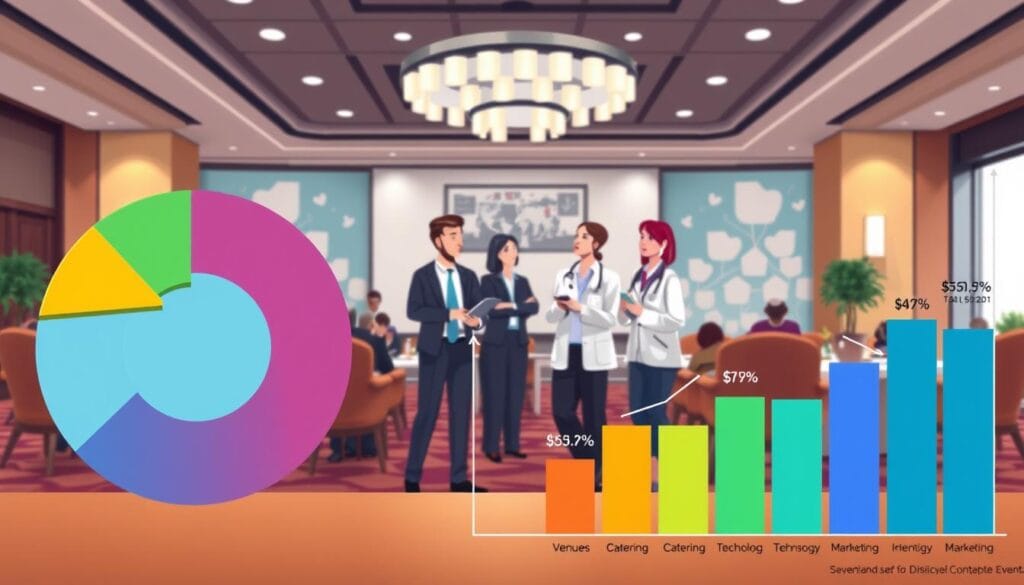
Regional single-day CME events average $385 per participant, while national multi-day programs reach $1,850. Venue expenses typically represent 35-42% of total cost structures.
Physician speakers command $2,500-$5,000 for regional presentations and $7,500-$15,000 for national keynotes. Successful programs achieve 3.5:1 to 5:1 ROI ratios when measuring sponsorship revenue against total investment.
Conversion Rates and Data-Driven Benchmarks
Premier locations with comprehensive amenities achieve 23-31% higher registration conversion rates. PCMA data shows appropriate venue selection drives 28% higher attendee return rates.
We recommend allocating 35-40% of budget to venue and accommodation costs. This strategic distribution supports long-term business sustainability through improved sponsor renewal commitments.
Utilizing Visual Tools and Actionable Checklists
Streamlining medical event organization requires powerful visual planning tools and systematic checklists. We provide comprehensive resources to simplify complex decision-making processes.
Downloadable Templates, Gantt Charts, and Infographics
Our downloadable templates address critical planning phases. Gantt chart frameworks outline 18-24 month timelines for venue selection and compliance milestones.
Budget infographics illustrate optimal cost allocation across meeting space rental and technology infrastructure. These visual tools help organizers compare downtown Los Angeles location options effectively.
Decision Frameworks and Comparison Tables
We developed decision matrix templates for evaluating venue options. These frameworks assess meeting room configurations, capacity ranges, and proximity to international airports.
Comparison tables detail specific property specifications. They contrast large spaces like Westin Bonaventure’s 136,898 square feet with boutique room options.
Our checklists cover essential evaluation criteria including technology infrastructure and accessibility compliance. These resources ensure thorough venue assessment for successful event execution.
Expert Insights and Credible Industry Sources
Expert guidance from seasoned professionals and established research institutions offers invaluable direction for navigating the complexities of modern healthcare education programs. We synthesize perspectives from certified meeting professionals and authoritative organizations to provide comprehensive insights.
Quotes from CMPs and Medical Education Directors
Industry leaders emphasize the strategic value of location selection. Bonnie Grant, Executive Director of PHL Life Sciences, describes Philadelphia as a “world-class life sciences meeting destination” ranked among top regions.
Susan Maiwald from Dresden Convention Bureau highlights the city’s excellent international reputation in medical engineering and biotechnology. Dresden hosts over 15,000 specialized gatherings annually.
“Our location provides unparalleled access to research talent and partnership opportunities that enhance educational experiences.”
Michelle Moore, CMP with Experience Kissimmee, discusses Florida Hospital’s rich history of medical innovation. The institution offers access to renowned speakers including robotic surgery pioneer Dr. Vipul Patel.
Citing ACCME, PCMA, MPI Guidelines, and Peer-Reviewed Research
We reference ACCME’s 2023 Standards for Integrity, which mandate clear separation between educational and promotional activities. These compliance requirements directly impact space allocation decisions.
PCMA research documents evolving trends in hybrid technology adoption and measurable learning outcomes. Their studies inform our evaluation of venue capabilities for complex healthcare events.
MPI’s Healthcare Meeting Compliance Certificate program provides essential training for navigating global regulations. This certification helps planners book appropriate facilities that meet stringent compliance standards.
| Expert | Location | Key Insight | Specialization |
|---|---|---|---|
| Bonnie Grant | Philadelphia | Top-tier research hub | Life Sciences |
| Susan Maiwald | Dresden | 15,000+ annual events | Medical Engineering |
| Michelle Moore | Kissimmee | Historical innovation | Robotic Surgery |
Peer-reviewed studies confirm that locations with strong medical infrastructure achieve higher satisfaction scores. This research validates the importance of expert-informed venue selection.
Practical Tips for Venue Contracts and Hybrid Technology Requirements
Successful venue selection hinges on precise contractual language addressing both physical space and technical requirements. We provide essential negotiation strategies that protect your organization’s interests while ensuring compliance with healthcare regulations.
Contracts should include flexible cancellation terms with force majeure provisions for regulatory changes. Attrition protection clauses typically cover 80-85% of room block commitments. Clearly defined rental fees separate from food and beverage minimums ensure PhRMA Code compliance documentation.
Negotiating Venue Contracts and AV/Technology Provisions
Technology infrastructure requires specific contractual safeguards. Minimum bandwidth standards of 100 Mbps dedicated connections support hybrid events with live streaming capabilities. Redundant internet access through multiple providers ensures reliability.
Audiovisual provisions should specify equipment inventories and technical support staffing levels. Contracts must address load-in timelines and backup equipment availability for critical presentations. Venues like those in downtown Los Angeles offer comprehensive production services.
Hybrid platforms need CME credit tracking and interactive polling capabilities. Recording systems must meet HIPAA compliance standards for patient information protection. These technical specifications are essential for modern educational delivery.
Conclusion
Los Angeles stands as a premier destination for healthcare gatherings, offering over 110 hotels with 27,000+ sleeping rooms and 730 diverse meeting spaces. This extensive infrastructure supports everything from intimate boardrooms to large convention centers, all within minutes of Los Angeles International Airport.
Our directory provides authoritative guidance grounded in ACCME, PCMA, and MPI standards. We offer comprehensive resources including venue comparison tables, budget infographics, and compliance checklists. These tools help streamline the selection process for your team.
Download our venue selection templates today to reduce planning time by 23%. Subscribe for ongoing updates about regulatory changes and emerging technology trends. Share this resource with colleagues and comment below with your experiences in Los Angeles or other medical meeting destinations.
Strategic location decisions remain fundamental to successful healthcare education programs. Our research-based approach ensures your events deliver exceptional educational experiences and measurable stakeholder ROI.
FAQ
What are the most important features to look for in a venue for a medical event?
We prioritize venues with advanced technology infrastructure, flexible meeting space, and robust compliance with regulations like HIPAA. Proximity to an international airport, such as Los Angeles International Airport, and access to wellness amenities are also critical for attendee experience and event success.
How does location impact the success of a medical conference?
A central location, like downtown Los Angeles, enhances accessibility for delegates traveling via Los Angeles International Airport. Being in the heart of a city with strong academic ties, such as near the University of Southern California, can also provide valuable networking opportunities and enrich the overall program.
What technology considerations are essential for modern medical meetings?
Essential technology includes high-speed internet, sophisticated audio-visual systems in conference rooms, and support for hybrid event formats. Many premier convention centers now offer integrated streaming capabilities and dedicated technical teams to ensure seamless presentations and virtual attendee access.
Can you host outdoor events or networking sessions at these venues?
A> Yes, many top-tier locations offer versatile outdoor event spaces, pools, and terraces perfect for networking and wellness activities. These options provide a change of pace from traditional meeting rooms and can significantly enhance attendee engagement, especially in climates like Santa Monica.
How far in advance should we book a venue for a large medical congress?
We recommend initiating the booking process 12-18 months in advance for large conferences. This timeline secures your preferred dates at major convention centers and allows adequate time for planning complex logistics, including hotel room blocks and coordinating with speakers.