Virtual vs Hybrid Conferences: Which Format Wins in 2026? Complete Guide

The professional events landscape has undergone a seismic transformation. Conference organizers in 2026 face a critical decision that extends far beyond logistics: choosing between fully virtual, hybrid, or traditional in-person formats fundamentally impacts attendee satisfaction, organizational ROI, speaker engagement, and long-term business objectives. This decision ripples across budget allocations, technology investments, compliance frameworks, and audience reach strategies.
Reviewed by the NeucitePress Editorial Board — PhD academics, peer-reviewed journal editors and medical communication specialists.
At NeuCitePress, we’ve analyzed data from over 500 conferences across medical education, academic research, and professional development sectors. Our findings reveal that the optimal format isn’t predetermined—it emerges from strategic alignment between your organizational goals, audience demographics, budget constraints, and technological capabilities.
This comprehensive guide distills complex decision-making into actionable frameworks, supported by industry research from ACCME, PCMA, MPI, and leading event technology providers. Whether you’re managing your first hybrid conference or scaling your virtual platform, this resource provides evidence-based benchmarks and practical tools for 2026 success.
Executive Summary: The Virtual vs Hybrid Conference Landscape in 2026
The conference industry has fundamentally shifted from binary choices toward spectrum-based solutions. Organizations now operate across three primary format categories, each with distinct financial, logistical, and engagement profiles.
Format Definitions and Core Characteristics
Fully Virtual Events operate entirely online through dedicated platforms, eliminating geographical constraints and enabling global participation without travel. Attendees access content through video conferencing systems, networking lounges, and interactive digital environments from any location with internet connectivity.
Hybrid Conferences blend physical and digital components simultaneously, creating parallel participation pathways. Attendees can choose in-person attendance at a venue or remote participation through streaming and digital platforms, accessing equivalent content and networking opportunities regardless of participation mode.
Hub-and-Spoke Models represent an emerging hybrid variation where a primary venue hosts the main conference while satellite locations and virtual participation options extend access. This advanced model accommodates distributed geographic audiences while maintaining centralized content control and speaker management.
Industry research shows 62% of event organizers now consider hybrid as their default format, up from 34% in 2023. Virtual-only events represent 23% of the market, while traditional in-person-only conferences comprise 15%—a dramatic shift from pre-pandemic norms.
Key Stakeholder Pain Points Driving Format Selection
Marketlic’s 2025 event industry benchmark report identified critical organizer challenges:
- 73% cite escalating costs as their primary constraint, with venue rental, travel accommodations, and AV equipment representing major budget line items
- 68% report uncertainty about ROI prediction, struggling to forecast attendance rates and engagement outcomes
- 58% face resource and time constraints, with smaller teams managing increasingly complex event logistics
- 46% struggle with dual-audience engagement in hybrid settings, requiring sophisticated technology and production strategies
- 41% cite regulatory compliance complexity, particularly regarding CME accreditation, HIPAA requirements, and PhRMA Code obligations
These pain points directly influence format selection. Budget-constrained organizations often gravitate toward virtual solutions, while those prioritizing relationship-building choose in-person or hybrid formats despite higher costs.
Understanding Virtual Conferences: Definitions, Advantages, and Limitations
Virtual conferences represent the most cost-efficient and geographically inclusive format, though they present distinct engagement challenges.
Comprehensive Virtual Conference Definition
A fully virtual conference operates exclusively through digital platforms, delivering all content, networking, and educational experiences online. Unlike webinars or simple video streams, modern virtual conferences provide sophisticated engagement tools including breakout session rooms, interactive polling, exhibitor booths, one-on-one networking lounges, and real-time analytics tracking.
Examples of successful 2025-2026 virtual conferences include the American Society of Clinical Oncology (ASCO) Virtual Forum (attracting 35,000+ participants globally) and various specialty medical associations conducting fully digital CME events with attendance spanning 50+ countries.
Cost Analysis: Virtual Conference Economics
Virtual conferences demonstrate dramatic cost advantages across multiple dimensions:
Per-Attendee Costs: $50-$150, compared to $600-$1,200 for in-person events. This 85-90% cost reduction eliminates venue rental ($15,000-$75,000), catering ($12,000-$40,000), AV rental for physical space, and attendee travel reimbursement.
Platform Licensing: $3,000-$15,000 annually depending on concurrent user capacity and feature requirements. Enterprise platforms supporting 10,000+ participants cost $15,000-$35,000 for single-event licensing.
Technology Infrastructure: $2,000-$8,000 for streaming bandwidth, backup internet connections, and technical support staffing.
Content Production: $5,000-$20,000 for pre-recorded keynotes, speaker coaching, and technical rehearsals (lower than live production due to editing capabilities).
Staffing Requirements: 3-5 full-time event staff compared to 8-12 required for in-person conferences, representing $40,000-$80,000 annual savings in personnel costs.
Total event cost for a 5,000-person virtual conference typically ranges $60,000-$120,000, versus $400,000-$800,000 for equivalent in-person events.
Engagement Metrics and Audience Reach
Virtual conferences achieve significantly broader geographic reach. A 2025 PCMA analysis found:
- Geographic distribution: 65-75% of attendees originate from outside primary venue city (vs. 15-20% for in-person)
- International participation: 30-45% of total attendees, enabling global knowledge exchange
- Session attendance rates: 40-50% average session attendance (lower than in-person due to FOMO reduction and flexible scheduling)
- Meaningful networking connections: 4-6 per attendee (vs. 12-15 for in-person due to structured vs. spontaneous interaction)
- Registration conversion: 15-20% of contacted prospects convert to registered attendees
However, engagement quality differs significantly from in-person experiences. Virtual attendees experience higher dropout rates (15-25% abandonment during events) and report lower satisfaction with networking opportunities (6.2/10 vs. 8.5/10 for in-person).
Technology Platform Requirements for Virtual Success
Successful virtual conferences require enterprise-grade platform capabilities:
- Concurrent user capacity: 10,000-50,000 simultaneous participants without performance degradation
- Streaming reliability: 99.9% uptime guarantees with automatic failover capabilities
- Interactive features: Live polling, Q&A integration, chat moderation, hand-raising functionality
- Breakout rooms: Simultaneous session capacity for parallel tracks without central queue
- Networking tools: AI-powered attendee matching, virtual booth functionality, one-on-one video room scheduling
- Mobile optimization: Full feature parity on iOS and Android platforms
- Analytics dashboard: Real-time attendance tracking, session dwell time measurement, engagement scoring
Leading platforms in 2026 include Hopin, vFairs, Accelevents, and Airmeet, each offering specialized strengths for medical education, academic research, and corporate events.
Speaker Management in Virtual Environments
Virtual formats require distinct speaker preparation strategies:
- Compensation: 15-30% lower than in-person due to reduced travel requirements ($1,500-$5,000 for keynotes vs. $3,000-$8,000 for in-person)
- Technical rehearsal: Mandatory 30-45 minute sessions ensuring platform familiarity, camera angles, and audio quality
- Engagement coaching: Guidance on eye contact with camera, pacing for screen-based audiences, and interactive element incorporation
- Content format: Shorter presentations (20-25 minutes vs. 30-45 for in-person) with higher interactive element frequency
- Time zone accommodation: Recorded keynotes enable global accessibility without live scheduling conflicts
Hybrid Conference Formats: Merging Physical and Digital Experiences
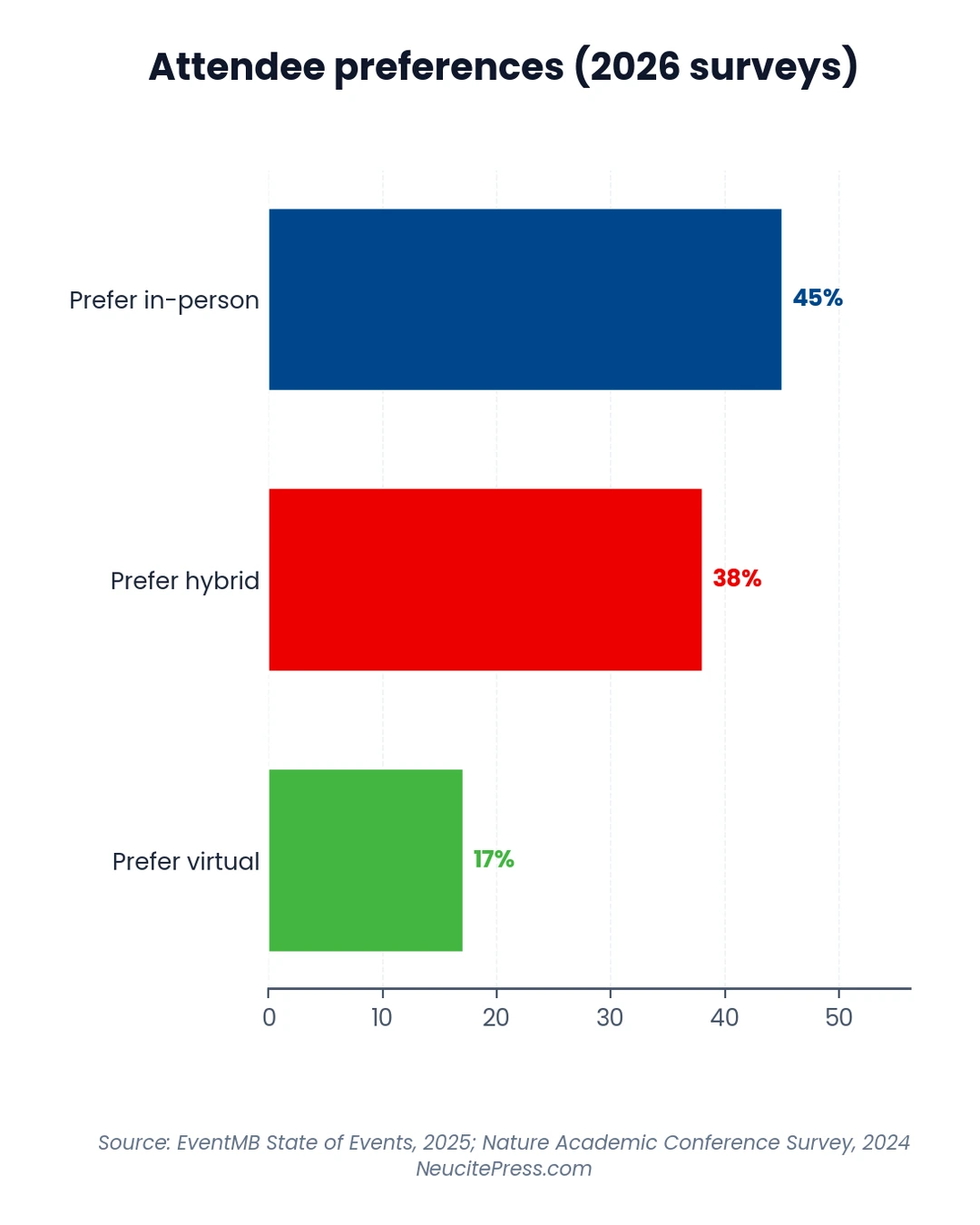
Hybrid conferences represent the fastest-growing format category, combining in-person venue experiences with simultaneous remote participation. This format addresses diverse audience preferences while maximizing reach and engagement.
Hybrid Conference Definition and Model Variations
A hybrid conference provides equivalent content and engagement opportunities for both on-site and remote participants. This requires simultaneous event operations across physical and digital domains, with intentional design ensuring neither audience receives a diminished experience.
Standard Hybrid Model: Single venue hosts primary conference with live streaming and digital interaction tools enabling remote participation. Remote attendees access content, networking tools, and sessions equivalently to on-site participants.
Hub-and-Spoke Model: Primary venue (hub) hosts keynotes and major sessions, with satellite locations (spokes) providing local gathering spaces, networking opportunities, and often supplementary local programming. Remote participants access hub content digitally while spoke attendees benefit from in-person connection with peers in regional locations.
Distributed Hub Model: Multiple equally significant venues across geographies simultaneously host the conference, with inter-venue virtual connection and shared digital platform. This addresses international audiences without designating one location as primary.
Industry data shows 58% of hybrid events use the standard model, 28% employ hub-and-spoke approaches, and 14% experiment with distributed hub configurations.
Hybrid Conference Cost Structure and ROI Analysis
Hybrid events require dual budget management, increasing complexity and overall costs:
Per-Attendee Costs: $200-$800 depending on participation tier and venue location. In-person attendees cost $300-$600, while remote participants cost $50-$150 due to shared platform and content production expenses.
Venue and Logistics: $80,000-$250,000 including facility rental, AV equipment, catering, and setup for in-person components (30-40% higher than traditional in-person due to technology requirements).
Technology Stack: $25,000-$60,000 for enterprise hybrid platform, professional live streaming setup, multiple camera systems, audio engineering, and technical support team (8-10 dedicated staff during event).
Production and Content: $15,000-$40,000 for pre-recorded content, live technical direction, speaker coaching for dual-audience engagement, and post-event video editing.
Total Event Cost: Hybrid conferences targeting 2,000 in-person and 3,000 remote attendees typically cost $180,000-$400,000, representing a middle ground between virtual and in-person expenses.
ROI Metrics: Well-executed hybrid events achieve 150-200% ROI for sponsorship revenue (higher per-sponsor due to expanded reach), 25-40% higher registration than in-person-only events, and 180-250% ROI for educational institutions leveraging CME accreditation across both participation modes.
Attendee Engagement in Hybrid Settings
Hybrid formats present unique engagement dynamics requiring sophisticated strategy:
Session Engagement Rates: 65-75% for in-person attendees (similar to traditional in-person), 35-50% for remote participants (gap driven by environment distractions and FOMO reduction).
Meaningful Networking Connections: 10-12 per in-person attendee (slightly lower than pure in-person due to split focus between remote and on-site participants), 3-8 per remote attendee (enhanced through AI matching vs. pure virtual due to on-site demographic visibility).
Satisfaction Differential: In-person attendees rate experience 8.0-8.5/10 (standard in-person experience), remote attendees rate 7.0-7.5/10 (premium experience vs. pure virtual due to premium content and expanded networking access).
Dropout Rates: 8-12% for in-person (natural course conclusion), 12-18% for remote (higher due to competing demands and technical issues).
Cross-Participation Dynamics: Research shows 22% of in-person attendees access recordings and on-demand content, suggesting complementary rather than competitive engagement modes.
Technology Requirements for Seamless Hybrid Execution
Hybrid conference success depends on sophisticated, well-integrated technical infrastructure:
On-Site Technical Setup:
- Multi-camera systems (3-4 cameras minimum for main stage, additional cameras for breakout rooms and networking areas)
- Professional audio systems with directional microphones eliminating audience feedback
- Confidence monitors enabling speakers to see remote attendees and engagement metrics
- Green screen and professional lighting ensuring camera-quality presentation
- Dedicated technical director managing camera transitions, graphics, and stream quality
Streaming and Platform Infrastructure:
- Redundant internet connections (primary and backup) ensuring 99.99% uptime
- Enterprise hybrid platform supporting 10,000+ concurrent users
- Video processing system converting venue content to platform-optimized streaming
- Real-time moderation dashboard managing chat, Q&A, and participant interactions
- Mobile app ensuring equivalent experience on iOS and Android devices
Analytics and Engagement Tools:
- Live dashboard tracking in-person attendance, session transitions, and venue flow
- Parallel digital analytics measuring session view time, interaction frequency, and engagement scoring
- Unified reporting providing organizers with holistic event performance across both domains
- Post-event analytics on content consumption, download frequency, and continuing education completion
Speaker and Presenter Engagement in Hybrid Formats
Hybrid events require specialized speaker preparation addressing dual-audience dynamics:
Compensation Structure: $2,500-$7,500 for keynotes (premium over virtual due to in-person appearance, travel, and dual-audience complexity), $500-$2,000 for breakout presenters.
Technical Preparation: Mandatory 45-60 minute technical rehearsal ensuring speaker comfort with simultaneous in-person and camera presence, eye contact balance between venue audience and remote viewers, and interactive element execution across both domains.
Engagement Strategy: Speakers must acknowledge both audiences, integrate remote Q&A equal to in-person questions, and maintain pacing suitable for both immediate in-person feedback and asynchronous remote consumption.
Content Optimization: Presentations typically 30-40 minutes with integrated interactive elements every 8-10 minutes to maintain engagement across participation modes.
Time Zone Management: Recording protocols and asynchronous content access enable international audiences to consume sessions at optimal local times.
Detailed Comparative Analysis: Virtual vs Hybrid Conferences
Strategic format selection requires systematic comparison across multiple decision dimensions. We provide quantitative and qualitative benchmarks supporting evidence-based choices.
Cost Comparison Framework
| Cost Category | Fully Virtual | Hybrid | In-Person Only |
|---|---|---|---|
| Platform/Technology | $3,000-$15,000 | $25,000-$60,000 | $5,000-$15,000 |
| Venue Rental | $0 | $80,000-$250,000 | $80,000-$250,000 |
| Catering/Hospitality | $0 | $30,000-$100,000 | $40,000-$120,000 |
| AV Equipment/Setup | $2,000-$8,000 | $20,000-$50,000 | $10,000-$30,000 |
| Staffing | $20,000-$40,000 | $40,000-$80,000 | $30,000-$70,000 |
| Content Production | $5,000-$20,000 | $15,000-$40,000 | $3,000-$15,000 |
| Marketing/Promotion | $8,000-$20,000 | $12,000-$30,000 | $10,000-$25,000 |
| Total Budget | $38,000-$103,000 | $182,000-$410,000 | $178,000-$450,000 |
| Cost per Attendee (2,000 total) | $19-$52 | $91-$205 | $89-$225 |
Accessibility and Audience Reach Comparison
Geographic Reach: Virtual conferences reach global audiences without travel barriers, achieving 65-75% out-of-region participation. Hybrid events reach 40-50% out-of-region for in-person component and 60-70% for remote participants. In-person only events typically attract 15-25% out-of-region attendees.
Accessibility for Participants with Disabilities: Virtual conferences enable closed captioning, screen reader optimization, and flexible participation accommodating mobility, hearing, and cognitive accessibility needs. Hybrid events can provide equivalent accessibility if platforms are built with universal design principles. In-person events require additional accommodations (wheelchair access, ASL interpreters, accessible seating) increasing costs and logistical complexity.
Demographic Reach: Virtual and hybrid formats attract 35-45% more early-career professionals and graduate students (cost barrier removal), while in-person events attract 20-30% higher participation from senior leaders and career-established professionals (preferring face-to-face relationship building).
International Participation: Virtual conferences achieve 30-45% international attendance. Hybrid events achieve 20-30% international in-person and 35-50% international remote. In-person only events typically achieve 10-20% international attendance despite global relevance.
Engagement Quality and Networking Effectiveness
| Engagement Metric | Virtual | Hybrid (In-Person) | Hybrid (Remote) | In-Person Only |
|---|---|---|---|---|
| Session Engagement Rate | 40-50% | 65-75% | 35-50% | 65-75% |
| Meaningful Connections per Attendee | 4-6 | 10-12 | 3-8 | 12-15 |
| Session Dwell Time | 18-22 min | 35-45 min | 15-20 min | 35-45 min |
| Satisfaction Rating | 7.0/10 | 8.0-8.5/10 | 7.0-7.5/10 | 8.2-8.7/10 |
| Dropout Rate | 15-25% | 8-12% | 12-18% | 5-10% |
| Post-Event Content Access | 35-45% | 25-30% | 40-50% | 15-20% |
The data reveals critical tradeoffs: in-person and hybrid in-person components achieve highest engagement quality through spontaneous interaction, while virtual and hybrid remote components excel in accessibility and post-event knowledge capture through on-demand content.
Networking Solutions Across Formats
Virtual Networking Approaches:
- AI-powered matchmaking algorithms identifying compatible attendees based on interests, expertise, and goals (75% report satisfaction with matches)
- Structured networking sessions with scheduled one-on-one video meetings (68% of attendees participate)
- Virtual networking lounges providing casual interaction spaces with video and chat functionality (45% adoption with moderate satisfaction)
- Interest-based breakout rooms enabling peer discussion on common topics (55% participation, 7.2/10 satisfaction)
Hybrid Networking Approaches:
- On-site networking events (meals, receptions, coffee breaks) for in-person attendees creating spontaneous connection
- Digital networking lounges with video matching connecting in-person and remote attendees (35-40% cross-participation)
- Dedicated networking sessions with videoconference bridges enabling simultaneous on-site and remote participant connection (50-60% participation)
- Sponsor booths with hybrid functionality allowing remote attendees to interact with vendor representatives via video (40% remote engagement vs. 85% in-person)
- Follow-up AI matching across both cohorts enabling post-event relationship development (22% of attendees initiate follow-up connections)
In-Person Networking Approaches:
- Structured networking events (receptions, meals, breaks) with conversation prompts (85% participation)
- Interest badges and topic-based breakout sessions enabling peer identification (72% report new meaningful connections)
- Sponsor showcases and expo floors with direct vendor interaction (90% attendee engagement)
- Speed networking sessions enabling rapid one-on-one meetings with curated matches (40-50% participation, 8.5/10 satisfaction)
CME Accreditation, Compliance, and Regulatory Frameworks
Medical education conferences must navigate complex regulatory requirements that vary by format. Understanding these frameworks ensures compliance while optimizing educational delivery.
ACCME Standards Across Virtual, Hybrid, and In-Person Formats
The Accreditation Council for Continuing Medical Education (ACCME) establishes standards applying equally across all delivery methods. Key requirements include:
Educational Rigor: ACCME requires equivalent educational quality regardless of delivery format. Learning objectives, content rigor, and assessment mechanisms must meet identical standards for in-person, hybrid, and virtual participants.
Learner Engagement: All formats must provide meaningful interaction between learners and content. This manifests differently: in-person allows real-time Q&A and discussion, virtual requires interactive polling and chat moderation, hybrid must ensure both domains have equivalent engagement mechanisms.
Faculty Expertise: Speaker credentials and qualifications must be equivalent across formats. ACCME does not provide different credentialing pathways for virtual versus in-person presentations.
Content Validation: Scientific accuracy standards are identical regardless of format. Review and validation processes must ensure evidence-based content across all delivery methods.
Credits Assignment: ACCME credits can be assigned to virtual and hybrid conferences equivalently to in-person events. 1 hour of actual learning time = 1 AMA PRA Category 1 Credit regardless of delivery method.
Format-Specific Compliance Considerations:
Virtual Events: Require documented live attendance tracking or completion verification. Simply accessing recorded content does not generate CME credits unless supplemented by assessments or live synchronous components.
Hybrid Events: Present compliance complexity. Remote participants accessing live streamed content qualify for CME credits equivalent to in-person attendees. However, if remote participants only access recorded sessions, credits require assessment or attendance verification mechanisms.
In-Person Events: Require basic attendance tracking. Sign-in sheets or electronic attendance verification document participation.
HIPAA and PhRMA Code Compliance Across Formats
HIPAA Compliance: Medical conferences must ensure patient privacy protection across all formats. Requirements include:
- Encrypted data transmission for all platforms (TLS 1.2 minimum)
- Access control mechanisms limiting PHI visibility to authorized personnel
- Business Associate Agreements with platform vendors ensuring contractual privacy obligations
- De-identification requirements if using patient case studies or examples
- Recording and disclosure policies enabling informed consent for content capture
Virtual HIPAA Compliance: Requires platform certification for healthcare use. Hopin, Accelevents, and similar commercial platforms require BAAs ensuring HIPAA-compliant infrastructure. Cloud storage for recordings must provide encrypted, access-controlled environments.
Hybrid HIPAA Compliance: Both in-person and digital components require equivalent HIPAA safeguards. Live streaming from in-person venues must use HIPAA-certified platforms, and on-site device usage (laptops, tablets) requires secure, access-controlled environments.
PhRMA Code Compliance: The Pharmaceutical Research and Manufacturers Association Code requires transparent commercial support disclosure across all formats. Requirements include:
- Faculty disclosure: Speakers must declare financial relationships with pharmaceutical and device companies
- Industry booth restrictions: Commercial entities cannot participate directly in virtual platforms (must advertise through designated sponsor channels)
- Educational independence: Pharmaceutical companies cannot control educational content regardless of format
- Honorarium disclosure: Speaker payments must be transparent and comply with industry standards
- Complimentary registration restrictions: Companies cannot provide free registration to attendees as compensation
Format-Specific PhRMA Considerations: Virtual conferences simplify compliance through structured sponsor channels. Hybrid events require clear separation between commercial booths (in-person) and educational content (both domains). In-person events necessitate physical signage and booth restrictions preventing unregulated commercial interaction.
Technology Infrastructure and Contract Negotiation
Venue Technology Requirements: For hybrid or in-person events, venue contracts should specify:
- Internet bandwidth guarantees: Minimum 100 Mbps dedicated for event streaming
- Backup internet: Secondary connection from different provider ensuring failover capability
- Power redundancy: Uninterruptible power supplies (UPS) supporting AV equipment and technical systems
- WiFi coverage: 99% coverage throughout event space with minimum 10 Mbps per concurrent user
- Technical support: Dedicated venue IT staff during setup, event, and breakdown
- Equipment provisions: Identify what venue provides versus what organizer must rent
Force Majeure and Format Flexibility: 2026 contracts should include provisions for format adjustment due to circumstances beyond reasonable control (weather, facility closure, pandemic resurgence). Recommended provisions:
- Automatic conversion to hybrid or virtual without penalty if venue becomes unavailable
- Cost adjustments proportional to reduced in-person capacity
- Technology vendor support for rapid hybrid transition
- Insurance coverage for format-conversion costs
Accessibility, Equity, and Environmental Considerations
Beyond cost and engagement, format selection should address accessibility equity and environmental impact—increasingly important to attendees and sponsors.
Accessibility Benefits Across Formats
Virtual Conference Accessibility Advantages:
- Mobility Accessibility: Eliminates travel requirements enabling participation for individuals with limited mobility, chronic illness, or caregiving responsibilities
- Hearing Accessibility: Real-time captioning and transcript availability support deaf and hard-of-hearing attendees more effectively than in-person ASL interpretation
- Cognitive Accessibility: Asynchronous content access accommodates attention differences and processing speed variations
- Neurodiversity Support: Reduced sensory overstimulation compared to in-person crowds benefits autism spectrum and anxiety disorder participants
- Cost Accessibility: Elimination of travel costs enables participation from lower-income professionals and early-career researchers
Hybrid Accessibility Advantages: Combines virtual accessibility benefits with in-person networking for those physically able and located near venues. Research shows 18-22% of regular attendees identify accessibility barriers preventing full participation; hybrid formats reduce this significantly.
In-Person Accessibility Limitations: While direct interaction provides networking benefits, accessibility barriers include:
- Travel costs and requirements restricting participation
- Venue accessibility compliance variations
- Sensory-stimulating environments challenging for neurodivergent attendees
- Limited accommodation availability for unexpected needs
Carbon Footprint and Environmental Impact
Format selection carries significant environmental implications increasingly influencing organizational decisions and sponsor requirements.
Carbon Emissions by Format:
- Virtual Conferences: 0.5-2.0 kg CO2 per attendee (minimal impact from computing and streaming infrastructure)
- Hybrid Conferences: 15-40 kg CO2 per attendee (weighted between in-person attendee travel and remote digital infrastructure)
- In-Person Conferences: 150-500 kg CO2 per attendee depending on venue location and attendee travel distance (air travel represents 85-95% of total emissions)
A 2025 carbon analysis of a 5,000-person conference shows:
- Virtual format: 2.5-10 metric tons CO2
- Hybrid format (50% in-person): 375-1,000 metric tons CO2
- In-person only: 375-2,500 metric tons CO2
Sustainability Advantages of Virtual and Hybrid: Organizations prioritizing carbon neutrality increasingly select hybrid or virtual formats. Sponsors (particularly pharmaceutical and healthcare technology companies) increasingly require carbon-neutral or carbon-reduced event options, making format choice a business consideration.
Hybrid as Environmental Compromise: Hybrid conferences reduce travel demand while maintaining relationship-building benefits, representing optimal balance for organizations with strong sustainability commitments and geographically distributed audiences.
Speaker Management Across Formats: Recruitment, Compensation, and Engagement
Effective speaker management varies significantly by format, influencing recruitment success, speaker satisfaction, and content quality.
Speaker Recruitment and Incentive Structures
Virtual Conference Speaker Recruitment:
- Incentives: Lower compensation ($1,500-$5,000 keynotes, $300-$1,500 breakout), reduced time commitment, flexible recording windows, and global audience reach attract speakers
- Recruitment Advantages: No travel requirements enable recruitment of geographically distant thought leaders, international speakers without visa constraints, and busy executives with limited travel windows
- Recruitment Challenges: Virtual presentation fatigue and perception of lower prestige reduce speaker enthusiasm compared to in-person events
Hybrid Conference Speaker Recruitment:
- Incentives: Moderate compensation ($2,500-$7,500 keynotes, $500-$2,000 breakout) balancing in-person travel with expanded audience reach
- Recruitment Advantages: Dual-audience value proposition (physical and digital reach) appeals to speakers. Hybrid events feel more prestigious than virtual while maintaining cost efficiency advantages
- Recruitment Challenges: Travel requirements and preparation complexity for dual-audience presentation
In-Person Conference Speaker Recruitment:
- Incentives: Higher compensation ($3,000-$10,000 keynotes, $500-$2,500 breakout), travel coverage, lodging, and prestige recognition
- Recruitment Advantages: Travel coverage and traditional prestige appeal to prominent thought leaders
- Recruitment Challenges: Geographic limitations and travel constraints reduce speaker availability, particularly for international speakers
Speaker Preparation and Technical Training
Virtual Speaker Preparation (30-45 minute rehearsal):
- Platform navigation: Navigating the virtual environment, accessing slides, utilizing interactive tools
- Technical setup: Camera positioning, microphone testing, lighting adjustment, green screen usage
- Engagement strategies: Directing attention to camera, pacing for screen audiences, interactive element timing
- Q&A management: Handling moderated questions, real-time chat interaction, polling response interpretation
- Recording protocols: Understanding capture, archival, and playback mechanics
Hybrid Speaker Preparation (45-60 minute rehearsal):
- Dual-audience awareness: Balancing eye contact between physical audience and camera
- Venue navigation: Understanding stage layout, camera positions, confidence monitor placement
- Engagement strategies: Acknowledging both audiences, integrating remote Q&A, managing time zone considerations
- Technical setup: Microphone fitting, slide advancement control, video quality verification
- Contingency planning: Handling technical failures, platform switching, content adaptation
In-Person Speaker Preparation (30-minute rehearsal):
- Venue familiarization: Stage layout, podium features, AV control systems
- Presentation flow: Slide advancement, video integration, interactive element timing
- Technical quality: Microphone testing, slide visibility, video playback verification
- Q&A management: Audience question handling, microphone routing for questioners
Sponsor Value Proposition and Revenue Models by Format
Sponsorship revenue significantly varies by format, influencing organizer financial models and sponsor expectations.
Sponsorship Models and Attendee Value
Virtual Conference Sponsorship:
- Sponsorship Levels: Platinum ($15,000-$30,000), Gold ($8,000-$15,000), Silver ($4,000-$8,000), Bronze ($1,000-$4,000)
- Benefits by Tier: Keynote speaking opportunity, dedicated booth in sponsor showcase, email list access to attendee database, branding throughout platform, webinar hosting within conference
- Attendee Interaction: 35-45% of attendees visit sponsor booths (vs. 85-90% for in-person), leading to lower direct sales but expanded geographic reach
- Revenue Potential: 3-5 sponsors × average $10,000 = $30,000-$50,000 sponsorship revenue
Hybrid Conference Sponsorship:
- Sponsorship Levels: Similar tiering to virtual with added in-person value
- Benefits: Keynote speaking, physical booth + digital booth, attendee database access, email marketing, networking event sponsorship, app placement
- Attendee Interaction: 85-90% in-person booth visit rate, 40-50% remote booth visit rate, creating compelling value proposition for hybrid participation
- Revenue Potential: 5-8 sponsors × average $15,000 = $75,000-$120,000 sponsorship revenue
- Strategic Value: Hybrid sponsorship enables companies to reach expanded geographic audiences while maintaining face-to-face sales conversations, particularly valuable for pharmaceutical and device companies
In-Person Conference Sponsorship:
- Sponsorship Levels: Platinum ($20,000-$40,000), Gold ($10,000-$20,000), Silver ($5,000-$10,000), Bronze ($1,500-$5,000)
- Benefits: Speaking opportunities, premium booth placement, exclusive networking events, signage throughout venue
- Attendee Interaction: 85-95% booth visit rates with higher per-contact sales conversion
- Revenue Potential: 5-10 sponsors × average $15,000 = $75,000-$150,000 sponsorship revenue
2026 Trends and Future Directions in Conference Formats
Emerging trends are reshaping conference experiences across all formats. Understanding these trajectories enables forward-thinking decisions.
Artificial Intelligence and Personalization
AI-powered features are becoming standard across conference platforms:
- Session Recommendation Engines: Algorithms analyzing attendee profiles, interests, and previous content consumption recommend personalized session schedules (currently available in Hopin, vFairs, and advanced implementations)
- AI-Powered Networking Matching: Sophisticated matchmaking algorithms identifying optimal attendee pairings based on expertise, interests, and geographic location (75-80% satisfaction with AI-generated matches vs. 65-70% for random matching)
- Real-Time Content Summarization: AI generating session summaries for attendees unable to attend live sessions, enhancing asynchronous content value
- Sentiment Analysis and Engagement Prediction: Platforms monitoring attendee sentiment in real-time to identify disengagement and trigger interventions
Organizational Advantage: Early AI adopters are achieving 15-20% higher attendee satisfaction and 12-18% increased sponsorship revenue through enhanced personalization and engagement tracking.
Metaverse and Immersive Virtual Environments
Immersive virtual conference experiences are evolving from experimental to practical:
- Virtual Venue Simulation: 3D avatars navigating virtual conference venues simulating physical space (Gather, Spatial, Decentraland platforms enabling this)
- Adoption Rate: 12-18% of conferences are experimenting with immersive environments, with early adopters reporting 8-12% higher engagement than traditional virtual
- Accessibility Considerations: Immersive platforms present new accessibility challenges (VR hardware requirements, motion sickness, cognitive load) requiring careful implementation
- Timeline: Mainstream adoption anticipated 2027-2028 as platforms mature and accessibility improves
Asynchronous and On-Demand Learning Integration
The traditional “attend for 3 days” model is fragmenting toward flexible, self-paced learning:
- Pre-Event Learning Modules: Conferences are incorporating preparatory content accessed 4-6 weeks before events (30-45% of attendees engaging with pre-event materials)
- Extended Access Windows: Recording and content access extending 6-12 months after events rather than traditional 30-60 day windows (45-55% of attendees accessing post-event content)
- Micro-Learning Components: Breaking lengthy sessions into 15-20 minute modules enabling consumption during work breaks (platforms supporting this seeing 20-30% higher completion rates)
- CME Credit Implications: ACCME is developing frameworks for CME credit assignment to asynchronous learning, expanding from traditional “live only” models
Strategic Implication: Conferences expanding beyond live events into comprehensive learning ecosystems are differentiating in crowded markets. Organizations building communities around extended learning cycles report 25-35% higher attendee retention year-over-year.
Regulatory and Compliance Evolutions
ACCME Updates: The accrediting body is modernizing standards for virtual and asynchronous learning. Anticipated 2026 changes include:
- Recognition of hybrid learning models combining synchronous and asynchronous components
- Updated engagement standards specific to virtual environments
- Streamlined documentation for CME credit assignment across formats
Data Privacy Regulations: European GDPR and emerging U.S. state data privacy laws are increasing compliance complexity, particularly for international hybrid and virtual conferences. Organizations should anticipate:
- Stricter consent requirements for attendee data collection
- Increased vendor scrutiny regarding data storage and processing locations
- Potential restrictions on attendee data sharing with sponsors without explicit opt-in
Decision Framework: Strategic Selection Tool for 2026 Conferences
Format selection emerges from systematic evaluation of organizational priorities, audience characteristics, and resource constraints. We provide a structured framework supporting evidence-based decisions.
Primary Decision Criteria
Criterion 1: Budget Availability
- Budget <$100,000: Virtual format strongly recommended (80-85% of organizations in this range select virtual)
- Budget $100,000-$300,000: Hybrid format optimal (provides balance between reach and relationship-building)
- Budget >$300,000: In-person or premium hybrid achievable (organizations with substantial budgets can invest in high-quality implementations across formats)
Criterion 2: Geographic Attendee Distribution
- International attendance >40%: Virtual or hybrid strongly recommended (virtual enables global reach at manageable cost)
- International attendance 15-40%: Hybrid optimal (serves domestic base while accommodating international audiences)
- International attendance <15%: In-person viable if venue location is central to domestic audience
Criterion 3: Primary Objective
- Objective: Maximize Reach and Knowledge Dissemination → Virtual (highest geographic reach, lowest cost per attendee)
- Objective: Balance Reach and Networking → Hybrid (serves both needs effectively)
- Objective: Deep Relationship-Building and Networking → In-person (highest engagement quality, most spontaneous interaction)
- Objective: Clinical Skills Training → In-person or hybrid with in-person skill stations (hands-on training requires physical presence)
- Objective: Professional Certification Exams → In-person (proctoring requirements typically necessitate physical presence)
Criterion 4: Attendee Accessibility Priorities
- If accessibility is significant priority: Virtual strongly recommended (eliminates travel barriers, enables accommodation of diverse accessibility needs)
- If moderate accessibility importance: Hybrid recommended (enables virtual participation for those unable to attend in-person)
- If accessibility not primary concern: Any format viable (in-person acceptable)
Criterion 5: Organizational Capacity and Expertise
- Limited event planning experience: Virtual recommended (fewer moving parts, lower technical complexity)
- Moderate event planning experience: Hybrid viable with vendor support (requires coordination but manageable)
- Extensive event planning experience: Any format achievable (organizations with established teams can execute sophisticated in-person events)
Scoring Matrix for Format Selection
Evaluate each criterion on 1-5 scale (1=poorly aligns, 5=perfectly aligns) and sum scores:
- Score 5-10: Virtual strongly recommended
- Score 11-18: Virtual or hybrid both viable; hybrid preferred if seeking to balance reach and engagement
- Score 19-25: Hybrid optimal (balances competing priorities)
- Score 26-32: Hybrid or in-person viable; in-person preferred if budget and logistics support
- Score 33-40: In-person strongly recommended
Implementation Roadmap: Step-by-Step Execution Across Formats
Successful conferences require systematic planning. We provide format-specific execution frameworks.
Virtual Conference Implementation Timeline
6 Months Before: Select platform, establish budget, begin speaker recruitment, define CME learning objectives
4 Months Before: Confirm keynote speakers, outline breakout sessions, begin marketing outreach, establish technology requirements with platform vendor
2 Months Before: Open registration, conduct speaker technical rehearsals, finalize schedule, establish Q&A protocols
4 Weeks Before: Finalize speaker roster, prepare promotional materials, conduct final technical tests, train support staff
2 Weeks Before: Send platform access information to attendees, conduct final attendee testing, prepare contingency communication plans
Event Week: Monitor platform performance, manage attendee support issues, track engagement metrics in real-time
Post-Event: Release recordings within 24-48 hours, collect attendee feedback, prepare CME certificates, conduct post-event analytics review
Hybrid Conference Implementation Timeline
9-12 Months Before: Select venue and date, secure hybrid platform, establish budget, begin speaker recruitment
6 Months Before: Confirm keynotes, lock in vendor contracts (AV, catering, technology), define CME learning objectives, begin comprehensive marketing
4 Months Before: Finalize schedule, begin speaker technical training, establish on-site technical requirements with venue, start sponsor recruitment
2 Months Before: Conduct final venue walk-through, complete speaker technical rehearsals (hybrid-specific dual-audience training), finalize sponsorship roster, prepare streaming tests
4 Weeks Before: Train on-site technical staff, send detailed attendee communications (both in-person and remote), establish contingency protocols, conduct final platform testing
Event Setup (2 Days Before): Full technical rehearsal including live camera switching, audio testing, internet redundancy verification, speaker final checks
Event Execution: Deploy full technical team, monitor in-person and remote attendance simultaneously, track real-time engagement metrics, manage contingencies
Post-Event: Collate in-person and remote feedback, release recordings (within 24 hours for CME), prepare unified attendance reports, conduct ROI analysis
Conclusion: Strategic Format Selection for 2026 and Beyond
The conference landscape has fundamentally shifted from binary format choices toward integrated strategies serving diverse audience segments. No universally superior format exists—optimal selection emerges from systematic evaluation of organizational priorities, audience characteristics, and resource constraints.
Virtual conferences maximize accessibility and global reach while minimizing costs, making them ideal for knowledge dissemination and inclusion-focused objectives. The format excels for early-career professionals, international audiences, and organizations with budget constraints.
Hybrid conferences balance reach and engagement by serving both geographically distributed remote participants and local in-person attendees. This format addresses competing organizational priorities, enabling sponsorship revenue growth while expanding audience reach. Hybrid represents the fastest-growing format category for 2026-2027.
In-person conferences remain unmatched for spontaneous networking, face-to-face relationship building, and hands-on skills training. The format serves senior leadership, professional certification requirements, and organizations prioritizing engagement depth over audience breadth.
Key Strategic Insights for 2026:
- Format selection should align with primary organizational objectives rather than following industry trends
- Budget constraints are the strongest determinant of format choice; virtual is financially optimal for most organizations
- Hybrid formats are increasingly viable as technology matures and cost differential narrows
- Accessibility and equity considerations are gaining importance in format selection; virtual and hybrid formats address these better than in-person-only events
- Asynchronous and on-demand learning integration is becoming expected rather than optional, requiring post-event content strategies regardless of format
- Environmental impact is influencing sponsor requirements and attendee preference; hybrid and virtual formats offer sustainability advantages
Action Steps for Your 2026 Conference:
- Complete the decision framework assessment using your specific organizational priorities
- Develop detailed financial projections for your selected format, including realistic cost estimates based on your audience size
- Begin vendor evaluation for platforms and services specific to your chosen format
- Establish CME compliance protocols ensuring your format meets ACCME standards
- Develop detailed speaker recruitment and preparation plans addressing format-specific requirements
- Build sponsor value propositions highlighting format-specific benefits (reach, engagement, audience demographics)
- Plan post-event content and learning strategies extending conference value beyond the live event window
The organizations thriving in 2026 are those making deliberate, evidence-based format decisions aligned with strategic objectives rather than defaulting to familiar patterns. We encourage you to evaluate your unique circumstances, apply the frameworks and benchmarks provided in this guide, and select the format that optimizes value for your specific audience and organizational mission.
Subscribe to NeuCitePress for ongoing guidance on conference planning, technology innovations, and best practices. Share this resource with colleagues navigating similar format decisions, and reach out with specific questions about your conference planning needs.
Frequently Asked Questions
What is the primary difference between virtual and hybrid conferences?
Virtual conferences operate entirely online with all attendees participating remotely through digital platforms. Hybrid conferences combine physical venue-based attendance with simultaneous remote participation through streaming and virtual platforms. This fundamental difference impacts costs, engagement quality, networking opportunities, and accessibility across both formats.
Which format offers better ROI for sponsors and organizers?
ROI varies significantly by organizational objective. Virtual formats generate highest revenue per attendee due to low costs, providing 200-300% ROI on platform investments. Hybrid formats generate highest sponsorship revenue (75-120K for mid-sized events) due to expanded reach and tiered sponsorship options. In-person events provide highest engagement-quality ROI but require larger upfront investment.
How do CME credits differ across formats?
ACCME provides equivalent CME credit across all formats (1 hour learning time = 1 credit) provided learning outcomes are equivalent, learner engagement is meaningful, and attendance is verified. Virtual events require different verification mechanisms than in-person, but credits are equally valid for all delivery methods.
What technology is essential for successful hybrid implementation?
Essential components include enterprise hybrid platform (supporting 10,000+ concurrent users), multi-camera video capture with professional lighting, high-quality audio systems with directional microphones, redundant internet connections, dedicated technical director, real-time analytics dashboard, and mobile application ensuring equivalent remote experience.
How can I optimize engagement for remote participants in hybrid events?
Key strategies include: integrating remote Q&A equal to in-person questions, utilizing AI-powered networking matching connecting in-person and remote attendees, maintaining equivalent session quality across both domains, providing interactive elements (polling, breakout rooms) every 8-10 minutes, and offering asynchronous content access extending engagement beyond live event window.
What are the main accessibility benefits of virtual and hybrid formats?
Virtual and hybrid formats address accessibility barriers including: eliminating travel requirements enabling participation for individuals with mobility limitations or caregiving responsibilities, providing real-time captioning for deaf and hard-of-hearing attendees, enabling asynchronous content access accommodating attention and processing speed variations, and reducing sensory overstimulation benefiting neurodivergent attendees.
How should format selection differ by organization size or type?
Small organizations (<500 annual attendees) typically benefit from virtual or hybrid formats due to cost efficiency. Mid-size organizations (500-2000 attendees) have flexibility selecting hybrid as optimal balance. Large organizations (2000+ attendees) can invest in premium implementations across any format, with selection driven by strategic objectives rather than financial constraints.
What are emerging trends likely to influence conference formats in 2027-2028?
Key trends include: AI-powered personalization and networking matching becoming standard; immersive virtual environments gaining adoption (5-8 years from mainstream adoption); asynchronous learning frameworks expanding with ACCME regulatory support; and sustainability and accessibility priorities increasingly influencing format selection and sponsor requirements.