Desk Rejection Rates: When and Why Editors Reject Immediately
Desk Rejection Rates: When and Why Editors Reject Immediately (2026 Data)
Imagine submitting your meticulously researched manuscript to a prestigious journal, only to receive a rejection notice within 48 hours—without peer review. This immediate editorial decision, known as a desk rejection, has become alarmingly common in academic publishing. Data shows that between 30% and 85% of all submissions across disciplines face desk rejection, making it the most critical hurdle in the publication pipeline.
Reviewed by the NeucitePress Editorial Board — PhD academics, peer-reviewed editors and subject-matter specialists.
A desk rejection occurs when an editor determines a manuscript is unsuitable for the journal before it reaches external reviewers. For early-career researchers, this outcome is particularly devastating: 67% receive zero constructive feedback, leaving them uncertain about how to improve.
Understanding desk rejection rates and their underlying causes is essential for navigating modern academic publishing. This comprehensive guide analyzes authoritative research, editorial data, and institutional trends to help researchers strategically improve their submission acceptance odds.
What Is a Desk Rejection?
A desk rejection represents an editorial decision made at the point of submission, before peer review commences. Editors screen for alignment with journal scope, methodological soundness, and manuscript quality. If concerns exist, the editor rejects the manuscript outright, protecting reviewer time and resources.
This process differs fundamentally from peer-reviewed rejection. While peer rejection reflects expert consensus on specific weaknesses, desk rejection signals that the manuscript doesn’t meet baseline publication standards for that particular venue. Importantly, a desk rejection isn’t a verdict on research quality—it’s a misalignment between manuscript and journal.
The Scale of the Problem
Recent publishing data reveals the magnitude of editorial gatekeeping. A landmark decade-long study published in Acta Ophthalmologica tracked submissions at a top-tier ophthalmology journal:
- 2010: 48% desk rejection rate (1,014 submissions)
- 2020: 67% desk rejection rate (2,449 submissions)
- Change: +19 percentage points with 142% increase in submission volume
This represents a critical trend: as submission volume surges, editors increasingly rely on desk rejection to manage reviewer workload and journal selectivity. The jump from 48% to 67% illustrates intensifying competition rather than declining manuscript quality.
Desk Rejection Rates by Journal Tier
Not all journals desk-reject at equal rates. Research reveals clear hierarchies based on journal prestige and selectivity:
Elite and Nature-Level Journals: 67-85%
Prestigious journals like Nature, Science, and PNAS receive 800-1,000 submissions monthly but publish only 40-50 articles. Their desk rejection rates exceed 70% because editorial selectivity is extreme—these journals accept fewer than 5% of submissions total.
A remarkable finding: elite journals desk-reject 86% of their most-cited papers before peer review even begins. Research analyzing 1,008 manuscripts at three elite medical journals found that of the 14 most influential published articles, 12 were initially desk-rejected. This paradox demonstrates that conventional gatekeeping may systematically filter out unconventional, paradigm-shifting work.
Top-Tier Q1 Journals: 50-60%
Quality journals ranked in the first quartile by impact factor typically desk-reject 50-60% of submissions. These journals maintain selective standards while still sending many manuscripts to peer review. Examples include most journals in the top 25% of their discipline by impact factor.
Mid-Tier Q2-Q3 Journals: 30-40%
Mid-tier journals desk-reject at lower rates, typically 30-40%. These publications have broader scope and larger editorial capacity for peer review. Authors often experience higher acceptance odds when targeting mid-tier venues, though citations and visibility may be lower.
Top Reasons Editors Desk-Reject Manuscripts
Turning these reasons into a repeatable screening order is covered in desk rejection criteria: what to screen and in what order, part of our submission screening service.
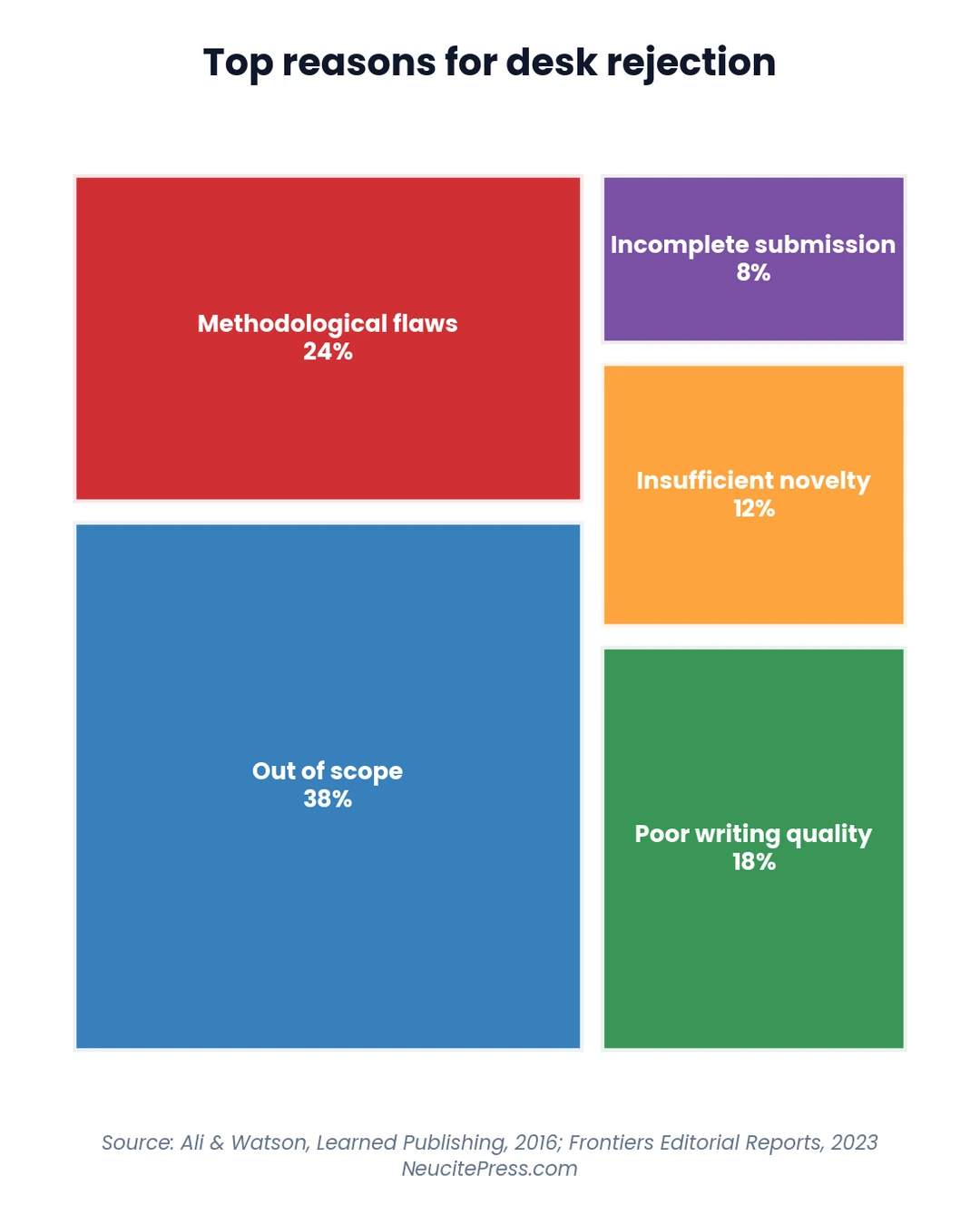
Editorial desk rejection decisions follow predictable patterns. Understanding common reasons helps researchers avoid preventable rejections:
1. Poor Fit with Journal Scope (28%)
The most common reason for desk rejection is misalignment between manuscript content and journal focus. Submitting a paleobiology study to a molecular biology journal, or vice versa, signals unfamiliarity with the journal. Before submission, editors expect authors to demonstrate knowledge of the journal’s scope, recent publications, and editorial priorities.
Prevention strategy: Read 5-10 recent articles in your target journal. Explain in your cover letter why this specific journal is ideal for your work. Avoid generic submissions to multiple journals without customization.
2. Insufficient Novelty (22%)
Manuscripts that lack originality face desk rejection. This includes incremental studies that don’t substantially advance the field, replications without novel insights, or work that closely mirrors recent publications by others. High-impact journals particularly emphasize novelty and significance.
Prevention strategy: Clearly articulate your novel contribution in the introduction and abstract. Distinguish your work from existing literature through new methodology, population, or theoretical lens. Conduct comprehensive literature searches to ensure your work fills an actual gap.
3. Methodological Issues (19%)
Flawed study design, inadequate sample sizes, poor statistical approaches, or questionable analytical methods trigger desk rejection. Editors screen for fundamental methodological problems that would compromise findings validity.
Prevention strategy: Have methodology reviewed by experienced colleagues before submission. Follow established standards for your discipline. Consult recent methodological papers if exploring novel techniques. Consider pre-registration for hypothesis-driven studies.
4. Poor Writing Quality (16%)
Manuscripts with grammatical errors, unclear exposition, or disorganized structure may be desk-rejected, especially at prestigious journals. Poor writing signals lack of care and potentially indicates rushed or low-quality work. Non-native English speakers are sometimes disadvantaged by this criterion.
Prevention strategy: Revise multiple times, reading aloud to catch errors. Solicit feedback from colleagues on clarity and organization. Consider professional editing services, especially if English isn’t your native language. Use grammar-checking tools and style guides specific to your discipline.
5. Ethical Concerns (9%)
Manuscripts raise red flags regarding human subject protections, animal welfare, conflicts of interest, or data integrity. Editors take ethical issues seriously and may desk-reject without external review.
Prevention strategy: Ensure institutional review board (IRB) approval. Declare all conflicts of interest. Provide data availability statements. Be transparent about funding sources and author contributions.
6. Other Reasons (6%)
Miscellaneous reasons include insufficient length, improper formatting, missing required elements (abstracts, keywords), and presentations that don’t meet journal specifications.
Geographical and Demographic Disparities in Desk Rejection
Research reveals troubling inequities in desk rejection rates. A comprehensive Thomson Reuters analysis of over three million manuscripts showed stark geographical differences:
- USA and Western Europe: 46.8-51.9% acceptance rates
- China: 26.8% acceptance rate
- India: 24.6% acceptance rate
- Brazil: 18.7% acceptance rate
These disparities reflect multiple factors: language barriers (many editors are native English speakers), familiarity with Western academic conventions, access to professional editing services, and institutional support infrastructure. Authors from less-resourced institutions face compounded challenges.
Early-career researchers fare particularly poorly. Graduate students and junior faculty receive the harshest treatment: 67% of early-career authors receiving desk rejection receive absolutely no feedback. This lack of guidance perpetuates cycles where junior scholars struggle to improve their work.
Strategic Approaches to Minimize Desk Rejection Risk
1. Select the Right Journal
Journal selection represents the most critical decision. Aim for journals where your work naturally belongs based on scope, audience, and impact factor alignment. Use tools like manuscript planning guides to identify appropriate venues before drafting the final version. Editors running the screening side of this can see how we structure intake and triage in our managed editorial office.
2. Polish Before Submitting
Invest time in manuscript preparation. Multiple revision rounds, peer feedback from experienced colleagues, and professional editing dramatically reduce desk rejection risk. Poor presentation signals poor science to editors.
3. Craft Targeted Cover Letters
Your cover letter should address the editor directly, explaining why your manuscript fits the journal’s scope and audience. Reference recent papers published in the journal. Avoid generic cover letters—editors can tell when you’ve customized your submission.
4. Follow Guidelines Precisely
Deviation from author guidelines—incorrect citation format, improper section headings, missing abstracts—provides editors with legitimate desk-rejection justification. Formatting compliance takes minimal effort but prevents unnecessary rejections. See our academic publishing guide for comprehensive guidelines across disciplines.
5. Consider Journal Tiers Strategically
While prestigious journals provide greater visibility, they also desk-reject at higher rates. Early-career researchers may increase publication odds by first targeting mid-tier journals, then pursuing higher-impact venues once publications establish credibility. This strategy builds a publication record while advancing toward more prestigious venues.
The Role of Machine Learning in Editorial Screening
Recent research explores artificial intelligence applications in manuscript screening. Some publishers now employ machine learning systems to identify manuscripts likely to be rejected, potentially increasing desk rejection efficiency. Understanding these technological gatekeeping mechanisms helps researchers anticipate editorial priorities.
However, AI-assisted screening raises concerns. If algorithms are trained on historical data, they may perpetuate existing biases against certain author demographics or institutional affiliations. Transparency in algorithmic editorial processes remains limited.
How to Respond Effectively to Desk Rejection
From the editor’s side, the wording matters as much as the decision — see how to desk-reject without inviting an appeal. One newer screening failure deserves its own check: AI-hallucinated citations.
Receiving a desk rejection stings, but it’s recoverable. Consider these steps:
- Read the editor’s decision letter carefully. If specific reasons were provided, they’re invaluable feedback. Use them to strengthen your manuscript.
- Don’t contact the editor. Desk rejections are typically final. Appealing rarely succeeds. Focus energy on revision and resubmission elsewhere.
- Revise substantially, then identify a more appropriate venue. If the rejection indicated scope mismatch, select a different journal. If methodological concerns were raised, address them substantively.
- Use rejection as motivation. Many successful academics faced early desk rejections. This setback doesn’t define your career or research quality.
Check before you submit. Our journal editors read your manuscript the way a handling editor will and flag desk-rejection risks first. Get a free desk check of your abstract and cover letter. Pre-submission editor review
FAQ: Desk Rejection Rates and Editorial Decisions
How long do editors take to desk-reject?
Editors typically desk-reject within 1-7 days. Some elite journals desk-reject within hours. Speed indicates that limited editorial review occurred—not necessarily that the rejection was hasty. Editors develop rapid assessment skills through experience.
Is desk rejection appealable?
Desk rejections are rarely overturned. Most journals don’t offer appeals processes for desk rejections, viewing them as editorial judgments on scope fit rather than quality assessments. Direct your energy toward alternative journals instead.
Can preprints reduce desk rejection risk?
Posting preprints establishes priority and visibility but doesn’t guarantee journal acceptance. Some high-impact journals penalize preprints, while others welcome them. Check journal policies before posting. A polished, well-promoted preprint can sometimes attract editorial attention positively.
Do desk rejection rates vary by discipline?
Yes. Computer science and physics journals typically desk-reject fewer manuscripts (20-40%) than medical and biological journals (40-70%), due to differences in publication culture and submission volumes. Your discipline’s norms matter significantly.
Does open access status affect desk rejection rates?
Open access journals generally desk-reject at lower rates (25-40%) than traditional subscription journals. However, this reflects selection rather than easier acceptance—open access journals may simply operate different editorial models or attract different submission demographics.
The Future of Editorial Gatekeeping
Academic publishing faces pressure to reform. High desk rejection rates frustrate researchers, delay science communication, and perpetuate access inequities. Some journals experiment with alternative approaches:
- Transparent editorial criteria and rubrics for desk rejection decisions
- Mandatory constructive feedback even for desk rejections (rare but growing)
- Two-stage review processes where more manuscripts reach peer review
- Blind or double-blind review extending to desk review phase
- Increased international representation on editorial boards
As an author, you can support these reforms by voting with your submissions—favoring journals with fair, transparent processes. As the field evolves, desk rejection practices will likely become more inclusive and systematic.
Key Takeaways
- Desk rejection rates range from 30-85% depending on journal prestige and submission volume.
- Elite journals desk-reject 67-85% of submissions, including many highly-cited papers that should reach peer review.
- The most common reason for desk rejection is poor journal fit (28%), followed by insufficient novelty and methodological issues.
- Early-career researchers face particular disadvantages, receiving no feedback in 67% of desk rejections.
- Strategic journal selection, thorough revision, and careful guideline compliance substantially reduce desk rejection risk.
- Geographical and institutional disparities exist, with authors from Western institutions experiencing higher acceptance rates.
- A desk rejection is not a judgment on your research quality—it reflects alignment between manuscript and journal.
Understanding desk rejection processes empowers researchers to navigate academic publishing more strategically. By selecting appropriate journals, polishing manuscripts thoroughly, and addressing common editorial concerns, you significantly improve the likelihood that your work receives fair peer review.
For guidance on other aspects of the publication process, explore our resources on manuscript revision strategies and peer review fundamentals.
Need help with this? Many desk rejections trace back to gaps in submission intake and screening, not manuscript quality. NeucitePress offers Journal Editorial Workflow Optimization — a structured audit of your submission-to-publication pipeline, including desk-rejection and peer-review screening, with SOPs and templates delivered as a one-time engagement from $499. Learn more →