EBSCO Journal Indexing: Benefits, Application Process & Strategic Guide 2026
EBSCO journal indexing represents a critical milestone for academic publishers seeking global visibility and research impact. With over 10,099 active full-text journals available through Academic Search Ultimate alone—representing a retail value exceeding $3.6 million—inclusion in EBSCO databases connects your scholarship with millions of researchers across institutional libraries worldwide.
Reviewed by the NeucitePress Editorial Board — PhD academics, peer-reviewed journal editors and medical communication specialists.
Yet many journal editors and publishers remain uncertain about the indexing process, eligibility criteria, and strategic advantages of database inclusion. This comprehensive guide demystifies EBSCO indexing, contrasts it with competing platforms like Scopus and Web of Science, and provides a step-by-step roadmap to successful application in 2026.
What Is EBSCO and Its Role in Academic Publishing
EBSCO Information Services operates as one of the world’s leading aggregators of academic and research content, with 70+ years of experience serving libraries, institutions, and researchers globally. Founded in 1944, the company has evolved from a book vendor into a sophisticated database aggregator managing multiple specialized research platforms.
The EBSCO ecosystem encompasses diverse databases tailored to specific disciplines and institutional needs:
- Academic Search Ultimate – The flagship multidisciplinary database with 10,099+ active full-text journals spanning sciences, social sciences, humanities, and more
- CINAHL – Specialized nursing and health sciences database with over 3,000+ titles
- Business Source Complete – Comprehensive business, economics, and management research collection
- PsycINFO – Psychology and behavioral science research platform
- Environment Complete – Environmental science and sustainability focused database
- GreenFILE – Environmental policy and practice resource collection
- MedicLatina – Latin American and Spanish-language medical research
- SPORTDiscus – Sports science and physical education literature
Unlike open-access repositories, EBSCO databases operate on subscription models used primarily by academic institutions, university libraries, hospital systems, and corporate research divisions. This institutional distribution model ensures your journal reaches qualified researchers within institutions that have invested in comprehensive research access.
EBSCO vs. Scopus vs. Web of Science: A Comparative Analysis
Understanding how EBSCO differs from other major indexing platforms is essential for strategic publishing decisions. Each platform serves distinct purposes within the academic ecosystem and offers different visibility pathways.
Scopus
Scopus, operated by Elsevier, represents the world’s largest abstract and citation database, indexing over 25,000 active journals, conference proceedings, and book series. The platform emphasizes citation tracking, h-index calculation, and research metrics integration.
Scopus Strengths: Metrics-focused with integration into author profiles, institutional dashboards, and funding body evaluation systems. Rapid indexing timelines (often 2-3 months) and broad multidisciplinary coverage. Growing acceptance in academic evaluation frameworks globally.
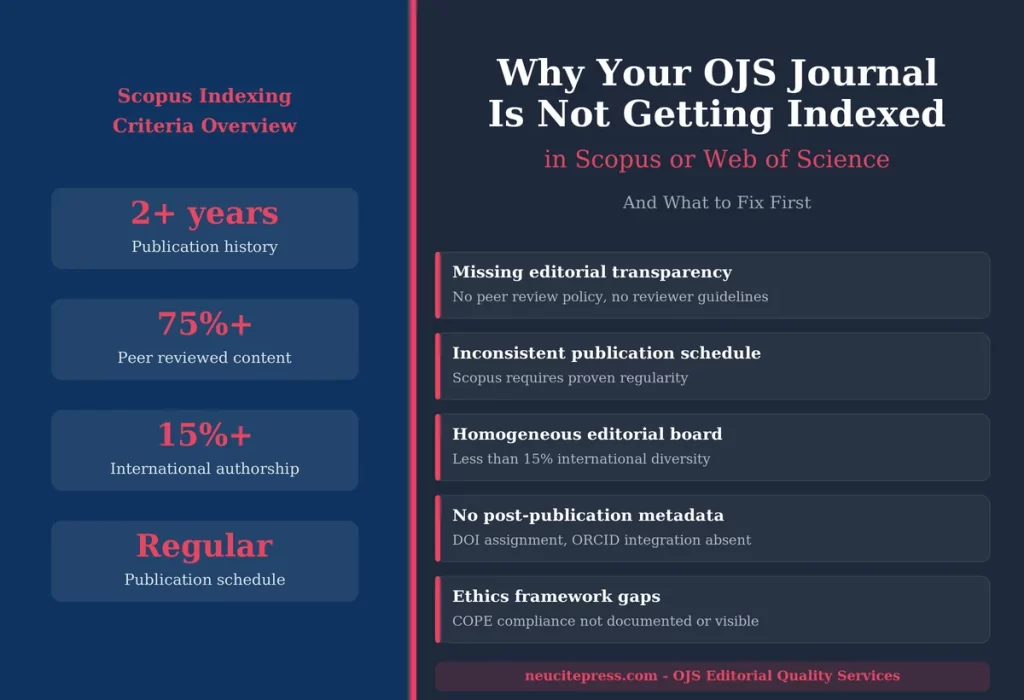
Scopus Limitations: Higher application barriers with selective content inclusion. Requires established publication history and stronger citation metrics. Less emphasis on regional or emerging journals. Focus on citation metrics may disadvantage newer publications.
Web of Science
Web of Science (Clarivate Analytics) operates as a premium citation-tracking database with selective journal inclusion criteria. The platform indexes approximately 21,000 core collection journals, focusing on impact and citation patterns.
Web of Science Strengths: Gold-standard citation index used in academic rankings and institutional evaluations. Rigorous peer review selection process maintains collection quality. Journal Impact Factor calculations strengthen researcher credibility. Seamless integration with Incites analytics platform.
Web of Science Limitations: Most selective of the three platforms with stringent acceptance criteria. Higher rejection rates for newer journals (30-40% rejection rate). Slower processing timelines (3-6 months). Limited coverage of regional and non-English journals until recent years.
EBSCO Databases
EBSCO Strengths: More accessible acceptance criteria than Scopus or Web of Science, particularly for established regional journals. Faster evaluation timelines (2-4 months). Integrated discovery through EBSCO Discovery Service, reaching millions of researchers. Diverse database tiers accommodate different journal maturity levels and specialties. Strong library adoption rates ensure consistent researcher access.
EBSCO Limitations: Less emphasis on citation metrics compared to Scopus. Smaller research impact visibility in academic evaluation frameworks. Perceived as “easier” to enter than competitive platforms. More limited integration with institutional metrics systems.
| Attribute | EBSCO | Scopus | Web of Science |
|---|---|---|---|
| Indexed Journals | 10,099+ (Ultimate tier) | 25,000+ | 21,000+ (Core) |
| Evaluation Timeline | 2-4 months | 2-3 months | 3-6 months |
| Acceptance Rate | 60-70% | 40-50% | 25-35% |
| Citation Tracking | Limited | Comprehensive | Comprehensive |
| Regional Content | Strong | Growing | Growing |
| Application Barriers | Moderate | High | Very High |
| Best For | Established regional journals, interdisciplinary research | Metrics-driven institutions, broad visibility | Impact-focused research, high-prestige publishing |
Strategic Benefits of EBSCO Indexing for Academic Journals
EBSCO indexing provides tangible advantages for journal visibility, researcher reach, and institutional credibility. Understanding these benefits enables strategic planning aligned with publishing goals.
Global Researcher Reach
EBSCO’s institutional subscription model provides direct access to millions of researchers across:
- Academic institutions: Universities, research centers, and colleges worldwide
- Health systems: Hospitals, clinics, and medical research facilities
- Corporate research divisions: Companies investing in innovation and development
- Public libraries: Community access to research materials in developed regions
- Government agencies: Federal, state, and international research divisions
This distribution ensures articles published in indexed journals reach researchers actively engaged in institutional research activities.
Credibility and Institutional Recognition
EBSCO indexing signals editorial quality to institutional subscribers, researchers, and peer evaluation committees. Many institutions view EBSCO-indexed journals as established, peer-reviewed publications worthy of research investment. This credibility becomes particularly valuable when combined with other indexing platforms (Scopus, Web of Science).
Long-Term Discoverability and Access
Unlike open-access repositories facing sustainability challenges, EBSCO’s commercial infrastructure ensures stable, long-term content preservation and accessibility. Researchers using institutional subscriptions access articles without concerns about platform abandonment or content removal.
Multi-Database Exposure
EBSCO’s flexible tiering system means journals may be indexed across multiple databases—Academic Search Ultimate, specialized subject databases (CINAHL, Business Source), or both. This multiplies researcher discovery pathways compared to single-database inclusion.
Institutional Metrics Integration
Academic institutions increasingly track publication output across multiple indexing platforms. EBSCO inclusion contributes to institutional research profiles, helping universities demonstrate research productivity in tenure evaluation, accreditation, and funding applications.
The EBSCO Database Ecosystem and Tier Structure
Understanding EBSCO’s database architecture helps journals position themselves strategically for optimal visibility and research impact.
Multidisciplinary Platforms
Academic Search Ultimate (ASU): EBSCO’s flagship database indexes 10,099+ active journals spanning all academic disciplines. This tier offers the broadest researcher reach for interdisciplinary and mainstream research.
Academic Search Complete: A previous-generation tier containing 8,400+ titles. New journals typically apply to Academic Search Ultimate rather than this older platform.
Subject-Specific Databases
EBSCO maintains discipline-specific databases serving specialized research communities:
- CINAHL (Cumulative Index to Nursing and Allied Health Literature): 3,200+ nursing, public health, and allied health journals
- Business Source Complete: 4,600+ business, economics, and management publications
- PsycINFO: 2,700+ psychology, behavioral science, and mental health journals
- Environment Complete: 1,400+ environmental science and sustainability titles
- GreenFILE: 400+ environmental policy and practice resources
- MedicLatina: Latin American and Spanish-language medical research
- SPORTDiscus: 800+ sports science and physical education publications
- Philosopher’s Index: 600+ philosophy and interdisciplinary research titles
Journals naturally fitting these specialized communities may be indexed in both multidisciplinary and subject-specific databases, increasing researcher visibility.
Step-by-Step EBSCO Application Process (2026 Guide)
The EBSCO application process follows a structured pathway with distinct evaluation stages. Understanding each phase helps editors and publishers optimize their submission materials.
Phase 1: Pre-Application Assessment and Planning
Timeline: 1-2 months before application
Before submitting formal applications, conduct comprehensive internal evaluation:
- Editorial team composition: Verify presence of international board members, editorial independence from publisher, and peer review documentation
- Publication consistency: Confirm ability to maintain regular publication schedule (2-4 issues yearly minimum for most databases)
- Content quality: Review recent publications for scientific rigor, originality, and audience fit
- Database selection: Determine optimal database tier (Academic Search Ultimate vs. specialized database)
- Competitor analysis: Examine similar journals currently indexed in target databases
- Technical readiness: Ensure ISSN assignment, DOI infrastructure, and XML metadata formatting capabilities
Phase 2: EBSCO Initial Submission
Timeline: Day 1 of evaluation
Submit application package through EBSCO’s content submission portal:
- Journal profile form: Complete publication details, editorial information, indexing history, and discipline classification
- Editor credentials: Provide editorial board member names, affiliations, and areas of expertise
- Sample issues: Submit latest 3-4 complete issues (PDF or XML)
- ISSN proof: Upload valid ISSN registration documentation
- Publishing information: Provide publication frequency, average article count, peer review process documentation, and copyright transfer agreements
- Metadata quality assessment: Submit 5-10 sample article records with abstracts, keywords, and author affiliations
Phase 3: EBSCO Content Evaluation (2-4 weeks)
Timeline: Weeks 1-4 of evaluation
EBSCO’s content specialists review submissions against standardized criteria:
- Bibliographic data quality: Article metadata completeness, formatting consistency, and proper indexing field population
- Editorial structure: Peer review evidence, editorial board independence, and decision documentation
- Content relevance: Journal scope fit within proposed database category
- Publication consistency: Ability to maintain regular publication schedule
- Technical capabilities: XML markup, article tagging, and metadata quality assessment
- Copyright and permissions: Proper licensing agreements and intellectual property documentation
EBSCO may request additional samples, clarifications, or revisions during this phase.
Phase 4: Internal Board Review and Recommendation (1-2 weeks)
Timeline: Weeks 4-6 of evaluation
EBSCO’s internal editorial board reviews content evaluator recommendations and makes indexing decisions. This phase involves:
- Standardized criteria application: Evaluation against published EBSCO acceptance standards
- Competitive positioning: Assessment relative to similar journals in proposed database
- Strategic fit: Alignment with EBSCO database coverage goals
- Final recommendation: Approval, conditional approval with revisions, or rejection
Phase 5: Publisher Notification and Next Steps (Days 60-120)
Timeline: End of evaluation period
EBSCO notifies publishers of indexing decisions:
If approved:
- Receive formal indexing agreement with licensing and content delivery requirements
- Configure delivery mechanism (FTP, API, or direct XML upload)
- Receive EBSCO technical documentation for metadata compliance
- Complete technical onboarding (2-4 weeks)
- Begin content delivery and indexing (timeline varies by database tier)
- Receive marketing materials highlighting EBSCO indexing status
If conditional approval (revisions requested):
- Receive detailed requirements for content, editorial, or technical improvements
- Address identified issues (typically 4-8 weeks)
- Resubmit revised materials
- EBSCO re-evaluates and provides final decision (additional 2-4 weeks)
If rejected:
- Receive detailed feedback on evaluation results
- Identify specific improvement areas (editorial, content quality, technical requirements)
- May reapply after addressing feedback (typically 6-12 months later)
- Alternative indexing pathways: Apply to other platforms or strengthen publications for future consideration
Phase 6: Technical Onboarding and Metadata Optimization
Timeline: 2-4 weeks post-approval
Publishers work with EBSCO technical teams on content delivery setup:
- Metadata schema compliance: Ensure XML submissions match EBSCO specifications
- Article-level indexing: Proper keyword assignment, subject classification, and abstract formatting
- Quality assurance: Pre-indexing review of sample articles to prevent delays
- Content delivery schedule: Establish regular submission timeline (weekly, bi-weekly, or monthly)
- Ongoing support: Access to EBSCO technical documentation and publisher support team
Content Quality Standards for EBSCO Acceptance
EBSCO maintains specific quality benchmarks across multiple dimensions. Understanding these standards helps publishers optimize applications.
Peer Review and Editorial Standards
EBSCO requires evidence of:
- Formal peer review process documentation
- International editorial board with subject-matter expertise
- Editorial independence from publishing company
- Conflict-of-interest policies
- Documented decision-making process (acceptance/rejection rationale)
- Minimum 2+ peer reviewers per manuscript
- Revise-and-resubmit capability for rejected articles
Metadata and Bibliographic Quality
Articles must include:
- Complete author names and institutional affiliations
- Structured abstracts (minimum 100-200 words for research articles)
- Keyword indexing (5-8 relevant keywords per article)
- Subject classification aligned with database indexing schemes
- Complete reference lists with proper formatting
- DOI assignment for all articles
- Article-level metadata in XML or MARC format
Publication Consistency
Journals must demonstrate:
- Regular publication schedule (at least 2 issues yearly)
- Consistent issue and article numbering
- Timely publication of accepted articles (within 3-6 months ideally)
- Archive preservation and historical content accessibility
- No evidence of publication delays or missed issues
Technical Requirements
Publishers should maintain:
- Valid ISSN (International Standard Serial Number)
- DOI (Digital Object Identifier) system for articles
- XML-compliant article markup
- Full-text PDF accessibility
- Proper character encoding and language tagging
- Mobile-responsive web presentation
Typical EBSCO Evaluation Timeline and Expectations
While individual applications vary, typical evaluation timelines follow predictable patterns:
Initial Screening (Days 1-7): Verify ISSN validity, confirm EBSCO contact details, assign to content evaluator, and request missing application materials if necessary
Content Assessment (Days 8-35): Conduct detailed review of sample articles, editorial standards, publication consistency, and metadata quality
Board Review (Days 36-50): Present evaluator findings to EBSCO editorial board, discuss recommendations, and prepare final decision
Notification (Days 51-75): Notify publisher of indexing decision and provide detailed feedback with next steps
Onboarding (Days 76-120): Complete technical setup, metadata optimization, and begin content delivery for approved journals
Some applications complete in 60 days, while others—especially those requiring revisions or additional clarifications—may extend to 120+ days.
Common Reasons for EBSCO Indexing Rejection
Understanding rejection reasons helps publishers address deficiencies and improve reapplication prospects.
Editorial and Peer Review Issues
- Insufficient evidence of formal peer review process
- Editorial board dominated by publisher employees
- Lack of international editorial representation
- Missing conflict-of-interest policies
- Inadequate documentation of acceptance/rejection decisions
- Single-reviewer system (EBSCO requires minimum 2)
Content Quality Problems
- Articles containing plagiarism or self-plagiarism
- Poor writing quality and limited peer review effectiveness
- Limited original research (excessive reprints or secondary content)
- Scope misalignment with proposed database category
- Insufficient subject-matter expertise in published articles
Publication and Metadata Deficiencies
- Inconsistent or delayed publication schedules
- Missing or incomplete abstracts
- Poor keyword and subject indexing
- Incomplete author affiliation information
- Missing DOI assignments
- Improper reference list formatting
Technical and Operational Issues
- Invalid or missing ISSN documentation
- Inability to provide metadata in required XML format
- Poor web platform technical standards
- Unclear or unstable digital publishing infrastructure
- No plan for long-term content preservation
Actionable Tips and Strategic Advantages for 2026
Publishers seeking EBSCO indexing in 2026 should consider these strategic recommendations.
Strengthen Editorial Infrastructure
Before applying, invest in:
- International editorial board expansion (at least 50% non-publisher members)
- Documented peer review protocols with decision rationale
- Conflict-of-interest disclosure requirements
- Published ethics policies aligned with COPE (Committee on Publication Ethics) standards
- Regular editorial board meetings with documented outcomes
Optimize Metadata Quality
Implement systems ensuring:
- Structured abstracts with clear research methodology, results, and conclusions
- Consistent keyword indexing using standardized vocabularies (MeSH for biomedical content, for example)
- Complete author affiliations with institutional identifiers
- Proper reference formatting with DOIs where available
- XML-compliant article markup before submission
Maintain Publication Consistency
Establish and maintain:
- Fixed publication schedule (e.g., 4 issues annually on specific dates)
- Minimum 5-10 articles per issue
- Predictable release dates for new issues
- Complete back-issue archives on journal website
- No breaks or suspended publication cycles
Prepare Comprehensive Application Materials
When ready to apply:
- Select 4-6 recently published issues representing editorial quality
- Prepare detailed editorial board biography document
- Document peer review process with example decision letters
- Compile publication statistics (rejection rate, average review timeline)
- Create metadata audit showing keyword and abstract quality
- Prepare technical documentation of XML capabilities
Leverage Multi-Platform Indexing Strategy
Consider strategic sequencing:
- Phase 1 (Months 1-6): Apply to EBSCO while building citation metrics
- Phase 2 (Months 7-18): Once EBSCO-indexed, apply to Scopus (more favorable with existing indexing)
- Phase 3 (Months 19-36): After 2+ years and citation accumulation, consider Web of Science
This strategic progression builds credibility incrementally and increases acceptance likelihood at each tier.
Monitor Feedback and Continuous Improvement
Post-indexing:
- Request EBSCO annual performance metrics and coverage data
- Monitor researcher usage statistics through institutional access reports
- Track citation accumulation to demonstrate research impact
- Continuously improve metadata quality and editorial standards
- Plan strategic expansions to additional EBSCO databases when eligible
Conclusion: Strategic Importance of EBSCO Indexing in 2026
EBSCO journal indexing represents a strategic milestone for academic publishers seeking enhanced visibility, institutional credibility, and researcher reach. With more accessible acceptance criteria than Scopus or Web of Science, EBSCO provides an optimal entry point for journals building their indexing portfolio.
By understanding EBSCO’s database ecosystem, mastering the application process, maintaining quality standards, and implementing strategic improvements, journal editors can maximize approval prospects and leverage indexing for long-term research impact. The 2026 landscape increasingly demands multi-platform indexing strategies, making EBSCO a foundational component of comprehensive journal visibility efforts.
Whether your journal is newly established or seeking expanded research distribution, EBSCO indexing provides tangible pathways to connect scholarship with institutional researchers, strengthen academic credibility, and contribute meaningfully to your field’s knowledge infrastructure.
Need help with this? Before investing months in an EBSCO application, NeucitePress offers the Indexing Readiness Audit ($799) — a gap analysis against DOAJ, Scopus and Web of Science criteria (the same editorial and metadata standards EBSCO evaluators screen for), with a prioritized improvement roadmap and a 30-minute results consultation. Learn more →