How to Improve Your Journal’s Impact Factor: 9 Proven Strategies for 2026
For over half a century, the journal impact factor has remained the gold standard metric for evaluating scholarly prestige and research influence. Clarivate’s Journal Citation Reports (JCR) systematically tracks this critical indicator across thousands of peer-reviewed publications worldwide. Despite recent calls for alternative metrics, the impact factor continues to shape editorial decisions, author submissions, and institutional rankings across the academic landscape.
Reviewed by the NeucitePress Editorial Board — PhD academics, peer-reviewed editors and subject-matter specialists.
Editorial teams managing scholarly publications face genuine obstacles. Securing Web of Science indexing presents a formidable initial challenge, with acceptance rates hovering around 10-15%. Following indexing approval, journals must wait a mandatory three-year period before receiving their first impact factor score. During this interval, competing publications aggressively pursue high-quality submissions, intensifying pressure on newer journals seeking to establish credibility.
This comprehensive guide provides evidence-based strategies proven to strengthen journal impact factors through sustainable, ethical approaches. We address the real operational challenges editors face while offering practical frameworks grounded in bibliometric research and publishing best practices.
Key Takeaways:
- The journal impact factor remains a dominant publication metric influencing author decisions, institutional rankings, and editorial strategy worldwide
- Web of Science indexing represents the critical first step—a highly selective process requiring demonstrated editorial excellence
- Building measurable impact factor improvements is a multi-year process demanding consistent strategic execution across multiple operational domains
- Ethical, evidence-based strategies ensure long-term credibility and avoid practices that damage journal reputation
- This guide provides a complete implementation framework editorial teams can execute immediately
- Success depends on systematically attracting higher-quality research while dramatically improving content discoverability
Understanding Journal Impact Factors and Current Metrics
The Impact Factor: More Than a Number
The journal impact factor functions as a two-year citation window metric. Clarivate calculates it by dividing the total citations received by articles published in years N-1 and N-2 by the total number of articles published during that same period. This straightforward calculation masks significant complexity in how editorial decisions, article types, and promotion strategies influence final scores.
Web of Science maintains 28 rigorous evaluation criteria for journal indexing decisions. Twenty-four standards assess editorial quality including peer review rigor, author diversity, plagiarism detection systems, and editorial transparency. The remaining four criteria focus directly on citation activity and publication impact. This multi-dimensional evaluation approach ensures indexed journals meet comprehensive quality benchmarks beyond simple citation counts.
Alternative Metrics and Their Significance
Modern scholarly assessment increasingly incorporates complementary metrics addressing traditional impact factor limitations. Understanding these alternatives helps editors develop comprehensive strategies that strengthen multiple bibliometric measures simultaneously.
Eigenfactor scores utilize sophisticated network analysis to weight citations based on the influence of citing journals. A citation from a high-impact journal carries greater algorithmic weight than citations from peripheral publications. This approach rewards papers that influence established research communities rather than niche audiences.
Scopus-powered metrics offer discipline-specific normalization. SNIP (Source Normalized Impact per Paper) accounts for citation patterns varying dramatically across fields. A mathematical biology review receiving 15 citations may represent exceptional impact, while a clinical oncology trial receiving 150 citations could fall below field-specific medians. SJR (SCImago Journal Rank) applies similar field-normalization while weighting journal prestige using a network algorithm similar to Google PageRank.
CiteScore, powered by Scopus, employs a three-year citation window offering faster metric updates than Clarivate’s two-year approach. Many newer journals find CiteScore publication more achievable, creating additional marketing opportunities before Web of Science impact factor scores appear.
The Declaration on Research Assessment (DORA) advocates moving beyond single-metric journal evaluation. This international initiative emphasizes directly assessing research content quality rather than reducing author contributions to venue metrics. Despite DORA’s influence, impact factor remains the practical metric influencing most institutional hiring, promotion, and funding decisions.

The 9 Proven Strategies for Improving Journal Impact Factor
Strategy 1: Implement Editorial Excellence Through Rigorous Quality Standards
The foundation of sustainable impact factor improvement rests on publishing genuinely high-quality research. Every article your journal publishes represents an investment in your future impact factor score. Articles published in year N contribute to citation potential for the next 3-5 years.
Strengthen your peer review process by recruiting reviewers with international publication experience and demonstrated expertise in emerging research directions. Create detailed reviewer guidelines specifying minimum expectations for comments, methodological rigor assessment, and constructive feedback timing.
Implement structured peer review workflows that standardize decision-making across your editorial team. Use scoring rubrics evaluating methodological rigor (0-10), novelty and significance (0-10), clarity and presentation (0-10), and potential citations (0-10). Decisions become data-driven rather than subjective, improving consistency and author confidence in your process.
Establish clear rejection criteria protecting publication quality. Journals with 60-70% desk rejection rates typically publish higher-impact research. Invest time upfront evaluating submissions against your scope rather than burdening reviewers with out-of-scope manuscripts.
Practical Implementation:
- Create a 40-50 item editorial excellence checklist evaluating each manuscript across key dimensions
- Recruit 2-3 top-tier reviewers for each manuscript ensuring expert feedback
- Implement a 14-day reviewer response deadline with automated reminders
- Track acceptance rates, review speed, and author demographics monthly
- Benchmark against comparable journals in your field
Strategy 2: Accelerate Review Timelines Through Process Optimization
Review speed directly influences citation potential. Articles published in January-March accumulate significantly more citations within the two-year impact factor window compared to articles published in September-December. Time-to-publication therefore represents a critical but often overlooked variable.
Implement ahead-of-print workflows allowing accepted articles to appear online within 48 hours of final approval. This extended publication window dramatically increases discoverability before formal print/issue publication. Many citations accumulate through online discovery before readers ever see articles in their issue context.
Create fast-track submission categories for exceptionally high-impact research. Establish clear operational criteria: manuscripts addressing emerging crisis topics, methodological innovations, or high-methodological-rigor original research qualify for expedited review timelines. Compress the standard 60-90 day review period to 20-30 days for fast-tracked submissions.
Hire additional editorial staff specifically focused on managing review workflows rather than asking editors to handle both content decisions and administrative tasks. Studies confirm dedicated editorial coordinators reduce editor burnout while improving article processing timelines.
Practical Implementation:
- Target maximum 30-day time-to-first-decision for standard submissions
- Implement ahead-of-print publication within 2 business days of acceptance
- Create fast-track category achieving publication within 21 days
- Recruit editorial staff based on workflow management skills
- Monitor and publish monthly review timeline metrics
Strategy 3: Expand Open Access Offerings to Maximize Citations
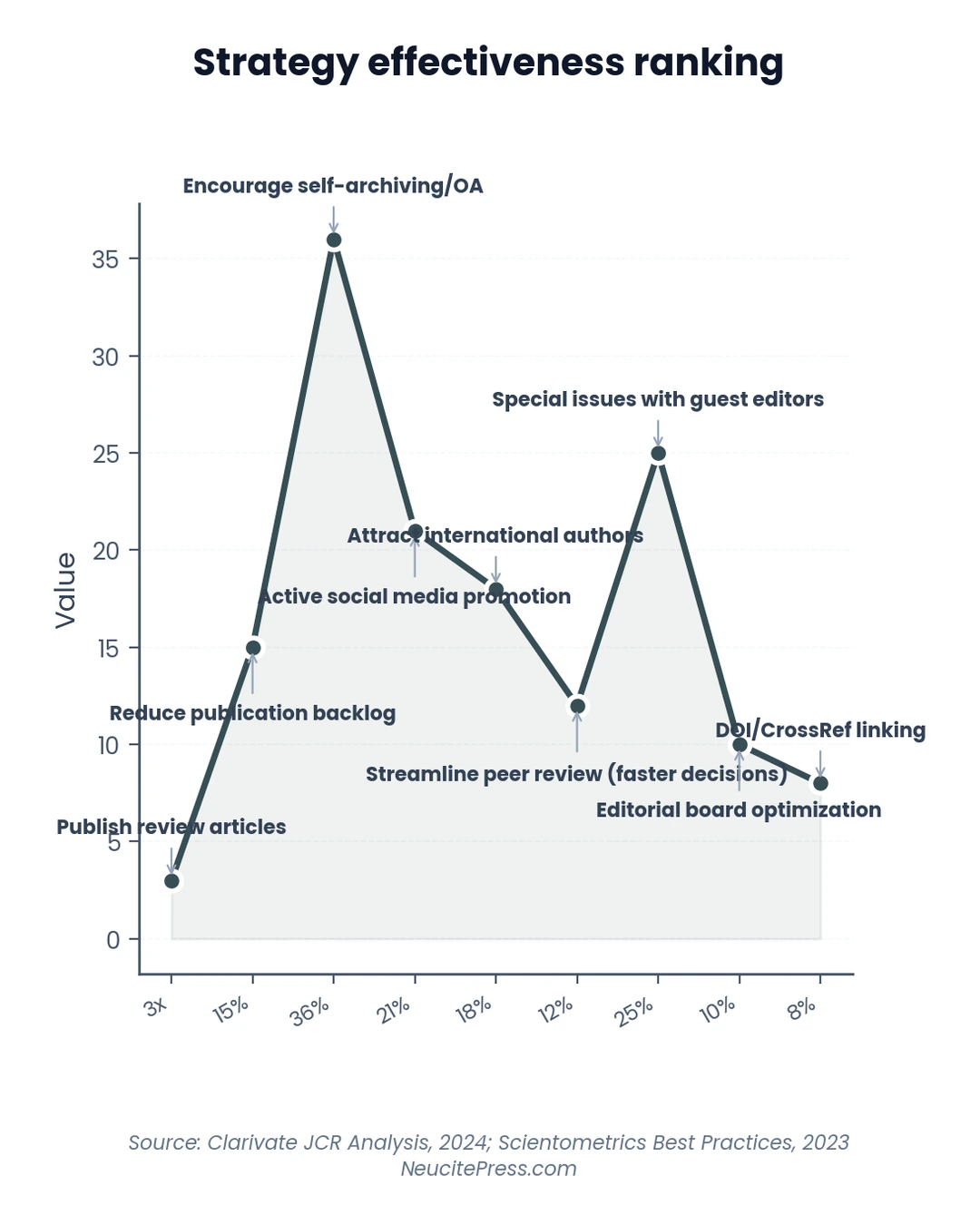
Research consistently demonstrates that freely available articles accumulate citations 30% faster than subscription-access alternatives. Open access also receives 50% more downloads, creating visibility benefits extending beyond citation metrics.
This doesn’t require eliminating subscription revenue. Hybrid open access models allow authors to pay publication fees unlocking immediate online access while subscription revenue continues for bundled journal packages. Many institutions budget specifically for open access publication fees, representing untapped author payment sources.
Negotiate with your hosting platform (typically Clarivate or Elsevier) for transparent open access conversion pricing. Standard rates range from $2,000-$5,000 per article depending on article type and journal prestige. Higher fees correlate with higher-impact journals.
Create open access arrangements with major funder organizations. NIH, European Research Council, and Wellcome Trust mandate open access for funded research. Establishing direct funding agreements reduces per-article conversion costs while guaranteeing consistent open access article volume.
Practical Implementation:
- Adopt hybrid open access model allowing both subscription and open access options
- Negotiate standard open access fees with your hosting platform
- Create dedicated open access landing pages for searchable discovery
- Deposit open access articles in PubMed Central and institutional repositories
- Market open access fees to authors during submission process
Strategy 4: Strategic Social Media Promotion and Scholarly Engagement
Social media engagement correlates positively with citation accumulation. Research demonstrates that articles receiving Twitter mentions within 14 days of publication show 18% higher citation probability. Strategic promotion extends article visibility far beyond traditional scholarly databases.
Develop a social media strategy specific to your journal’s research focus. Oncology journals succeed on Twitter where multiple cancer research communities share findings actively. Engineering journals perform better on LinkedIn where professional practitioners discover and implement innovations. Customize platform selection and messaging to your audience.
Create detailed content promotion workflows. For every accepted article, develop a tweet summarizing key findings in 140 characters, an Instagram visual highlighting the research, and a LinkedIn summary targeting professional practitioners. Distribute this content strategically across the author’s personal networks and your journal’s official accounts.
Encourage author self-promotion through acceptance email templates providing social media guidance. Authors represent your journal’s most powerful marketing channel. When authors share their published work with 500-2,000 personal connections, aggregate reach increases dramatically compared to journal-only promotion.
Establish partnerships with research organizations, professional societies, and university communications offices. These partners amplify your promotion efforts, exponentially increasing content reach within relevant research communities.
Practical Implementation:
- Create social media calendar planning promotions for all upcoming articles
- Develop template graphics for Twitter, Instagram, and LinkedIn featuring article highlights
- Include social media promotion guidance in acceptance notification emails
- Monitor social media mentions and track engagement metrics monthly
- Establish partnerships with 5-10 professional organizations in your research domain
Strategy 5: Cultivate Strategic Citation Networks with Influential Researchers
Citation networks exhibit well-documented preferential attachment patterns. Influential researchers cite their prior collaborators, research teams, and institutional affiliates at significantly higher rates than random chance. Strategic author recruitment targeting these citation-influential researchers generates measurable citation increases.
Actively recruit manuscripts from researchers whose prior work significantly influences your field. Identify the 30-50 most-cited researchers in your journal’s focus area using Google Scholar profiles. Personally invite submissions from these influential authors. Many accept invitations especially for review articles synthesizing their research domains.
Create special issue edited by respected leaders in your field. Guest editors bring their collaborators’ research, expanding your author base to citation-influential networks. Special issues typically generate 20-40% more citations than standard issues due to concentrated topical focus.
Establish editorial board appointments targeting researchers whose networks encompass influential publication bases. Editorial board members frequently submit their best work to journals where they serve in governance roles. This simple strategic positioning increases access to highly-cited research.
Practical Implementation:
- Identify and personally invite top 30 researchers in your field
- Create 2-3 special issues annually with influential guest editors
- Recruit editorial board emphasizing network reach and citation influence
- Track citations from recruited authors versus general submissions
- Document editorial board contribution to improved metrics
Strategy 6: Curate Special Issues Attracting High-Citation-Potential Research
Special issues focusing on emerging, trending, or crisis-response topics accumulate disproportionately high citations. Research on COVID-19 pandemics, artificial intelligence applications, and climate change impacts attracts intensive scholarly attention regardless of journal tier.
Develop special issue planning processes identifying emerging topics 18-24 months before peak research momentum. Topic selection requires balancing three variables: research community interest, publication volume potential, and strategic fit with your journal’s established scope.
Select guest editors strategically based on research networks and community influence. The right guest editor brings not just editorial expertise but existing relationships with 50+ potential contributors within emerging research subfields.
Market special issues aggressively through multiple channels. Promote in your journal’s website homepage, social media, professional conferences, and direct email to your author database. Special issue promotion typically runs 6-9 months ahead of publication deadline.
Plan special issue content to include a comprehensive review article synthesizing the emerging field, original research articles advancing the frontier, and perspective pieces from established leaders. Mixed content formats increase citation diversity while ensuring comprehensive topic coverage.
Practical Implementation:
- Establish special issues committee meeting quarterly to identify emerging topics
- Create 2-3 annual special issues with clear impact factor targets
- Recruit guest editors based on network reach and field prominence
- Develop social media campaign launching 6 months before submission deadline
- Monitor special issue citations separately to evaluate strategy effectiveness
Strategy 7: Expand International Author Diversity and Global Research Networks
Citation patterns correlate strongly with author geography. Research from well-represented geographic regions (North America, Western Europe, East Asia) receives higher citation rates. However, journals demonstrating international diversity in their author base expand potential citation networks exponentially.
Actively recruit manuscripts from emerging research hubs in Latin America, Africa, Southeast Asia, and Eastern Europe. These regions produce increasingly high-quality research while remaining underrepresented in many English-language journals. Featuring this research expands your citation reach into growing research communities.
Create language support programs assisting non-native English authors in preparing submissions. Language barriers represent a primary submission barrier for international researchers. Professional editing services or editorial staff providing feedback on language clarity reduce barriers while maintaining rigorous quality standards.
Establish partnerships with research organizations and universities in target geographic regions. These partnerships create awareness of your journal, facilitate researcher recruitment, and build lasting relationships with influential research institutions.
Develop special issues specifically highlighting research from specific regions or research networks. South Asia Research Initiative issues, African Continent Research Perspectives, or Latin American Research Innovations create opportunities for targeted recruitment while demonstrating geographic diversity commitment.
Practical Implementation:
- Recruit international editorial board members covering diverse geographic regions
- Create language support resources assisting international authors
- Establish partnerships with 10-15 universities in target regions
- Plan regional special issues on emerging research topics
- Track and publish author geographic diversity metrics
Strategy 8: Deploy Early Online Access Strategies for Maximum Discoverability
The traditional journal publishing model delays article publication 2-6 months following acceptance. During this interval, articles receive zero citations despite completing peer review. Early online access workflows dramatically compress this lag, extending the citation window.
Implement ahead-of-print systems publishing accepted articles as uncorrected proofs within 1-2 days of acceptance. While final proofs undergo copyediting, the article appears online with full search engine optimization (SEO) implementation. Many citations occur during this interval when article visibility peaks.
Coordinate ahead-of-print publication with social media promotion. Announce online publication through all platforms simultaneously, capturing authors and their networks at maximum attention levels. Optimal publication window for promotion occurs within 7 days of online publication.
Create RSS feeds enabling subscribers and search engines to discover ahead-of-print articles immediately upon publication. Integrate feeds with Google Scholar and Scopus APIs ensuring maximum discovery across academic databases.
Practical Implementation:
- Establish ahead-of-print publication workflow within 48 hours of acceptance
- Create comprehensive SEO optimization for all ahead-of-print articles
- Develop RSS feeds linking to ahead-of-print collection
- Coordinate social media promotion with ahead-of-print publication
- Monitor citation accumulation during ahead-of-print period versus formal publication
Strategy 9: Strategic Article Type Curation for Citation Potential
Different article types accumulate citations at dramatically different rates. Review articles synthesizing existing knowledge typically generate 3-5x more citations than original research in comparable fields. Understanding these patterns enables strategic content planning maximizing citation potential.
Develop editorial plans balancing article types strategically. Target 15-20% review articles, 70-80% original research, and 5-10% perspective pieces or editorials. Review articles focus editorial recruitment on recognized experts synthesizing recent developments. Perspective pieces feature prominent researchers commenting on research trends.
Create competitive review article processes where leading researchers propose comprehensive reviews of emerging topics. Competitive assignment ensures review articles address hot topics while featuring recognized expertise. These articles typically generate 100-300+ citations within 5 years.
Plan original research article selection emphasizing methodological rigor, statistical power, and interdisciplinary relevance. Multi-disciplinary research reaches broader audiences, accumulating citations from researchers outside the primary field. These articles frequently exceed traditional discipline-specific citation rates.
Consider short report formats creating rapid publication pathways for time-sensitive research. Crisis response, disease outbreak, or methodology development research warrants rapid publication even if articles are shorter than traditional research papers. Speed-to-publication dramatically increases citation potential for rapidly evolving topics.
Practical Implementation:
- Develop annual content calendar specifying article type distribution targets
- Recruit 5-10 review articles annually from recognized field leaders
- Monitor citation patterns by article type and adjust content strategies accordingly
- Create expedited publication pathways for time-sensitive original research
- Track contribution of different article types to overall impact factor calculation
Timeline Expectations and Realistic Impact Factor Goals
Realistic Timeframes for Impact Improvement
Building journal impact factors represents a multi-year process requiring patience and consistent execution. Editorial teams should anticipate specific timeline stages:
Years 1-2 (Web of Science Indexing Phase): Focus entirely on achieving Web of Science indexing. Strengthen editorial infrastructure, build international editorial board, implement systematic quality controls, and increase author recruitment efforts. No impact factor exists during this phase; optimization targets future readiness.
Years 3-5 (Initial Metric Collection Phase): Following indexing approval, the three-year mandatory wait before first impact factor score begins. During this critical period, publish only highest-quality research. Every article published in year 3 will be evaluated for your initial score. Maintain consistent article quality while building author base and citation visibility.
Years 5-7 (Initial Score and Early Growth): Your first impact factor typically appears in year 5-6 following indexing. This score reflects years 2-3 publication quality and citation accumulation patterns. Many journals see first scores of 0.8-2.5 depending on field and article quality. Expect 10-15% annual growth during this period as improved visibility and author recruitment bear fruit.
Years 7-10 (Sustained Growth Phase): Established journals implementing comprehensive strategies typically see 5-8% annual growth in years 7-10. Some journals achieve higher growth (15-20%) by entering prestigious journal cohorts and attracting citation-influential author networks.
Field-Specific Impact Factor Benchmarks
Impact factor benchmarks vary dramatically by discipline. Understanding realistic goals within your specific field prevents unrealistic expectations and inappropriate strategy adjustments:
Basic Biology Journals: Target range 4.5-8.0. These journals benefit from extensive citation networks within basic science research communities. Review articles generate 150-300+ citations. Original research typically achieves 20-50 citations.
Clinical Medicine Journals: Target range 2.5-5.0. Clinical research receives fewer citations than basic science due to smaller practitioner communities. High-quality clinical trials typically accumulate 30-80 citations.
Surgical Specialties: Target range 1.8-3.5. Specialized surgical journals face limited author bases and citation networks. Impact factors below 2.0 remain respectable for surgical sub-specialties.
Nursing/Allied Health: Target range 1.2-2.5. These journals serve primarily clinical practitioners. Citation patterns emphasize clinical applicability over theoretical contribution.
Engineering/Technology: Target range 1.5-3.0. Engineering journals emphasize practical innovation. Citation patterns differ fundamentally from basic science disciplines.
Interdisciplinary/Multidisciplinary: Target range 3.5-6.0. Broader scopes attract diverse author bases and citation networks. Interdisciplinary research achieves higher citation rates through multi-discipline impact.
Using Realistic Targets for Strategic Planning
Set strategic targets based on your journal’s current field position and competitive environment. New journals should target 50% of established journal medians within 7-10 years. Established journals should target 10-15% annual growth as realistic and sustainable.
Avoid artificial optimization strategies creating short-term metrics gains while damaging long-term credibility. Self-citation strategies, citation manipulation, or selective article rejection to artificially inflate metrics violate ethical standards and risk losing Web of Science indexing.
Track monthly performance against quarterly strategic targets. Comprehensive dashboard systems monitoring review speed, article quality metrics, author diversity, social media engagement, and citation accumulation enable data-driven decision-making.
Ethical Considerations and Sustainable Growth
The scholarly publishing industry has witnessed increasing scrutiny of questionable practices designed to artificially inflate impact factors. Editorial teams must navigate the tension between maximizing metrics and maintaining research integrity.
Predatory Practices to Avoid
Self-citation manipulation artificially increases metrics by selectively citing prior articles from your journal. Clarivate monitors journal self-citation rates closely. Journals with >35% self-citations face editorial concerns and potential indexing review. Maintain self-citation rates below 15% through careful editor monitoring.
Citation cartels involving mutual journal citation agreements between editors inflate all participant journals’ metrics. These arrangements violate COPE (Committee on Publication Ethics) standards and can result in indexing loss and editorial sanctions.
Selective article acceptance/rejection based on predicted citation potential creates false impression of publication quality. Editorial decisions should emphasize methodological rigor and scope fit rather than citation predictions.
Publication of duplicate or overlapping content from single author/lab distributes identical findings across multiple articles, fragmenting discovery while artificially increasing author publication counts.
Ethical Impact Factor Development
Sustainable impact factor improvement follows these core principles:
- Publish only research meeting rigorous quality standards regardless of predicted citation impact
- Make editorial decisions based on methodological rigor and scope fit, not bibliometric predictions
- Maintain self-citation rates below 15% and monitor citation patterns regularly
- Encourage author diversity and geographic representation genuinely reflecting research quality
- Implement transparent policies regarding plagiarism, conflict of interest, and research ethics
- Report all metrics accurately to Clarivate and supporting platforms
The DORA initiative emphasizes that research impact extends far beyond citation counts. Community benefit, methodological innovation, and theoretical contribution matter profoundly even when citation accumulation lags behind discipline norms.
Building long-term credibility through ethical practices creates sustainable impact factor improvements while protecting your journal’s reputation and editorial integrity.
Measuring Progress and Interpreting JCR Reports
Understanding Your Journal Citation Reports
When your first JCR impact factor appears, understanding the included data ensures appropriate interpretation and strategy refinement. The standard JCR report includes:
Impact Factor: Total 2-year citations divided by number of articles published. This single metric receives disproportionate attention but represents only one dimension of journal performance.
5-Year Impact Factor: Longer window providing more stable metrics less susceptible to single-year publication fluctuations. Many journals see higher 5-year scores as earlier work accumulates additional citations.
Immediacy Index: Average citations received per article in the year of publication. This metric reveals publication importance within current research discourse. High immediacy indicates rapidly-adopted research while low scores suggest longer-term citation accumulation patterns.
Cited Half-Life: Years required for cited articles to accumulate 50% of total citations. Basic science journals typically show 7-10 year half-lives as foundational work receives long-term citation. Clinical journals often show 3-5 year half-lives as research becomes outdated more rapidly.
Article Influence Score: Citation impact per article adjusted for journal prominence. High article influence scores indicate your articles significantly influence broader research communities beyond raw citation counts.
Eigenfactor Score: Weighting citations based on prestige of citing journals. This metric recognizes that citations from high-impact journals carry greater algorithmic weight than citations from lower-impact publications.
Monitoring Monthly Performance Metrics
While official JCR metrics update annually, internal monitoring systems should track performance monthly to enable real-time strategy adjustments:
Track actual citations to articles published in the reference years for your next JCR score update. If your 2025 impact factor will be calculated in 2026, monthly tracking of citations to 2024-2025 articles enables proactive strategy refinement.
Monitor acceptance rates, rejection rates, and time-to-publication metrics identifying bottlenecks. Editorial workflow analysis frequently reveals efficiency opportunities invisible without systematic measurement.
Analyze author demographics tracking geographic diversity, institutional representation, and emerging author representation. Intentional author recruitment targeting underrepresented regions requires baseline metrics.
Measure social media engagement for published articles tracking Twitter mentions, LinkedIn shares, and website traffic. These metrics predict citation accumulation patterns 3-6 months ahead of actual citation data.
Track reviewer response rates, reviewer comment quality, and editor decision consistency. Weak peer review systems emerge through systematic tracking of these quality metrics.
Creating action plans based on these monthly metrics enables continuous improvement rather than waiting for annual JCR reports to identify performance issues.
Conclusion and Implementation Framework
Improving your journal’s impact factor requires systematic implementation of comprehensive strategies emphasizing both editorial excellence and strategic promotion. The nine proven strategies outlined in this guide—editorial excellence, review speed optimization, open access expansion, social media promotion, citation network cultivation, special issue curation, international author recruitment, early online access, and strategic article type selection—provide a complete roadmap for sustainable growth.
Success requires patience and consistent execution. New journals should anticipate 5-7 years before achieving meaningful impact factor improvements. Established journals implementing multiple strategies simultaneously typically see 10-15% annual growth within 3-5 years.
Prioritize implementation sequentially rather than attempting all strategies simultaneously. Begin with foundational editorial excellence improvements creating the quality baseline upon which all other strategies depend. Progress to promotion and visibility strategies amplifying your strongest research.
Avoid shortcuts and ethical compromises. Long-term journal success depends on earning researcher respect through genuine quality, not manipulating metrics or adopting predatory practices.
Download our complete editorial planning toolkit and strategic implementation checklist. Subscribe to our publishing insights newsletter for ongoing guidance. Share this resource with colleagues facing similar journal development challenges.
Your journal’s scholarly impact represents more than metrics—it represents the collective contributions of thousands of researchers advancing human knowledge. Strategic focus on sustainable growth ensures your journal meaningfully serves your research community while building lasting credibility within the academic landscape.
Professional Note: All strategies should comply with your publisher’s policies and ethical guidelines established by COPE (Committee on Publication Ethics). Specific implementation approaches may require adjustment based on your journal’s unique circumstances, field discipline, and institutional context.
As publishing research confirms: “The scientific content of work matters more than any single metric.” Systematic application of these evidence-based approaches will progressively strengthen your publication’s scholarly influence and research community impact.