How to Turn Your PhD Thesis Into a Published Book: Expert Guide
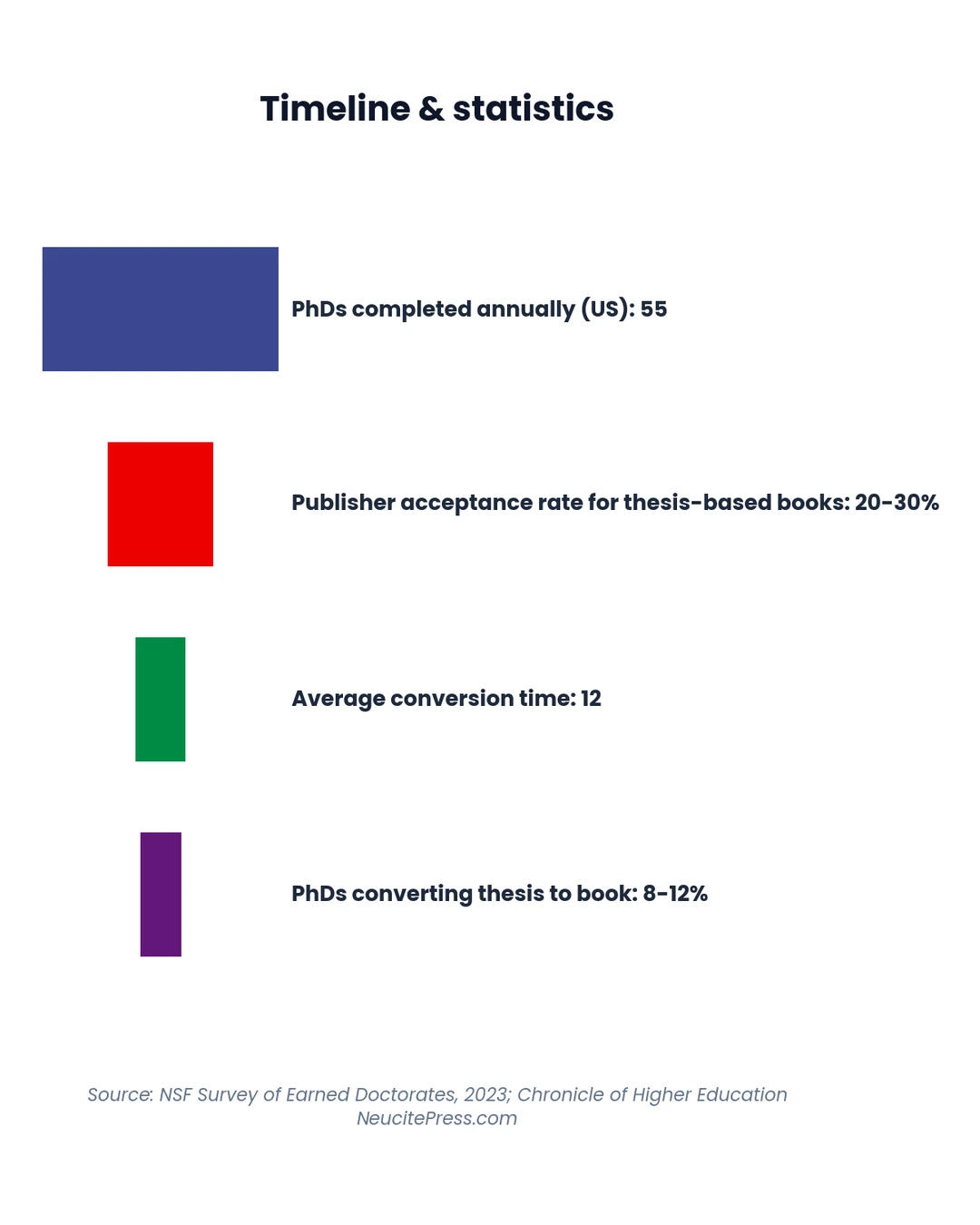
Your PhD thesis represents years of dedicated research and intellectual investment. Yet fewer than 15% of completed dissertations ever become published books, despite containing groundbreaking insights that could transform your field. If you’re asking yourself “how do I turn my PhD thesis into a published book?”, you’re not alone—this is one of the most important questions scholars face after completing their doctoral work.
Reviewed by the NeucitePress Editorial Board — PhD academics, peer-reviewed editors and subject-matter specialists.
The good news: your dissertation isn’t the finished product. It’s raw material for something even more powerful. Unlike a thesis designed to prove qualification to a committee of 3-5 experts, a published book must captivate hundreds or thousands of readers across institutions, disciplines, and career levels. This transformation requires strategic reconceptualization, not just editing.
This comprehensive guide walks you through the entire journey from thesis to published book. Based on insights from senior academic publishers and successful authors, we’ll show you exactly what changes, when to start, how long it takes, and how to avoid the common pitfalls that derail most first-time authors.
Why Transform Your Thesis Into a Book?
Beyond the obvious prestige of having a published book on your CV, several compelling professional benefits justify the substantial time investment required.
Career Advancement and Institutional Recognition
Academic hiring committees and promotion panels increasingly value book publications alongside journal articles. A published monograph signals that your research has survived rigorous peer review and commercial viability assessment—a double validation that journal articles alone cannot provide.
For scholars in the humanities and social sciences, a book publication often becomes the flagship credential that distinguishes candidates. In STEM fields where books are less common, a published volume demonstrates your ability to synthesize complex research into accessible, comprehensive frameworks.
Beyond hiring and promotion, books establish you as a thought leader. Publishers invest in marketing, and successful books generate speaking invitations, consulting opportunities, and collaboration requests that simply don’t come from dissertation chapters alone.
Expanding Your Research Impact and Influence
A book reaches different audiences than a journal article. While your specialized journal publication might be read by 200-500 researchers in your narrow field, a well-marketed scholarly book can reach 2,000-5,000+ readers including advanced students, practitioners, and scholars from adjacent disciplines.
Books also have longer shelf lives than journal articles. They’re assigned in graduate seminars, quoted in textbooks, and referenced decades after publication. The accumulated citation impact often exceeds that of any single journal article.
Perhaps most importantly, books allow you to address the “so what?” question that many dissertation readers silently ask. A book format lets you explore implications, applications, and broader significance in ways that academic journals’ tight formatting constraints simply don’t permit.
Understanding Thesis vs. Book: The Critical Differences
Before diving into the mechanics of transformation, you need to understand what makes a book fundamentally different from a dissertation. These aren’t just formatting differences—they’re genre differences that require reconceptualizing your entire project.
Purpose and Audience
Your dissertation proves mastery to a small, expert committee. These readers are evaluating whether you’ve done sufficient original research to merit a doctoral degree. They already understand your field, your methodology, and your literature. Your job is to demonstrate technical competence and scholarly rigor.
Your book must engage a much broader audience. Readers might be graduate students encountering your topic for the first time. They might be scholars from adjacent fields seeking relevant insights. They might be practitioners asking how your research applies to real-world problems. They’re not evaluating your qualification—they’re deciding whether your book is worth their limited reading time.
This audience difference changes everything about structure, voice, and emphasis.
Structure and Organization
Dissertations typically follow a standardized structure: introduction with literature review, methodology section, then sequential chapters of findings. This structure serves the thesis’s purpose—proving you understand existing scholarship and conducted original, rigorous research.
Books often reorganize this material entirely. Many successful academic books move from problem/question to solution/answer. Others reframe the dissertation’s chapters as progressively deepening explorations of a central argument. Some extract key insights and present them non-sequentially, organized by practical application rather than research methodology.
The opening chapter is a perfect example. Where a dissertation introduction might spend 40-50 pages on literature review and gap identification, a book introduction typically spends 10-15 pages establishing what readers will learn and why it matters to them.
Scope and Focus
Most dissertations are too long. They include comprehensive literature reviews, exhaustive methodology sections, and appendices of data that served your degree requirements but obscure your central argument for book readers.
Successful book conversions typically cut 15-25% of dissertation content. This isn’t because the content was bad—it’s because the book format demands laser focus on your core contribution. Specialized appendices become supplementary online materials. Tangential literature reviews become single paragraphs. Secondary findings become footnotes or disappear entirely.
Writing Voice and Audience Engagement
Dissertation writing emphasizes caution and comprehensiveness. You hedge claims, acknowledge limitations extensively, and demonstrate that you’ve considered counterarguments. This defensive posture serves dissertation purposes but alienates book readers who want authoritative guidance.
Successful authors shift toward confident expert voice. Instead of “While limitations suggest caution in generalization,” you write “This evidence demonstrates.” You maintain scholarly rigor while sounding like someone readers want to learn from.
This doesn’t mean abandoning scholarship—it means rebalancing. A book addresses readers’ likely questions directly rather than anticipating examiner objections.
The Complete Transformation Roadmap: How to Turn Your Thesis Into a Book
Now let’s walk through the actual process. Most successful transformations follow this sequence.
Phase 1: Strategic Reconceptualization (Weeks 1-4)
Step 1: Identify Your Core Argument in One Sentence
Before touching your manuscript, distill your entire project into a single compelling sentence. Not a summary—a sentence that captures what changes in your field, what readers will know or be able to do after reading your book.
Weak: “This book examines how social media platforms shape political discourse.”
Strong: “This book reveals how algorithmic content curation has fundamentally altered the mechanisms of political persuasion, with actionable implications for democratic institutions.”
That one sentence becomes your north star. Every chapter, section, and paragraph either advances this argument or gets cut.
Step 2: Define Your Actual Target Audience
Don’t say “scholars in my field.” Be specific. Are you targeting PhD students early in their career? Established researchers seeking new frameworks? Practitioners wanting research-informed guidance? Faculty members teaching graduate seminars?
Different audiences require different emphasis. If your primary audience is graduate students, you’ll need more foundational material and clearer explanations. If your audience is practitioners, you’ll need more application-focused sections and less methodological detail.
Research this audience concretely. What journals do they read? What conferences do they attend? What professional challenges do they face that your research addresses?
Step 3: Develop Your Unique Value Proposition
What does your book offer that existing books don’t? This isn’t about claiming originality—it’s about articulating your distinctive perspective or approach.
Maybe you synthesize previously disconnected research areas. Maybe you present methodology rarely applied in your field. Maybe you offer longitudinal evidence where previous work relied on cross-sectional data. Maybe you introduce international perspectives underrepresented in Anglophone scholarship.
Your value proposition becomes central to your proposal and marketing. Publishers need to understand what makes your book different in 2-3 sentences.
Phase 2: Structural Reconstruction (Weeks 5-12)
Step 4: Redesign Your Chapter Architecture
Lay out your dissertation chapter titles and ask: would a reader unfamiliar with academic conventions understand what each chapter is about? Would a general scholar in your field find a logical progression?
Most dissertations need significant restructuring. Common improvements:
- Combine several short chapters into cohesive argument units
- Split overstuffed chapters into clearer, more focused sections
- Reorder chapters to move from reader interest and practical relevance rather than research methodology
- Extract literature review from the introduction and distribute relevant context throughout chapters
- Create new bridging chapters that connect dissertation findings to broader implications
Step 5: Develop New or Revised Chapter Openings
Each dissertation chapter typically opens with research questions, literature positioning, or methodology. Book chapters should open by answering “why does this chapter matter to me as a reader?”
Effective chapter openings often:
- Pose a practical problem your chapter addresses
- Preview the key insight readers will gain
- Connect to themes established in previous chapters
- Speak directly to reader interests and concerns
Step 6: Audit and Edit for Inclusivity
Review your language for unnecessary jargon and over-reliance on field-specific terminology. A good test: could an intelligent graduate student from an adjacent discipline follow your arguments?
Dissertations often include terminology and references that felt necessary for your committee but confuse broader readers. Replace with clearer language or add brief explanations where specialized terms are essential.
Phase 3: Content Revision and Enhancement (Weeks 13-24)
Step 7: Expand Application and Implications
A common weakness in dissertation-to-book conversions: insufficient discussion of why the research matters beyond academic interest. Book readers ask “so what?” more insistently than committees do.
Identify opportunities to expand implications sections. What does your evidence suggest about policy, practice, or future research? Who outside academia should care about your findings? What real-world problems does your research illuminate?
Step 8: Strengthen Your Evidence Presentation
Dissertation tables and figures often prioritize exhaustiveness over clarity. Review each data presentation: does it advance your argument? Could it be simpler? Would a visualization improve comprehension?
Create new figures and tables specifically for your book audience, emphasizing key findings rather than comprehensive methodology displays.
Step 9: Develop Stronger Narrative Thread
Dissertations are defensible documents. Books are compelling stories. Rewrite your transitions between sections to build narrative momentum rather than just list topics sequentially.
Each chapter should flow toward the next. Each section should build on previous sections. Your conclusion should feel inevitable rather than summarized.

Phase 4: Publishing Path Selection (Weeks 25-28)
Step 10: Decide Between Academic and Trade Presses
University presses are the traditional home for academic books. They’re prestigious, peer-reviewed, and highly credible. However, they have narrow audience expectations and expect specialized rather than general interest books.
Trade presses sometimes accept academic books with broad appeal. They’re better at marketing and distribution but offer lower advances and may pressure you to make content more accessible than you’re comfortable with.
Many successful academic authors now consider hybrid publishers or self-publishing with professional services. These paths offer more control and potentially faster timelines, though with different credibility assumptions.
Step 11: Research Target Publishers
Don’t submit to random publishers. Identify presses that regularly publish books in your field, have published similar books recently, and market to your target audience.
Read recent books from your target publisher. Contact acquisitions editors to discuss your project before investing months in proposal writing. Publishers appreciate serious inquiry and often provide valuable feedback that improves your chances.
Phase 5: Proposal Development (Weeks 29-40)
Step 12: Write Your Book Proposal
A complete proposal typically includes: executive summary (1 page), chapter outline (3-5 pages), market analysis (2-3 pages), author biography (1 page), comparable titles analysis (2-3 pages), and 1-2 sample chapters (25-40 pages).
Your proposal should argue not just that your research is good, but that there’s an identifiable market of readers who will buy this book. Include specific numbers: how many people work in this field? How many graduate programs teach this topic? What’s the annual publication rate for competing titles?
Publishers want evidence of your author platform. If you have 5,000+ Twitter followers in your field, mention it. If you’ve published journal articles from this research, note their citation impact. If you’ve given talks that generated interest, document audience response.
Step 13: Obtain Letters of Support (Optional but Powerful)
Strong endorsement letters from senior scholars significantly improve proposal acceptance rates. Approach 1-3 scholars who are well-known in your field, have published relevant work, and can credibly endorse your book’s significance.
Make their job easy: explain clearly why you’re asking them, outline your book’s core argument and contribution, and give them specific talking points about why this book matters.
Phase 6: Publisher Submission and Review (Weeks 41-52+)
Step 14: Submit to Publishers
Follow submission guidelines exactly. Simultaneous submissions to multiple publishers are acceptable and often necessary—just notify each publisher if you receive an offer elsewhere.
Publishers typically respond within 6-8 weeks with their initial assessment. Some will desk reject immediately. Others will send your manuscript to 2-3 external peer reviewers, a process taking 6-12 weeks. A few will immediately offer development contracts.
Step 15: Respond to Reviewer Comments
If reviewers request revisions, don’t be discouraged—it’s normal and often improves your final book. Create a detailed response letter addressing each comment, explaining what you changed and why.
Some requests you’ll disagree with. That’s okay. Explain your reasoning, but be prepared to compromise on points that don’t affect your core argument.
Timeline Expectations: How Long Does It Really Take?
Most authors underestimate the timeline required. Here’s what to expect:
- Reconceptualization: 1-2 months — Understanding how your thesis needs to change
- Restructuring and rewriting: 4-8 months — The core work of transformation
- Revision and enhancement: 2-4 months — Responding to feedback from beta readers
- Proposal development: 4-6 weeks — Writing and refining your submission package
- Publisher review: 3-6 months — Initial assessment and peer review
- Revisions based on feedback: 2-4 months — Making changes publishers request
- Copyediting and production: 3-4 months — After acceptance before publication
Total timeline: typically 18-36 months from starting concept to published book.
This assumes you’re working on this alongside other academic responsibilities. If you can dedicate substantial time, you might compress this to 12-18 months. If you’re doing this as a secondary project, 24-36 months is more realistic.
Navigating Common Pitfalls and Mistakes
Mistake 1: Minimal Revision Approach
The most common error is treating the book as a slightly polished dissertation. Authors who submit with only surface-level edits face rejection rates exceeding 85%. Publishers immediately recognize work not reconceived for broader audiences.
Solution: Budget 200-400 hours for strategic revision beyond basic editing. This is where your book succeeds or fails.
Mistake 2: Failing to Reduce Word Count
Dissertations rarely compress into good books without cutting. Attempting to preserve every argument, evidence snippet, and methodological detail dilutes your narrative.
Solution: Aim to cut 15-25% of your dissertation word count. Let your core argument guide what stays.
Mistake 3: Inadequate Market Analysis
Proposals that claim “anyone interested in X will buy this book” fail immediately. Publishers need numbers: how many people teach in this area? What’s the addressable market size? How many comparable books sell annually?
Solution: Research your market thoroughly. Look at Amazon rankings for comparable titles, examine university press catalogs, review conference attendance figures.
Mistake 4: Wrong Publisher Selection
Submitting to presses that rarely publish in your field wastes everyone’s time. Your book might be excellent but not aligned with a particular publisher’s list.
Solution: Identify 5-10 target publishers that actively publish relevant books. Read their recent catalogs. Contact acquisitions editors informally first.
Mistake 5: Underestimating Timeline
Authors who expect to finish in 6 months typically abandon projects when reality takes twice that long. Realistic timelines reduce burnout and improve final quality.
Solution: Plan for 18-24 months minimum. Build in buffers for unexpected delays.
Financial Realities: Budgeting Your Transformation
Professional transformation requires investment. Here’s what to budget:
- Developmental editing: $2,000-5,000 (highly recommended for first-time authors)
- Copy editing: $1,000-2,500 (if self-publishing; publishers include this)
- Cover design: $500-2,000 (self-publishing only)
- Indexing: $500-1,500
- Market research: $0-500 (book sales databases, publisher catalogs, etc.)
- Marketing and distribution: $1,000-5,000+ depending on your promotional efforts
University presses handle editing, design, and production at no cost to you. Your investment is time. Trade publishers may offer advances to offset costs. Self-publishing requires the most upfront investment but gives maximum control.
Most authors recoup publishing costs through book sales only if they actively promote their work and reach 1,000+ readers.
Success Stories and Strategic Tips From Published Authors
Tip 1: Build Your Platform Before You Publish
Authors with established platforms—whether journal publications, speaking experience, or social media presence—have significantly higher acceptance rates. If your proposal mentions “I’m presenting findings at three major conferences this year” or “I have two peer-reviewed articles from this research already published,” your chances improve dramatically.
Tip 2: Write Your Book for Today’s Readers, Not Tomorrow’s
Avoid the temptation to endlessly update your manuscript to include latest research. At some point, it’s finished. Published books inevitably contain research slightly dated by publication time—readers understand this. Forward momentum matters more than perfect currency.
Tip 3: Collaborate With Your Acquisitions Editor
If a publisher expresses serious interest, their acquisitions editor becomes your partner. Share early drafts, ask for feedback, respond to suggestions seriously. Publishers invest in books they believe in, and your collaborative engagement signals commitment.
Tip 4: Don’t Underestimate Post-Publication Marketing
Your book’s first sales come from your network. Identify everyone who should know about your book: colleagues in your field, anyone you’ve collaborated with, your Twitter/LinkedIn followers, conference attendees, institutions where you’ve given talks. Let them know when your book releases.
Tip 5: Preserve Your Original Dissertation
Your dissertation was a significant accomplishment. Don’t erase it trying to turn it into a book. Many successful authors preserve their dissertation in institutional repositories while simultaneously publishing a reconceived book version. Both serve different purposes and audiences.
Final Advice: Starting Your Transformation Journey
Transforming your PhD thesis into a published book is one of the most rewarding professional projects you can undertake. It requires patience, strategic thinking, and willingness to reconceptualize work you’ve already invested years in—but the payoff extends far beyond your CV.
A published book establishes you as a thought leader in your field. It reaches audiences your dissertation never will. It creates lasting intellectual impact that compounds over years of citations and classroom use.
The path isn’t easy, and the statistics are sobering—only 15% of dissertations become books. But that statistic doesn’t reflect research quality. It reflects authors who either never start the transformation or who approach it without understanding the fundamental reconceptualization required.
You’re already ahead if you understand that a book isn’t a edited dissertation. You’re ahead if you’re willing to invest 200-400 hours in strategic revision. You’re ahead if you approach the process with clear understanding of what publishers want, what readers need, and what your research uniquely contributes.
The authors whose dissertations successfully become books share one characteristic: they treat the transformation as a distinct project, not as editing. They reconceive their core argument for new audiences. They cut ruthlessly. They rebuild their manuscript from strategic principles rather than derivative logic.
If that’s the approach you’re ready to take, your dissertation can absolutely become a published book that influences your field for decades.