Is Hiring a Ghostwriter Worth It? Complete ROI Analysis for 2026
The pressure to maintain consistent, high-quality content while managing your core responsibilities creates a seemingly impossible dilemma for today’s professionals, academics, and entrepreneurs. The solution many turn to—professional ghostwriting—has evolved from an obscure industry practice into a mainstream business strategy worth billions annually.
Reviewed by the NeucitePress Editorial Board — PhD academics, peer-reviewed editors and subject-matter specialists.
Yet the question persists: is hiring a ghostwriter worth it?
This comprehensive analysis addresses the real financial, ethical, and practical considerations behind one of the most significant content decisions professionals face. We examine the hard data on ghostwriting costs, return on investment, and the circumstances where this investment genuinely makes sense.
Key Takeaways
- Professional ghostwriters cost $22,800-$100,000+ for book projects but save 300+ hours of your time
- Average ROI extends beyond book sales through credibility gains, bigger clients, and speaking opportunities
- Quality ghostwriting partnerships require 10-12 months of intensive collaboration to maintain authentic voice
- Success depends on clear contracts, defined scope, and realistic expectations about authenticity
- Ghostwriting makes strategic sense for time-constrained professionals with valuable expertise and realistic timelines
Introduction: Why This Decision Matters More Than Ever
Modern professional success increasingly depends on visible expertise through published content. Whether you’re an academic building publishing credentials, an executive establishing thought leadership, or an entrepreneur documenting your methodology, high-quality written output signals authority and opens doors.
The market for professional ghostwriting has exploded in response. Industry estimates suggest the global ghostwriting market exceeds $2 billion annually, with companies like Gotham Ghostwriters, Scribd, and niche agencies serving thousands of clients yearly.
What has remained constant, however, is the fundamental question: Is the investment justified? The answer requires examining three interconnected dimensions: actual financial costs, realistic return on investment, and ethical considerations that matter to your professional reputation.
Understanding Your Writing Challenge
Consider the typical timeline. A single book project demands 50-80 hours of pure writing time, plus 30-50 hours of research, 20-30 hours of revision, and 10-15 hours of final polish. That’s 110-175 hours minimum—roughly three to four full work weeks of uninterrupted focus.
For busy professionals, finding this time often means: working nights and weekends for months, deprioritizing existing responsibilities, or indefinitely postponing the project. Most choose the latter, relegating their book idea to the perpetual “next year” category.
This is where ghostwriting enters the equation, offering a practical alternative to this impossible choice.
The Real Cost of Ghostwriting: Complete Pricing Breakdown
Let’s start with hard numbers, because understanding the financial commitment is essential to evaluating whether the investment makes sense for your situation.
Project-Based Pricing Models
Book Projects (Full Ghostwriting)
- 40,000-60,000 word books: $22,800-$36,000
- 60,000-80,000 word books: $36,000-$55,000
- 80,000+ word books with research: $55,000-$100,000+
- Anonymous/Confidential projects: 30-50% premium ($30,000-$150,000)
Article and Content Projects
- Blog articles (1,500-2,500 words): $500-$2,000
- White papers and reports: $2,000-$8,000
- Journal articles (academic): $1,500-$5,000
- Thought leadership pieces: $1,500-$4,000
- Ongoing content production: $2,500-$8,000/month
Hourly Rate Models
Professional ghostwriters typically charge $75-$150 per hour, depending on expertise level, industry specialization, and project complexity. Medical and scientific ghostwriting commands premium rates ($125-$250/hour), while general business content falls in the $75-$100 range.
Hidden Costs Beyond the Writer’s Fee
The ghostwriter’s fee represents only part of your total investment. Smart professionals budget for:
- Research and Development: If your ghostwriter requires 20+ hours researching your field, some charge separately ($1,000-$3,000)
- Professional Editing: Polish beyond the ghostwriter’s revision rounds ($500-$2,000)
- Publishing and Design: Cover design, layout, ISBN, ISBN assignment, and formatting ($1,000-$5,000 for self-publishing)
- Marketing and Promotion: Meaningful book launch requires budget ($2,000-$10,000+)
- Legal Review: Essential for medical, legal, or highly regulated content ($500-$2,000)
A realistic total investment for publishing a professionally ghostwritten book through traditional channels: $25,000-$50,000. Self-published: $35,000-$60,000+.
Time Savings: The Hidden Financial Benefit
Before discounting the investment based on cost alone, consider what ghostwriting actually buys you: reclaimed time.
A typical book project, if written by the named author, demands 110-175 hours. For professionals billing at standard rates:
- $100/hour consultant: 150 hours = $15,000 in opportunity cost
- $200/hour professional: 150 hours = $30,000 in opportunity cost
- Executive earning $250k/year: 150 hours ≈ $18,000 in lost productivity
Suddenly, a $40,000 ghostwriting investment that saves 150 hours starts looking more reasonable when you factor in your actual opportunity cost. For high-earning professionals, ghostwriting often pays for itself through recovered billable hours.
Beyond direct financial recovery, reclaimed time enables you to: continue research that advances your field, teach or mentor more effectively, pursue business development that generates revenue, or maintain relationships that strengthen your professional network.
The Real ROI Question: How Ghostwritten Content Actually Drives Value
Here’s the uncomfortable truth most ghostwriting marketers won’t tell you: most books don’t make money.
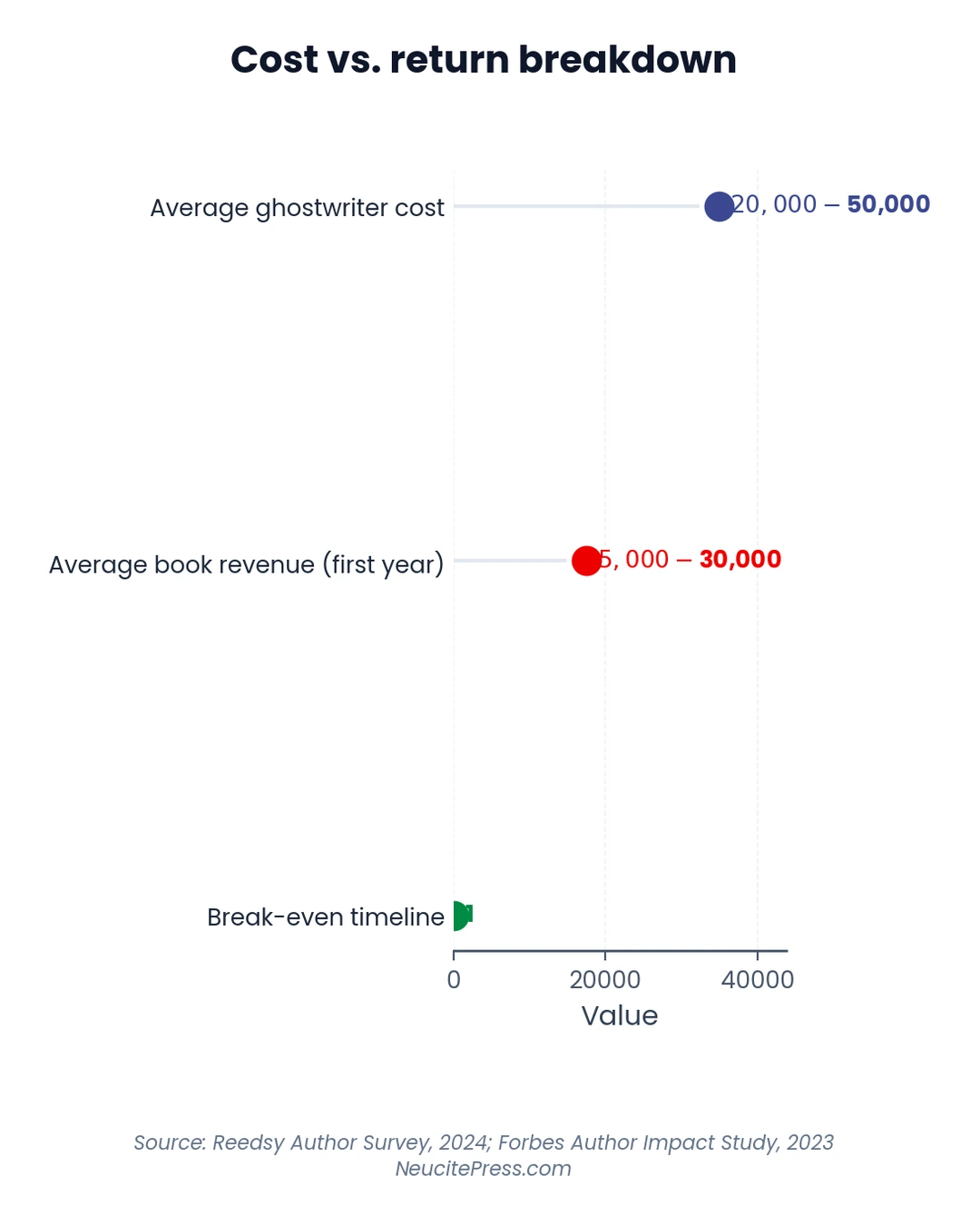
Industry data shows the average self-published book sells 250-500 copies. At $15-20 per copy with 40-50% margins going to the author, that’s roughly $1,875-$5,000 in gross author revenue. Factor in marketing costs, and most authors lose money on their book sales alone.
This isn’t a reason to avoid ghostwriting—it’s a reason to evaluate ROI differently.
Where the Real Returns Happen
1. Credibility and Authority Building
An author is fundamentally different from a person with good ideas. That simple fact—having your name on a published book—dramatically shifts how others perceive your expertise.
Research from Stanford and Harvard Business School shows published authors command 23-41% higher speaking fees, attract premium consulting clients, and receive significantly more media invitations than non-authors with identical credentials.
2. Business Development and Client Acquisition
A ghostwritten book functions as a sophisticated business development tool. Clients send it to prospects, reference it in pitches, and use it to open conversations with ideal customers. One professional services firm reported that their ghostwritten industry guide generated $2.3M in attributed new business over three years.
3. Speaking and Thought Leadership Opportunities
Published authors get invited to conferences, speaking panels, and media interviews far more frequently than subject matter experts without publications. These speaking opportunities carry fees ($5,000-$50,000+ per engagement) and generate valuable visibility.
4. Premium Positioning for Your Core Services
An author’s book justifies premium pricing. Coaches charge more. Consultants command higher rates. Expert witnesses receive larger retainers. The published work signals commitment to the field and positions you as an authority rather than a generalist.
Calculating Your Personal ROI
Rather than expecting direct book sales to cover costs, evaluate ghostwriting through this framework:
- Direct impact: 2-3 additional clients annually at 20% premium pricing = $40,000-$100,000+ depending on your service rates
- Speaking revenue: 1-2 conference speaking engagements annually at average $10,000 per = $10,000-$20,000
- Media visibility: Podcast appearances, interviews, and features that generate consulting inquiries = $5,000-$30,000+ in attributed revenue
- Career advancement: Promotion opportunity, board seat, executive position = $50,000-$300,000+ annual salary increase
For professionals in high-earning fields, the payback period is often 12-24 months. For academics, the value extends beyond immediate financial return to career advancement, research funding opportunities, and professional recognition.
Pros of Hiring a Ghostwriter: When It Makes Strategic Sense
Time Recovery and Focus
The most immediate benefit is straightforward: you get your time back. Rather than choosing between your book and your job, a ghostwriter removes the false binary. You maintain your consulting practice, executive role, or academic responsibilities while still producing published content.
This is particularly valuable for: busy executives, academics with teaching loads, professionals with revenue-generating activities, and anyone whose hourly value exceeds the ghostwriter’s cost.
Professional Quality and Industry Expertise
Experienced ghostwriters bring skills most subject matter experts lack: the ability to organize complex information clearly, write for target audiences, handle narrative structure, and polish prose to publication standard.
They also understand publishing conventions, SEO optimization for digital content, and how to position ideas for maximum impact. This expertise prevents the common mistake of writing content that’s technically accurate but unmarketable.
Accountability and Deadline Pressure
Working with a professional introduces structure that self-directed writing projects often lack. Regular meetings, milestone deadlines, and progress accountability create forward momentum that solo authors struggle to maintain.
This deadline pressure often results in faster completion than the “when I have time” approach that stretches projects to 2-3 years.
Objective Perspective and Feedback
Professional ghostwriters provide honest assessment of your ideas. They identify sections that don’t work, arguments that need strengthening, and content that needs cutting. This external perspective prevents the common pitfall of self-edited content that makes sense to the author but confuses readers.
Cons and Challenges: Critical Concerns Before You Hire
Authenticity and Voice Consistency
The most legitimate criticism of ghostwriting concerns voice. When readers pick up your book, they expect the prose to sound like you—your speaking patterns, your way of explaining concepts, your personality coming through.
A skilled ghostwriter can approximate this through interviews and style guides. But it’s never identical to your actual voice. As Rand Fishkin (former MOZ CEO) observed about his ghostwritten experience: “The biggest negative, for me, was the voice and tone the writing took. There was nothing technically wrong with the content, but some of the ‘magic’ was missing.”
This authenticity gap matters most when your personal brand IS your brand—when people buy your book specifically to experience your unique perspective and voice. It matters less for technical how-to content or industry reports where voice is secondary to utility.
Loss of Personal Credit and Creative Satisfaction
From the ghostwriter’s perspective, the con is stark: they do the work and someone else receives credit. Psychologically, this proves harder than most anticipate. One ghostwriter noted depression setting in after three months of anonymous, unattributed work.
From the author’s perspective, there’s an uncomfortable cognitive dissonance: claiming authorship of work you didn’t personally write. This internal conflict can feel dishonest, even when the ghostwriter was hired professionally and fairly compensated.
Collaboration Challenges and Revision Cycles
Ghostwriting requires significant time investment from the author—just not in writing. Expect to spend 20-30 hours in interviews, brainstorming sessions, reviewing drafts, and providing feedback. If you don’t have this time, the collaboration breaks down.
Revision cycles often extend longer than anticipated. What seemed like a clear concept becomes murky when written. Multiple rounds of feedback and rewriting are standard, not exceptions.
Financial Risk for Book Sales Uncertainty
You’re investing $30,000-$100,000+ with no guarantee of sales success. Unlike traditional publishing (where the publisher assumes financial risk), when you hire a ghostwriter, you assume all market risk. The book might not sell, might not generate speaking invitations, might not attract clients.
This is acceptable if you’re evaluating ROI properly (through credibility and positioning rather than pure sales), but it requires honest assessment of realistic expectations.
Ethical and Professional Considerations
Transparency and Reader Trust
The fundamental ethical question: are you being honest with your readers about your work?
Most readers assume the name on the book represents the person who wrote it. Completely anonymous ghostwriting doesn’t violate this assumption—readers don’t know there was a ghostwriter. But it’s arguably less honest than transparent collaboration.
The most ethically sound approach: co-crediting (“Written by [Author] with [Ghostwriter]”) or acknowledgment sections that explain the collaboration. This respects reader expectations while being factually honest.
Regulatory Compliance in Medical and Regulated Industries
Medical ghostwriting occupies murky ethical territory. ICMJE (International Committee of Medical Journal Editors) guidelines require disclosure of all contributors. FDA regulations demand transparency about who influenced content in healthcare marketing.
PhRMA (Pharmaceutical Research and Manufacturers of America) Code requires that medical professionals understand and approve all content before publication, and that relationships with pharmaceutical companies are transparent.
If your ghostwritten content falls into medical, legal, or highly regulated categories, consult qualified legal counsel about compliance requirements specific to your jurisdiction and industry.
Intellectual Property and Rights Ownership
Your contract should explicitly address IP ownership. Standard practice: ghostwritten work becomes the property of the hiring author. But clarify:
- Can the ghostwriter reference this work in their portfolio?
- Who owns the copyright?
- What happens to unpublished drafts if the project ends?
- Can either party terminate, and what are the financial implications?
Don’t hire without a written agreement addressing these issues.
Critical Success Factors: How to Make Ghostwriting Work
Finding the Right Ghostwriter Match
Quality variation in ghostwriting is enormous. The difference between a mediocre ghostwriter and an excellent one isn’t subtle—it’s transformative.
Evaluate potential ghostwriters on:
- Portfolio quality: Does their published work match your desired standard?
- Industry experience: Have they written in your field? Do they understand the conventions and terminology?
- Client testimonials: Specifically ask previous clients about the collaboration experience
- Communication style: Schedule interviews with 2-3 candidates. Chemistry matters enormously
- Process clarity: Can they explain their methodology clearly? Vague processes often signal amateur operations
- Revision policy: How many revision rounds are included? What’s the cost for additional revisions?
Establishing Clear Scope and Expectations
The most common source of ghostwriting failure: misaligned expectations. The author envisioned a 60,000-word book; the ghostwriter understood 40,000 words. The author expected memoir; the ghostwriter wrote business advice.
Prevent this with a detailed scope document that specifies:
- Target word count and structure (chapter breakdown)
- Intended audience and reading level
- Your core message and key takeaways (3-5 main points)
- Examples and stories you want included
- Tone and voice preferences (formal vs. conversational, etc.)
- Research materials and existing content to build from
- Revision schedule and total number of revision rounds included
- Timeline and milestone dates
Maintaining Authentic Voice Through Collaboration
The interview process is where authentic voice comes from. Expect 5-10 hours of recorded conversation with your ghostwriter. The best approach:
- Record yourself explaining key concepts in your own words (not reading prepared text)
- Share previous writing samples, speeches, or articles
- Discuss how you naturally explain complex ideas to clients or students
- Provide feedback on early draft sections, specifically noting where voice feels off
Skilled ghostwriters can capture authenticity from this material. Average ghostwriters cannot. This reinforces the importance of finding experienced professionals.
The Revision and Feedback Process
Budget for 3-4 rounds of major revisions. Expect to spend 15-20 hours reading and providing detailed feedback. More rounds are possible but often indicate misalignment that suggests the collaboration isn’t working.
Provide specific feedback: “This section doesn’t sound like me” is less helpful than “I would explain this concept through the lens of market competition, not individual psychology.”

The Different Types of Ghostwriting Arrangements
Full Ghostwriting (Complete Anonymity)
The ghostwriter researches, outlines, writes, and revises based on limited direction from you. You provide overall vision and feedback, but the writer does nearly all intellectual heavy lifting. Most common for: busy executives, technical experts without writing background, thought leaders wanting maximum time savings.
Cost: Highest ($40,000-$100,000+)
Your time: Lowest (10-15 hours total)
Authenticity risk: Moderate to high
Collaborative Ghostwriting
You and the ghostwriter work closely through extensive interviews, outline development, and multiple feedback cycles. The writer produces content based on your intellectual contribution. Most common for: academics, professionals who enjoy some writing involvement, thought leaders wanting stronger voice alignment.
Cost: Moderate ($25,000-$50,000)
Your time: Moderate (25-40 hours)
Authenticity: Good to excellent
Editing and Enhancement
You’ve written rough drafts; the ghostwriter restructures, enhances, and polishes to publication quality. Most common for: professionals with strong ideas but weak writing skills, academics with dense material needing clarification, anyone who has already done the intellectual work.
Cost: Lowest ($8,000-$20,000)
Your time: Moderate-high (20-30 hours)
Authenticity: Excellent (it’s your voice already)
Co-Author Arrangement
Both you and the writer receive credit, with the ghostwriter often as co-author. Useful when the writer brings genuine expertise or research contribution. Less common in traditional publishing; more common in academic and technical fields.
Cost: Variable, often includes royalty sharing
Your time: Moderate
Authenticity: Excellent
Contract Essentials: Protecting Both Parties
Never proceed without a written contract. At minimum, your agreement should address:
Scope and Deliverables
- Exact word count range
- Number of revision rounds included
- Timeline and milestone dates
- Delivery format and file specifications
Payment Structure
- Total fee and payment schedule (never pay all upfront)
- Milestone-based payments (e.g., 25% upon signing, 25% upon outline approval, 25% upon first draft, 25% upon final delivery)
- Cost for revisions beyond included rounds
- Late payment penalties and interest
Intellectual Property
- Copyright ownership (typically the hiring author)
- Rights to reuse content
- Portfolio and promotional use by ghostwriter
- Confidentiality obligations
Termination and Contingencies
- Either party’s ability to terminate and under what conditions
- Payment obligations if terminated early
- Ownership of partially completed work
- Dispute resolution process
Have a lawyer review any contract involving work worth $10,000+. The legal cost ($500-$1,500) is worthwhile insurance.
Publishing Options: Traditional vs. Self-Publishing vs. Hybrid
Traditional Publishing
Process: Agent submits manuscript to traditional publishers. If accepted, publisher handles editing, design, distribution, and marketing.
Cost to author: Usually none (publisher invests).
Reality check: Traditional publishers rarely accept books from unknown authors without existing platforms (email list, social media following, speaking reputation). If you’re not already famous, traditional publishing is unlikely regardless of manuscript quality.
Advantage: Publisher credibility and bookstore distribution
Self-Publishing
Process: You handle all publishing logistics—editing, design, ISBN, distribution, and marketing.
Cost to author: $1,500-$5,000+ (design, editing, marketing)
Realistic expectations: You’ll sell fewer books than a traditionally published author (unless you have a platform). You’ll make more money per book sold, but far fewer people will buy.
Advantage: Complete control and higher per-book margins
Hybrid Publishing
Process: Publisher provides some services (editing, design, distribution) while author covers portion of costs.
Cost to author: $2,000-$8,000
Reality check: Quality varies enormously. Some hybrid publishers are legitimate and professional. Others are thinly disguised vanity presses that overcharge for minimal services.
Advantage: More professional result than pure self-publishing, lower cost than traditional
Distribution Reality
Self-published and hybrid books face significant distribution challenges. Bookstores rarely stock them. Amazon provides the largest distribution channel, but visibility is limited. Your actual distribution will be primarily through:
- Your direct channels (email list, website, speaking events)
- Direct sales (signing events, business meetings)
- Amazon and online retailers
Don’t expect physical bookstore presence unless you have significant platform or local popularity.
Decision Framework: Is Ghostwriting Right for You?
Use this framework to evaluate whether hiring a ghostwriter aligns with your situation:
Question 1: Do You Have Valuable Expertise Worth Publishing?
Be honest. Is your expertise genuinely valuable to others? Do people regularly ask you for advice on your topic? Would others pay for your knowledge?
If no: Reconsider whether a book is the right project. Building expertise often precedes writing about it.
If yes: Proceed to Question 2.
Question 2: Do You Have the Time to Collaborate?
Realistic estimate: Even with a ghostwriter, you’ll invest 20-40 hours in interviews, feedback, and revision. Do you have this time available?
If no: Postpone the project or hire someone for other obligations to create this time.
If yes: Proceed to Question 3.
Question 3: What’s Your Target ROI?
Be specific. Are you expecting:
- Direct book sales revenue? (Unrealistic for most authors)
- Speaking engagements and visibility? (Realistic)
- New clients or business development? (Realistic if you have the platform)
- Career advancement or credibility? (Realistic)
- Something else? (Specify)
If your target ROI relies on book sales, recalibrate. If it relies on credibility, positioning, or business development, proceed to Question 4.
Question 4: Is a Book the Right Format?
Before committing to a 40,000+ word book, test the waters with shorter content:
- 5-10 blog articles (1,500-2,000 words each) on your core themes: $3,000-$8,000
- 1-2 white papers or long-form reports: $2,000-$5,000
- A comprehensive resource guide: $2,000-$4,000
This approach: tests your ideas in written form, creates content you can reuse, costs less, and establishes track record with a ghostwriter before committing to a book. Many people discover they prefer writing shorter content.
If shorter content proves successful and you want to scale up, proceed to Question 5.
Question 5: Can You Afford the Investment?
Total realistic cost: $35,000-$75,000 (ghostwriting + publishing + modest marketing). Can you comfortably afford this?
If yes: Move forward with finding a ghostwriter.
If no: Start with shorter content, build toward a book, or explore ghostwriting only after other financial priorities are addressed.
If maybe: Consider phased approach—hire a ghostwriter for articles first, build your platform, then commit to a book.
Real-World Case Studies: When Ghostwriting Delivered ROI
Case 1: The Executive Book That Opened Doors
A management consultant hired a ghostwriter for a 55,000-word book on organizational transformation. Investment: $38,000 plus $8,000 for design and marketing. Result within 18 months:
- 3 new consulting engagements directly attributed to the book: $180,000 in contract value
- 2 conference speaking invitations: $25,000 in fees (and significant visibility)
- Promotion to partner at firm (salary increase): $50,000 annually
Total attributed value: $255,000+ against $46,000 investment. Payback period: 2.7 months.
Case 2: The Academic Ghostwriter Collaboration
A professor collaborated with a ghostwriter on a 45,000-word academic-facing book. Investment: $32,000. Result within 2 years:
- Research grant secured (book cited in proposal): $250,000
- Promotion to associate professor: $35,000 annual raise
- Invited to edit academic journal special issue: Career advancement, no direct financial value
Total attributed value: $285,000+ (grant + raise over typical remaining career). Payback period: Immediate, plus career trajectory improvement.
Case 3: The Thought Leader Positioning
An entrepreneur hired a ghostwriter for a 40,000-word book on consumer behavior. Investment: $35,000. Result within 18 months:
- Book sales (modest): $8,000 net revenue
- Direct inquiries from book readers: 4-5 annually, 1-2 converting to consulting projects: $20,000-$30,000 annually
- Visibility and credibility in tight professional community: Immeasurable
Total financial value within 2 years: $48,000-$68,000 against $35,000 investment. Payback period: 9-12 months.
Case 4: The Misaligned Expectations (Cautionary Tale)
A small business owner hired a ghostwriter for a “how-to” book expecting it to become a bestseller generating $100,000+ in revenue. Investment: $30,000. Result:
- Book sales: 300 copies, $4,500 gross revenue, $2,250 net after distribution
- No speaking invitations
- No new business generated
- Regret about the investment
Problem: Author’s expectations were entirely unrealistic. Most self-published books don’t become bestsellers. Absent significant platform and marketing, expect modest sales. This author would have been better served setting expectations around positioning and visibility rather than revenue.
Conclusion: Making Your Decision
Is hiring a ghostwriter worth it? The answer depends entirely on your specific situation, expectations, and timeline.
Ghostwriting makes strong sense if:
- You have valuable expertise and limited time
- Your career or business benefits from published positioning
- You can commit 25-40 hours to collaboration
- Your financial expectations are realistic (credibility, not bestseller sales)
- You can afford $35,000-$60,000+ investment
- You’re willing to wait 10-14 months for completion
Ghostwriting probably doesn’t make sense if:
- You’re expecting the book to generate significant revenue through sales
- You don’t have time for meaningful collaboration
- You’re undecided about your core message or audience
- You fundamentally enjoy writing and value the creative process
- You lack the budget or can’t justify the investment
- Your book idea is speculative rather than rooted in proven expertise
For most ambitious professionals—academics building credentials, executives establishing thought leadership, entrepreneurs documenting methodology—strategic ghostwriting represents a legitimate, worthwhile investment. The key is evaluating it with clear-eyed realism about actual ROI and understanding exactly why you want the book to exist.
The worst outcome isn’t wasting money on ghostwriting. It’s postponing your book indefinitely while waiting for time that never arrives. Sometimes the smartest investment is outsourcing the writing so you can focus on the strategy, promotion, and relationship-building that actually translates a book into career advancement.
FAQ
What exactly does a ghostwriter do?
A ghostwriter is a professional writer hired to produce content officially credited to another person. They craft articles, books, blog posts, and other materials while capturing the client’s unique voice and ideas. The ghostwriter remains anonymous, transferring all authorship rights to the client. The writer conducts interviews, performs research, writes drafts, incorporates feedback through multiple revision rounds, and ultimately produces publication-ready content.
How much does a ghostwriter cost?
Ghostwriting costs vary significantly based on project scope and writer expertise. Book projects range from $22,800 for 40,000-word books to $100,000+ for complex, research-intensive projects. Individual articles cost $500-$2,000. Hourly rates range from $75-$150 for general writers to $125-$250 for medical and technical specialists. Total project costs (including publishing, design, and marketing) typically run $35,000-$75,000.
Is hiring a ghostwriter worth it financially?
Direct ROI through book sales is typically modest. Most self-published books sell 250-500 copies, generating $1,875-$5,000 in author revenue. However, the real ROI comes through credibility building, client acquisition, speaking opportunities, and career advancement. Professionals report 12-18 month payback periods when evaluating ghostwriting through these lenses. For high-earning professionals, the time savings alone often justify the investment.
How long does a ghostwriting project take?
A typical book project requires 10-14 months from initial contract to final delivery. This timeline includes: 1-2 months of interviews and outline development, 2-3 months of initial draft writing, 2-3 months of revision cycles, and 1-2 months of final polish. Blog articles and shorter pieces typically complete in 4-8 weeks. Your timeline can extend if you’re slow providing feedback or taking longer between revision cycles.
How can I ensure ghostwritten content sounds authentic to my voice?
Authenticity comes from deep collaboration. Expect 5-10 hours of recorded interviews where you explain concepts in your natural speaking voice. Share previous writing samples and speeches. Provide specific feedback on voice and tone during revisions. Skilled ghostwriters can replicate your speaking patterns and conceptual frameworks, but this requires significant investment in the interview and feedback process. Mediocre writers cannot achieve this regardless of how much information you provide.
What are the ethical concerns with ghostwriting?
The primary ethical concern is transparency with readers. Most readers assume the name on a book represents the actual author. Completely anonymous ghostwriting doesn’t violate this assumption—readers don’t know a ghostwriter existed. However, co-crediting (\”Written by [Author] with [Ghostwriter]\”) or acknowledgment sections are more ethically transparent. In medical and regulated industries, ICMJE and PhRMA guidelines require disclosure of all contributors and industry relationships. Consult legal counsel before ghostwriting regulated content.
How do I find a qualified ghostwriter?
Evaluate potential ghostwriters on portfolio quality, industry experience, client testimonials, communication style, process clarity, and revision policies. Interview 2-3 candidates. Ask for references from previous clients specifically about collaboration experience. Review published work they ghostwrote (if they can disclose). Start with a small trial project (blog articles or a white paper) before committing to a large book project. Expect to invest 5-10 hours in finding and evaluating the right writer.
What should a ghostwriting contract include?
Your contract must specify: exact word count, number of revision rounds, timeline and milestones, payment schedule (never all upfront), copyright ownership, confidentiality terms, how the ghostwriter can reference the work, termination conditions, and dispute resolution. Never pay 100% upfront. Standard payment structure: 25% upon signing, 25% upon outline approval, 25% upon first draft delivery, 25% upon final delivery. Have a lawyer review any contract worth $10,000+.