How to Write a Book Using AI Tools: The 2026 Author’s Guide
Reviewed by the NeucitePress Editorial Board — PhD academics, peer-reviewed editors and subject-matter specialists.
The landscape of book writing has fundamentally transformed. Artificial intelligence is no longer a futuristic concept—it’s reshaping how authors approach manuscript creation in 2026. Industry analysis reveals that 60% of authors using AI tools report significantly reduced completion times, turning what once required months into a matter of weeks.
This comprehensive guide explores how to write a book using AI tools effectively. Whether you’re crafting your first novel, completing a non-fiction manuscript, or exploring hybrid writing approaches, AI-assisted tools now offer unprecedented support. Our methodology preserves your authentic authorial voice while leveraging technological innovation to overcome traditional writing bottlenecks.
Why Authors Are Turning to AI for Book Writing in 2026
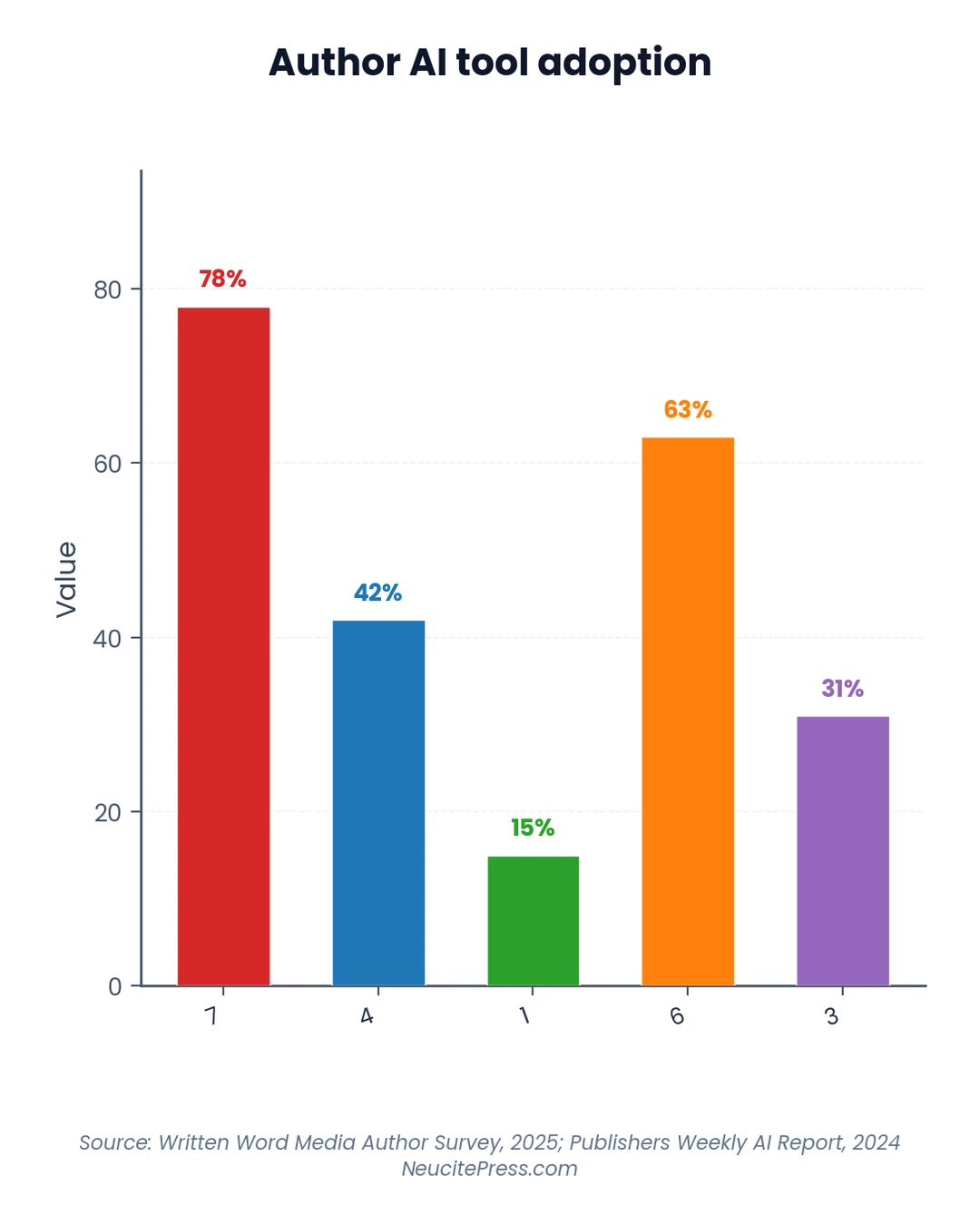
The adoption of AI writing tools represents more than a trend—it reflects fundamental changes in how creative professionals approach their craft. Over 20,000 writers currently integrate AI platforms into their daily writing practices, with this number growing exponentially.
The Traditional Barriers to Book Completion
Historically, manuscript completion presented substantial obstacles. First-time authors typically invested 6-12 months on initial drafts, faced debilitating writer’s block, and struggled to maintain narrative consistency across hundreds of pages. These challenges created significant barriers to entry, particularly for aspiring authors juggling day jobs and family responsibilities.
The economic dimension further complicated matters. Professional editing services cost $2,000-$5,000 for a full manuscript review. Writing courses ranged from $500-$3,000. These investments felt prohibitive for many talented writers exploring the viability of their projects.
How AI Transforms the Writing Process
Modern AI writing tools directly address these historical pain points. Platforms like ChatGPT, Claude, and specialized fiction tools like Sudowrite operate as collaborative partners that:
- Generate creative alternatives instantly—providing multiple plot directions, character details, or dialogue options in seconds
- Maintain narrative consistency—tracking character voices, plot threads, and world-building details across entire manuscripts
- Overcome creative stagnation—offering structured brainstorming when writer’s block threatens momentum
- Provide real-time editorial feedback—identifying pacing issues, logical inconsistencies, and tone shifts
- Enable accessibility—making professional writing support affordable at $0-$50 monthly
The result is measurable: authors report 60% faster manuscript completion, increased creative output, and higher satisfaction with their writing process. This efficiency gain applies across all genres—fiction, non-fiction, memoir, and hybrid formats.
| Factor | Traditional Method | AI-Assisted Method | Advantage |
|---|---|---|---|
| First Draft Completion | 6-12 months | 2-6 weeks | 60-90% time reduction |
| Editorial Support Cost | $2,000-$5,000 | $0-$50/month | 95% cost reduction |
| Writer’s Block Recovery | Days or weeks | Minutes | Immediate creative support |
| Narrative Consistency Checking | Manual tracking | Automated analysis | Error reduction 70-80% |
| Revision Cycles | Multiple manual passes | AI-assisted target refinement | Faster convergence to quality |
Understanding AI’s Role: Amplification, Not Replacement
A critical misconception exists around AI and creative writing. Some fear AI will replace human authors. The reality is substantially different.
The Human-AI Partnership Model
Successful AI-assisted writing operates on a partnership principle. The AI system handles mechanical aspects—generating initial prose, tracking continuity, checking grammar and structure—while the human author provides the essential elements that make writing meaningful: emotional authenticity, unique perspective, voice, and vision.
Think of AI as an exceptionally knowledgeable writing assistant. It understands narrative patterns, can generate competent prose, and offers instant feedback. But it cannot:
- Generate genuine emotional resonance
- Create truly original voice or perspective
- Make meaningful thematic choices
- Understand the lived experience that informs authentic storytelling
- Develop the vision that makes a work distinctive
The human author brings everything AI cannot. This division of labor creates optimal efficiency while preserving creative integrity.
Ethical AI Use in Publishing
Publishing industry standards now recognize AI-assisted writing as legitimate when properly disclosed. Major publishers distinguish between:
- AI-Assisted Content—predominantly human-authored work using AI for research, drafting support, editing, or formatting
- AI-Generated Content—primarily or entirely generated by AI with minimal human creative input
- Hybrid Approach—intentional blending where both AI and human contribution are substantial and acknowledged
Industry best practice requires transparent disclosure of AI’s role. This maintains reader trust and respects the creative labor involved. Most major publishers now accept AI-assisted manuscripts provided the author maintains authentic creative control and discloses the methodology.
The Best AI Writing Tools for Authors in 2026

The AI writing tool ecosystem has matured significantly. Different platforms excel at different stages of manuscript development. Strategic selection depends on your specific project needs and writing style.
ChatGPT for Brainstorming and Initial Drafting
Cost: Free (limited) or $20/month Plus
ChatGPT remains the most accessible entry point for AI-assisted writing. Its conversational interface and context awareness make it ideal for brainstorming, initial outlining, and rapid first-draft generation.
Best For: Concept development, character creation, plot brainstorming, dialogue generation, worldbuilding discussions
Key Features:
- Conversational interface natural for creative exploration
- Strong context retention within conversations
- Capable of adapting tone and voice based on guidance
- Excellent at generating multiple creative alternatives
- Free version sufficient for many projects
Workflow Tips: Provide detailed prompts with character backgrounds, plot situations, and desired emotional tone. Use follow-up prompts to refine output. Treat generated text as raw material requiring substantial revision rather than final prose.
Claude for Long-Form Writing and Complex Narratives
Cost: Free (limited) or $20/month
Claude, Anthropic’s AI assistant, excels at sustained narrative generation. Its extended context window enables working with entire chapters, maintaining consistency across longer passages.
Best For: Chapter-length composition, complex scene development, non-fiction explanation, detailed world-building, maintaining voice consistency across long passages
Key Features:
- 100,000+ token context window (vs. ChatGPT’s 8,000)
- Excellent for detailed scene work and complex sequences
- Strong analytical capabilities for non-fiction
- Reliable narrative coherence over extended passages
Workflow Tips: Feed entire chapter drafts for revision feedback. Use Claude for substantive editing and structural analysis. Leverage its analytical strengths for non-fiction research summaries and explanatory passages.
Sudowrite for Specialized Fiction Enhancement
Cost: $10-$30/month
Sudowrite represents the first generation of AI tools designed specifically for fiction authors. It integrates directly into writing workflows with features tailored to storytelling needs.
Best For: Scene expansion, character dialogue refinement, pacing adjustment, emotional beat enhancement, style consistency
Key Features:
- Integrated editor with fiction-specific functions
- Genre templates for specific storytelling approaches
- Character consistency checking
- Emotional tone analysis and adjustment
- Direct integration with popular writing software
Workflow Tips: Use Sudowrite’s specialized fiction features after generating initial drafts. Leverage the scene expansion feature to develop thin passages. Employ emotional tone analysis to ensure consistency in character voice.
Jasper for Commercial and Non-Fiction Writing
Cost: $39-$125/month
Jasper specializes in commercial writing—marketing copy, brand voice development, product descriptions—but also handles non-fiction well through its brand voice templates.
Best For: Non-fiction with commercial applications, business books, self-help, practical guides, maintaining consistent brand voice
Key Features:
- Brand voice training ensures consistency
- Specialized templates for various writing formats
- Strong SEO optimization capabilities
- Team collaboration features
- Content planning and research tools
Workflow Tips: Train Jasper on your author voice through sample texts. Use brand voice templates to maintain consistency across longer works. Leverage research capabilities to support non-fiction fact-gathering.
Squibler for Integrated Book Projects
Cost: Free (limited) or $25-$99/month
Squibler integrates multiple AI capabilities specifically for book-length projects. It handles everything from outlining through final editing in a unified interface.
Best For: Authors preferring integrated platforms, long-form projects requiring multiple AI capabilities, complete workflow automation
Key Features:
- All-in-one book development platform
- Project organization and chapter management
- AI-powered writing generation and editing
- Progress tracking and milestone features
- Manuscript export for publishing
Workflow Tips: Use Squibler’s organizational features to keep projects structured. Leverage the platform’s integrated editing functions to maintain continuity. Use progress tracking for accountability.
ProWritingAid for Comprehensive Editing
Cost: $100-$120/year
ProWritingAid functions as your AI-powered editor, analyzing everything from grammar and style to pacing, tone, and reader engagement patterns.
Best For: Revision and editing phases, identifying pacing problems, ensuring consistent tone, detecting overused words and phrases, optimizing readability
Key Features:
- Comprehensive manuscript analysis
- Style and tone consistency checking
- Pacing and readability analysis
- Genre-specific benchmarks
- Detailed improvement suggestions
Workflow Tips: Use ProWritingAid in revision phases after completing drafts. Don’t rely solely on automated suggestions—apply judgment to maintain your voice. Compare your writing against genre benchmarks to ensure market appropriateness.
Midjourney for Visual Content and Cover Design
Cost: $10-$60/month
While not a writing tool, Midjourney deserves mention for its value in the book development process. High-quality images and cover designs significantly impact commercial success.
Best For: Book cover generation, character visualization, setting imagery, promotional materials
Key Features:
- High-quality image generation from text descriptions
- Consistency across multiple generated images
- Commercial-grade output suitable for publication
- Rapid iteration and refinement
Step-by-Step Guide: How to Write a Book Using AI Tools
Stage 1: Outline and Conceptual Development (Week 1)
Objective: Develop a complete outline and character bible using AI assistance.
Tools: ChatGPT or Claude
Process:
- Define Your Core Concept
- Write a 1-2 paragraph summary of your book’s central idea
- Identify your target reader and intended market
- Outline three to five central themes or messages
- Generate Initial Plot Structure
- Prompt: “I’m writing a [genre] novel about [core concept]. Generate a three-act structure with major plot points, turning points, and climax for a [length] manuscript.”
- Request multiple variations and select the most compelling
- Refine and personalize the structure with your unique elements
- Develop Character Profiles
- Prompt: “Create detailed character profiles for the protagonist, antagonist, and three supporting characters. Include background, motivation, arc, voice, and relationship dynamics.”
- Generate character voice samples to establish distinctive speaking patterns
- Create a character relationship map documenting all connections
- Build World and Setting Details
- For fiction: “Generate detailed worldbuilding for [setting]. Include geography, culture, technology level, magic system (if applicable), and rules governing this world.”
- For non-fiction: “Create a detailed outline of topics and subtopics to cover, arranged in logical teaching progression.”
- Establish Your Voice Guidelines
- Provide AI samples of your writing or similar authors whose voice you admire
- Create a voice reference document describing tone, vocabulary level, sentence structure preferences
- Establish consistency rules for dialogue patterns, narrative perspective, and emotional expression
Stage 2: Rapid First Draft Generation (Weeks 2-4)
Objective: Generate a complete first draft rapidly while maintaining quality and consistency.
Tools: Claude (for long passages) or ChatGPT, supplemented with Sudowrite or Squibler for fiction
Process:
- Chapter-by-Chapter Prompt Engineering
- For each chapter, provide: chapter summary, key plot points to hit, character emotional arcs, dialogue requirements, scene setting details
- Reference your established character profiles and voice guidelines
- Request specific word count targets (typically 2,000-3,000 words per chapter)
- Iterative Refinement Process
- Generate initial chapter content from AI
- Provide feedback on tone, pacing, character consistency
- Request revisions emphasizing specific improvements
- Repeat until chapter meets quality standards (typically 2-3 iterations)
- Maintain Consistency Architecture
- Keep detailed notes on all established facts—character details, plot points, setting information
- Reference this continuity document in every prompt
- Ask AI to flag any potential inconsistencies before finalizing chapters
- Build a running summary of established plot elements for context in subsequent chapters
- Strategic Hybrid Approach
- Write important emotional scenes yourself to preserve authenticity
- Use AI for structural scenes, transitions, and supplementary material
- Balance AI assistance with your personal creative input
- Ensure distinctive voice elements come from your writing, not AI generation
- Daily Progress Tracking
- Aim for 2-4 chapters daily in this phase
- Maintain momentum by focusing on volume in first draft
- Save all versions for later reference and analysis
- Document which AI tools and prompts produced your best results
Stage 3: Structural Editing and Enhancement (Weeks 5-6)
Objective: Refine structure, pacing, and narrative coherence while amplifying emotional impact.
Tools: Claude for analysis, ProWritingAid for mechanical editing, Sudowrite for enhancement
Process:
- Structural Analysis
- Feed complete manuscript to Claude for structural feedback
- Ask for analysis of: pacing across three acts, character arc completion, plot thread resolution, thematic resonance
- Identify weak chapters requiring rewriting
- Evaluate whether middle passages drag or earlier exposition weighs down opening
- Mechanical Editing Pass
- Use ProWritingAid to analyze full manuscript
- Address: grammar errors, readability issues, overused words/phrases, inconsistent punctuation
- Apply changes systematically, maintaining your unique voice
- Compare against genre benchmarks (pacing, sentence length, passive voice percentage)
- Character Consistency Review
- Run character voice consistency check through Claude or Sudowrite
- Ensure each character maintains distinctive speech patterns and behavior
- Identify scenes where characters feel out-of-voice and flag for revision
- Check emotional arcs and ensure adequate character development
- Pacing and Emotional Beat Adjustment
- Use Sudowrite to identify emotional tone shifts
- Ensure pacing accelerates appropriately toward climax
- Add or expand emotional beats that feel rushed
- Trim exposition or slow sections that lose momentum
- Scene-Level Enhancement
- For weak scenes: use Sudowrite to expand, enhance dialogue, or improve emotional resonance
- Request specific improvements: “Expand this dialogue to show more tension” or “Add sensory details to make this setting come alive”
- Always review AI suggestions critically—accept improvements, reject outputs that feel inauthentic
Stage 4: Final Polish and Preparation (Week 7)
Objective: Final quality assurance, copyediting, and preparation for publication or submission.
Tools: Grammarly, ProWritingAid, Squibler’s export functions
Process:
- Line-Level Copyediting
- Conduct manual read-through for final corrections
- Use Grammarly for consistent grammar and punctuation
- Watch for: consistency in character names/details, proper formatting, dialogue punctuation
- Readability Optimization
- Ensure opening chapters hook readers immediately
- Verify pacing accelerates appropriately
- Confirm ending provides satisfactory closure
- Check that thematic elements resolve meaningfully
- Metadata Preparation
- Write compelling back cover copy
- Create author bio
- Develop keywords and categories for discoverability
- Generate book description for various platforms
- Format and Export
- Format manuscript according to publisher or platform specifications
- Create print and digital editions with appropriate formatting
- Generate table of contents if applicable
- Export to publishing platform or agent submission format
Critical Considerations: Ethics, Quality, and Publisher Policies
Disclosure and Transparency
Industry standards increasingly require transparency about AI involvement. Best practices include:
- Author’s Note: Include brief statement in book’s front matter disclosing AI-assisted writing methodology
- Manuscript Submission: Inform agents and publishers of AI tools used and extent of AI contribution
- Platform Requirements: Comply with specific disclosure requirements of self-publishing platforms
- Reader Trust: Transparency builds long-term credibility with your audience
Publisher Policies on AI Content
Major publishers now distinguish AI-assisted manuscripts from purely AI-generated ones. Current policies (2026):
- Big Five Publishers: Accept AI-assisted manuscripts; require disclosure; typically reject purely AI-generated work
- Independent Publishers: Policies vary widely; always inquire before submission
- Self-Publishing Platforms: Most accept AI-assisted work with disclosure; many restrict purely generated content
- Literary Agents: Generally accept AI-assisted submissions; rarely represent AI-generated-only projects
Copyright and Intellectual Property Considerations
Legal landscape around AI-generated content remains evolving, but key principles include:
- Your Original Work: Content you personally write is fully copyrighted under your name
- AI-Generated Passages: Copyright status depends on jurisdiction; US law generally does not recognize copyright in AI-generated work unless substantially modified by human authorship
- Modified AI Content: Substantial human revision can establish copyright protection
- Attribution Practice: Best practice attributes inspiration sources and acknowledges AI assistance
Quality Assurance Checklist
Before publication, verify:
- Does the manuscript reflect your authentic voice and vision?
- Are all factual claims (in non-fiction) independently verified?
- Does emotional authenticity come through despite AI assistance?
- Are character arcs complete and satisfying?
- Is the manuscript free of AI artifacts (awkward phrasing, clichés, inconsistency)?
- Have you disclosed AI involvement appropriately?
- Does the final product meet professional publishing standards?
Limitations and Realistic Expectations
While AI tools offer tremendous advantages, understanding their limitations prevents disappointment and ensures quality outcomes.
What AI Cannot Do
Genuine Emotional Authenticity: AI cannot replicate lived experience or generate truly original emotional insight. Scenes resonating deeply typically contain elements of human vulnerability and authentic perspective AI cannot manufacture.
Original Voice: AI generates prose in patterns learned from training data. Distinctive authorial voice—what makes your work unmistakably yours—must come from your unique perspective, experiences, and creative choices.
Complex Thematic Development: While AI recognizes thematic patterns, weaving meaningful thematic commentary throughout a manuscript requires human intentionality. Themes typically emerge from authorial vision, not algorithmic analysis.
Factual Accuracy (without verification): Current language models occasionally “hallucinate”—generating plausible but false information. Non-fiction authors must independently verify all factual claims.
Contextual Understanding Beyond Training Data: AI cannot genuinely understand cultural nuance, historical context, or specialized knowledge it hasn’t encountered in training data. These require human expertise.
Hybrid Approach Strategy
Optimal results combine AI and human capabilities strategically:
- AI Excels At: Generating alternatives, maintaining continuity, identifying structural problems, suggesting mechanical improvements, rapid prose generation
- Humans Excel At: Emotional authenticity, original voice, thematic coherence, strategic decision-making, authentic insight
- Effective Division: AI handles mechanical scaffolding; human author provides creative vision and emotional authenticity
Real Results: AI Writing Success Stories
Measurable outcomes from AI-assisted writing include:
- Ammaar Reshi’s Achievement: Bestselling children’s book created in days using ChatGPT as collaborative partner
- Indie Author Success: Self-published authors completing series in 2-3 months using AI tools, previously requiring 1-2 years per title
- Non-Fiction Acceleration: Business and self-help authors reducing research and writing timelines by 70-80%
- Traditional Publisher Acceptance: Multiple indie-published, AI-assisted works picked up by major publishers
- Reader Reception: No discernible quality differential between traditionally written and AI-assisted manuscripts when human authorship is maintained
Conclusion: Your Path Forward
Learning how to write a book using AI tools represents an evolution in authorship, not a replacement of it. The 20,000+ authors currently leveraging these tools aren’t abandoning their creative vision—they’re amplifying it through intelligent assistance.
AI writing tools enable you to focus on what only you can provide: authentic voice, original perspective, emotional truth, and creative vision. Mechanical aspects that historically consumed 70% of writing time—generating alternatives, tracking continuity, identifying pacing problems—now receive automated support. This frees you to concentrate on the 30% that matters most: creating work that resonates with readers.
The timeline has fundamentally changed. What previously required months now takes weeks. The economic barrier has collapsed—professional-grade assistance costs less than a monthly coffee subscription. The skill barrier has lowered—you don’t need advanced techniques to produce publishable work; you need strategic collaboration with intelligent tools.
Your unique voice remains irreplaceable. AI cannot make your story; it can only help you tell it more efficiently.
FAQ: AI Book Writing Questions
Is using AI tools ethical when writing a book?
Yes, when used appropriately with human author maintaining creative control and disclosing involvement. AI as collaborative tool (like editors, writing courses, or research assistants) is standard practice. Pure AI generation without human authorship raises ethical concerns—hybrid approaches where human author drives vision and creative decisions are professionally recognized.
How much faster can I complete a book with AI assistance?
Most authors report 60% reduction in timeline. Manuscripts typically requiring 6-12 months complete in 2-6 weeks. Actual timeline depends on your starting readiness, desired quality level, and how effectively you use AI tools. Professional editing and revisions extend overall timeline but still total significantly less than traditional approaches.
Will my book be worse if I use AI assistance?
No—quality depends on the author’s vision and revision effort, not the tools used. AI-assisted manuscripts reviewed blindly show no quality differential from traditionally written work when human authorship is maintained. The author’s skill and commitment to quality determine outcomes, not the writing methodology.
Do traditional publishers accept AI-assisted manuscripts?
Yes, with disclosure. Major publishers now explicitly accept AI-assisted work (distinct from AI-generated content). Disclosure requirements are standard—include methodology in submission. Agents and publishers want transparency so they can properly categorize and market your work.
How do I maintain my unique voice with AI assistance?
Your voice comes through revision, not generation. Use AI for initial drafting and mechanical tasks, then rewrite substantially. Your distinctive voice emerges through your unique choices—what to keep, what to change, how to personalize. Overwriting 70% of AI-generated content ensures authentic voice.
What’s the copyright status of AI-assisted writing?
Work substantially created or revised by you is fully copyrighted. Pure AI-generated content without human modification has unclear copyright status (jurisdiction-dependent). Best practice: ensure your creative contribution is substantial, then copyright under your name. Disclose AI involvement but maintain ownership confidence.
Can I use AI tools for non-fiction and research-heavy books?
Yes, but verify all facts independently. AI excels at summarizing information and suggesting organizational structures but cannot guarantee accuracy. For research-heavy work, use AI for initial research, then verify through primary sources. Compliance industries (medical, legal, financial) require particular rigor in human verification.
Which AI tool should I start with as a beginner?
Start with free ChatGPT or Claude for brainstorming and initial draft development. These are the most intuitive and don’t require financial commitment. After understanding your preferences, add specialized tools like Sudowrite (for fiction) or ProWritingAid (for editing). This staged approach lets you build proficiency without overwhelming yourself with multiple platforms.