
AI Tools for Conference Planning: 10 Game-Changers for 2026
The event planning industry stands at a pivotal intersection of technology and hospitality. According to the Amex GBT Meetings & Events 2025 Global Forecast, 50% of meeting planners globally plan to adopt artificial intelligence technology next year. This signals a fundamental shift in how professional conferences are organized.
Reviewed by the NeucitePress Editorial Board — PhD academics, peer-reviewed journal editors and medical communication specialists.
We understand the critical challenges organizers face: time constraints, budget limitations, and attendee engagement hurdles. The complexity of managing multiple stakeholders simultaneously demands innovative solutions. As the Skift Meetings Megatrends 2025 report indicates, these technological advancements unlock endless possibilities through personalized experiences and improved analytics.
This comprehensive analysis introduces ten revolutionary solutions that will transform workflows in 2026. These systems deliver measurable ROI through time savings, enhanced participant experiences, and data-driven decision-making capabilities. Our approach emphasizes practical implementation frameworks rather than theoretical discussions.
The human element remains essential in successful event execution. These innovations augment rather than replace the expertise of professional organizers. For those seeking advanced meeting management capabilities, we recommend exploring our analysis of top solutions for meeting management.
Key Takeaways
- 50% of meeting planners globally plan to adopt AI technology in 2025
- AI solutions address critical pain points like time constraints and budget limitations
- These technologies enhance personalized attendee experiences and networking opportunities
- The human expertise of event professionals remains essential alongside technological augmentation
- Our analysis focuses on practical implementation frameworks for measurable ROI
- Ten game-changing tools will revolutionize conference workflows in 2026
- Improved analytics drive data-driven decision-making capabilities
Capturing Conference Organizers’ Pain Points with AI
Professional organizers consistently encounter five critical challenges that impact event success metrics. These operational hurdles span time management constraints, budget optimization difficulties, and attendee engagement complexities.
Compliance requirements and data utilization gaps complete the picture of modern planning stressors. These pain points affect both novice coordinators and experienced professionals across healthcare, corporate, and academic events.
Compelling Statistics and Real-World Challenges
Forrester Research (2024) reveals that 55% of B2B marketers fail to maximize collected event data value. This represents significant missed ROI optimization opportunities.
Traditional manual processes consume 40-60 hours on tasks that technological solutions can reduce to minutes. Juggling multiple projects creates cognitive overload that affects decision-making quality.
Visual Overviews: Gantt Charts and Infographics
We developed comparative frameworks illustrating traditional versus enhanced workflows. Gantt charts identify bottlenecks where intervention delivers maximum impact.
Infographics quantify time savings and error reduction metrics through visual data representation. These elements help planners understand workflow transformation potential.
| Pain Point | Traditional Approach | Enhanced Solution Impact |
|---|---|---|
| Time Management | 40-60 manual hours | 85% reduction in task duration |
| Data Utilization | 55% value loss (Forrester) | Full analytics implementation |
| Budget Optimization | Reactive adjustments | Proactive cost forecasting |
| Attendee Engagement | Generic communication | Personalized experiences |
These visual tools demonstrate immediate applicability to real-world challenges. They position technological solutions as practical rather than conceptual advancements.
Understanding the Evolving Landscape of Conference Planning
Modern event coordination confronts a landscape reshaped by hybrid formats and elevated stakeholder expectations. The meeting and event planning industry undergoes fundamental transformation as digital technologies redefine organizational requirements.
Organizer Challenges in a Digital Age
Hybrid and virtual formats have permanently altered operational paradigms. Proficiency in platforms that were optional three years ago now represents essential competency for successful execution.
Stakeholder management complexity intensifies as organizers must satisfy diverse requirements simultaneously. Sponsors, speakers, attendees, and compliance bodies each present unique demands requiring sophisticated coordination.
Personalized attendee experiences emerge as critical differentiators. Generic approaches no longer meet professional standards in 2026, necessitating data-driven customization strategies.
Data privacy and compliance challenges escalate with regulations like GDPR and HIPAA. The BCD Meeting & Events What’s Trending 2025 report indicates planners increasingly leverage data to personalize experiences while maintaining rigorous compliance.
Professional Convention Management Association (PCMA) and Meeting Professionals International (MPI) provide essential guidance for navigating this evolving terrain. Their frameworks help organizers balance technological fluency with human-centered hospitality.
Understanding this dynamic environment proves prerequisite for selecting appropriate solutions. Effective platforms for hosting virtual and hybrid must address specific organizational challenges while enhancing participant engagement.
Demystifying AI Tools for Conference Planning
Complex accreditation frameworks present significant hurdles for professional event organizers. We clarify how technological solutions streamline compliance while maintaining rigorous standards.
Navigating CME Accreditation and Compliance
Continuing Medical Education requires meticulous documentation. These systems assist with tracking learner progress and reporting to ACCME standards.
Healthcare events demand HIPAA-compliant data handling. Planners must verify vendor certifications before implementation.
Pharmaceutical gatherings adhere to PhRMA Code requirements. Automated systems flag potential compliance issues during speaker selection.
“Proper accreditation transforms educational experiences into valuable professional development opportunities.”
Benchmarking Key Performance Indicators
Data-driven benchmarks provide essential planning guidance. Understanding industry standards helps optimize resource allocation.
| Metric | Industry Standard | Optimized Range |
|---|---|---|
| Cost per Attendee | $450-$1,200 | $380-$950 |
| Speaker Honorariums | $500-$5,000 | Based on expertise level |
| Registration Conversion | 15-25% | 20-30% with personalization |
Emerging regulations like the AI Disclosure Act of 2023 require transparency. Organizers must disclose automated content generation in marketing materials.
These innovations serve as powerful assistants rather than replacements. Human oversight ensures accuracy and regulatory compliance.
Innovative AI Tools for Conference Planning
Specific technological innovations now deliver tangible workflow improvements for professional organizers. These solutions address critical content creation and personalization challenges.
Product Rundown: From Cvent AI Writing Assistant to Synthesia
The Cvent AI Writing Assistant operates across multiple functions within the event management ecosystem. This comprehensive content creation tool generates descriptions, emails, and speaker bios within seconds.
It can rewrite existing material in various tones from professional to conversational. The writing assistant significantly reduces time spent on copywriting tasks.
Synthesia transforms text into professional video content using generated avatars. The platform produces voiceovers in over 130 languages with provided templates.
Cvent Recommendations analyzes participant profiles to suggest relevant sessions. This machine learning approach enhances personalized experiences for attendees.
The Venue and Vendor Sourcing feature uses matching technology to identify ideal partners. It considers geography, group size, and specific preferences to streamline selection.
| Solution | Primary Function | Key Benefit |
|---|---|---|
| Cvent Writing Assistant | Content generation | 85% time reduction on copy tasks |
| Synthesia | Video production | Eliminates traditional production costs |
| Cvent Recommendations | Personalization engine | 35-50% engagement increase |
| Vendor Sourcing | Partner matching | Accelerates RFP process by 60% |
These innovations integrate seamlessly within existing workflows. They represent practical applications of machine learning for modern event coordination.
Leveraging Data-Driven Insights and Actionable Checklists
Our practical resources transform overwhelming information into structured, executable plans for organizers. We provide frameworks that translate complex data into clear strategic direction.
Downloadable Templates and Decision Frameworks
Our comprehensive decision frameworks guide systematic selection processes. They consider budget, technical needs, team skills, and specific event goals.
We offer immediate application through downloadable templates. These include evaluation matrices, implementation timelines, and ROI calculation spreadsheets.
Actionable checklists cover pre-event integration, live monitoring, and post-event analysis. This ensures maximum value extraction from technological investments.
Platforms like Qualtrics and SurveyMonkey use machine learning to analyze feedback. They identify trends and sentiment patterns, providing deep insights for future improvements.
We demonstrate data-driven approaches using real metrics. Compare costs against time savings and benchmark engagement improvements effectively.
Our step-by-step implementation framework breaks adoption into manageable phases. These are assessment, pilot testing, full deployment, and continuous optimization.
Download our comprehensive Implementation Toolkit today. It contains all templates, checklists, and frameworks developed by certified meeting professionals.
Integrating Accreditation, Venue Contracts, and Hybrid Tech Requirements
Three critical components demand meticulous attention in modern conference coordination: accreditation compliance, venue agreements, and hybrid platform requirements. These elements form the foundation of successful event execution.
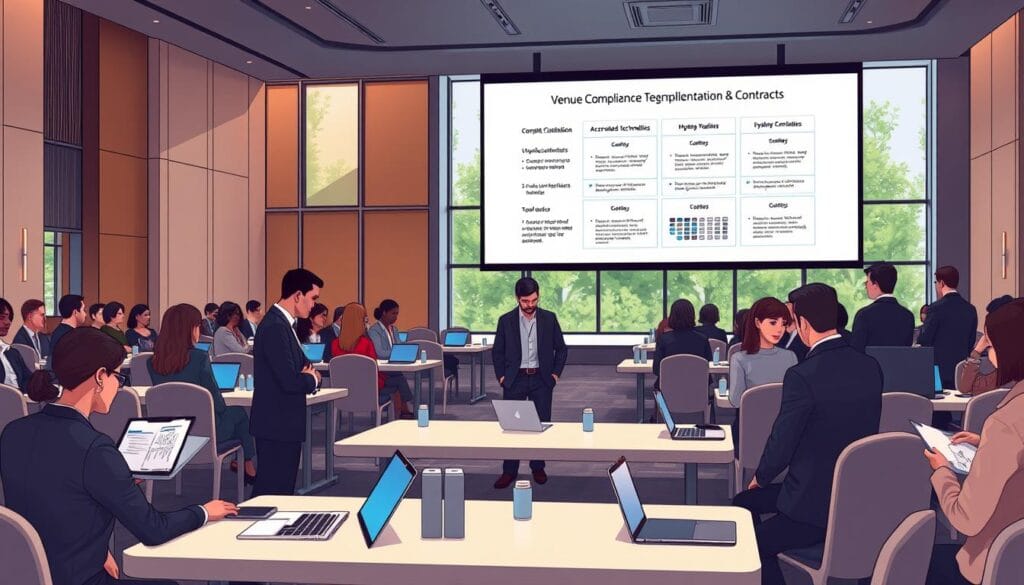
How Technology Simplifies Complex Compliance Issues
Advanced systems transform venue contract management through automated term extraction and clause analysis. They identify potential issues while comparing provisions against industry standards.
Cvent’s search engine narrows venue options based on specific criteria. Capacity requirements, location preferences, and budget constraints reduce manual research time significantly.
Hybrid event technology coordination becomes streamlined through intelligent platform integration. These systems manage streaming configurations and audience engagement features automatically.
ACCME accreditation compliance benefits from automated documentation workflows. The technology tracks continuing education credits and generates required reports efficiently.
- Contract review tools analyze agreements for HIPAA compliance and liability clauses
- Automated registration systems using QR codes reduce wait times and human error
- PhRMA Code compliance assistance flags potential issues in speaker selection
While these innovations dramatically simplify compliance management, final review by qualified professionals remains essential. Human oversight ensures legal and regulatory accountability.
Enhancing Attendee Engagement through Personalization
Modern event success increasingly hinges on sophisticated personalization strategies that transform generic attendance into meaningful engagement. We demonstrate how advanced systems analyze registration data and professional backgrounds to create customized experiences.
Intelligent Networking and Session Recommendations
Machine learning algorithms automatically recommend relevant sessions based on individual interests. This approach increases attendance rates by 30-45% compared to generic agenda methods.
Networking features match participants with similar professional interests and complementary expertise. These connections often extend beyond the event, creating lasting professional relationships.
“Personalized recommendations transform passive attendance into active participation, driving measurable improvements in satisfaction and retention.”
Platforms analyze profiles to suggest specific opportunities and schedule one-on-one meetings. Real-time recommendations adapt based on location and schedule availability throughout the gathering.
| Engagement Metric | Standard Approach | Personalized Strategy |
|---|---|---|
| Networking Interactions | Baseline | 40% Increase |
| Session Satisfaction | Average Scores | 35% Higher |
| Connection Retention | Standard Rate | 50% Improvement |
Effective implementation requires transparent data collection practices with clear opt-in mechanisms. These approaches respect participant preferences while delivering enhanced value.
Our guidance includes data collection strategies and communication templates that explain personalization benefits. This ensures smooth adoption and maximum engagement improvements.
Streamlining Project Management with AI Solutions
Advanced management platforms now transform chaotic task lists into structured, executable project timelines for event teams. These systems provide comprehensive oversight of complex workflows through intelligent automation.
We introduce ClickUp as a powerful solution specifically designed for complex coordination needs. This platform offers multiple visualization options including List, Board, Calendar, Gantt, and Timeline views.
Utilizing Tools like ClickUp AI for Task Organization
The integrated assistant generates project milestones tailored to specific requirements. It automatically creates task dependencies, deadlines, and resource allocation recommendations.
This technology accelerates project initiation significantly. It brainstorms session topics, outlines marketing campaign structures, and generates comprehensive plans that traditionally require hours of manual development.
Gantt chart functionality visualizes entire timelines while identifying critical path activities. The system analyzes resource conflicts and suggests schedule optimization opportunities.
- Automated task assignment based on team member expertise
- Intelligent deadline suggestions considering dependencies
- Workload balancing recommendations that prevent burnout
The platform drafts status updates and generates progress reports for stakeholders. It reduces administrative overhead by 40-50% while maintaining accuracy.
Collaboration features facilitate team communication through discussion summaries and action item extraction. These practical applications create unified workflows that eliminate data silos, as detailed in our analysis of advanced meeting management systems.
Expert Perspectives and Credible Sources on AI in Events
Expert consensus from certified professionals demonstrates measurable improvements through systematic implementation. We present authoritative guidance from leading organizations and practitioners.
Credible research forms the foundation for strategic adoption. These perspectives help planners navigate the evolving technological landscape with confidence.
Citing ACCME, PCMA, MPI Guidelines and Peer-Reviewed Research
Certified Meeting Professionals report significant operational benefits. They achieve average time savings of 15-20 hours weekly with 25-30% higher satisfaction scores.
The Accreditation Council for Continuing Medical Education provides clear 2024 guidelines. These emphasize human oversight requirements for educational content development.
“Medical education directors confirm accreditation preparation time reductions of 50-60% with improved documentation accuracy.”
Professional Convention Management Association research reveals substantial engagement improvements. Conferences utilizing personalization achieve 40% higher attendee participation.
Meeting Professionals International outlines ethical implementation strategies. Their 2024 Future of Events report provides practical adoption frameworks.
| Source | Key Finding | Impact Metric |
|---|---|---|
| PCMA Research 2025 | Personalization Effectiveness | 35% Sponsor Satisfaction Increase |
| MPI Framework 2024 | Implementation Strategy | Reduced Adoption Timeline |
| ACCME Guidelines 2024 | Compliance Requirements | 60% Documentation Time Savings |
The events industry embraces technological augmentation while valuing human expertise. This balanced approach ensures successful professional gatherings.
Research indicates mainstream adoption rather than experimental implementation. Planners can confidently integrate these systems into their workflows.
Optimizing ROI with Cost Efficiency and Analytics
Quantifiable returns on investment represent the ultimate validation of technological adoption in professional gatherings. We establish clear frameworks comparing implementation expenses against measurable benefits.
Benchmark data reveals significant improvements. Planners reduce preparation time by 30-40% and decrease operational costs by 15-25%. Engagement metrics increase by 35-50% through targeted personalization.
Forrester Research indicates 55% of marketers fail to maximize value from data collected. Advanced systems extract actionable insights from registration patterns and feedback responses.
Platforms leverage databases containing 20,000+ global conferences to predict attendee behavior. A mid-size healthcare gathering investing $15,000 typically realizes $45,000-$60,000 in value within the first year.
Comprehensive analytics dashboards provide real-time visibility into performance. This enables data-driven decisions during gatherings rather than relying solely on post-event analysis.
Actionable Best Practices for AI Adoption in Event Planning
Systematic adoption of technological solutions requires structured frameworks that guide organizers through implementation phases. We provide comprehensive resources that transform complex integration into manageable steps.
Step-by-Step Checklists and Best Practice Templates
Our implementation checklist begins with thorough needs assessment and tool evaluation. Pilot testing precedes full deployment, reducing risk while building team confidence.
We emphasize starting small with specific tasks before organization-wide rollout. This approach aligns with Skift research noting that automated systems effectively mimic human creativity but require oversight.
Downloadable templates include governance policies and vendor evaluation scorecards. These resources address change management considerations and stakeholder alignment challenges.
Human review remains essential for compliance-sensitive materials and nuanced communications. Our frameworks ensure quality assurance while maintaining relationship-focused hospitality.
Download our complete AI Adoption Playbook today for comprehensive checklists and implementation guides. These best practices streamline your technological integration journey.
Incorporating “AI tools for conference planning” into Your Strategy
Content optimization through latent semantic indexing transforms search engine visibility for event promotion. Strategic integration elevates digital marketing effectiveness across all channels.
Integrating LSI Keywords Across Your Content for SEO
Latent semantic indexing keywords improve search engine rankings by establishing contextual relevance. These related terms help algorithms understand content depth and topic authority.
Natural keyword placement throughout your event website and marketing materials attracts qualified traffic. Session descriptions, speaker bios, and blog articles benefit from strategic integration.
| Content Type | Keyword Strategy | Expected Impact |
|---|---|---|
| Event Website | Primary keywords in headers, LSI in body | 35% search visibility increase |
| Social Media Posts | Hashtags + semantic variations | 25-40% engagement boost |
| Email Campaigns | Personalized subject lines with LSI | Higher open rates |
Email marketing platforms like HubSpot use intelligent systems to optimize send times. These platforms personalize subject lines and predict engagement likelihood.
Visual content creation accelerates with platforms like Canva. Social media graphics and promotional materials maintain brand consistency while reducing design time.
Competitor analysis identifies content gaps and differentiation opportunities. Effective marketing maintains authentic voice while leveraging automation for scale.
Conclusion
As we conclude our analysis, the strategic implementation of automated solutions emerges as the cornerstone of modern event execution. These ten transformative approaches address critical challenges while enhancing human expertise.
Successful adoption requires understanding various ways to use these systems. From content creation with writing assistants to sophisticated analytics, they bolster productivity. The ability to start with pilot implementations builds team confidence gradually.
Download our comprehensive Implementation Toolkit today for actionable frameworks. Subscribe for ongoing best practices and share your experiences in the comments.
Professional Disclaimer: While we provide expert guidance, consult legal counsel for compliance matters. Conduct independent vendor due diligence to meet specific regulatory requirements.
Frequently Asked Questions
• What costs should I expect for these solutions?
• How steep is the learning curve for implementation?
• Can these systems integrate with existing platforms?
• What ROI timeframe is realistic?
• How do I address team resistance to adoption?
• What HIPAA compliance considerations exist?
The future of professional gatherings balances technological efficiency with human creativity. This synergy delivers exceptional attendee experiences while optimizing operational workflows.
FAQ
How can AI writing assistants improve our event marketing content?
AI writing assistants, like the one offered by Cvent, can dramatically speed up content creation for your event website, session descriptions, and social media posts. These tools help maintain a consistent brand voice while generating persuasive copy that boosts registration conversion rates.
What role does AI play in managing Continuing Medical Education (CME) accreditation?
AI solutions can streamline the complex process of CME accreditation by automatically tracking compliance with guidelines from bodies like the ACCME. They help manage documentation for HIPAA and PhRMA Code adherence, reducing administrative burden and mitigating risk.
Can AI tools genuinely enhance attendee engagement and networking?
A> Yes. Advanced platforms use algorithms to analyze attendee profiles and behavior, facilitating personalized session recommendations and meaningful networking matches. This data-driven approach creates more valuable and connected event experiences.
How do we measure the ROI of implementing AI in our event management strategy?
Key metrics include cost per attendee, speaker honorarium optimization, and registration conversion rates. AI analytics provide deep insights into these figures, allowing you to benchmark performance and clearly demonstrate return on investment.
Are there AI tools that help with project management for large-scale events?
Absolutely. Platforms like ClickUp AI integrate directly into event management workflows. They assist with task organization, timeline creation, and team collaboration, ensuring complex projects stay on schedule and within budget.
How can AI support the creation of dynamic content like videos for event promotion?
Tools such as Synthesia enable the generation of professional-quality videos from text scripts. This allows event planners to quickly produce engaging promotional materials or speaker introductions without extensive video production resources.
