

Managed Editorial Office — Annual
Overview
“We publish sixty articles a year and the whole operation depends on one part-time assistant and the editor’s evenings.” Established journals need consistent, professional operations, and institutional resources rarely stretch to a full editorial office. The annual term of the Managed Editorial Office provides the office, the production line and the accountability of an SLA, so that the editorial board can concentrate on scientific judgment.
NeucitePress runs the full cycle: submission screening, reviewer management, correspondence, OJS records, copyediting, typesetting, JATS XML and DOI deposit for accepted articles, monthly reporting, quarterly strategy calls and an annual operations review.
Who this is for: established journals, typically publishing 50 or more articles a year, that want to professionalize operations, reduce editorial burden and improve the author experience without building an in-house team.
What’s Included
- Editorial office — submission screening with similarity check, reviewer shortlists for editor approval, invitations, reminders, replacements and escalation, review compilation and decision packages for the editor, author and reviewer correspondence, revision tracking and complete OJS records
- Production — copyediting, typesetting in the journal template (PDF and HTML), proofreading, JATS XML and Crossref DOI deposit for accepted articles within the allowance
- Dedicated editorial manager and named production staff for the term, with trained backup for continuity
- Reporting — monthly performance reports on submissions, turnaround and acceptance; quarterly strategy calls; an annual operations review with recommendations
- Service-level agreement — response times, turnaround targets and escalation procedure stated in the proposal
- Data protection — encrypted manuscript data, logged access and GDPR-compliant processes
- Transition support — a 60-day hand-over with full documentation if you choose not to renew
How It Works
| Phase | Timeline | Activities |
|---|---|---|
| Onboarding | Weeks 1–2 | System setup, workflow documentation, team introductions, historical data migration, proposal confirming allowance, limits and SLA |
| Transition | Weeks 3–4 | Shadow current operations, begin handling new submissions |
| Full operations | Month 2 onward | Complete management of the editorial and production workflow |
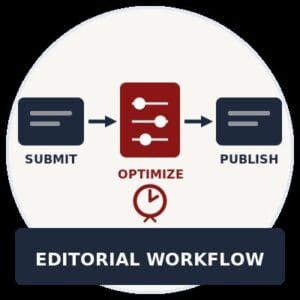
| Optimization | Quarterly | Process improvements based on performance data; annual review at term end |
What Stays With Your Editors
The journal’s editors keep final authority over reviewer selection, editorial assessment and acceptance. The office proposes reviewers, compiles reviews and prepares decision packages; the editor-in-chief makes every accept, revise and reject decision. NeucitePress runs the process, the production line and the OJS infrastructure.
Important Limitations
- The annual submission allowance and active-manuscript limit are agreed in the proposal; manuscripts beyond the allowance are handled at the per-submission rates stated there. Expedited handling is available at the rate in the proposal.
- Response times and turnaround targets are stated in the SLA. Reviewer acceptance and review completion depend on reviewers; NeucitePress commits to the process and the stages it controls.
- Production is for English-language manuscripts; translation is quoted separately.
- Works with your existing submission system (OJS, ScholarOne, Editorial Manager or similar); administrator access is required.
- Indexing applications are separate services. One journal; portfolio pricing on request. Quarterly or annual billing.
Common Questions
How does this compare to hiring a managing editor?
A full-time managing editor is a salaried post with management overhead and no backup. The annual term provides the function with named staff, trained backup, production and an SLA for a fraction of that cost.
What if we consistently exceed the allowance?
Overage is charged at the per-submission rate; if volume is consistently higher, the allowance is revised at the next quarterly review.
What if the service is not meeting the SLA?
A 90-day satisfaction review is built in. If agreed SLA terms are not being met, you may terminate with 30 days’ notice and receive a pro-rated refund for unused months.
Every engagement can begin with the Journal Health Check.




Reviews
There are no reviews yet.