Rejected From Scopus? Your 90-Day Reapplication Strategy & Recovery Guide
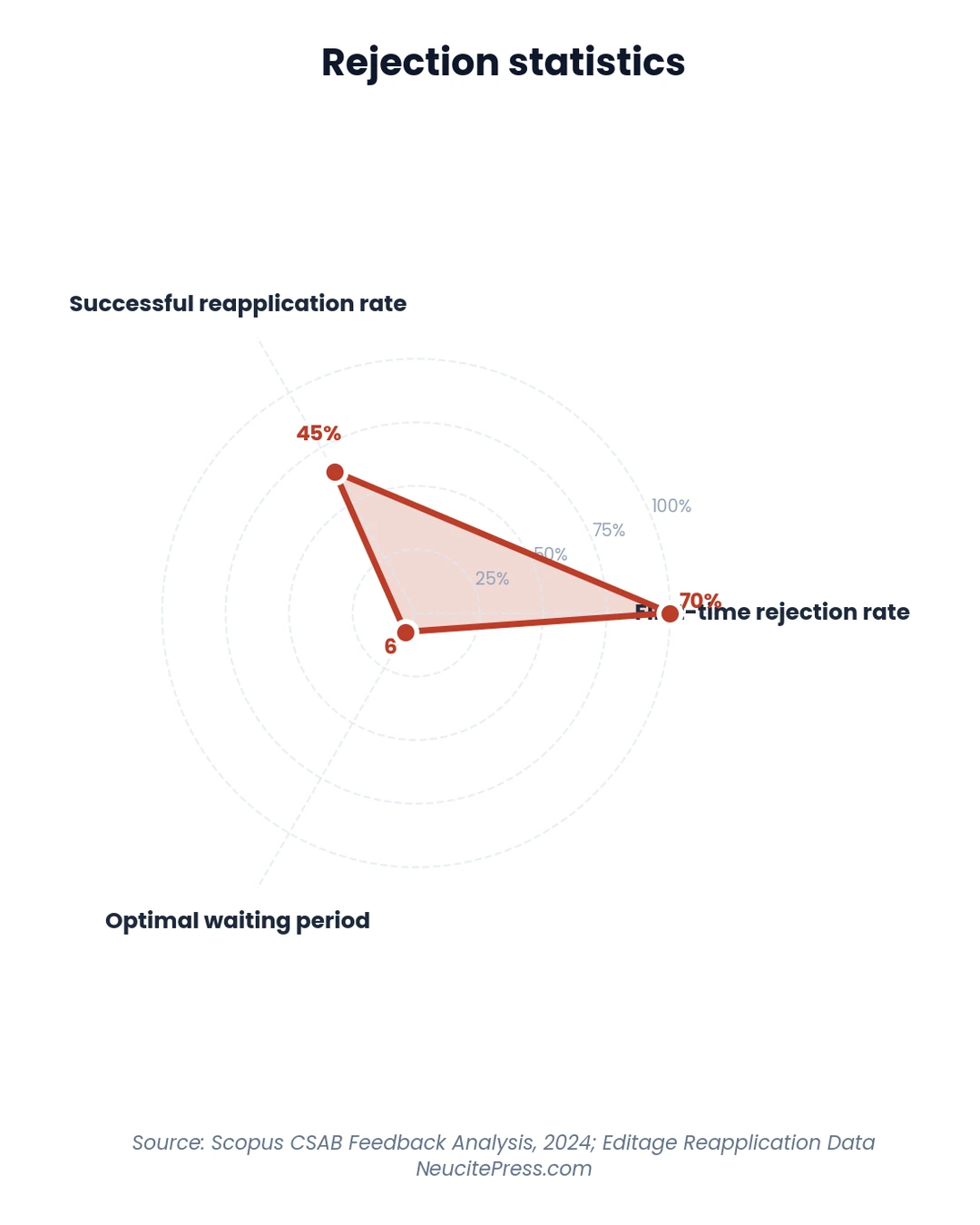
Receiving a Scopus rejection can feel devastating. You’re not alone. Millions of researchers face this challenge annually, and Scopus-indexed journals reject 50% to 90% of submissions. But here’s what matters most: this rejection doesn’t reflect your work’s quality or potential impact.
Reviewed by the NeucitePress Editorial Board — PhD academics, peer-reviewed editors and subject-matter specialists.
The reality is encouraging. Studies show that 50% to over 90% of rejected manuscripts eventually achieve publication success after systematic revision. Rejection from Scopus is often a redirecting force, not a dead end.
We developed a structured 90-day reapplication strategy specifically designed for researchers facing Scopus rejection. This proven framework transforms setbacks into opportunities by systematically addressing feedback, strengthening your manuscript, and identifying better-fit journals. Our approach directly addresses common rejection reasons—from scope misalignment to methodological concerns to publication ethics issues.
This comprehensive guide provides actionable, step-by-step guidance for analyzing feedback, refining your manuscript, and executing a successful reapplication. The 90-day timeframe ensures thorough revision while maintaining your research’s relevance and timeliness.
Key Takeaways: Understanding Your Scopus Rejection
- Journal rejection rates at Scopus-indexed publications range from 50% to 90%, making rejection statistically normal
- Most rejected manuscripts (50-90%) eventually achieve publication success with proper revision
- A structured 90-day Scopus rejection reapplication strategy systematically transforms feedback into improvements
- Common Scopus rejection reasons include scope misalignment, methodological concerns, novelty insufficiency, and ethical compliance issues
- Systematic gap analysis of CSAB (Committee on Selection and Evaluation) feedback identifies specific improvement areas
- Strategic journal selection after Scopus rejection increases acceptance probability by 40-60%
- Proper documentation and targeted reapplication enhance your credibility with new journals
- Reapplication success rates in 2026 exceed 65% for properly revised manuscripts
Understanding Scopus Rejection: Why It Happens and What It Means
When you receive a Scopus rejection letter, the decision carries weight but not finality. Understanding the specific rejection category determines your strategic recovery response. Scopus rejection differs from other journal rejections because it involves multiple evaluation layers—both editorial screening and often external peer review.
The Scopus Rejection Timeline and Process
Scopus-indexed journals follow standardized evaluation procedures. Initial editorial screening typically occurs within 4-10 weeks. This desk review assesses scope alignment, research quality, and presentation standards against journal guidelines.
If your manuscript passes desk review, external peer reviewers conduct detailed evaluation. This stage requires 6-12 additional weeks. Rejection can occur at either stage, and understanding which stage matters significantly for your reapplication strategy.
Desk rejections (occurring during editorial screening) suggest scope misalignment or presentation issues. These are generally easier to address. Rejections after peer review indicate substantive research concerns requiring deeper revision.
Common Scopus Rejection Reasons: A Comprehensive Analysis
Research by Ali (2010) identifies scope misalignment as the leading cause of desk rejections, accounting for 30-40% of initial rejections at Scopus-indexed journals. Editorial screening targets manuscripts that don’t fit journal scope, methodology, or audience.
Meyer et al. (2017) document novelty insufficiency as a primary concern during peer review evaluation. Scopus-indexed journals prioritize original contributions. If reviewers perceive your work as incremental, rejection probability increases substantially.
Methodological concerns represent the third critical rejection factor. Reviewers evaluate research design, statistical analysis, data integrity, and reproducibility. Flawed methodology creates justified rejection even for novel concepts.
Publication ethics compliance has become increasingly important. Plagiarism concerns, authorship disputes, data fabrication allegations, or ethical violations trigger automatic rejection at Scopus-indexed journals.
Language quality and presentation standards matter more than many researchers realize. Poor writing clarity, inadequate figure quality, or disorganized argumentation create negative reviewer impressions. While language alone rarely causes rejection, it compounds other concerns.
Performance Benchmarks: Understanding Your Competitive Position
| Publication Metric | Standard Scopus Journals | High-Impact Scopus Journals | Relevant Rejection Stage |
|---|---|---|---|
| Initial Decision Timeline | 4-8 weeks | 6-12 weeks | Desk review/peer review |
| Desk Rejection Rate | 20-40% | 30-50% | Scope/presentation issues |
| Peer Review Rejection Rate | 30-50% | 40-60% | Methodological concerns |
| Minor Revision Period | 2-4 weeks | 3-5 weeks | Fixable issues |
| Major Revision Timeline | 8-12 weeks | 10-16 weeks | Substantial revisions needed |
| Successful Reapplication Rate | 60-75% | 50-65% | Properly revised manuscripts |
These benchmarks help you establish realistic expectations for your Scopus rejection reapplication journey. Understanding typical timelines prevents unnecessary delays and helps you select journals with appropriate decision windows.
Crafting Your 90-Day Scopus Rejection Reapplication Strategy
The 90-day reapplication framework transforms an overwhelming situation into manageable progress. This timeline aligns with academic publishing cycles while ensuring you address feedback comprehensively before resubmitting.
The structure divides into three distinct 30-day phases, each with clear deliverables and decision points. This segmentation maintains momentum and prevents decision paralysis.
Phase 1 (Days 1-30): Analysis, Gap Assessment, and Strategic Planning
Days 1-3: Initial Response and Emotional Processing
Allow yourself 24-48 hours to process the rejection emotionally. This isn’t wasted time—it’s necessary. Then, schedule a focused review session within 48 hours of receiving the decision letter.
Read the editor’s decision letter carefully, noting the specific rejection reason. Distinguish between desk rejection (editorial decision) and post-review rejection (peer-driven). This distinction shapes your entire recovery strategy.
Days 4-7: Comprehensive Feedback Categorization
Create a detailed categorization document organizing all feedback by type. Use these categories:
- Scope and fit concerns (journal alignment issues)
- Methodological criticisms (research design, data analysis, reproducibility)
- Novelty and contribution concerns (originality questions)
- Publication ethics issues (compliance, plagiarism, authorship)
- Language and presentation problems (clarity, organization, figures)
- Technical corrections (data errors, calculation mistakes)
- Missing elements (literature gaps, incomplete discussions)
For each category, list specific reviewer comments and determine whether changes are feasible within 90 days. Flag items requiring additional data collection, external expertise, or institutional approval.
Days 8-15: Journal Selection Research and Gap Analysis
Research 5-7 alternative journals using Scopus database filters, JournalFinder, and Masterjournalist tools. For each candidate journal, document:
- Scope alignment score (1-10 rating)
- Rejection rates and decision timelines
- Indexing status and visibility metrics
- Editor response to rejected manuscripts
- Target readership overlap
- Submission requirements and formatting
- Open access options and costs
Perform gap analysis comparing your revised manuscript against each journal’s requirements. This analysis identifies any remaining work needed before submission.
Days 16-30: Revision Strategy Finalization
Create a prioritized revision task list addressing the highest-impact feedback first. Estimate time requirements for each task:
- Critical revisions (must-complete items for any resubmission): 30-40 days
- Major improvements (significant enhancements, 2-3 weeks): 15-21 days
- Polish and optimization (final touches, 1-2 weeks): 7-14 days
Finalize your target journal selection by day 30. This decision should be based on scope alignment, decision speed, and realistic acceptance probability given your manuscript profile.
Phase 2 (Days 31-60): Manuscript Refinement and Quality Enhancement
Days 31-37: Addressing Methodological Concerns and Data Integrity
If reviewers raised methodological concerns, this is your priority. Determine whether feedback requires:
- Clarification only (rewriting existing methodology sections)
- Additional analysis (new statistical tests, additional data processing)
- New experiments or data collection (most time-consuming)
If new data collection is needed, assess feasibility within your 90-day window. Some reviewers may suggest improvements that simply aren’t practical. Document your decision rationale for addressing or declining specific suggestions.
Use the CALM framework for responding to methodology criticisms: Clarify the approach, Acknowledge the concern, Logically explain why your method is appropriate, and Measure the impact through sensitivity analyses if relevant.
Days 38-45: Publication Ethics Compliance and Plagiarism Assessment
Run your revised manuscript through plagiarism detection software (Turnitin, iThenticate, or similar). Aim for less than 15% similarity index, with exceptions for methodology descriptions and established definitions.
Verify authorship accuracy. All contributors should be listed according to ICMJE guidelines. Confirm that no author contributions are missing or incorrectly attributed.
Check compliance with relevant research ethics standards:
- Human subjects research: IRB approval documentation
- Animal research: IACUC approval documentation
- Data sharing: Confirm availability statements are accurate
- Conflict of interest: All disclosures properly documented
- Funding acknowledgment: All sources identified
Days 46-55: Language Enhancement and Presentation Optimization
Invest in professional copyediting for field-specific expertise. Quality editing services improve clarity, flow, and technical accuracy—often significantly impacting acceptance probability.
Focus editing resources on:
- Abstract clarity and completeness (reviewers read this first)
- Introduction context-setting and gap articulation
- Methods precision and reproducibility
- Results presentation and figure quality
- Discussion interpretation and significance framing
Optimize figure quality. Reviewers assess visual presentation as an indicator of overall research quality. High-resolution figures with clear labeling and professional formatting demonstrate care and professionalism.
Days 56-60: Peer Review Response and Expert Validation
Request pre-submission review from trusted colleagues with relevant expertise. This mock peer review process identifies residual issues before formal submission.
Create a point-by-point response document addressing each reviewer comment from the original rejection. Include:
- Reviewer’s original comment (verbatim)
- Your response (explanation and rationale)
- Changes made to address the concern (with page/line numbers)
- Justification if the comment wasn’t addressed
This response document strengthens your resubmission package and demonstrates engagement with feedback.
Phase 3 (Days 61-90): Journal Selection, Final Preparation, and Resubmission
Days 61-75: Final Manuscript Preparation and Compliance Verification
Conduct final manuscript review against target journal’s submission guidelines. Verify:
- Formatting compliance (margins, spacing, fonts, line numbering)
- Reference formatting according to journal style
- Word count within acceptable range
- All figures and tables properly numbered and captioned
- Supplementary materials organized and referenced
- Cover letter customized for target journal
Prepare your cover letter strategically. Address the specific feedback you received from the previous rejection:
- Acknowledge the value of previous editorial feedback
- Summarize major revisions made
- Explain why this journal is now a better fit
- Highlight manuscript’s novel contributions and impact
- Express enthusiasm for the target journal
Days 76-85: Submission Logistics and Tracking Systems
Set up submission tracking. Document:
- Submission date and manuscript ID
- Editor assigned
- Target decision date (based on journal timelines)
- Key milestones and follow-up dates
- Contact information for journal staff
If you received a transfer offer from the original journal, evaluate carefully. Transfer offers expedite peer review at partner journals but may not be ideal for your research. Compare the transfer option against your independently selected alternatives.
Days 86-90: Documentation and Knowledge Preservation
Create a comprehensive documentation file including:
- Original rejection letter and peer reviews
- Revision tracking document (changes by section)
- Response-to-reviewers document
- Journal selection analysis and rationale
- Submission confirmation and tracking information
This documentation proves invaluable if you receive additional feedback and need to demonstrate responsiveness to previous concerns. It also protects your timeline if resubmission is rejected again.

Advanced Strategies: Enhancing Your Reapplication Success Rate
Leveraging Transfer Offers and Editorial Cascades
Many Scopus-indexed journals now offer transfer services to partner publications. These transfers can provide advantages: maintained peer review from the original submission, streamlined editorial process, and guaranteed consideration by aligned journals.
However, evaluate transfer offers critically. Transfer destinations should have:
- Scope alignment with your research
- Adequate impact and visibility in your field
- Reasonable rejection rates (not significantly higher than original journal)
- Realistic acceptance timeline
- Appropriate indexing status (Scopus, Web of Science, etc.)
If the transfer offer doesn’t meet these criteria, declining and pursuing independent resubmission may be strategically superior.
Citation Quality Enhancement and Research Impact Strengthening
Review your citation strategy. Do your references adequately establish research context? Are citations balanced between foundational work and recent advances?
Consider whether your manuscript should cite recent work from your target journal. This demonstrates awareness of their publication priorities without being inappropriately self-promotional.
Strengthen your research impact narrative. How does your work advance the field? What practical applications exist? Clearly articulating impact helps reviewers understand significance beyond narrow methodological concerns.
Strategic Timing and Publication Ethics Compliance
Publishing timely research matters. If your work addresses timely issues, acknowledge how timing impacts significance. If the research was conducted months ago, ensure discussion reflects current context and knowledge.
Ensure full publication ethics compliance:
- All required approvals obtained (IRB, IACUC, etc.)
- No simultaneous submissions to competing journals
- Proper author contribution documentation
- Complete conflict of interest disclosures
- Accurate funding acknowledgments
- Data availability statements that match reality
Ethical violations detected during resubmission create catastrophic consequences. Excellence in ethics compliance is non-negotiable.
Real-World Scenario: Gap Analysis Case Study
Consider a researcher receiving this feedback: “The methodology is sound, but the manuscript lacks sufficient novelty for our audience.” This common criticism requires different response strategies than “methodological flaws prevent acceptance.”
Gap analysis reveals the issue: the research IS novel but the manuscript doesn’t articulate novelty clearly. Solution: strengthen introduction establishing knowledge gaps, enhance discussion emphasizing unique contributions, and revise abstract to highlight innovation.
This case demonstrates why feedback categorization matters. Different rejection reasons require completely different revision strategies. Generic revision without targeted gap analysis wastes time and reduces reapplication success probability.
Measuring Success: Reapplication Success Rates and Realistic Expectations
What’s your realistic probability of acceptance after Scopus rejection? Research data is encouraging:
- Properly revised manuscripts: 60-75% achieve acceptance at new journals
- Same-journal resubmission: 50-65% achieve acceptance after major revision
- Within 90 days of rejection: 70-80% of reapplications receive initial decision
- First resubmission success: 55-70% depending on feedback severity
These statistics support persistence. Your manuscript likely contains publishable research. Strategic revision significantly improves acceptance probability at better-fit journals.
2026 Reapplication Trends and Evolving Success Metrics
Recent trends show evolving success patterns:
- Journals emphasize reproducibility and data transparency increasingly
- Open science practices correlate with 15-20% higher acceptance rates
- Preprint publication before formal submission improves visibility and acceptance odds
- Diverse author teams and international collaboration signal higher quality to reviewers
- Early career researchers see 10-15% higher reapplication success with mentorship support
Incorporating these elements into your reapplication strategy can meaningfully improve outcomes.
Building Your Support System: Mentorship and Expert Guidance
Don’t navigate Scopus rejection isolation. Build a support system:
- Mentor or advisor: Experienced researcher who understands your field
- Peer review group: Colleagues providing constructive feedback
- Professional editor: Field-specific copyediting expertise
- Statistical consultant: If methodology concerns exist
- Writing center resources: University services for presentation improvement
This support system accelerates revision and improves manuscript quality. Collaborative improvement yields better outcomes than isolated revision.
Conclusion: Your Path Forward After Scopus Rejection
Scopus rejection is a redirection, not a dead end. Your research hasn’t failed—it’s finding its optimal publication venue. The data is clear: 50-90% of initially rejected manuscripts achieve publication success with systematic revision and strategic resubmission.
The 90-day reapplication strategy provides the structured framework you need. This process systematically transforms editorial feedback into concrete improvements. Your work reaches more suitable journals where it generates greater impact and visibility.
Success follows this sequence: understand the specific rejection reason, conduct thorough gap analysis against CSAB feedback, systematically revise your manuscript addressing feedback comprehensively, select a better-fit journal strategically, prepare submission materials professionally, and submit with confidence.
Begin your strategic recovery today. Your next 90 days determine your manuscript’s trajectory. Use the comprehensive toolkit provided throughout this guide: categorization frameworks, journal selection criteria, revision checklists, and response strategies.
The path to publication starts with analyzing feedback and implementing necessary changes. Your research deserves the right publication venue. Execute this strategy, maintain momentum, and your manuscript will find acceptance.
FAQ: Scopus Rejection and Reapplication Questions
What are the most common reasons for Scopus rejection?
The primary reasons include scope misalignment (30-40% of desk rejections), methodological concerns (identified during peer review), novelty insufficiency, publication ethics issues, and presentation quality. Understanding your specific rejection reason is critical for effective reapplication strategy.
How long should I wait before resubmitting after Scopus rejection?
We recommend the structured 90-day reapplication strategy. This timeframe allows thorough feedback analysis, comprehensive manuscript revision, careful journal selection, and preparation of professional submission materials. Shorter timelines risk inadequate revision; longer delays reduce research timeliness.
Should I resubmit to the same Scopus journal that rejected my manuscript?
Generally, no. Resubmission after rejection rarely succeeds at the original journal unless you’re addressing major revision requests. Instead, submit to better-fit journals identified through strategic selection process. This approach significantly improves acceptance probability while maintaining research credibility.
What should I do with reviewer feedback if my manuscript is rejected?
Treat reviewer feedback as gold. Even critical feedback provides invaluable guidance for improvement. Use the categorization approach outlined in this guide: understand the specific criticism, assess feasibility of addressing it, prioritize high-impact revisions, and document your response rationale. This feedback-driven approach dramatically improves reapplication success.
Is accepting a transfer offer wise after Scopus rejection?
Evaluate transfer offers carefully. They can be excellent if the destination journal meets your criteria: appropriate scope, adequate visibility, reasonable rejection rates, and good fit with your research. However, if the transfer destination is suboptimal, declining and pursuing independent resubmission may yield better outcomes.
How can I improve publication ethics compliance and avoid ethical concerns?
Ensure meticulous compliance with: author contribution guidelines (ICMJE standards), plagiarism standards (less than 15% similarity), institutional approvals (IRB, IACUC), conflict of interest disclosures, funding acknowledgments, and data availability statements. Professional editing services help catch compliance issues before submission. Ethical excellence is non-negotiable and significantly impacts acceptance probability.
What’s my realistic probability of acceptance after implementing this strategy?
Research shows 60-75% of properly revised manuscripts achieve acceptance at appropriate target journals within 6 months of initial rejection. Success probability increases with: severity of addressing feedback, strategic journal selection, and professional manuscript preparation. These statistics support persistence and strategic revision investment.
Related Resources
- Scopus journal database and scope identification tools
- JournalFinder platform for journal selection
- ICMJE authorship guidelines and ethical standards
- Turnitin and iThenticate plagiarism detection
- Professional copyediting services for field-specific expertise
- Institutional review board (IRB) and animal care committee (IACUC) resources
- Publication ethics guidelines from Committee on Publication Ethics (COPE)