How Long Does Scopus Indexing Take? Complete Timeline & Processing Guide
Researchers frequently ask: “How long does Scopus indexing take?” The answer is more nuanced than most expect. While articles typically appear within 2-12 weeks after publication, the complete journey from initial journal application to confirmed database inclusion spans months.
Reviewed by the NeucitePress Editorial Board — PhD academics, peer-reviewed editors and subject-matter specialists.
Scopus Indexing Timeline: 2026 Key Facts
- Post-publication indexing: 2-12 weeks
- Total timeline: 3-8 months average
- Application success rate: 16.5% overall
- Active indexed titles: 31,138+ journals
How Long Does Scopus Indexing Actually Take?
The definitive answer depends on which phase you’re tracking. Most confusion stems from conflating three distinct timelines: journal application review, technical evaluation, and post-publication article indexing.
Timeline by Phase
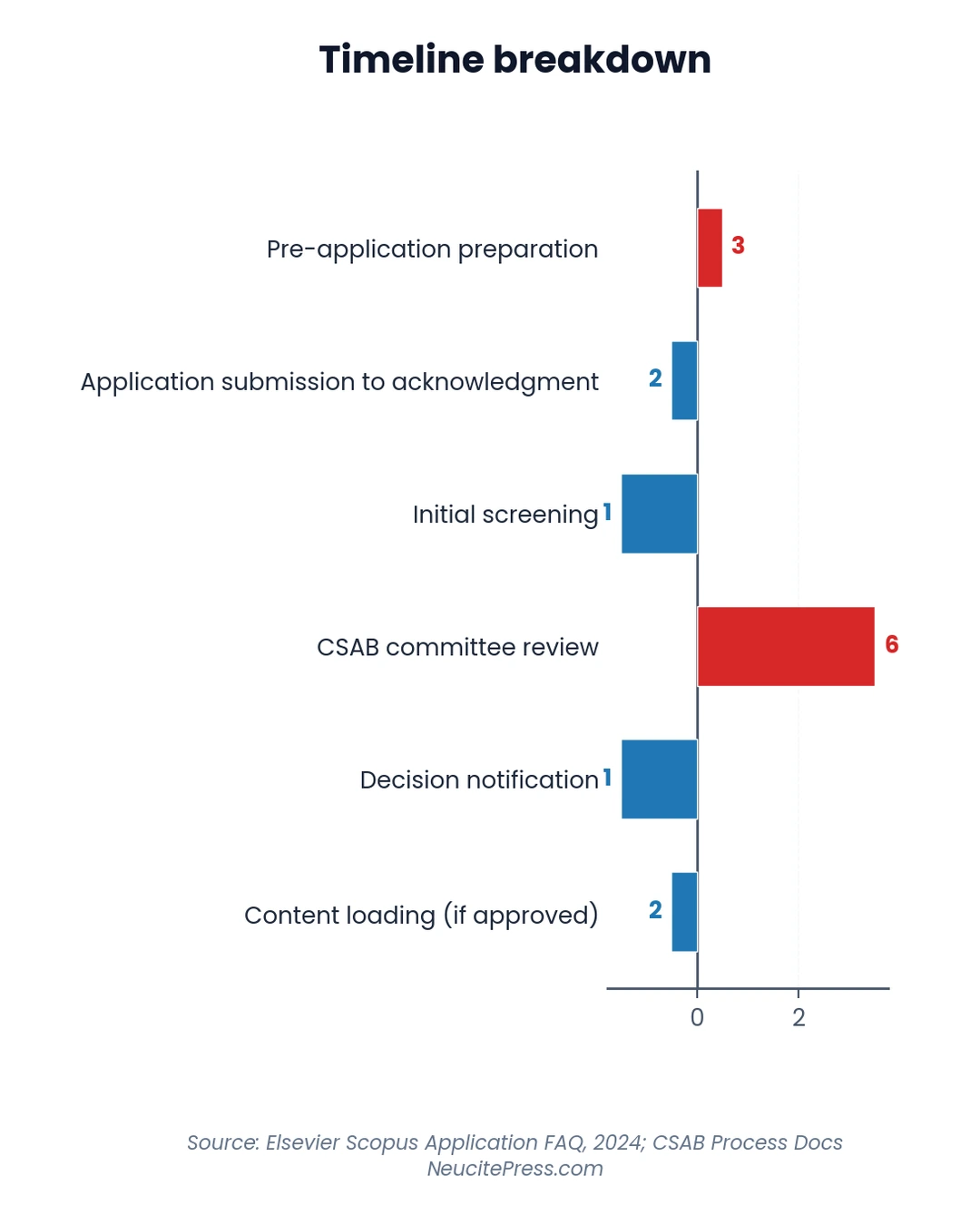
- Journal Application Review: 4-12 weeks
- Technical & CSAB Evaluation: 2-8 weeks
- Post-Publication Article Indexing: 2-12 weeks
- Complete Cycle: 6-12 months typical
Post-Publication Indexing Times by Publisher
- Major Publishers (Elsevier, Springer, Wiley): 2-3 weeks
- Standard Academic Publishers: 4-8 weeks
- Regional/Independent Publishers: 6-12 weeks
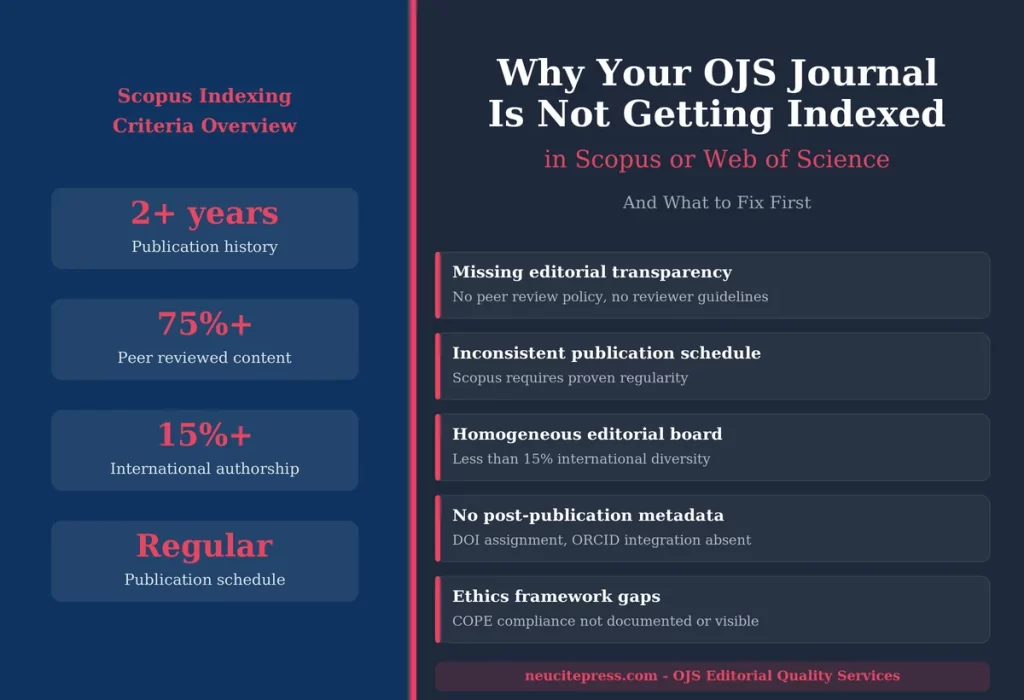
Timeline and outcome are the same question. The criteria the board scores against are listed in the 14 Scopus indexing requirements, and our indexing readiness service assesses a journal against them before submission.
The Journal Application Process Timeline
Before any articles can be indexed, the journal itself must pass Scopus evaluation. This is where most delays occur.
Stage 1: Initial Submission (Week 0)
Publishers submit applications through the official Scopus Title Evaluation Portal with:
- Valid ISSN (print/electronic)
- Peer review documentation
- Ethics statement
- Journal website with review information
- Recent sample issues
- Publishing schedule and archive access
Stage 2: Technical Review (Weeks 1-4)
Scopus technical evaluators assess basic compliance. This stage determines advancement to expert review.
Stage 3: Content Selection & Advisory Board Review (Weeks 5-12)
International expert panels evaluate journals across five dimensions:
- Journal Policy: Editorial board, ethics, retraction procedures
- Content Quality: Research rigor, methodology, citation potential
- Journal Standing: Publisher reputation, editorial independence
- Publishing Regularity: Consistent schedules, no major gaps
- Online Availability: Website accessibility, abstracts, archival stability

Scopus Acceptance Funnel: Real Data from 3,500+ Annual Applications
Scopus receives approximately 3,500 journal applications yearly. The acceptance funnel reveals actual timelines:
Key Factors Affecting How Long Scopus Indexing Takes
Publisher Size & Infrastructure
Publisher capability is the strongest predictor of indexing speed:
- Tier 1 (Elsevier, Springer, Wiley): Automated pipelines = 2-3 weeks
- Tier 2 (University Press): Batch submission = 4-8 weeks
- Tier 3 (Regional Publishers): Manual processes = 3-6 months
Metadata Quality Impact
Accurate metadata is critical. Incomplete data causes approximately 15-20% of delays:
Common Metadata Issues Adding Delays
- Incomplete author affiliations: +1-2 weeks
- Inconsistent DOI formatting: +2-3 weeks
- Missing keyword indexing: +1 week
- Incorrect subject category: +2-4 weeks
- Non-English abstract issues: +2-3 weeks
Journal Discipline Effects
Different academic fields experience varying timelines:
- STEM fields: Faster (2-4 weeks) – established standards
- Medicine/Healthcare: Moderate (4-8 weeks) – ethics review
- Social Sciences: Slower (6-12 weeks) – diverse patterns
- Humanities: Slowest (8-16 weeks) – specialized categories
2024 Policy Changes Affecting Timeline
August 2024 Update: Removed 2-Year Requirement
Scopus removed the two-year publication history requirement for new journals:
- Before: New journals needed 2+ years of publishing history
- Now: Can apply after establishing regular publication
- Impact: Expedites timeline for emerging publications by 12-24 months
- Requirement: CSAB still needs article count evidence
Generative AI Policy Emphasis
Scopus now requires or strongly encourages AI policies. Journals lacking AI statements face delays (add 1-2 weeks), while robust policies expedite review (save 1 week).
Tracking Your Scopus Application Status
Title Evaluation Tracker
After submission, you receive a Tracking ID for real-time status updates showing current phase, queue position, and estimated timeline.
Note: Early and frequent status checks don’t accelerate processing. Applications follow fixed schedules regardless of inquiry frequency.
What to Do While Waiting
- Enhance editorial board diversity
- Update website accessibility and design
- Audit and improve metadata accuracy
- Document citation impact of published articles
- Strengthen ethics policies including AI guidance
Strategies to Expedite Scopus Indexing
Publisher-Level Optimization
Author-Level Best Practices
- Complete affiliation information with institution name and country
- Consistent author name spelling across all publications
- Include DOIs in reference formatting
- Professional English abstract editing
- Standardized field-specific keywords
Handling Rejections & Reapplication Timeline
Two routes exist after a rejection, and they have different clocks: appealing the decision or a 90-day re-application strategy.
The Rejection Process
If rejected, Scopus provides detailed feedback on specific improvement areas. Feedback typically arrives 8-12 weeks after submission.
Reapplication Timeline
Post-Rejection Timeline
- 90-day embargo before reapplication
- 3-6 months for improvements
- Complete second application: 6-12 months
- Second attempt success rate: ~45%+ improvement
- Reapplications often have reduced review queue time
Realistic Expectations by Journal Type
Key Takeaways
- Post-Publication: 2-12 weeks for article indexing after publication
- Complete Timeline: 6-12 months from application to confirmed indexing
- Success Rate: Only 16.5% of applications succeed
- Publisher Impact: Major publishers achieve 2-3 weeks; smaller publishers 3-6 months
- Metadata Matters: Complete data can save 2-4 weeks
- Policy Updates: 2024 policy removed 2-year requirement; AI policies emphasized
- Best Practice: Plan 4-6 week buffer beyond official timelines
Frequently Asked Questions
Can I expedite Scopus indexing after rejection?
Yes. Most journals benefit from a 90+ day embargo before reapplication, using this time to strengthen policies and improve infrastructure. Second applications have approximately 45% higher acceptance rates when addressing specific CSAB feedback.
How do I check my Scopus application status?
Use the Scopus Title Evaluation Tracker with your assigned Tracking ID. This tool provides real-time updates on whether your application is in technical review or CSAB expert review phase, with typical queues suggesting 2-8 week wait times between phases.
What’s the fastest way to get indexed in Scopus?
Work with established major publishers maintaining direct Scopus data pipelines. Ensure error-free metadata, robust peer review documentation, and strong editorial board diversity. These factors can reduce typical timelines from 12 months to 3-6 months.
Does article quality affect indexing speed?
Article quality doesn’t directly affect post-publication indexing speed. Speed is determined by publisher infrastructure and metadata accuracy. However, journal quality (citation patterns, editorial standards) significantly affects whether the journal itself qualifies for Scopus.
How often does Scopus update its indexed content?
Scopus updates 2-3 times per year. Articles typically appear 2-12 weeks after publication. Major publishers trigger updates more frequently through automated feeds, while smaller publishers operate on monthly or quarterly cycles.
Need help with this? The timeline you get depends almost entirely on how complete the application is when it goes in. NeucitePress runs a Journal Health Check ($799) against the Scopus criteria before you apply, and if you have already been rejected, Why Scopus / Web of Science Said No ($699 per database) identifies what to fix before the re-application window opens.
Conclusion
How long does Scopus indexing take? The answer depends on which timeline you measure. For articles in already-indexed journals, expect 2-12 weeks. For journals applying to Scopus, plan 6-12 months from initial submission to confirmed database inclusion.
The 75% rejection rate underscores Scopus’s rigorous quality standards. Success requires strong publisher infrastructure, flawless metadata, credible peer review, and demonstrated editorial quality. The 2024 policy changes—removing the 2-year requirement and emphasizing AI policies—have reshaped application priorities and accelerated timelines for emerging journals.
Strategic planning starting 6-12 months before needing Scopus visibility gives researchers and publishers the best chance of success. Coupled with continuous quality improvements and proper metadata management, the journey becomes manageable and predictable.