
Week-Long Conference Organization: Complete Strategic Planning Guide for 1,200+ Attendees
Week-long conference organization is among the most complex logistical undertakings in academic event management. Unlike a single-day symposium or even a three-day congress, a five-to-seven-day event demands an entirely different planning architecture — one built around sustained attendee engagement, layered programming, rotating venue logistics, and a budget that can easily reach six or seven figures. This guide walks you through every phase of planning a successful week-long academic or medical conference for 1,200 or more attendees, from the 18-month strategy session to the post-event evaluation report.
Reviewed by the NeucitePress Editorial Board — PhD academics, peer-reviewed editors and subject-matter specialists.

Why Week-Long Conference Organization Demands a Different Approach
Most conference planning guides are written with two-day or three-day events in mind. Scale that to five, six, or seven days and the assumptions break down quickly. Attendee fatigue becomes a real concern. Multi-track programming must be carefully sequenced to avoid cannibalizing attendance. Catering contracts grow enormously complex. Your technology infrastructure needs to run reliably for an extended period. Speaker scheduling logistics multiply exponentially.
The numbers alone illustrate the difference. A well-organized 1,200-attendee, one-day event might require 15–20 planning committee members and a total budget of $400,000–$600,000. The same headcount stretched across seven days will typically require 40–60 committee members across specialized sub-committees and a budget of $1.5 million to $3 million or more, depending on venue, country, and programme complexity.
Understanding this difference is not meant to be discouraging — it is meant to ensure that your organizing committee begins the project with eyes wide open. When week-long conference organization is approached with the right structures from the outset, the result is an event that builds institutional prestige, advances scientific dialogue, and generates the kind of attendee loyalty that drives registration year after year. For a closer look at how logistics scale with attendance, see our guide on large medical conference logistics for 1,000+ attendees.
The Three Organizing Principles
Before diving into timelines and budgets, every week-long conference organizing committee should align on three foundational principles that will inform every decision that follows:
Principle 1 — Coherence over density. It is tempting to pack every available hour with programming. Resist this. Attendees need white space — unstructured time for networking, reflection, and recovery — or engagement collapses by day three.
Principle 2 — Modular scalability. Design each day as a module that functions independently but connects thematically to the whole. This makes last-minute changes — a cancelled keynote, a room reassignment — far less catastrophic.
Principle 3 — Data-driven iteration. Build in formal feedback mechanisms from day one. A week-long event has a rare advantage over shorter conferences: you can collect data on days one and two and make meaningful adjustments before day four.
The 18-Month Strategic Planning Timeline for Week-Long Conference Organization
Eighteen months is the minimum recommended lead time for a week-long conference of 1,200 or more. Some annual events with fixed dates begin scoping their next edition while the current one is still underway. Our detailed 18-month conference planning timeline covers week-by-week milestones; here we summarize the strategic phases.
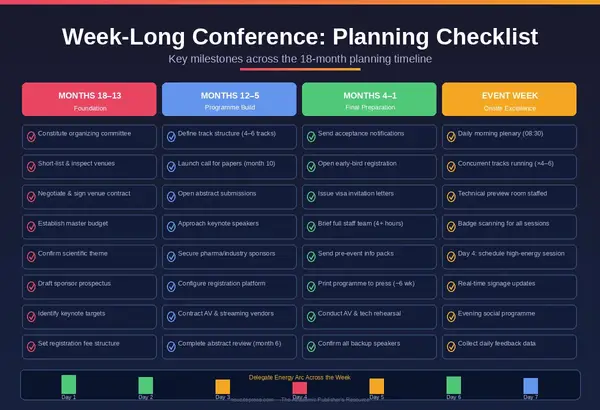
Months 18–13: Foundation Phase
This phase is entirely about decisions that are expensive or impossible to reverse later. The organizing committee — including the chair, scientific programme committee lead, logistics lead, finance lead, and communications lead — must be constituted before month 15 at the latest. Venue short-listing, contract negotiations, and deposit payments must be completed in this window. For a clear breakdown of who should hold which role, see our overview of conference committee roles and responsibilities.
Key deliverables at the end of this phase include a signed venue contract with room blocks, a ratified master budget, a confirmed scientific theme and sub-themes, and a preliminary sponsor prospectus ready for distribution.
Months 12–9: Programme Development Phase
The scientific programme committee now builds the intellectual architecture of the conference. This means defining the track structure (typically four to eight thematic tracks for an event of this size), setting abstract submission categories, drafting the call for papers, and approaching keynote speakers with sufficient lead time for international travel planning.
Your call for papers template should be live no later than month 10. Abstract submission systems should be tested and finalized by month 9. This is also the window to secure pharmaceutical or industry sponsors — a process that requires its own careful ethical framework, as detailed in our guide on how to secure pharmaceutical sponsors ethically.
Months 8–5: Operational Build-Out Phase
With the programme taking shape, operational teams now build all supporting infrastructure: registration platform configuration, hotel room block management, audio-visual contracts, catering menus, shuttle and transportation arrangements, and the conference app or delegate portal. Abstract review is completed and acceptance notifications go out by month 6. Final programme scheduling — resolving speaker conflicts, balancing track loads — is done in this window.
Months 4–1: Final Preparation Phase
This phase is dominated by communications — confirming registrations, processing payments, sending pre-conference information packages, issuing visa invitation letters, and managing the inevitable last-minute speaker withdrawals and substitutions. The final printed programme goes to the printer no later than six weeks before the event. Onsite staff briefing and rehearsals take place in the final two weeks.
Budget Management for a 1,200-Attendee Week-Long Conference
Budget management is where week-long conference organization most commonly goes wrong. The extended duration amplifies every line item, and the sheer volume of moving parts creates opportunities for cost overruns that would be negligible in a one-day event but catastrophic over a full week.
Revenue Sources
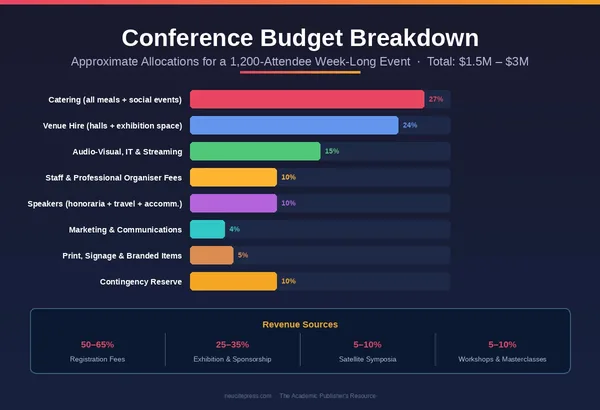
A well-structured revenue model for a 1,200-attendee week-long conference typically draws from four sources:
Registration fees should represent 50–65% of total revenue. For a medical or academic conference, early-bird fees for members of the organizing society might range from $800 to $1,500, with standard non-member rates of $1,200 to $2,200. A mix of full-week and single-day registrations is common — price single-day tickets at 30–40% of the full-week rate to incentivize full-week registration.
Exhibition and sponsorship income should represent 25–35% of revenue. A well-designed exhibition floor for an event of this size can accommodate 40–80 exhibitors. Sponsorship packages (gold, silver, bronze, plus à la carte items like lanyards, coffee breaks, and app sponsorship) can yield $300,000–$600,000 for a well-attended event in a competitive niche.
Satellite symposia and industry-sponsored sessions can generate $15,000–$40,000 per session. A five-day programme might accommodate six to ten such sessions with careful ethical oversight.
Workshop and masterclass fees for pre-conference or concurrent skills workshops, charged separately from the main registration, can add $50,000–$150,000 depending on the specialty and workshop format.
Expenditure Categories and Benchmarks
For budget planning purposes, the following approximate allocations are based on industry benchmarks for comparable events:
Venue hire (rooms, plenary hall, exhibition space) typically accounts for 20–28% of total expenditure. Audio-visual, IT, and streaming infrastructure: 12–18%. Catering (all meals, coffee breaks, social events): 22–30%. Speakers (honoraria, travel, accommodation): 8–12%. Printed materials, signage, and branded items: 4–6%. Staff (professional conference organiser fees, onsite staff): 8–12%. Marketing and communications: 3–5%. Contingency reserve: at minimum 8–10%.
The contingency reserve deserves special emphasis in week-long event planning. With seven days of operations, the probability of unexpected costs — a broken AV system, an emergency catering extension, a last-minute room requirement — is substantially higher than in a shorter event. A 10% contingency is not excessive; in our experience, many week-long conferences consume their full reserve and require ad hoc adjustments regardless.
Venue Selection for Week-Long Events
Venue selection for a week-long conference of this scale is constrained to a fairly narrow set of options: large convention centres, hotels with substantial conference facilities, or university campuses with purpose-built conference infrastructure. Each has distinct advantages and trade-offs.
Convention Centres
A dedicated convention centre offers the greatest flexibility in room configuration and the most reliable AV infrastructure. The drawbacks are that delegates must travel to and from hotels each day (introducing logistics complexity and attendee fatigue) and that catering is typically locked to in-house providers with less flexibility and higher per-head costs.
Conference Hotels
An all-in-one conference hotel — where the majority of delegates sleep, eat, and attend sessions in the same complex — dramatically reduces logistics overhead and improves networking. For a 1,200-person event, you will likely need a main hotel supplemented by overflow accommodation blocks at nearby properties, managed under a room block agreement. Ensure that overflow properties are within a 10-minute shuttle ride at most.
University Campuses
University campuses offer unique character and often lower hire costs, but they require significant investment in temporary infrastructure (catering tents, shuttle systems between buildings) and may constrain programming flexibility. They work best for events with a strong academic identity where the setting itself is part of the intellectual experience.
Critical Venue Requirements for Seven-Day Events
Beyond the basics, a week-long event imposes additional requirements on venue infrastructure that should be confirmed in writing before contract signature: reliable high-speed internet (with dedicated bandwidth guarantees, not shared access), adequate loading dock and storage access for exhibitors (who need to move substantial materials in and out), sufficient catering production capacity for peak meal service of 1,200 covers, accessible registration and information desk space that can be staffed continuously for seven days, and secure storage for delegate bags, poster boards, and exhibition materials overnight.
Multi-Track Programming Strategy
The programming structure of a week-long conference is where the scientific vision meets operational reality. For a 1,200-person event, a typical programme might run four to six concurrent tracks across a core hours block of 08:30–17:30 each day, with morning and afternoon plenary sessions that bring the entire audience together.
Track Architecture
Each track should be conceptually distinct enough that delegates experience minimal cross-track conflict — that is, they should rarely be forced to choose between two sessions that are equally relevant to their work. This requires careful consultation between the scientific programme committee and the abstract reviewers during session assignment.
Design the overall track arc across the week intentionally. Day one should be accessible and energising — choose keynote speakers with broad appeal and schedule foundational or overview sessions in the morning tracks. Build to greater technical depth and specificity in the middle of the week. Reserve the final day for synthesis, controversial debates, and future-directions sessions that send delegates home with intellectual momentum.
The Plenary Session Strategy
Plenary sessions serve a dual purpose: they provide intellectual anchor points that give the conference its identity, and they physically reunite the entire delegate community, counteracting the fragmentation that multi-track programming inevitably creates. For a week-long event, plan for one morning and one late-afternoon plenary each day — morning plenaries set the intellectual agenda for the day, while late afternoon plenaries create a communal ending that transitions naturally into social programming.
Award lectures, named lectureships, and society business meetings are best placed in afternoon plenaries, where attendance is high and the tone is celebratory. Technical keynotes — those requiring full delegate attention and notes — perform better in morning slots when cognitive energy is highest.
Speaker Management at Scale
A week-long conference for 1,200 attendees will typically involve 200–400 invited and abstract-selected speakers across plenary sessions, symposia, oral presentation sessions, workshops, and poster previews. Managing this volume of speakers requires systematic processes that prevent the small errors — wrong room assignment, missing AV file, missed dinner invitation — that erode speaker experience and damage reputation.
The Speaker Management System
Implement a centralised speaker portal no later than six months before the event. The portal should allow each speaker to: submit their final presentation file, confirm their session time and room, access their travel and accommodation confirmation, and indicate any AV requirements not met by the standard setup. Designate a named speaker liaison for each track, responsible for maintaining personal contact with the speakers in their track throughout the preparation period.
Establish a firm presentation upload deadline — five working days before the conference opens is a realistic minimum. Presentations submitted after this deadline should be flagged immediately, as last-minute files are a leading cause of AV failures and session delays. Build a dedicated technical preview room staffed throughout the conference where speakers can test their presentations before their session.
International Speaker Logistics
For large international events, a meaningful proportion of speakers will require visa support. Assign a dedicated visa support coordinator and establish a clear turnaround time for invitation letters (48 hours is the standard). Maintain a tracker of all visa applications and flag those at risk of delay to the speaker and to the session chair by four months before the event. Always have at least two confirmed backup speakers for each plenary slot, ready to substitute if a visa is denied or travel becomes impossible.
Registration and Delegate Logistics
Registration management for a 1,200-person week-long conference is a continuous operation that begins 12 months before the event and does not end until the final post-event invoice is settled. The registration team — even if supported by an automated platform — should include at least one experienced registration manager and a dedicated team of two to three for onsite processing.
Registration Platform Requirements
For an event of this scale and duration, the registration platform must support: tiered pricing (early bird, standard, late, onsite, day pass, student, accompanying person), group bookings, abstract submission integration, session-specific workshop registration with capacity management, dietary requirement collection, accessibility requirement flagging, and integration with the conference app for badge generation. Budget for a professional registration system rather than a generic event ticketing tool — the complexity justifies the cost.
Badge and Access Management
For a week-long event, RFID-enabled or QR-code badges that track session attendance are increasingly standard. The data collected is valuable for post-event reporting, for demonstrating CPD/CME compliance to delegates, and for understanding which sessions drove the greatest engagement. Ensure the system can generate individual attendance certificates automatically at the end of the conference — this reduces staff load dramatically compared to manual certificate processing.
Technology Infrastructure
Technology failures at a week-long conference are not merely inconvenient — they can derail scientific sessions, cut off remote presenters, and undermine the confidence of the entire organizing committee in real time. Technology infrastructure planning must be treated as a core operational function, not an afterthought.
Network and Connectivity
Commission a dedicated network assessment of your venue no later than six months before the event. For 1,200 delegates, all actively using devices during sessions, the minimum bandwidth requirement is typically 500 Mbps symmetrical, with burst capacity to 1 Gbps. Dedicated Wi-Fi SSIDs for speakers and staff — isolated from the delegate network — prevent congestion during critical moments. All plenary AV systems should be connected via wired ethernet, never over Wi-Fi.
Hybrid and Live-Streaming Components
Post-pandemic, a significant proportion of week-long conferences now offer hybrid attendance options — either full live streaming or session-on-demand access for registered delegates who cannot attend in person. If you are planning a hybrid component, this should be designed from the outset, not added as an afterthought in the final months. Hybrid production requires dedicated cameras, operators, an encoding workstation, and a streaming platform — all of which need testing and rehearsal. Budget accordingly: a competent hybrid production setup for a plenary hall typically adds $15,000–$30,000 per day in production costs.
Catering and Social Programming
For a week-long event, catering and social programming are not peripheral concerns — they are central to the delegate experience and to the financial success of the event. Attendees who feel well-fed, socially connected, and entertained return the following year. Those who feel exhausted, poorly fed, and overscheduled do not.
Catering at Scale
For 1,200 delegates, daily catering typically includes morning coffee and pastries before the first session (30-minute window, high throughput required), a mid-morning coffee break (20 minutes), a seated or standing lunch (60–90 minutes), an afternoon coffee break (20 minutes), and a post-session drinks reception at least two or three evenings per week. Dietary requirement collection must be rigorous — at 1,200 covers, a poorly managed dietary system creates significant operational risk and can cause harm.
Build a detailed catering brief that specifies per-head estimates for each service, allergen management protocols, themed menu concepts for each evening event, and service timing tied to the programme schedule. Share this brief with your caterer at least three months before the event and conduct a formal pre-event briefing meeting with all catering department heads.
Social Programme Design
A week-long conference should include at minimum: a welcome reception (day one evening, informal, free bar), a gala dinner or awards banquet (mid-conference), and a closing drinks reception. Additional evenings should offer structured but optional social activities — city tours, cultural events, or sporting activities — that allow delegates to choose their level of social engagement.
The gala dinner is particularly important for an event of this scale. It serves as a communal high point and a fundraising vehicle if awards are presented during the dinner. Venue selection for the gala dinner often takes nearly as much planning as the main venue — it must be accessible from the conference venue, have sufficient capacity for all delegates (or be designed as a ticketed premium event if full-capacity seating is cost-prohibitive), and have catering of a quality that justifies its position as the social centrepiece of the week.
Risk Management for Week-Long Events
A week-long conference concentrates risk in a way that shorter events do not. Seven days of operations means seven times the exposure to equipment failures, health incidents, weather disruptions, and speaker cancellations. Formal risk management — not informal “we’ll deal with it when it happens” thinking — is essential.
Risk Register and Contingency Protocols
Build a formal risk register no later than six months before the event. Each risk should be rated by likelihood and impact, assigned an owner, and paired with a mitigation strategy and a contingency response. High-priority risks for a week-long event typically include: lead keynote cancellation within 60 days of the event, AV system failure during a plenary session, catering supply disruption, delegate medical emergency, venue damage or force majeure, and cyber-security incident affecting the registration platform.
For each high-priority risk, the contingency protocol should be documented in writing, shared with the relevant committee members, and rehearsed where possible. The lead keynote cancellation protocol, for example, should name the replacement speaker, specify who contacts them and when, and clarify how the programme will be adjusted in the interim.
Health and Safety
For a medical conference, health and safety planning has an additional dimension: your delegates are typically health professionals, and the event itself may attract significant media or public attention. Ensure you have a named medical officer on duty throughout the event, a documented first aid response plan, clearly marked first aid stations, AED availability, and a relationship with the nearest emergency department. For large events in international destinations, brief all senior staff on local emergency services protocols before the event opens.
Post-Event Evaluation
The value of a week-long conference is not fully realized until the post-event evaluation is complete and acted upon. Many organizing committees treat the closing reception as the end of the project. In reality, it marks the beginning of a critical three-month evaluation phase that will determine the quality of the next edition. For those planning recurring annual events, see our guide on annual conference planning and year-over-year momentum building.
Evaluation Mechanisms
A comprehensive post-event evaluation for a week-long conference should include: a delegate satisfaction survey (target 30–40% response rate; incentivize with early access to abstract proceedings), a speaker satisfaction survey, an exhibitor and sponsor satisfaction survey, a session-level attendance analysis from badge scanning data, social media sentiment analysis, financial reconciliation against budget, and a committee debrief session within three weeks of the event.
The session-level attendance data is particularly valuable for multi-track programmes. Which sessions were oversubscribed? Which ran at 40% capacity? The answers should directly inform the track structure and session allocation in the following year’s programme.
Common Mistakes in Week-Long Conference Organization
Despite the best planning intentions, certain mistakes appear repeatedly in post-event evaluations of large week-long conferences. Awareness of these patterns is the most efficient form of risk management available to a new organizing committee.
Underestimating programme density fatigue. The temptation to fill every available session slot is nearly universal and consistently regretted. Six sessions running simultaneously from 08:30 to 19:00 across seven days will produce audience exhaustion, poor session attendance in the latter half of the week, and negative delegate feedback regardless of programme quality. Build rest into the programme deliberately.
Inadequate staff briefing. At a seven-day event with 1,200 delegates, your onsite staff team may number 60–100 individuals. Staff who do not know the programme, cannot answer basic logistical questions, or are unclear about their escalation chain create delegate frustration at scale. Invest in thorough staff briefing — a minimum of four hours of structured orientation on the day before opening — and produce a staff handbook that covers every foreseeable scenario.
Underinvesting in signage. In a large convention centre or multi-building campus venue, delegate wayfinding is a recurring friction point. Digital and physical signage must be comprehensive, updated in real time as room assignments change, and clearly visible from all major circulation routes. Poor wayfinding is one of the most commonly cited frustrations in post-event surveys of large conferences — it is cheap to get right and expensive (in delegate satisfaction terms) to get wrong.
Treating the abstract book as optional. In an era of digital programmes, printed or downloadable abstract books are sometimes deprioritized. This is a mistake for a week-long event, where delegates use the abstract book not just for session navigation but for note-taking, post-event reference, and citation. Ensure the abstract book is professionally produced, DOI-stamped if appropriate, and available in both digital and print formats.
Not planning for the mid-conference energy dip. Day four of a seven-day conference is almost universally the most challenging for delegate energy and attendance. Plan specifically for this: schedule your most dynamic or controversial session on day four morning, use the afternoon for interactive workshops rather than passive listening sessions, and organize a particularly engaging social activity for day four evening.
For organizers who are earlier in their event planning journey, our guides on small academic conference planning for 50 attendees and single-day symposium planning provide foundational principles that scale upward.
How NeuCitePress Supports Conference Organizers
Professional Conference Planning Resources from NeuCitePress
NeuCitePress publishes peer-reviewed guides, toolkits, and planning resources developed specifically for academic and medical conference organizers. Whether you are planning your first major event or refining the processes of an established annual congress, our resources are designed to help you build conferences that advance science and create lasting professional communities.
Our flagship guide, How to Organize a Medical Conference: The Complete 2026 Guide, covers the full planning lifecycle with downloadable templates, budget models, and speaker management tools.
Frequently Asked Questions
How early should week-long conference organization begin?
For a week-long conference of 1,200 or more attendees, planning should begin at least 18 months before the event opens. Venue contracting, keynote speaker outreach, and sponsor prospectus distribution all require this lead time. Annual events often begin planning the next edition while the current event is still underway, using the post-event evaluation as the starting point for the subsequent programme.
What is a realistic budget for a week-long conference with 1,200 attendees?
Total expenditure for a well-organized week-long academic or medical conference with 1,200 attendees typically falls in the range of $1.5 million to $3 million, depending on the venue country, programme complexity, and social programme ambition. Venue and catering together typically account for 42–58% of total costs. Revenue from registration fees, sponsorship, and exhibition income generally covers 95–110% of costs for established events with strong brand recognition. First-edition events should budget for a potential shortfall of 10–20% and have contingency funding in place.
How many organizing committee members are needed for a week-long event?
A week-long conference for 1,200 attendees typically requires a core organizing committee of 15–25 members, supported by sub-committees for the scientific programme (10–20 reviewers and track chairs), sponsorship and exhibitions, communications and marketing, registration and logistics, social programme, and technology. The total number of people with formal committee roles often reaches 60–100. A professional conference organiser (PCO) or event management company is strongly recommended to provide operational management, allowing scientific committee members to focus on programme quality.
How many concurrent tracks should a week-long conference run?
For 1,200 attendees, four to six concurrent tracks during breakout session hours is the typical range. Fewer than four tracks fails to serve the audience diversity of a large event; more than six creates choice paralysis and fragments attendance to the point where individual sessions feel under-attended. Tracks should be thematically distinct to minimize scheduling conflicts for delegates with broad interdisciplinary interests. At least one morning and one afternoon plenary session each day should bring all tracks together in the main hall.
What is the biggest risk in week-long conference organization?
Based on post-event evaluations across comparable events, the most commonly cited risk that materializes into actual problems is inadequate contingency planning for programme changes — particularly keynote speaker cancellations within 60 days of the event. The second most significant risk is budget overruns in catering, typically driven by underestimating the per-head cost of week-long refreshment provision and evening events. A minimum 10% contingency reserve and confirmed backup speakers for all plenary slots are the two most high-return risk mitigation investments an organizing committee can make.
References and Further Reading
- Silvers JR. Professional Event Coordination. 2nd ed. Hoboken, NJ: Wiley; 2012.
- Allen J, O’Toole W, McDonnell I, Harris R. Festival and Special Event Management. 6th ed. Brisbane: Wiley Australia; 2022.
- International Congress and Convention Association (ICCA). ICCA Statistics Report: The International Association Meetings Market. Amsterdam: ICCA; 2024.
- Fenich GG. Meetings, Expositions, Events, and Conventions: An Introduction to the Industry. 5th ed. Pearson; 2019.
- Mair J, Whitford M. An exploration of events research: event topics, themes and emerging trends. International Journal of Event and Festival Management. 2013;4(1):6–30. doi:10.1108/17582951311307485
- Maritz A, Hosie P. Transforming events management education through innovative pedagogies. Journal of Convention & Event Tourism. 2011;12(4):288–303.
