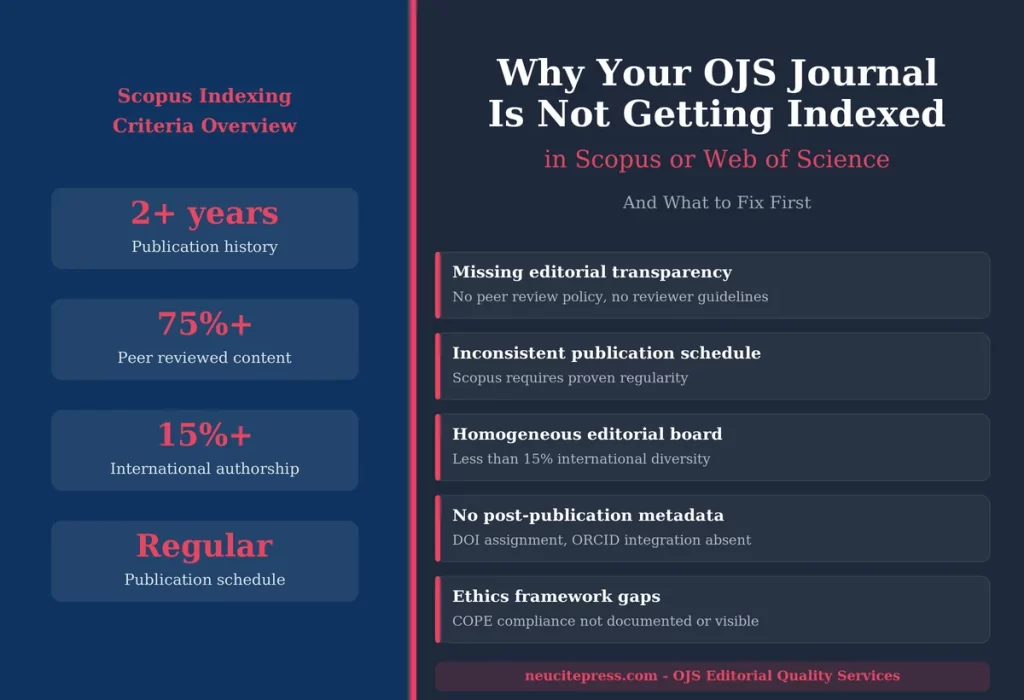
SCI Indexed Journal Requirements: Complete Clarivate Evaluation Criteria 2026
Academic publishers worldwide face a critical challenge: how to meet SCI indexed journal requirements and gain recognition from Clarivate’s prestigious Web of Science database. With fewer than 15% of journal submissions achieving acceptance on their first attempt, understanding the evaluation framework has become essential for editorial teams seeking international visibility.
Reviewed by the NeucitePress Editorial Board — PhD academics, peer-reviewed journal editors and medical communication specialists.
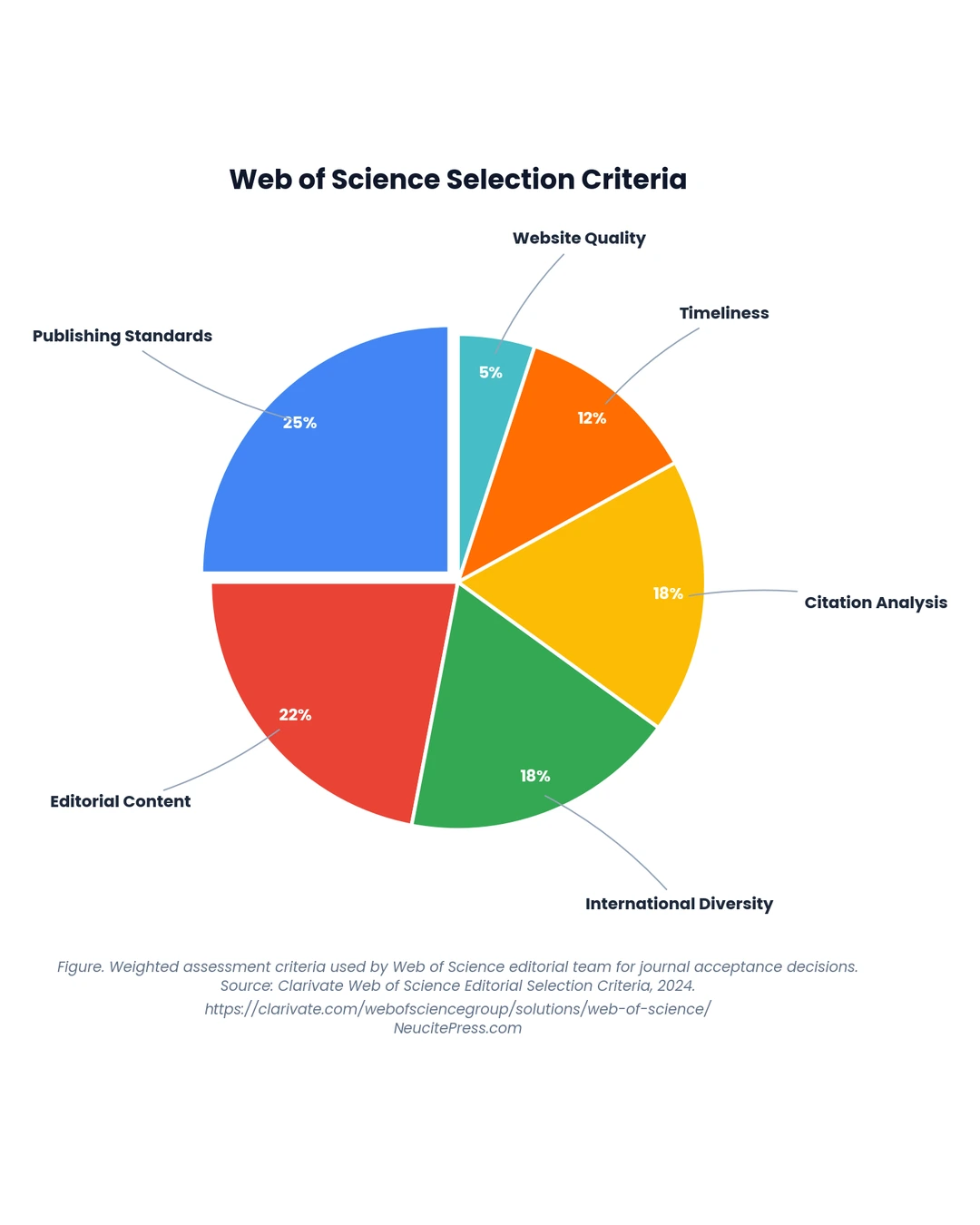
This comprehensive guide demystifies the SCI indexed journal requirements that Clarivate uses to evaluate submissions. Whether you’re launching a new scholarly publication or optimizing an existing journal for indexing eligibility, you’ll discover the specific criteria, quality standards, and operational benchmarks that determine acceptance or rejection.
What Are SCI Indexed Journal Requirements?
SCI indexed journal requirements refer to the comprehensive set of quality, ethical, and operational standards that publications must meet to gain inclusion in Clarivate’s Science Citation Index, Science Citation Index Expanded (SCIE), or Emerging Sources Citation Index (ESCI). These requirements form the foundation of academic publishing integrity and scholarly impact measurement.
Understanding Clarivate’s Three-Tier Indexing System
Clarivate maintains three distinct indexing tiers, each with specific SCI indexed journal requirements:
Science Citation Index Expanded (SCIE): The flagship collection representing the world’s most influential scholarly journals. SCIE-indexed publications demonstrate exceptional citation performance and editorial excellence. Acceptance represents the highest recognition tier and typically requires 3-7 years of sustained performance at ESCI level before promotion. SCIE journals command significantly higher submission rates and attract leading researchers in their fields.
Emerging Sources Citation Index (ESCI): A dynamic collection for developing journals that meet core quality standards but haven’t yet demonstrated sustained citation impact. ESCI serves as the entry point for most new journals pursuing SCI indexed journal requirements compliance. Approximately 70% of new journal applications are accepted to ESCI, making it an achievable milestone for well-managed publications. ESCI journals remain under continuous monitoring for potential promotion to SCIE based on citation performance.
Science Citation Index (SCI): A historical designation now largely replaced by SCIE. Legacy publications may retain SCI indexing, but new acceptances typically go directly to ESCI or SCIE based on performance metrics. Understanding SCI vs SCIE distinction is important for older journals, but most contemporary applications target ESCI as the initial milestone.
This tiered approach reflects the reality that SCI indexed journal requirements operate on a spectrum. Publications don’t simply succeed or fail—they progress through demonstrated quality and citation performance over time. The dynamic nature of these tiers means journals can advance when meeting higher standards or be demoted if quality metrics decline.
Clarivate’s 28 Evaluation Criteria: The Complete Framework
At the heart of all SCI indexed journal requirements lies Clarivate’s evaluation framework of 28 specific criteria. Understanding these criteria is fundamental to successful indexing applications. Clarivate’s team of expert editors applies these criteria uniformly across all submissions, ensuring consistency while allowing for disciplinary variations.
The 24 Quality Criteria: Editorial Standards and Operations
Twenty-four of the 28 SCI indexed journal requirements focus exclusively on editorial quality, publication ethics, and operational excellence. Clarivate organizes these into five essential categories that cover every aspect of scholarly publication:
1. Publishing Standards and Practices (6 criteria)
- Valid International Standard Serial Number (ISSN) registration with the ISSN International Centre
- Digital Object Identifier (DOI) assignment system for all published articles through CrossRef or equivalent
- Transparent editorial board with institutional affiliations and current contact information publicly displayed
- Clear, narrowly-focused journal scope statement that guides author submissions
- Consistent publication frequency and schedule adherence (no unexplained gaps)
- Professional website with complete journal information, policies, and author guidelines readily accessible
2. Peer Review and Editorial Integrity (6 criteria)
- Documented peer review policy clearly describing the review process and standards
- Conflict of interest screening and disclosure requirements for both reviewers and editors
- Qualified reviewer selection processes with expertise verification in relevant subject areas
- Reasonable review timelines that respect both reviewer and author needs (typically 60-90 days)
- Formal appeals mechanism allowing authors to dispute rejection decisions with new evidence
- Transparent reporting of acceptance and rejection rates demonstrating review rigor
3. Publishing Ethics and Transparency (6 criteria)
- Plagiarism detection system integration with defined thresholds and response procedures
- Authorship and contributor role documentation using standardized systems like CRediT
- Retraction and correction policies aligned with Committee on Publication Ethics (COPE) guidelines
- Disclosure of funding sources, competing interests, and author conflicts of interest
- Data availability and reproducibility commitments for appropriate research types
- Ethical approval documentation for human subjects, animal research, and sensitive data studies
4. Technical Operations and Digital Infrastructure (3 criteria)
- Permanent digital archiving with verified backup systems ensuring long-term content preservation
- Mobile-responsive website design enabling access across all device types
- XML metadata formatting enabling automated indexing by search engines and databases
5. Content Quality and Scope Management (3 criteria)
- Disciplinary focus consistency across published articles demonstrating clear editorial vision
- International author and editor representation showing global scholarly engagement
- Appropriate article types and content organization aligned with stated journal scope
The 4 Citation Impact Criteria: Measuring Scholarly Influence
Beyond editorial quality, Clarivate evaluates four citation-based metrics that directly assess a publication’s scholarly influence in its field:
Citation Performance Metrics
- Citing article frequency and citation rate trends demonstrating that research communities cite journal content
- Citation half-life showing how long published articles remain relevant and continue receiving citations
- Comparative performance against disciplinary peers in similar specialties and research areas
- International citation patterns demonstrating that cited work has cross-border scholarly impact
These SCI indexed journal requirements emphasize that quality alone doesn’t guarantee success. Publications must demonstrate that researchers actively cite their content—evidence of genuine scholarly impact and influence. Clarivate recognizes that citation patterns vary by discipline, so evaluation considers field-specific norms and expectations.
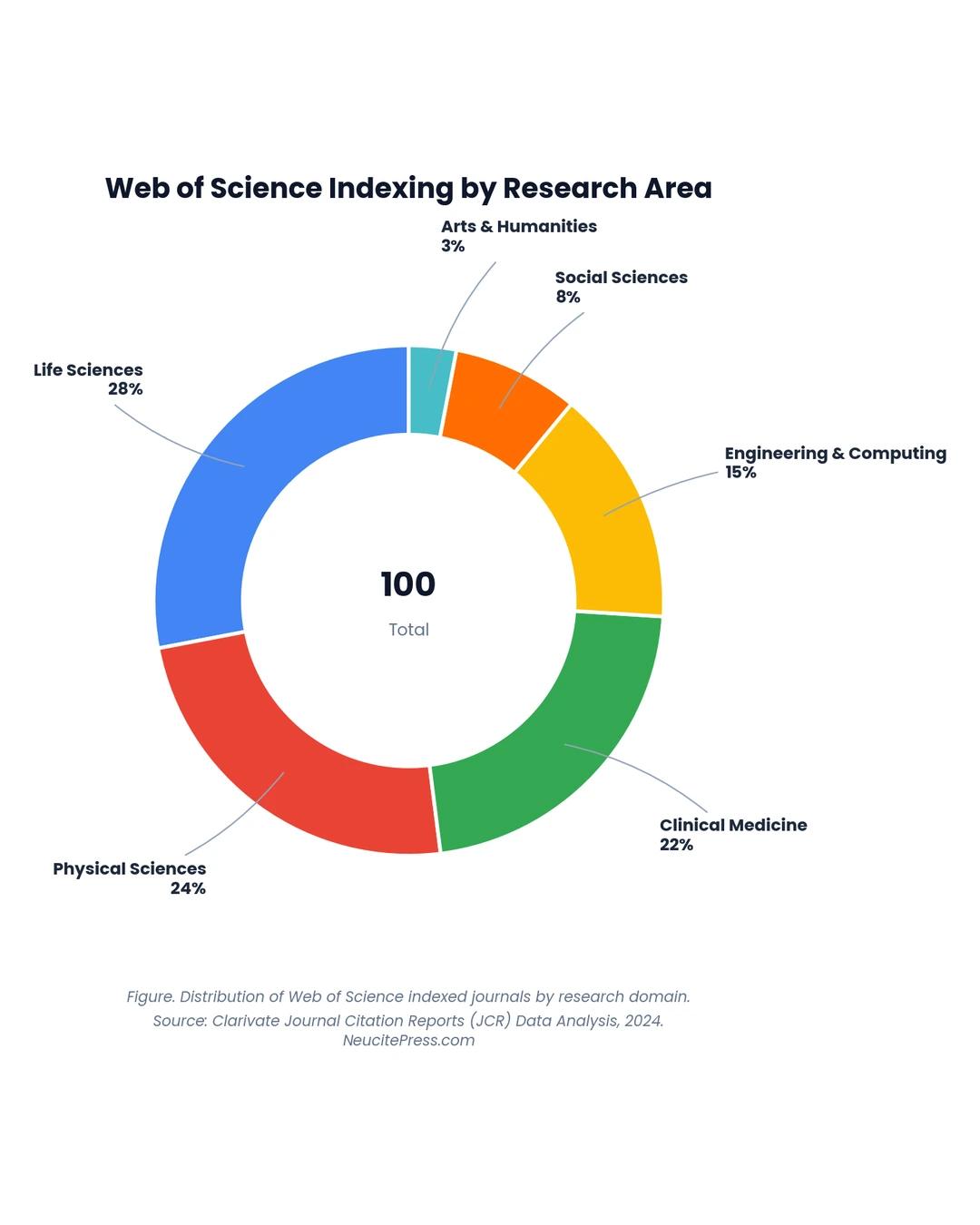
Common Rejection Reasons: Why SCI Indexed Journal Requirements Applications Fail
Understanding common rejection patterns helps publications avoid preventable mistakes when pursuing SCI indexed journal requirements compliance. Research shows these reasons account for 88% of rejections:
Editorial Board Deficiencies (35% of rejections)
The most frequent cause of rejection relates to editorial board composition and structure. Clarivate’s evaluators scrutinize whether editorial boards demonstrate genuine expertise, international representation, and active engagement. Common issues include:
- Boards dominated by single institutions creating appearance of bias and limiting diverse perspectives
- Limited geographic diversity reducing international credibility and global relevance
- Board members lacking active research records or current publication history
- Insufficient disciplinary expertise in core subject areas covered by the journal
- Honorary positions filled by retired researchers with limited current engagement in field
- Missing institutional affiliations or out-of-date contact information
- Editorial boards smaller than 8-10 members indicating insufficient editorial capacity
Successful applications typically feature editorial boards with 10-15 members representing 8 or more countries and 6 or more institutions. Board members should demonstrate active publication records within the past 3 years and clear expertise in the journal’s subject area.
Peer Review Documentation Gaps (28% of rejections)
Clarivate requires detailed documentation of peer review procedures demonstrating systematic quality control. Many publications fail to meet SCI indexed journal requirements because they lack:
- Formal written peer review policy documents detailing procedures and standards
- Documented reviewer selection criteria and expertise qualifications
- Records demonstrating conflict-of-interest screening implementation
- Evidence of timely review completion with reviewer report dates and turnaround times
- Sample rejection notifications showing constructive feedback and specific improvement suggestions
- Documented appeals process and examples of appeals handled
- Tracking systems showing review consistency and fairness across submissions
Applications require 10-20 sample peer review cases thoroughly documented showing the systematic process. Each case should include decision correspondence, reviewer reports, author responses, and final editorial decisions demonstrating quality control.
Publishing Ethics Policy Weaknesses (18% of rejections)
Many journals underestimate the rigor required for SCI indexed journal requirements in ethics policies. Common shortfalls include:
- Vague plagiarism detection procedures without specified tools or acceptable similarity thresholds
- Missing data on actual plagiarism cases discovered and corrective action taken
- Inadequate authorship dispute resolution procedures for multi-author conflicts
- No documented retraction policy aligned with COPE guidelines or examples of retractions handled
- Insufficient ethical approval documentation for sensitive research including human subjects studies
- Missing data availability statements or reproducibility commitments
- Unclear funding disclosure or conflict of interest management procedures
Strong applications include detailed ethics policies with specific thresholds (e.g., plagiarism detection at 25% similarity), documented examples of cases handled, and clear procedures for various ethical violations. Publications should demonstrate proactive ethics management, not reactive responses to problems.
Citation Impact Inadequacy (12% of rejections)
Even journals meeting all editorial quality criteria may be rejected if they fail to demonstrate citation impact. SCI indexed journal requirements include thresholds for:
- Minimum citation rates relative to journal age and subject discipline
- Citation velocity showing increasing citation frequency over time rather than declining
- International citation patterns with citations from multiple countries indicating global relevance
- Self-citation ratios within acceptable limits (typically below 20%) avoiding appearance of artificial inflation
- Citation distribution showing that most published articles receive some citations rather than citations concentrated in few articles
Journals must demonstrate that their content is actually cited by the research community. Early-stage journals often improve citation metrics by publishing highly relevant content in growing fields, engaging international authors, and building visibility within scholarly networks.
Technical and Compliance Issues (7% of rejections)
Technical SCI indexed journal requirements often prove easier to address than editorial issues, yet some journals stumble on basic requirements:
- Website accessibility problems or outdated technical infrastructure preventing indexer access
- Missing XML metadata in article records or incomplete bibliographic information
- Inadequate digital archiving systems or backup procedures lacking long-term preservation strategy
- Non-mobile-responsive website design excluding mobile device users
- Missing DOI assignment or inconsistent DOI practices across publication years
- Unclear publication dates or sequencing issues affecting article identification
Step-by-Step Preparation Timeline for SCI Indexed Journal Requirements
Successful applications require systematic planning and phased implementation. Here’s a realistic 18-24 month preparation timeline that most publications follow:
Months 1-3: Assessment and Planning Phase
- Conduct comprehensive gap analysis comparing current practices against all 28 criteria
- Document current practices and identify specific deficiencies requiring attention
- Establish target submission date (typically 24-30 months post-launch for new journals)
- Create detailed action plan with specific tasks, responsible parties, and completion dates
- Budget for technical improvements, staff development, and potential consulting support
- Establish internal tracking systems to monitor progress against timeline
Months 4-8: Editorial Infrastructure Development Phase
- Recruit and formalize editorial board members (target 10-15 members from 8+ countries)
- Develop formal peer review policy documentation describing procedures and standards
- Implement plagiarism detection system integration (Turnitin, Copyscape, or equivalent)
- Create comprehensive ethics policy documents covering authorship, conflicts, retractions
- Establish reviewer management systems and develop reviewer database
- Implement DOI assignment system and configure digital object identifier infrastructure
Months 9-14: Process Documentation and Case Development Phase
- Complete 20-30 detailed sample peer review cases with full documentation
- Document all rejection decisions with reviewer feedback and editorial rationales
- Create formal procedures manuals for all processes including peer review, ethics, retractions
- Implement XML metadata systems and verify metadata completeness
- Archive and verify digital backup procedures with preservation strategy documentation
- Gather evidence of international representation and editorial board engagement
Months 15-18: Quality Assurance and Citation Development Phase
- Conduct third-party audit of documentation completeness against 28 criteria
- Review citation metrics and analyze performance trends across published articles
- Optimize website technical performance and mobile responsiveness testing
- Prepare sample materials for submission package including guidelines and policies
- Conduct internal compliance review against all 28 criteria identifying remaining gaps
- Develop citation promotion strategies to increase scholarly visibility
Months 19-24: Application Preparation and Submission Phase
- Compile comprehensive application documentation with all required materials
- Register publisher account on Clarivate portal and familiarize with submission system
- Submit formal application with complete documentation package
- Respond promptly to evaluation team queries and additional information requests
- Participate in supplementary documentation requests providing clarifications as needed
- Maintain editorial excellence during evaluation period as journal remains under assessment
SCI Indexed Journal Requirements by Disciplinary Focus
While the 28 core criteria apply universally, specific disciplinary contexts impose additional nuances that successful journals must address:
Biomedical and Life Sciences Journals: These fields face stricter requirements for ethical approval documentation, with particular emphasis on human subjects protection and informed consent procedures. Publications must demonstrate compliance with Declaration of Helsinki standards and relevant institutional review board (IRB) approval processes. Clinical trial registration requirements may apply depending on research types published. These journals often need to document data sharing policies and open science commitments reflecting community standards in biomedicine.
Social Sciences and Humanities Journals: These disciplines require different citation patterns as books and book chapters are cited more frequently than journal articles. Evaluators adjust impact expectations accordingly accounting for discipline-specific citation norms. However, international representation in editorial boards remains equally important. These fields may have different publication timelines and article lengths that should be clearly documented in scope statements.
Engineering and Technology Journals: These fields emphasize technical innovation and practical applications beyond theoretical contributions. While citation impact remains important, evaluators also consider whether content addresses real-world engineering challenges and contributes to technological advancement. Patent citations may be relevant for some engineering journals. Industry engagement and applied research representation may strengthen applications in these fields.
Regional and National Journals: Emerging research economies may face higher barriers to SCI indexed journal requirements due to citation patterns and geographic concentration. However, Clarivate has acknowledged this disparity and created the ESCI tier specifically to support developing scholarly communities. Regional journals should emphasize international editorial board representation, translation quality if non-English language publications, and efforts to build citation networks across geographic regions.
Differences Between SCI, SCIE, and ESCI in 2026
Understanding how these indexing tiers differ clarifies the progression path for most journals pursuing SCI indexed journal requirements:
ESCI (Emerging Sources Citation Index): Entry-level indexing for journals meeting all 24 editorial quality criteria. ESCI journals must satisfy all SCI indexed journal requirements for quality and ethics but haven’t yet demonstrated sustained citation impact. Most new journal applications enter ESCI. Average duration before promotion: 3-7 years. ESCI provides immediate benefits including increased visibility, author credibility, and submission rates while journals develop citation impact metrics. ESCI inclusion signals quality assurance to researchers and institutions even without mature citation data.
SCIE (Science Citation Index Expanded): Flagship collection for high-performing journals demonstrating exceptional citation impact. SCIE requirements are identical to ESCI for editorial quality (24 criteria), but citation performance (4 criteria) must meet strict thresholds. Only 15-20% of ESCI journals ever achieve SCIE promotion. SCIE indexing provides maximum scholarly prestige and author incentives. Journals remain eligible for inclusion in impact factor calculations and receive highest visibility in research evaluation systems.
SCI (Historical Science Citation Index): Largely historical designation now consolidated into SCIE. No new journals are accepted to SCI; legacy journals retain their designation for continuity. This tier is essentially obsolete for new applications. Understanding SCI legacy status helps when evaluating older journals or historical publication records.
Dynamic Progression and Demotion: Importantly, SCI indexed journal requirements operate dynamically. ESCI journals demonstrating strong citation growth can be promoted to SCIE. Conversely, SCIE journals experiencing citation declines may be moved back to ESCI. This system ensures indexing reflects current scholarly impact rather than historical reputation. Journals must maintain quality standards continuously, not just at application time.
Key Statistics on SCI Indexed Journal Requirements Success Rates
Application Success Metrics (2024-2025 data)
- 12-18% of initial applications achieve acceptance to ESCI or higher
- Average applicants require 2.3 submission attempts over 4-7 years total
- 67% of rejections involve correctable editorial deficiencies rather than fundamental flaws
- Publications from established research economies: 22% acceptance rate on initial attempts
- Publications from emerging economies: 9-12% acceptance rate reflecting citation disadvantages
- Journals with 3+ years publication history: 35% acceptance rate
- Journals under 2 years old: 2% acceptance rate (insufficient evaluation period)
- Journals with documented peer review: 45% acceptance rate vs 8% without documentation
- Journals with explicit ethics policies: 38% acceptance rate vs 15% without
Impact of Successful Indexing
- Submission volume increases by average 340% within 18 months post-acceptance
- Citation rate increases by 250-400% within 3 years post-indexing
- Journal reputation scores improve by 2-3 points on 5-point scale
- Editorial board recruitment becomes 50% easier post-acceptance
- Author manuscript quality improves significantly attracting stronger submissions
- Institutional support and funding opportunities increase substantially
- International author participation increases by 200%+ post-indexing
Actionable SCI Indexed Journal Requirements Checklist
Editorial Quality Category (Score 24 criteria)
- [ ] Valid ISSN registration confirmed with ISSN International Centre
- [ ] DOI assignment system integrated and functional for all published articles
- [ ] Editorial board documented with 8+ members from 6+ countries with affiliations
- [ ] Journal scope statement clear, concise, and narrowly focused
- [ ] Publication schedule consistent and publicly stated with no unexplained gaps
- [ ] Professional website with complete journal masthead and policies
- [ ] Formal peer review policy document drafted and publicly published
- [ ] Conflict of interest screening procedures documented and implemented
- [ ] Reviewer expertise verification system in place with documented procedures
- [ ] Review timeline targets (60-90 days) established and tracked
- [ ] Formal appeals process for rejection decisions published in guidelines
- [ ] Acceptance and rejection rates tracked and documented with annual reporting
- [ ] Plagiarism detection tool integrated with clear thresholds defined
- [ ] Authorship and contributor role documentation system implemented
- [ ] Retraction policy aligned with COPE guidelines and examples documented
- [ ] Funding source and conflict of interest disclosure forms implemented
- [ ] Data availability statements required in author guidelines
- [ ] Ethical approval documentation procedures defined for sensitive research
- [ ] Digital archiving system with verified backups in place
- [ ] Mobile-responsive website design confirmed and tested
- [ ] XML metadata formatting implemented for all articles
- [ ] Disciplinary focus consistency verified across 20+ published articles
- [ ] International author representation documented and tracked (target 30%+)
- [ ] Appropriate article types clearly defined in scope statement
Citation Impact Category (Score 4 criteria)
- [ ] Citation tracking system established and documented showing metrics
- [ ] Citation growth trends analyzed demonstrating upward trajectory
- [ ] Citation half-life calculated for published content showing relevance duration
- [ ] International citation patterns verified showing multi-country citations
Frequently Asked Questions About SCI Indexed Journal Requirements
How long must a journal publish before applying for SCI indexing?
Most applications are submitted 2-3 years after launch. Clarivate requires sufficient publication history to assess consistency and citation patterns. Publications under 18 months old face near-zero acceptance probability. Optimal timing is 24-36 months post-launch with 30-50 published articles demonstrating consistent editorial quality and emerging citation patterns. Early application wastes resources as insufficient data exists for evaluation.
Can journals apply for SCIE directly, or must they start with ESCI?
New journal applications go directly to ESCI evaluation. The pathway typically progresses: ESCI (entry, 3-7 years) → SCIE (if citations meet thresholds) → Maintained SCIE status (with continued citation monitoring). Direct SCIE application is not available for new journals. This progression ensures consistent quality standards across the indexing system.
What citation metrics must a journal demonstrate to meet requirements?
ESCI entry requires consistent but modest citation: typically 30-50% of articles receiving at least one citation within 18 months of publication. SCIE promotion requires much higher thresholds: 70%+ of articles cited, with citation growth trajectories demonstrating increasing impact. Discipline-specific norms are considered—citation patterns vary significantly between fields.
How important is international editorial board representation?
Critical and non-negotiable. Evaluators scrutinize geographic diversity extensively. Single-country or single-institution boards face near-automatic rejection raising bias concerns. Successful applications feature boards representing 6+ countries and 8+ institutions. Regional journals should still maximize international representation regardless of regional focus. International board members strengthen citation networks and improve visibility globally.
Are regional journals disadvantaged compared to English-language journals?
Historically yes, but Clarivate has made explicit commitments to reducing geographic bias in recent years. The ESCI tier was created partly to serve emerging research communities. However, regional publications do face citation disadvantages due to smaller potential citing audience. This limitation remains a structural challenge requiring strategic responses like building international author networks and publishing English-language content alongside regional language options.
What happens if a journal is rejected? Can it reapply?
Yes. Most successful journals require 2-3 application attempts. Rejection typically includes feedback on specific deficiencies. Publications should address these gaps systematically before reapplying. Waiting 12-18 months and demonstrating improvement significantly increases reapplication success rates. Many journals view rejection as valuable guidance for improvement rather than final determination.
Do predatory journals fail SCI indexed journal requirements?
Absolutely. Clarivate’s rigorous peer review and ethics requirements effectively screen out predatory operations. Publications with weak quality control, minimal peer review, or ethical red flags fail automatically at initial screening. This is one reason legitimate indexing carries such prestige—it represents genuine quality validation distinguishing legitimate scholarly journals from exploitative publications.
Conclusion: Your Path to Meeting SCI Indexed Journal Requirements
Meeting SCI indexed journal requirements represents an achievable goal for dedicated publications committed to scholarly excellence and systematic improvement. The 28-criterion framework, while comprehensive, provides clear guidance for targeted enhancement efforts. Success requires understanding these criteria deeply and implementing them consistently.
The pathway forward demands honest assessment of current practices, realistic timeline planning spanning 18-24 months, and sustained commitment to quality standards. The investment pays substantial dividends: increased visibility, citation impact, author submissions, and institutional credibility that justify the effort invested.
Publications that follow systematic approaches dramatically increase their indexing success rates compared to those applying prematurely. Starting with thorough gap analysis, prioritizing high-impact improvements, and developing detailed implementation timelines creates the foundation for successful applications. The specific criteria Clarivate uses provide a roadmap—follow it carefully and success becomes highly probable.