Journal Indexing Services: Complete Guide to Fast-Track Database Approval in 2026
Over 90% of academic researchers rely on scholarly indexing databases to discover credible, peer-reviewed research. This makes journal indexing services essential for any publication seeking global visibility, higher citation rates, and institutional recognition.
Reviewed by the NeucitePress Editorial Board — PhD academics, peer-reviewed editors and subject-matter specialists.
Yet the path to indexing approval remains one of the most challenging hurdles for journal editors and publishers. The process demands expertise in complex technical requirements, strict metadata standards, and evolving database criteria. A single oversight—improper DOI implementation, incomplete metadata, or misaligned editorial policies—can result in rejection or delays spanning 12-24 months.
This comprehensive guide covers everything modern journal publishers need to know about journal indexing services. Whether you’re launching a new publication, seeking inclusion in prestigious databases like Scopus and Web of Science, or optimizing your current indexing strategy, this guide provides actionable, step-by-step insights backed by current industry data and best practices.
What Are Journal Indexing Services?
Journal indexing services are specialized platforms that catalog, organize, and make academic research discoverable through structured databases. These services enable researchers worldwide to find relevant, high-quality articles through systematic indexing of metadata, abstracts, and full-text content.
Think of indexing services as the backbone of academic discovery. Without them, millions of research articles would exist in isolation, rarely found by the researchers who need them. Journal indexing services bridge this gap by creating standardized, searchable repositories that connect researchers with relevant scholarly content.
How Journal Indexing Services Work
The indexing process follows a multi-step workflow. Publishers submit their journal content—including article metadata, abstracts, full text, and bibliographic information—to indexing services. These platforms then apply sophisticated algorithms and human review to categorize, tag, and organize the content using standardized vocabularies like Medical Subject Headings (MeSH), Library of Congress Classification, or discipline-specific taxonomies.
Once indexed, content becomes discoverable through database searches, citation tracking, and algorithmic recommendations. Search algorithms use indexed keywords, author information, publication dates, and cited references to return relevant results when researchers query the database.
Why Journal Indexing Services Matter
Indexing services directly influence:
- Research Discoverability: Indexed articles appear in database search results, dramatically increasing visibility compared to non-indexed publications.
- Citation Impact: Researchers locate indexed articles more frequently, leading to higher citation counts and greater academic impact.
- Journal Credibility: Inclusion in prestigious databases signals quality and reliability to academic institutions, funding agencies, and prospective authors.
- Manuscript Submissions: Indexed journals receive 3-5x more manuscript submissions compared to non-indexed counterparts, particularly in medical and life sciences fields.
- Author Recruitment: Top researchers preferentially submit to indexed journals, improving publication quality and impact metrics.
- Institutional Recognition: Journal inclusion in major indexes influences library acquisition decisions, institutional ranking metrics, and promotion/tenure evaluations.
Major Journal Indexing Databases: Types, Coverage, and Criteria
The global landscape includes hundreds of indexing services, ranging from multidisciplinary platforms to highly specialized databases. Understanding each category helps publishers prioritize their indexing strategy.
Multidisciplinary Citation Databases
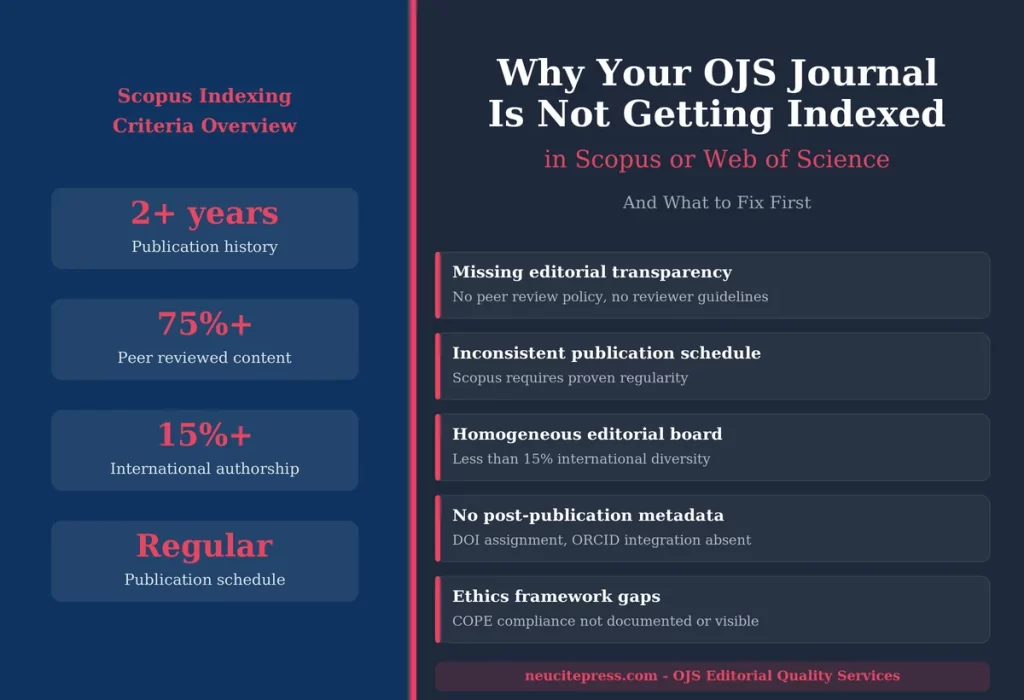
Scopus (Elsevier) indexes over 36,000 active titles across life sciences, social sciences, physical sciences, and health sciences. It emphasizes rigorous peer review processes, editorial board quality, and international representation. Scopus evaluation typically requires 2-4 years of publication history, consistent publication frequency, and documented peer review procedures.
Web of Science Core Collection (Clarivate) covers approximately 20,000 carefully selected journals deemed to meet strict impact and quality standards. This highly selective database requires established publication track records (typically 3+ years), international editorial boards, and demonstrated citation potential. Inclusion in Web of Science significantly impacts journal rankings and researcher perceptions of quality.
Google Scholar functions as a broad, automated indexing service that crawls academic websites, publishers’ platforms, and institutional repositories. Unlike curated databases, Scholar automatically includes content meeting basic scholarly criteria. It requires no formal application but demands proper technical implementation (structured metadata, accessible full-text).
Biomedical and Life Sciences Indexes
PubMed (National Library of Medicine) indexes approximately 30 million biomedical citations, making it the primary resource for life sciences researchers. PubMed’s parent platform, MEDLINE, covers peer-reviewed journals meeting strict quality criteria including editorial independence, peer review documentation, and ethical oversight (IRB approval where applicable).
PubMed Central (PMC) provides free, full-text access to biomedical and life sciences literature. PMC participation requires compliance with content standards, metadata formatting, and preservation requirements. For open-access and selected subscription journals, PMC inclusion dramatically increases article accessibility and citation potential.
EMBASE (Biomedical Pharmacology Database) covers approximately 8 million drug and biomedical records, emphasizing pharmacological research, clinical trials, and adverse drug reactions. EMBASE targets pharmaceutical, medical device, and healthcare journals with rigorous quality and relevance screening.
Specialized and Regional Indexes
DOAJ (Directory of Open Access Journals) indexes over 20,000 peer-reviewed open-access journals across all disciplines. DOAJ evaluation emphasizes transparent peer review processes, author rights clarity, and ethical publication practices. Inclusion signals quality commitment to open science communities.
AJOL (African Journals Online) promotes African scholarship by indexing over 700 peer-reviewed journals from African institutions. This regional index increases visibility within African academic networks while supporting scholarly communication on the continent.
JSTOR curates academic content across humanities, social sciences, and sciences, serving academic libraries and researchers through institutional subscriptions. JSTOR indexes selected journals meeting stringent editorial standards and relevance criteria.
PsycINFO (American Psychological Association) specializes in psychology, behavioral sciences, and related fields, indexing approximately 2,500 journals. Inclusion requires demonstrated relevance to psychology research and rigorous editorial standards.
Database Selection Framework
Publishers should prioritize indexing applications using this framework:
- Disciplinary Fit: Seek indexes aligning with your journal’s primary research area and target researcher audience.
- Strategic Impact: Prioritize databases heavily used by your target readership (e.g., PubMed for medical journals, PsycINFO for psychology publications).
- Feasibility Assessment: Evaluate your journal’s readiness against database criteria (publication history, peer review documentation, technical infrastructure).
- Timeline Expectations: Plan applications considering each database’s evaluation timeline (3-12 months typical).
- Competitive Positioning: Analyze competitor journals’ indexing profiles to identify gaps and opportunities.
Professional Journal Indexing Services vs. DIY Approach
Publishers face a critical decision: pursue indexing independently or engage professional indexing services. This analysis compares both approaches across key dimensions.
DIY Indexing Approach: Resource Requirements and Risks
Self-managed indexing requires substantial internal resources. Publishers must:
- Research database-specific criteria and evolving requirements
- Develop technical infrastructure (DOI registration, XML metadata formatting, sitemap implementation)
- Compile comprehensive documentation (editorial policies, peer review procedures, ethical guidelines)
- Manage correspondence with database administrators and address feedback
- Implement technical corrections and resubmit applications when rejected
- Monitor compliance with ongoing indexing requirements
Industry data reveals DIY applications consume 200-400 hours per database application. For publishers managing limited editorial staff, this diverts resources from content acquisition, peer review oversight, and author services.
Success Rates: Self-managed applications achieve 15-25% acceptance rates in competitive databases (Scopus, Web of Science). Common rejection reasons include incomplete documentation, inadequate peer review evidence, and technical implementation errors.
Timeline Impact: Rejected applications trigger 6-12 month reapplication waiting periods, extending the path to indexing by 18-24+ months.
Professional Journal Indexing Services: Benefits and Investment
Professional indexing service providers specialize in navigating database requirements and optimizing applications. These firms typically employ:
- Database evaluation specialists with insider knowledge of indexing criteria
- Technical experts managing metadata optimization and technical requirements
- Documentation specialists building comprehensive compliance evidence
- Application strategists sequencing submissions for maximum approval probability
- Ongoing support teams managing database communications and compliance monitoring
Key Advantages:
- Higher Success Rates: Professional submissions achieve 45-65% acceptance versus 15-25% for DIY attempts—a 2-3x improvement.
- Faster Timelines: Expert guidance typically compresses approval timelines from 18-24 months to 12-18 months through optimized applications and direct database relationships.
- Resource Efficiency: Outsourcing indexing frees internal teams to focus on editorial quality, author services, and content development.
- Reduced Risk: Professional expertise minimizes rejection probability and costly application restarts.
- Strategic Sequencing: Professionals recommend optimal database sequences, building credibility progressively toward selective indexes.
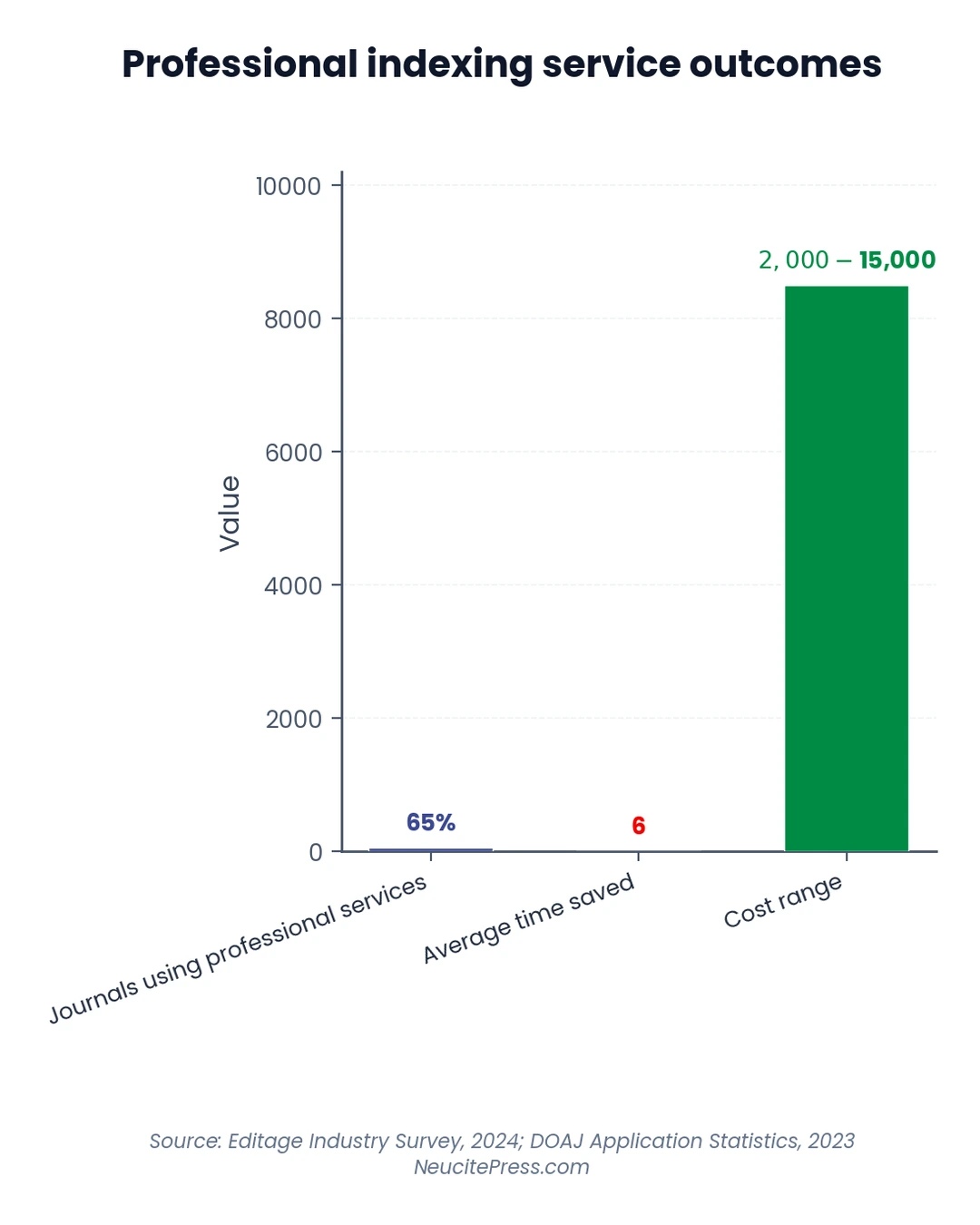
Investment and ROI: Professional indexing services typically charge $5,000-$15,000 per database application, with comprehensive multi-database packages ranging $25,000-$50,000. Given improved acceptance rates and faster timelines, this investment typically pays for itself through increased manuscript submissions and citation impact within 12-24 months.
Hybrid Approach: Strategic Professional Guidance
Many publishers combine professional guidance with internal execution. Consultants help with strategic planning, documentation development, and technical preparation while internal teams manage application submissions and compliance monitoring. This balanced approach reduces investment while maintaining expert guidance.
Evaluation Criteria for Different Indexing Databases
Each indexing service applies unique evaluation criteria reflecting its focus and standards. Understanding these requirements ensures targeted, successful applications.
Core Evaluation Dimensions
Editorial Governance: Databases evaluate editorial board composition, editor qualifications, and editorial independence. Requirements include:
- Documented editorial board with international representation
- Editorial board member affiliations at recognized institutions
- Clear editor selection and term management procedures
- Evidence of editorial independence from commercial interests
Peer Review Documentation: Strong evidence of rigorous peer review is essential. Documentation should include:
- Written peer review procedures explaining reviewer selection, evaluation processes, and decision-making
- Evidence of international reviewer participation
- Average review timelines and revision request protocols
- Published reviewer acknowledgment (optional but valued)
Publication Consistency: Databases assess whether journals maintain regular, predictable publication schedules:
- Planned publication frequency (quarterly, bi-monthly, monthly)
- Publication history demonstrating consistency over 2-3 years
- No unexplained publication gaps exceeding 6 months
- Archival preservation of older issues
Content Quality and Relevance: Indexing services evaluate:
- Originality of research (no previously published or plagiarized content)
- Appropriate methodology and rigorous research design
- Clear writing and professional presentation
- Relevance to the database’s disciplinary focus
International Representation: Most prestigious databases require:
- Authors from multiple countries across recent publication history
- Diverse institutional affiliations spanning different nations
- Editorial board members from international institutions
Ethical Standards and Compliance: Databases verify:
- Documented conflict-of-interest policies for authors and editors
- IRB approval documentation for human subjects research
- Animal care committee approval for animal research
- Data availability statements or supplementary data provisions
- Retraction policies and procedures for handling misconduct
Technical Implementation: Modern indexing requires:
- DOI assignment for all published articles
- Properly formatted XML metadata
- Structured abstracts with standardized headings
- Author affiliation information with institutional identifiers
- Complete bibliographic references with DOIs where available
Database-Specific Requirements Comparison

| Database | Publication History Required | Selectivity Level | Typical Timeline | International Requirement | Open Access Status |
|---|---|---|---|---|---|
| Scopus | 2-4 years | Moderate-High | 3-6 months | Required | Both OA and subscription |
| Web of Science | 3+ years | Very High | 6-12 months | Required | Both OA and subscription |
| PubMed/MEDLINE | 2 years (medical content) | High | 3-6 months | Preferred | Both formats |
| PubMed Central | 1 year | Moderate | 1-3 months | Preferred | Open Access required |
| DOAJ | 6-12 months | Moderate | 4-8 weeks | Preferred | Open Access required |
| EMBASE | 2-3 years | High | 6-12 months | Required | Both formats |
| Google Scholar | No requirement | Low (automatic) | 2-8 weeks | Not required | Both formats |
Understanding Indexing Service Pricing and Packages
Professional indexing service providers offer tiered packages accommodating different journal sizes, disciplinary focuses, and strategic goals.
Typical Service Pricing Structure
Single Database Application Package: $5,000-$15,000 per application
- Complete documentation review and development
- Technical readiness assessment and optimization
- Application preparation and submission
- Initial communication with database representatives
- Support addressing first round of feedback (limited revisions)
Multi-Database Strategic Packages: $25,000-$50,000 for coordinated applications across 3-5 databases
- Prioritized database sequencing strategy
- Coordinated technical preparation across all applications
- Comprehensive documentation development
- Full support through approval or reapplication cycles
- Ongoing compliance monitoring for 12 months post-approval
Ongoing Compliance and Maintenance: $3,000-$8,000 annually per journal, typically covering:
- Quarterly compliance audits ensuring continued database standards
- Metadata quality assurance and optimization
- Updates to documentation reflecting policy changes
- New indexing opportunity identification
- Database communication and issue resolution support
Additional Costs to Budget
Beyond professional service fees, plan for:
- DOI Registration: $1-2 per article (CrossRef or other registration agencies)
- XML Schema Development: $2,000-$5,000 one-time if custom implementation required
- Technical Infrastructure: $0-$3,000 depending on current website capabilities
- Content Migration: $1,000-$10,000 if archival content needs reformatting
Timeline Expectations for Journal Indexing Approval
Understanding realistic timelines helps publishers plan strategically and avoid discouragement during the indexing journey.
Typical Approval Timelines by Database
Google Scholar: 2-8 weeks. Scholar automatically indexes properly formatted academic content with no formal application process. Implementation requires correct metadata markup and accessible full-text content.
DOAJ (Open Access): 4-12 weeks. DOAJ processes applications relatively quickly, though complex cases or documentation gaps may extend review. Reapplication after rejection can take another 8-12 weeks.
PubMed Central: 1-3 months for established publishers or journals with existing PubMed/MEDLINE records. New publishers may face extended timelines for initial compliance verification.
PubMed/MEDLINE: 3-6 months for standard review process. Complex cases involving regulatory or ethical questions may extend to 9-12 months. Initial rejection typically requires 6+ month waiting periods before reapplication.
Scopus: 3-6 months for applications meeting current standards. Journals requiring substantial remediation may face 9-12 month timelines. Rejected applications must typically wait 6-12 months before reapplication.
Web of Science: 6-12 months for comprehensive evaluation. This selective database requires meticulous review of editorial quality, peer review rigor, and citation potential. Reapplication after rejection requires 12+ months waiting.
Specialized Databases (EMBASE, etc.): 6-12 months depending on evaluation complexity and required documentation.
Accelerating the Timeline
Professional guidance typically compresses timelines by 20-30% through:
- Comprehensive, complete initial submissions reducing back-and-forth communication
- Proactive documentation addressing common feedback before it’s requested
- Direct relationships with database representatives enabling faster clarifications
- Parallel preparation across multiple databases rather than sequential applications
- Preliminary readiness assessments identifying and correcting deficiencies before application
Red Flags: Identifying Unreliable Indexing Service Providers
Not all indexing service providers offer legitimate value. Publishers should avoid providers making unrealistic guarantees or employing questionable practices.
Major Red Flags
Guaranteed Approval Claims: Reputable providers acknowledge that databases make final approval decisions. Providers guaranteeing acceptance are either dishonest or planning to submit applications regardless of readiness (likely resulting in rejection).
No Readiness Assessment: Legitimate providers conduct comprehensive readiness assessments before submitting applications. Skip providers who immediately proceed to application without evaluating your journal’s current compliance level.
Excessive Upfront Payment: Be cautious of providers requiring full payment before any work begins. Reputable firms often structure payments across project phases (assessment, development, submission, post-submission support).
Vague Documentation and Credentials: Verify provider expertise through case studies, client references, and documented experience with your target databases. Avoid providers unable to articulate specific database requirements.
Generic, Non-Customized Approaches: Every journal’s indexing path differs. Providers applying identical templates across journals are likely cutting corners and oversimplifying complex requirements.
No Post-Approval Support: Legitimate providers understand indexing is ongoing. After approval, compliance monitoring ensures your journal maintains good standing. Providers abandoning you post-approval create long-term risk.
Pressure for Rapid Decisions: Quality consulting involves thorough analysis and strategic planning. Providers pressuring immediate commitments are likely prioritizing volume over quality.
Step-by-Step Journal Indexing Process
Understanding the complete indexing workflow helps publishers anticipate requirements and prepare systematically.
Phase 1: Pre-Application Readiness Assessment (4-8 weeks)
1. Establish Baseline Understanding: Document current journal status including publication history, editorial board, peer review procedures, and technical infrastructure.
2. Conduct Database Research: Analyze target databases’ specific requirements. Review recent acceptance criteria announcements, scope statements, and application instructions.
3. Perform Gap Analysis: Compare your journal against target database requirements. Identify deficiencies in documentation, technical implementation, editorial governance, and content quality.
4. Prioritize Applications: Sequence databases strategically, typically starting with more accessible indexes (Google Scholar, DOAJ) before targeting selective databases (Web of Science, Scopus).
5. Develop Implementation Timeline: Create realistic project schedule accounting for documentation development, technical implementation, and application submission.
Phase 2: Documentation Development (6-12 weeks)
1. Editorial Policy Documentation: Develop formal written policies covering:
- Editorial selection and succession procedures
- Conflict of interest disclosure requirements for editors and authors
- Publication ethics statement addressing plagiarism, data fabrication, and authorship disputes
- Retraction and correction procedures
- Copyright and licensing terms
2. Peer Review Documentation: Create comprehensive peer review procedures including:
- Reviewer selection criteria and process
- Number of reviewers per submission (typically 2-3)
- Confidentiality and anonymity procedures
- Review timeline expectations
- Decision-making and appeal procedures
3. Quality Assurance Documentation: Compile evidence of content quality including:
- Author guidelines emphasizing methodological rigor
- Editorial team qualifications and expertise
- Peer review evidence (reviewer comments, decision letters—anonymized)
- Research ethics compliance (IRB approvals, data availability)
4. Technical Documentation: Prepare information on:
- DOI implementation and registration agency details
- XML/metadata formatting compliance
- Website accessibility and searchability
- Archival preservation procedures
Phase 3: Technical Preparation (4-8 weeks)
1. DOI Registration: Establish DOI registration through CrossRef or alternative agencies. Register DOIs for all published articles and plan prospective assignment.
2. Metadata Optimization: Ensure all articles include comprehensive metadata:
- Article title with proper character encoding
- Author names and institutional affiliations
- Publication date and volume/issue information
- Abstract with structured headings (for specialized databases)
- Keywords and subject classifications
- Complete reference lists with DOIs
3. Website Technical Implementation: Verify technical readiness:
- Schema markup for academic articles (schema.org)
- XML sitemap for article discoverability
- Robots.txt configuration enabling indexing
- SSL/HTTPS implementation for security
4. Archive Accessibility: Ensure back issues remain accessible:
- Complete archive availability on website
- Digital preservation through third-party services (LOCKSS, Portico)
- Permanent URLs (permalinks) for article stability
Phase 4: Application Submission (2-4 weeks)
1. Complete Application Forms: Fill database application forms comprehensively, providing:
- Journal metadata (title, ISSN, scope, frequency)
- Editorial contact information
- Sample published articles
- Editorial policies and procedures
2. Prepare Supporting Materials: Compile submission package including:
- Formatted editorial policies
- Sample peer review evidence
- Editorial board list with affiliations
- Recent article examples
- Technical compliance documentation
3. Submit Application: Submit completed application through database portal or direct email per specific database instructions.
4. Document Submission: Maintain detailed records of submission date, contact person, tracking numbers, and all supporting documentation provided.
Phase 5: Application Review and Communication (3-12 months)
1. Monitor Communication Channels: Regularly check email and database portals for status updates or requests for additional information.
2. Address Feedback Promptly: Respond to database queries and information requests within requested timeframes. Delayed responses risk application delays or rejection.
3. Provide Clarifications: Be prepared to explain editorial procedures, clarify technical details, or provide additional documentation as requested.
4. Manage Expectations: Understand that review timelines vary. Lack of communication doesn’t indicate negative outcomes; databases often review applications silently before requesting information.
Phase 6: Post-Approval Compliance (Ongoing)
1. Verify Indexing: After approval notification, verify articles appear in database indexes within typical timeframes (2-8 weeks typical).
2. Maintain Standards: Continue meeting indexing criteria:
- Regular publication on announced schedule
- Rigorous peer review maintenance
- Complete, accurate metadata provision
- Ethical standards adherence
- Technical compliance (DOI assignment, XML formatting)
3. Monitor Compliance: Establish internal procedures ensuring ongoing compliance. Databases conduct periodic reviews; failure to maintain standards can result in removal.
4. Plan Future Indexing: Once established in initial databases, sequence applications to additional indexes, building credibility progressively.
Preparing Your Journal for Successful Indexing
Strategic preparation significantly improves indexing success rates. Publishers should address these elements proactively.
Essential Preparations Checklist
Editorial Governance:
- Establish formal editorial board with clear roles and international representation
- Document editor selection, term limits, and succession procedures
- Define editorial independence from commercial interests or political influences
- Implement editor and author conflict-of-interest disclosure procedures
Peer Review Rigor:
- Implement standardized peer review procedures with documented guidelines
- Recruit qualified reviewers from diverse, international institutions
- Maintain detailed records of reviewer assignments, comments, and decisions
- Establish typical review timelines (4-8 weeks target)
- Implement revision request and resubmission procedures
Publication Quality:
- Develop comprehensive author guidelines emphasizing methodological rigor
- Establish plagiarism screening procedures and detection thresholds
- Implement data availability requirements or supplementary data provisions
- Ensure ethical compliance (IRB, animal care approvals where applicable)
- Maintain consistent publication schedule aligned with announced frequency
Technical Infrastructure:
- Register and assign DOIs to all published content
- Implement complete, accurate metadata for every article
- Establish XML export capability or use publishing platforms supporting structured data
- Implement schema markup for search engine optimization
- Ensure secure HTTPS website access
Documentation and Policies:
- Write formal editorial policies document covering scope, frequency, and review processes
- Develop ethics policy addressing plagiarism, fabrication, authorship disputes
- Create retraction procedures and publicly available retraction statements
- Document copyright and licensing terms clearly on website
- Establish data preservation and archival strategies
Documentation Requirements for Indexing Applications
Successful applications require comprehensive, well-organized supporting documentation. Different databases request different materials, but core documents serve all applications.
Core Documentation Package
1. Journal Editorial Policies Document (5-10 pages)
Formal document covering:
- Journal scope and disciplinary focus
- Editorial mission and publication frequency
- Editorial board list with member names, degrees, institutional affiliations
- Editor selection and succession procedures
- Conflict of interest policies for editors and authors
- Publication ethics statement addressing plagiarism and fabrication
- Retraction and correction procedures
- Data availability and supplementary materials policies
- Copyright and licensing information
2. Peer Review Procedures Document (3-5 pages)
Detailed procedures covering:
- Peer review process overview
- Reviewer selection criteria and identification process
- Double-blind versus single-blind procedures
- Number of reviewers per manuscript (typically 2-3)
- Review timeline expectations
- Reviewer confidentiality protections
- Revision and resubmission procedures
- Appeal processes for rejected manuscripts
- Reviewer acknowledgment and incentive procedures
3. Editorial Board List (1-2 pages)
Comprehensive listing including:
- Editorial board member names (full and last names)
- Highest earned degrees (M.D., Ph.D., etc.)
- Current institutional affiliations and departments
- Geographic distribution showing international representation
- Board member contact information (typically email)
4. Author Guidelines (2-4 pages)
- Manuscript length specifications
- Structured abstract requirements (Background, Methods, Results, Conclusions)
- Section headings and formatting standards
- Reference format and citation requirements
- Author affiliation and funding disclosure requirements
- Conflict of interest disclosure procedures
- Figure, table, and supplementary material specifications
5. Sample Published Articles (5-10 recent articles)
- PDFs of recent articles (last 1-2 years)
- Representing diverse authors and institutions
- Demonstrating proper metadata, references, and formatting
- Showing international authorship representation
6. Institutional Affiliation Documentation
- Publisher information and institutional registration details
- Office address and contact information
- Editor-in-Chief institutional affiliation and contact details
- Evidence of institutional backing or editorial society affiliation
7. Technical Compliance Documentation
- DOI registration documentation (CrossRef membership/credentials)
- XML schema or metadata export samples
- Website accessibility details (HTTPS, schema markup)
- Archival preservation strategy (LOCKSS, Portico, etc.)
- Sitemap and indexing configuration details
Choosing the Right Journal Indexing Service Provider
Selecting a professional indexing partner significantly impacts success probability and timeline efficiency. Use these criteria to evaluate potential providers.
Provider Evaluation Framework
Experience and Track Record:
- Years operating and number of successful journal placements
- Success rates with target databases (request specific numbers)
- Case studies or client testimonials from comparable journals
- Experience with your journal’s disciplinary area
- Track record with journals in your publication stage (new versus established)
Database Expertise:
- Detailed knowledge of target database criteria and procedures
- Ability to articulate database-specific requirements without generic responses
- Evidence of relationships with database representatives or administrators
- Understanding of evolving database standards and recent changes
- Familiarity with alternative databases serving your discipline
Service Scope and Transparency:
- Clear explanation of services included and excluded
- Transparent pricing with itemized cost breakdowns
- Written contracts specifying deliverables, timelines, and payment terms
- Defined scope of revisions and post-submission support
- Clear explanation of what remains the publisher’s responsibility
Communication and Support:
- Availability for questions and clarifications throughout the process
- Regular progress updates and transparent communication about challenges
- Responsiveness to emails and inquiries within 24-48 hours
- Designated primary contact maintaining continuity throughout the project
- Post-approval support and ongoing compliance monitoring offered
Realistic Expectations:
- Honest about realistic timelines and success probability
- Clear acknowledgment that databases make final decisions
- Willingness to conduct thorough readiness assessment before proceeding
- Transparent about challenges and required remediation work
- No unrealistic guarantees or pressure tactics
Questions to Ask Potential Providers
1. Experience and Success Rates: “How many journals have you helped index with Scopus/Web of Science/PubMed? What percentage achieved approval on first application versus requiring reapplication?”
2. Database Criteria Knowledge: “What are the three most common reasons journals don’t get approved for Scopus? How do you address these in your process?”
3. Timeline Realism: “What realistic timeline can we expect from initial readiness assessment through approval? What factors extend timelines?”
4. Readiness Assessment: “What does your initial assessment process involve? What gaps might prevent us from applying immediately?”
5. Revision Procedure: “If the database requests revisions, how much additional support is included? What are costs for extensive remediation?”
6. Post-Approval Support: “What happens after approval? Do you provide ongoing compliance support?”
7. References: “Can you provide three recent client references I can contact about their experience?”
Future of Journal Indexing: Trends and Considerations for 2026
The journal indexing landscape continues evolving in response to open science initiatives, technology advancements, and changing researcher behaviors.
Emerging Trends
Open Science and Transparency Emphasis: Indexing services increasingly demand data availability, code sharing, and methodology transparency. Publishers should plan for enhanced requirements around research reproducibility and open data provision.
Preprint and Preregistration Recognition: Traditional journals now compete with preprint servers. Some indexes increasingly recognize preprints or preregistered studies, blurring traditional publication boundaries.
Diversity and Equity Focus: Databases increasingly evaluate editorial board diversity, author representation, and geographic fairness. Publishers should proactively expand international editorial participation.
AI and Automated Indexing: Machine learning improves content categorization and discoverability. Proper metadata becomes even more critical as algorithms depend on structured data.
Integration with Research Evaluation Systems: Indexing increasingly connects to researcher evaluation systems (promotions, tenure, funding decisions). Journal selection becomes more strategically important.
Conclusion
Journal indexing services represent a critical pathway to academic visibility, citations, and institutional credibility. Whether pursuing independent indexing or engaging professional support, success requires comprehensive planning, meticulous documentation, and realistic timeline expectations.
The investment in professional guidance typically pays for itself within 12-24 months through increased manuscript submissions, higher citation impact, and institutional recognition. For journals serious about academic impact and visibility, strategic indexing should rank among top publication priorities.
Ready to explore indexing for your journal? Begin with a comprehensive readiness assessment, develop realistic timelines, and consider professional guidance to maximize approval probability and accelerate your path to global academic recognition.
Frequently Asked Questions
What are the primary benefits of journal indexing? Indexing dramatically increases research discoverability, leads to higher citation counts, enhances journal credibility, attracts quality manuscript submissions (3-5x improvement typical), and supports author career advancement and institutional recognition.
How do I choose which databases to prioritize? Select databases by disciplinary relevance, readiness assessment, strategic importance to your target readers, publication history requirements, and timeline feasibility. Professional advisors often recommend sequencing from more accessible to selective indexes.
Are open access journals treated differently by indexing services? No, reputable indexing services evaluate quality independent of business model. High-quality open access journals are indexed alongside subscription journals if they meet quality and ethical standards.
What’s the typical cost investment for professional indexing support? Single database applications range $5,000-$15,000. Multi-database strategic packages cost $25,000-$50,000. ROI typically occurs within 12-24 months through improved submissions and visibility.
How long does the indexing process typically take? Timelines vary by database: Google Scholar (2-8 weeks), DOAJ (4-12 weeks), PubMed Central (1-3 months), PubMed (3-6 months), Scopus (3-6 months), Web of Science (6-12 months). Professional support often reduces timelines by 20-30%.
What if my application gets rejected? Most databases allow reapplication after 6-12 months. Use the feedback to address deficiencies, strengthen documentation, and improve technical compliance. Professional providers help navigate reapplication strategies.