EU CTR Lay Summaries: What Sponsors Must Publish, and When
Every interventional trial run under the Clinical Trials Regulation ends with two results documents, not one. Alongside the technical summary of results, the sponsor must publish an EU CTR lay summary: a plain-language account of what the trial found, written for the people who took part and for the public. It goes into the EU database through the Clinical Trials Information System (CTIS), it is public, and the deadline runs from the end of the trial, whether the results are good, bad or inconclusive.
This guide is for clinical operations, regulatory and medical affairs teams at sponsors and CROs. It sets out who must publish, when, what the summary must contain, how readable it has to be, what to do about translations, how it reaches CTIS, the mistakes that cause rework, and a workflow you can run from database lock to upload. Every requirement below is taken from the regulation text on EUR-Lex or from the European Commission and EMA guidance documents we opened and link to. Where the regulation is silent, we say so.
THE SHORT ANSWER
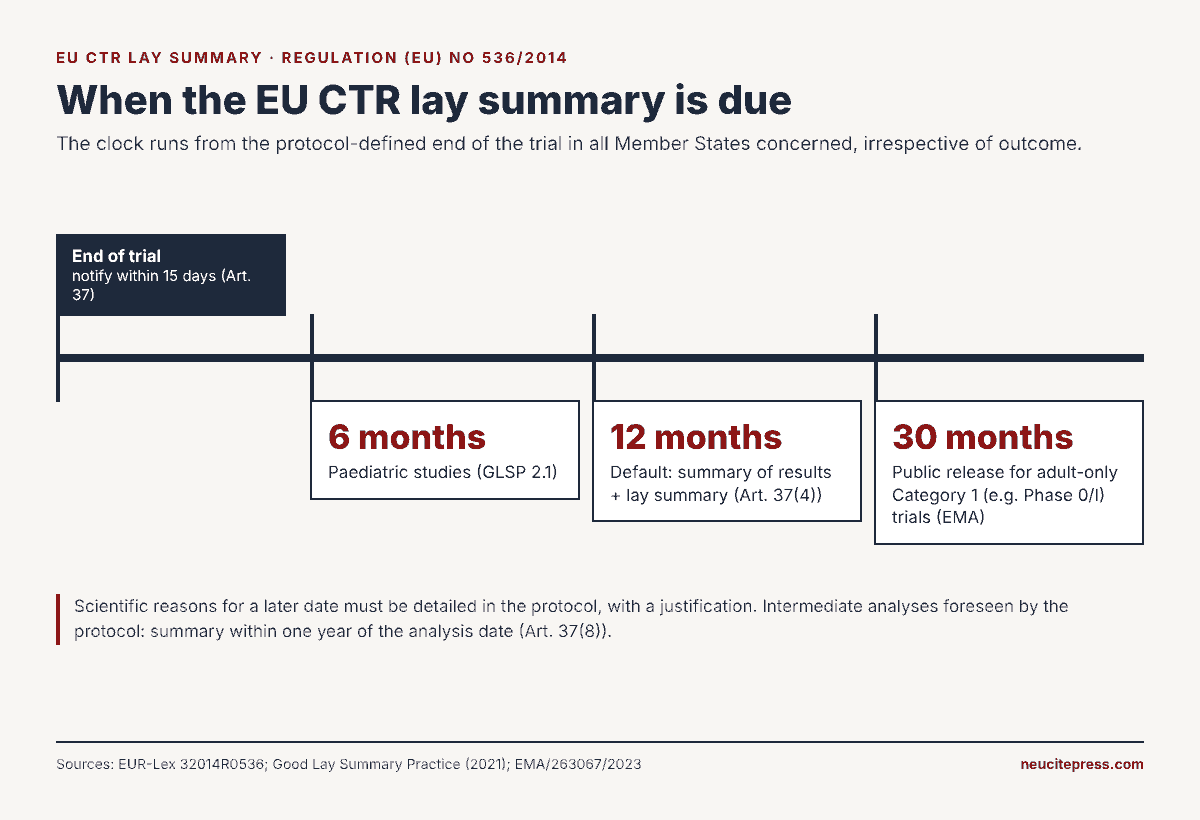
The sponsor must submit a lay summary with the summary of results to the EU database within one year of the end of the trial in all Member States concerned, irrespective of outcome (Article 37(4), Regulation (EU) No 536/2014). The Commission’s guidance gives 6 months for paediatric studies (Good Lay Summary Practice). The content is fixed by the 10 elements of Annex V.
What is an EU CTR lay summary?
Regulation (EU) No 536/2014 requires the summary of results of a clinical trial to be “accompanied by a summary written in a manner that is understandable to laypersons” (Article 37(4)). The content of the technical summary is set by Annex IV; the content of the lay summary is set by Annex V. Recital 39 of the regulation explains the intent: the sponsor submits both summaries, and the clinical study report where applicable, within the defined timelines.
The European Commission’s Good Lay Summary Practice (GLSP), adopted by the Clinical Trials Expert Group on 9 July 2021 and published on 4 October 2021, describes the lay summary as “a mandatory requirement” under the regulation and “a transparency obligation to all trial participants and the interested public.” It is the most detailed practical guidance available and is published in EudraLex Volume 10, next to the earlier expert group recommendations, Summaries of Clinical Trial Results for Laypersons (version 2, published 22 February 2018).
Two scope points are worth fixing early. First, the GLSP applies to aggregate results only; returning individual results to a participant is out of scope. Second, it states that plain language summaries of journal publications and conference abstracts are out of scope. A regulatory lay summary and a plain-language summary of a publication are different documents with different owners, rules and review routes.
Who must publish an EU CTR lay summary?
The obligation sits with the sponsor. The expert group recommendations put it plainly: “It is the responsibility of the trial sponsor to ensure that the lay summary is developed and submitted to the EU database within the timelines required by applicable regulation.” A CRO, agency or writer can prepare it, but the sponsor owns the deadline and the content.
The regulation has applied since 31 January 2022, the day CTIS went live. EMA also states that from 31 January 2025, any trials approved under the old Clinical Trials Directive that continue running need to comply with the Clinical Trials Regulation (EMA, Clinical Trials Regulation). If your portfolio still contains trials that started under the Directive, check how each one was transitioned and plan its results obligations under the Regulation.
The obligation also reaches into the consent process. Article 29(6) requires that each participant is told that the summary of results and a summary understandable to a layperson will be made available in the EU database, “irrespective of the outcome of the clinical trial, and, to the extent possible, when the summaries become available.” In other words, your informed consent form already promises a lay summary. The lay summary is the sponsor keeping that promise.
EU CTR lay summary timelines: when it is due
The core rule for the EU CTR lay summary deadline is in Article 37(4): “Irrespective of the outcome of a clinical trial, within one year from the end of a clinical trial in all Member States concerned, the sponsor shall submit to the EU database a summary of the results of the clinical trial.” The lay summary accompanies it.
| Situation | Deadline | Source |
|---|---|---|
| Standard trial | Within one year from the end of the trial in all Member States concerned | Article 37(4) |
| Trial with paediatric participants | No later than 6 months from the protocol-defined end of the trial | GLSP section 2.1 |
| Category 1 trial (pharmaceutical development, e.g. Phase 0/I, bioequivalence), adults only | Submitted in CTIS within 12 months; made public 30 months after the end of the trial in the EU/EEA | EMA/263067/2023, Annex I; GLSP section 2.1 |
| Scientific reasons prevent submission on time | As soon as available; the protocol must specify when, with a justification | Article 37(4) |
| Protocol foresees an intermediate data analysis | Summary of those results within one year of the intermediate analysis date | Article 37(8) |
Requirements checked against the sources on 4 October 2026. The 6-month and 30-month figures come from the GLSP and EMA’s CTIS transparency rules, not from the text of Article 37.
Three details change the date in practice. Early termination: under Article 37(7), the date of early termination is deemed to be the end of the trial, so the clock starts then. Temporary halt: if a halted trial is not resumed within two years, the expiry of that period or the sponsor’s decision not to resume, whichever is earlier, is deemed the end of the trial. Interim results: the GLSP notes that the EU Portal provides for an interim scientific summary but does not anticipate a lay summary of interim results; if you plan one, the GLSP recommends saying so in the patient information sheet and consent form.
The deferral route is narrow. The GLSP says deferral of publication timelines can be requested for approval by the Member States concerned, either in the initial application or as a substantial modification. Separately, EMA’s revised transparency rules removed the deferral mechanism that had allowed sponsors to delay publication of certain data and documents for up to seven years after the end of the trial (EMA news, 6 October 2023). Do not build a lay summary plan on the assumption that publication can wait.
Required content: the 10 elements of Annex V
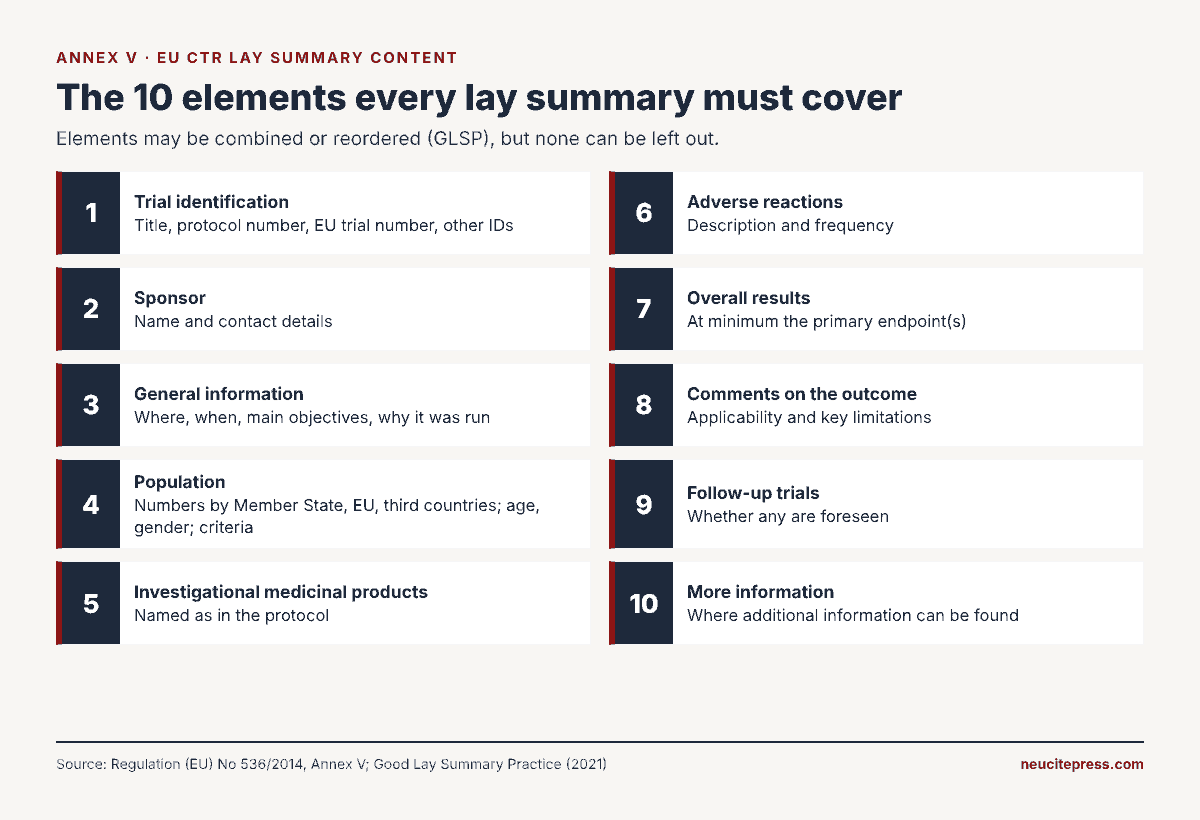
Annex V of the regulation lists what the EU CTR lay summary must contain, and Article 39 lets the Commission amend that list by delegated act. The wording below is taken from the regulation text:
- Clinical trial identification (including title of the trial, protocol number, EU trial number and other identifiers);
- Name and contact details of the sponsor;
- General information about the clinical trial (including where and when the trial was conducted, the main objectives of the trial and an explanation of the reasons for conducting it);
- Population of subjects (including information on the number of subjects included in the trial in the Member State concerned, in the Union and in third countries; age group breakdown and gender breakdown; inclusion and exclusion criteria);
- Investigational medicinal products used;
- Description of adverse reactions and their frequency;
- Overall results of the clinical trial;
- Comments on the outcome of the clinical trial;
- Indication if follow up clinical trials are foreseen;
- Indication where additional information could be found.
The GLSP adds practical detail for each element. The points that most often matter for sponsors are these:
- Order is flexible, coverage is not. Sponsors “must cover all 10 elements” but may combine them or change their order.
- Overall results means at least the primary endpoint. Citing the Commission’s draft Q&A, the GLSP says the summary should reflect, at a minimum, the results of the primary endpoint(s) and potentially patient-relevant secondary endpoints. If you include secondary endpoints, define them through a documented framework applied across your trials, “no later than database lock”. Link to the full list of outcomes in the scientific summary.
- Adverse reactions, not adverse events. Annex V asks for adverse reactions. The GLSP reminds authors that the scientific summary reports adverse events, and that the lay summary should explain what “side effects” means in the trial. Following the expert group, serious adverse reactions are listed first, then other common reactions by frequency, as numbers and percentages.
- One trial, not the final word. The comments section should state whether results apply to a specific population, describe the main limitations and remind readers that other trials may show different results.
- No promotion, anywhere. Products should be named as in the protocol, follow-up information should point to registries rather than marketing pages, and links should not expose readers to promotional content.
- Protect identities. In rare-disease trials, small numbers can identify people. The GLSP asks sponsors to take care with demographics.
The GLSP also supports the expert group’s suggestion to open with a short summary, to thank the participants, and to date the document.
EU CTR lay summary readability: how plain is plain enough?
The readability benchmark for an EU CTR lay summary comes from the expert group recommendations: “A well written lay summary would normally be accessible by young people from the age of 12 years upwards” (Summaries of Clinical Trial Results for Laypersons). The GLSP repeats it and encourages sponsors of paediatric trials to consider a child-focused version in addition to the version for parents or legal representatives.
The GLSP’s writing principles are practical: short words, sentences and paragraphs; active voice; no technical or scientific language, with medical terms in brackets; neutral, non-promotional wording; no statistical terms; consistent terms; no Latin expressions. On numbers, it recommends whole numbers, consistent denominators and units, visuals to help interpretation, and not leaving calculations to the reader.
Readability formulae are allowed but secondary. The expert group encourages a language-specific reading test, and the GLSP names the Flesch Reading Ease and Flesch–Kincaid scores as commonly used. Both documents warn that a good score does not prove the text is understandable, so the GLSP recommends using formulae only as a supplement. The stronger test is people. The expert group suggests testing with a small number of people from the target population where feasible, and the GLSP describes read-through sessions with a group of at least 6–10 people, mixing patients with the disease and members of the public. User testing is not mandatory, but the GLSP calls it good practice.
Design counts as much as wording. The GLSP advises headings and descriptive sub-headings, white space, black text, bold for emphasis rather than italics, underlining or capitals, bar graphs for comparisons between groups and pie charts for proportions. Visuals should still work when printed in black and white, and the electronic PDF should be readable by screen readers, so do not lock it with security settings that block text-to-speech.
Translation of the EU CTR lay summary
The regulation itself does not request translations; the GLSP says so directly. The expectation comes from guidance. The expert group recommendations state that “as a minimum, the summary is expected to be provided in the local language of each of the EU countries where the trial took place”, with languages matching those used in the patient information sheet in each country, and note that PDF versions of translated lay summaries are uploaded separately. Where resources allow, an English version is suggested if the trial did not include Ireland or Malta, though this is not mandatory.
Three practical rules follow from the GLSP:
- Lock the source first. Finalise and approve the source-language text before translation starts, and use a glossary of pre-defined lay terms.
- Release together. Translated versions should be available as soon as possible, ideally in parallel with the source version, so that all participants get the information at the same time.
- Protect meaning and neutrality. The expert group asks that translations keep the original meaning and non-promotional character, and take the cultural validity of medical terms into account. The GLSP suggests sponsors consider user testing of translated versions too.
Translation is where most deadline slippage hides. Seven languages for a multinational trial is seven review cycles. Plan them from the protocol stage, as the GLSP recommends, and align the lay terms with the ones already used in the informed consent form.
CTIS submission and publication
The EU database is a core element of CTIS, and sponsors upload the EU CTR lay summary through the EU portal. Article 81(4) makes the EU database publicly accessible, subject to confidentiality grounds such as personal data and commercially confidential information. Under EMA’s revised CTIS transparency rules, the “final summary of results, with a layperson summary” is published when submitted for Category 2 and 3 trials and for Category 1 trials in a paediatric population or part of a paediatric investigation plan; for Category 1 trials only in adults it is published 30 months after the end of the trial in the EU/EEA (EMA/263067/2023). For most sponsors, that means the lay summary is public the day it is submitted.
On format, the GLSP states that the EU Portal accepts the lay summary as a PDF, covering print material such as text, figures and cartoons, and that at the time of writing it excluded videos and animations. Sponsors are free to produce videos for separate dissemination. Check current CTIS documentation before you commission anything other than a PDF for upload.
Uploading is the legal minimum, not the end of the job. The GLSP says the expert group’s preferred additional option is direct dissemination to trial participants, for example printed copies shared by investigators. Whatever the channel, it recommends a sponsor policy that disseminates all lay summaries regardless of outcome, decided “ideally as early as the initial trial approval application but not later than before database lock.” If you plan to go beyond the EU portal, the consent documents should tell participants where and when to expect the summary. Note too that the GLSP points out ethics committees do not review communications to patients after the end-of-trial notification, but they see the lay summary once it is uploaded.
Common EU CTR lay summary mistakes
Most rework on an EU CTR lay summary comes from a short list of avoidable errors. Each one below maps to a specific line in the regulation or the guidance.
1. Starting at database lock. The GLSP says planning should start at protocol preparation, with a template shell pre-filled before results exist.
2. Copying the technical summary. The expert group warns against simply copying text from the technical summary. Shortened jargon is still jargon.
3. Reporting adverse events as side effects. Annex V asks for adverse reactions and their frequency, which are not the same list.
4. Picking secondary endpoints after seeing the data. Define the selection rule no later than database lock, or limit the summary to primary endpoints.
5. Promotional tone. Superlatives, brand-style product names and links to product websites breach the non-promotional principle in both guidance documents.
6. Statistics left in. P values, confidence intervals and hazard ratios without explanation fail the GLSP’s “do not use statistical terms” principle.
7. Treating a readability score as proof. Formulae measure sentence and word length, not understanding. Test with readers where you can.
8. Late translations. Translations that arrive after the source version create unequal access, which the GLSP explicitly tries to avoid.
9. Numbers that do not reconcile. Randomised versus treated participants must be explained simply and match the results section.
10. Missing dates and thanks. Undated summaries and no word of thanks to participants are small omissions that reviewers notice.
One error deserves its own line because it is now common: unverified references and figures introduced during drafting, particularly where AI tools are used. The lay summary has to agree with the scientific summary to the last participant. Our editors describe how journals now check whether references are fabricated and why AI-hallucinated citations have become a screening problem. The same discipline applies to a regulatory document that is public on day one.
EU CTR lay summary workflow: from database lock to CTIS upload
The GLSP organises the process in four steps: planning, development, translation and dissemination. The table below turns that into a working sequence from database lock to CTIS upload. The only fixed deadline is the legal one; internal durations depend on your SOP, the number of languages and the size of the review group, so we have not invented them. Fill in your own dates working backwards from the deadline.
| Step | What happens | Owner / sign-off | Basis |
|---|---|---|---|
| 0. Before lock | Template shell pre-filled with trial information and endpoint structure; secondary endpoint rule fixed; dissemination strategy decided; translation languages listed from the PIS/ICF | Clinical operations, medical writing, regulatory | GLSP 2.1, 2.2, Element 7, section 5 |
| 1. Database lock | Final tables and analyses available; no lay drafting from unlocked data | Data management, biostatistics | Sponsor SOP |
| 2. Scientific summary | Annex IV summary of results prepared; it is the source the lay summary must match | Medical writing, biostatistics | Article 37(4), Annex IV |
| 3. Lay draft | All 10 Annex V elements; adverse reactions; numeracy rules; plain design; date and thanks | Writer experienced in results and lay language | Annex V; GLSP 3.1–3.6 |
| 4. Review | Accuracy against the scientific summary; statistics; non-promotional check; patient or advocate review where possible | Trial team, medical monitor, statistician, regulatory, legal | GLSP 2.2, 3.7 |
| 5. User test (optional) | Read-through or user testing with people unfamiliar with the trial; revise | Patient engagement lead | GLSP 3.7 |
| 6. Lock and approve | Content owners document approval of the source-language version; accessible PDF produced | Sponsor content owners | GLSP 2.2, 3.4 |
| 7. Translate | Local languages matching the PIS/ICF; glossary; review; ideally released in parallel | Translation vendor, local affiliates | Expert group section 9; GLSP 4 |
| 8. CTIS upload | Lay summary PDF(s) submitted with the summary of results through the EU portal | Regulatory / CTIS user | Article 37(4): within one year of end of trial; GLSP: 6 months for paediatric studies |
| 9. Disseminate | Direct sharing with participants via investigators or other channels promised in the PIS/ICF | Clinical operations, sites | GLSP 5 |
Section numbers refer to the GLSP Handbook (2021) and the expert group recommendations (version 2, 2018).
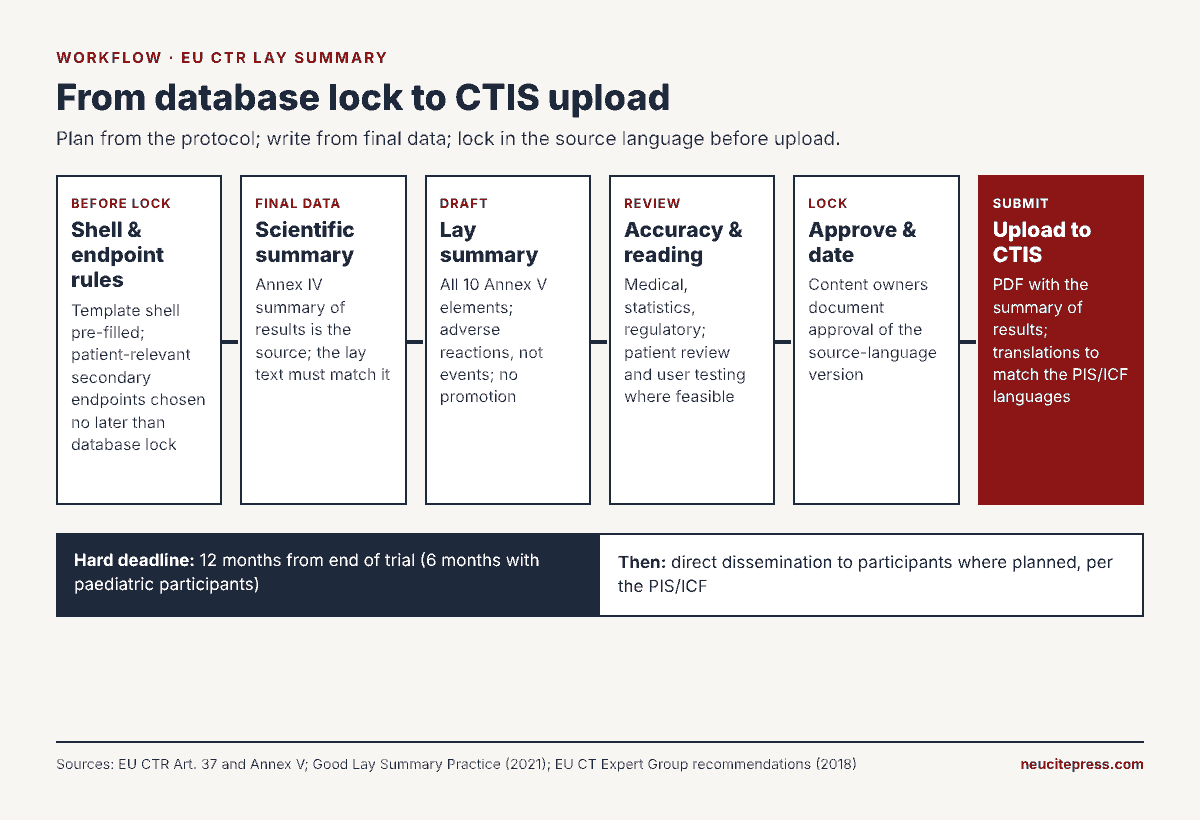
Two habits make this sequence hold. Keep the lay summary team inside the same review loop as the scientific summary, so that every number is checked against one source. And keep a written record of who approved what and when; the GLSP recommends that content owners document their approval before the text is locked.
Who should write it?
The GLSP lists the competencies an EU CTR lay summary needs: scientific knowledge, familiarity with the PIS/ICF, scientific summary and CSR, knowledge of the disease and population, clinical research methodology, judgement on safety results, statistics, lay language communication, quality control, legal and regulatory knowledge, visual design, and the ability to integrate stakeholder feedback. It notes that a lay summary can be prepared by a team or an individual depending on resources. The expert group adds that “medical writers with particular experience of writing in plain language for the public” who can apply health literacy and numeracy principles “may be helpful”.
For small and mid-size sponsors, the GLSP is also direct about money: budget for lay summary production, patient involvement, translations and dissemination at the time the trial is funded, not at the end. Outsourcing the drafting is common; outsourcing the accountability is not possible.
How NeucitePress supports EU CTR lay summaries
NeucitePress is a publisher with an in-house journal editorial office, our own DOI and ISBN registration and a medical book catalogue. Our plain-language summaries service and regulatory writing service bring that editor-side discipline to lay summaries of trial results, working from your scientific summary and the Annex V elements.
- Writers with advanced degrees (PhD, PharmD, MD or MSc), with AI used under expert control and disclosed as ICMJE and GPP 2022 require.
- A compliance file with the work: reference verification against DOI with retraction flags, a similarity report and a QC sign-off.
- Figures built in R.
- Three review rounds included, and fixes for our own errors always free.
- NDA signed the same day, a written proposal within 24 hours, and a US contract with Neucite LLC. The production team is in India, so revisions move overnight.
Sponsors and CROs with a pipeline of trials can also see our service for agencies and CROs, and the full range on the medical communication hub.
See a lay summary built from your own data
Request a free sample draft under NDA, delivered in 3 working days (one per organisation), and judge the quality before you commit.
Request a free sample draft See the plain-language summary service
Conclusion
An EU CTR lay summary is a legal deliverable with a fixed clock, a fixed content list and a public audience. Article 37 sets the deadline, Annex V sets the content, and the Commission’s guidance sets the standard for readability, translation and dissemination. The sponsors who meet it without a scramble do three things: they plan from the protocol, they write from locked data in the same loop as the scientific summary, and they lock and translate on a schedule that leaves room for review. Start the shell before the last participant’s last visit, and the deadline stops being a risk.
Frequently asked questions
Is the EU CTR lay summary mandatory for every trial?
For clinical trials under Regulation (EU) No 536/2014, Article 37(4) requires the summary of results to be accompanied by a lay summary, irrespective of the trial’s outcome. The sponsor is responsible for submitting it to the EU database.
What is the deadline for submitting the lay summary to CTIS?
Within one year from the end of the trial in all Member States concerned (Article 37(4)). The GLSP gives 6 months for paediatric studies. For adult-only Category 1 trials (pharmaceutical development trials such as Phase 0/I, bioequivalence, bioavailability and biosimilarity trials), EMA’s transparency rules defer public release to 30 months after the end of the trial, but submission is still expected within 12 months.
Does the lay summary have to be translated?
The regulation does not request translations, but the expert group recommendations expect, as a minimum, the local language of each EU country where the trial took place, matching the patient information sheet languages. An English version is suggested, not mandatory, where Ireland and Malta were not involved.
What reading level should a lay summary target?
The expert group says a well written lay summary would normally be accessible to young people from age 12 upwards. Readability formulae such as Flesch Reading Ease can support, but not replace, testing with real readers.
Can a lay summary be a video?
The GLSP states that the EU Portal accepts the lay summary as a PDF and, when the guidance was written, excluded videos and animations. Sponsors may produce videos for separate dissemination alongside the PDF uploaded to CTIS.
Sources
- Regulation (EU) No 536/2014 of the European Parliament and of the Council of 16 April 2014 on clinical trials on medicinal products for human use. Articles 29, 37, 81 and Annexes IV–V. EUR-Lex 32014R0536 (accessed 4 Oct 2026).
- European Commission, Clinical Trials Expert Group. Good Lay Summary Practice, version 1. Adopted 9 July 2021, published 4 October 2021. health.ec.europa.eu
- Expert group on clinical trials. Summaries of Clinical Trial Results for Laypersons, version 2. Published 22 February 2018. health.ec.europa.eu
- European Commission. EudraLex Volume 10: Clinical trials guidelines. health.ec.europa.eu
- European Medicines Agency. Revised CTIS transparency rules. EMA/263067/2023, adopted 5 October 2023. ema.europa.eu
- European Medicines Agency. Clinical Trials Regulation. ema.europa.eu (accessed 4 Oct 2026).
- European Medicines Agency. Revised transparency rules for the EU Clinical Trials Information System (CTIS). News, 6 October 2023. ema.europa.eu