Why Industry-Sponsored Manuscripts Get Desk-Rejected: An Editor’s Checklist
An industry-sponsored manuscript can be scientifically sound and still come back within days with a desk rejection: no reviewers, no comments, a two-line letter. For pharma, biotech and medtech publication teams that outcome costs more than time. It pushes back the publication plan, delays the move from congress data to a citable paper and, when the editor spotted a transparency gap, it makes the next journal look harder at the same file.
This guide is written from the editor’s side of the desk. It starts with what published audits say about why manuscripts get desk rejected, then works through the items an editor screens on a company-sponsored paper: scope, the novelty statement, reporting completeness, trial registration and data-sharing statements, sponsor role and writing-support disclosure, overlapping publication, references, AI-use statements and the cover letter. It ends with a printable pre-submission checklist your team can run before every submission.
Key points
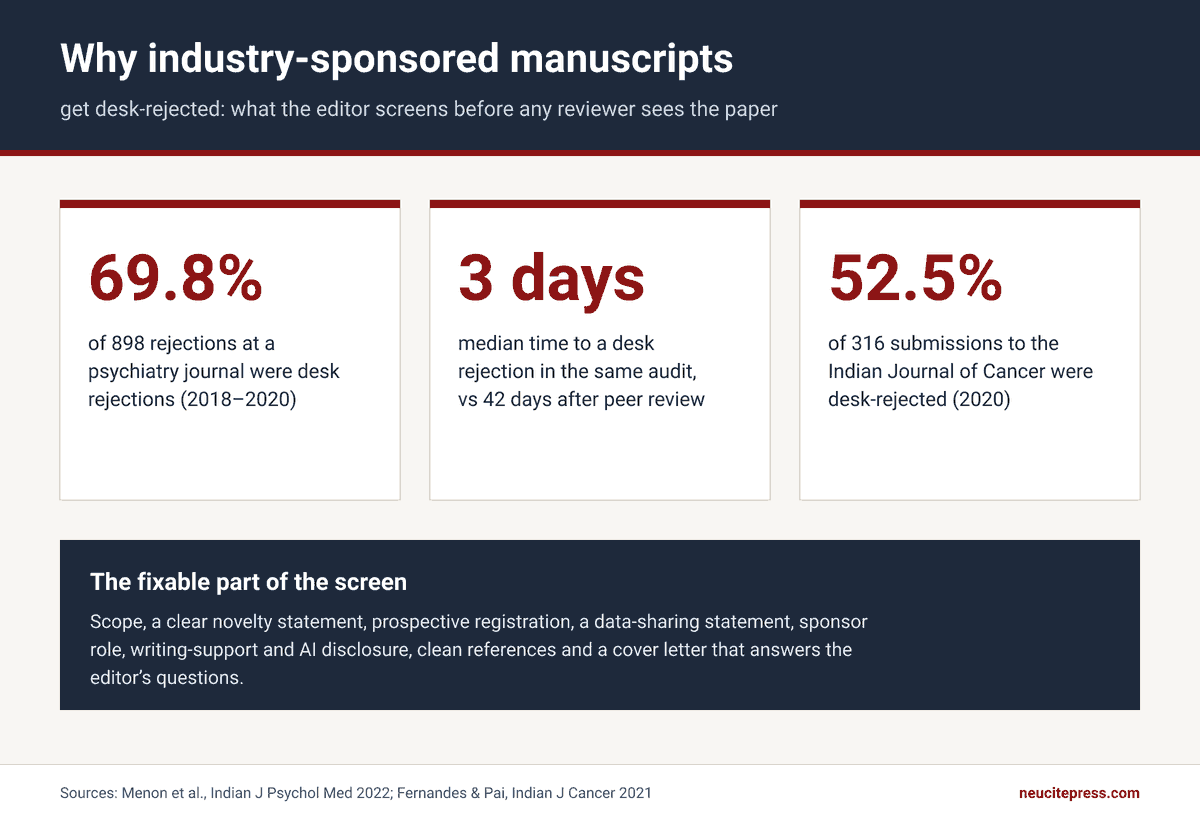
- In a content analysis of 898 rejection reports at the Indian Journal of Psychological Medicine, 627 (69.8%) were desk rejections, with a median of 3 days to decision (Menon et al., 2022).
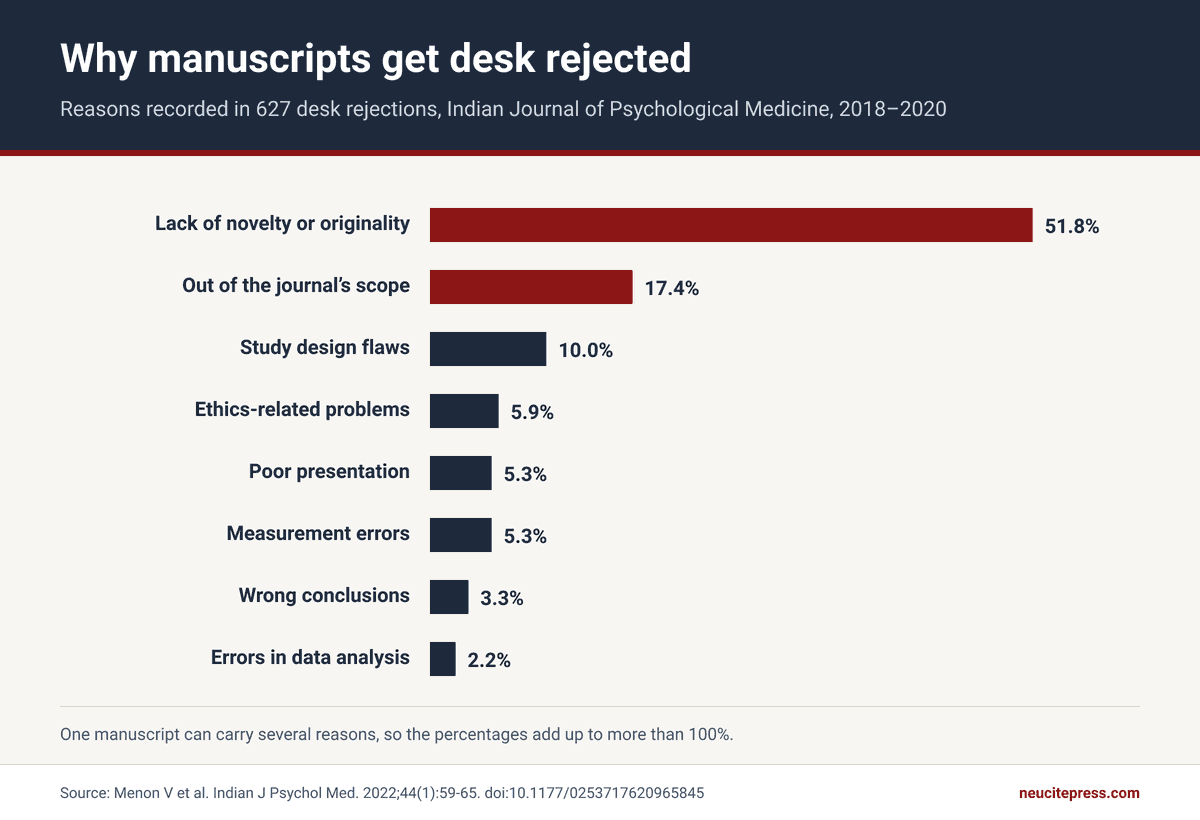
- In that audit the two leading desk rejection reasons were lack of novelty or originality and being outside the journal’s scope.
- For sponsored research, the ICMJE Recommendations make several items close to non-negotiable: prospective trial registration, a data-sharing statement for trials, a statement on the sponsor’s role and disclosure of AI use.
- Almost every one of these failures is visible on the first pages of the submission, which is exactly where the editor looks first.
What desk rejection is and how often it happens
Desk rejection, also called editorial rejection, immediate rejection or rejection without review, is a decision the handling editor makes before any external reviewer sees the paper. The editor reads the title page, abstract, cover letter and declarations, skims the methods and decides whether the manuscript is worth a reviewer’s time. The decision is quick because the criteria are coarse.
Audits from medical journals give a sense of scale:
| Journal | Sample | Finding | Source |
|---|---|---|---|
| Indian Journal of Psychological Medicine | 898 rejection reports, Jan 2018 to May 2020 | 627 (69.8%) of the rejections were desk rejections. Median time to desk rejection 3 days, against 42 days for rejection after peer review. | Menon et al., 2022 |
| Indian Journal of Cancer | 316 manuscripts, Apr to May 2020 | 166 (52.5%) were desk-rejected. Of the 149 that went further, 105 had not followed the instructions to contributors. | Fernandes & Pai, 2021 |
| Pakistan Journal of Medical Sciences | Editorial, 2019 | 70% to 80% of submissions are not processed further after initial screening and the editor’s triage. | Jawaid & Jawaid, 2019 |
| International Journal of Public Health | 30 manuscripts pre-screened independently by three co-editors-in-chief | Full agreement on the pre-screen decision for only 43% of manuscripts (67% after second opinions). Individual first-round rejection rates were 47%, 80% and 60%. | Künzli et al., 2026 |
Figures as reported by each source. Rates are journal-specific and are not benchmarks for other journals.
Two points matter for a publication team. First, rates vary widely between journals, so a desk rejection on its own rarely says “this research is weak.” Second, the International Journal of Public Health study found that the main drivers of disagreement between editors were the soft criteria, novelty and originality. The parts of the screen your team controls completely are the hard criteria: fit, compliance and transparency. Those are where a sponsored manuscript most often hands the editor an easy reason to say no. Our earlier piece on desk rejection rates and why editors reject immediately covers the rate question from the journal’s side.
Why manuscripts get desk rejected: what the audits record
The most detailed breakdown in the open literature comes from the Menon et al. content analysis. Of 627 desk rejections, lack of novelty or originality was recorded in 325 (51.8%) and being out of the journal’s scope in 109 (17.4%). Study design flaws appeared in 63 (10.0%), ethics-related problems in 37 (5.9%) and poor presentation in 33 (5.3%). The ethics category covered missing ethics approval or consent, plagiarism, unregistered intervention trials and duplicate submission. One manuscript could carry several reasons.
The editorial from the Pakistan Journal of Medical Sciences lists the reasons in an editor’s own words. Several of them map directly onto sponsored manuscripts:
- failure to follow the instructions on the journal website;
- no signed undertaking from all authors about exclusive submission;
- “too many authors with strong suspicion of gift authorship”;
- papers outside the journal’s scope, or better suited to a specialty journal;
- poor literature search and very old references;
- clinical trials that are not registered;
- no ethics committee or institutional review board approval.
None of these is about whether the drug or device works. They are about whether the paper is fit to send to reviewers. That is good news, because it means most of the risk can be removed before submission.
Why an industry-sponsored manuscript gets a different desk rejection screen
Editors read a company-sponsored paper with the ICMJE transparency items in mind. Under its conflicts of interest recommendations, ICMJE asks that articles be published with statements declaring the sponsor’s name and its role, if any, “in study design; collection, analysis, and interpretation of data; writing of the report” and any restrictions on submission, or a statement that the source had no such involvement. Articles should also say whether the authors had access to the study data. ICMJE adds that editors may ask authors of a study sponsored by a funder with a proprietary or financial interest in the outcome to sign a supporting statement.
The ICMJE section on clinical trials goes further: with sponsored research, authors’ access to the supporting data “should be expressly provided for in any research agreements,” and in academic and industry collaborations at least one academic author should have accessed the primary data. The authorship section lists “writing assistance, technical editing, language editing, and proofreading” among the activities that do not on their own qualify someone as an author, so professional medical writing support belongs in the acknowledgments.
Company-sponsored publications are also expected to follow Good Publication Practice (GPP) 2022, which applies to manuscripts, meeting presentations, posters, abstracts and plain-language summaries. The practical consequence is simple. A sponsored manuscript carries more mandatory statements than an investigator-initiated one, and each missing or vague statement is a fast, defensible reason for a desk rejection.
The editor’s desk rejection checklist, item by item
The order below follows how a desk editor typically reads a submission: the quick checks first, the detailed ones later. Each item is something the editor can verify from the cover letter, title page, declarations or checklist without reading the full results.
1. Scope and journal fit
Out-of-scope submissions were the second most common desk rejection reason in the Menon audit. For sponsored work the usual failure is aiming a narrow product-specific analysis at a general medical journal, or sending a subgroup analysis to a journal that publishes it only as a research letter. Read the journal’s aims and scope, check the article types it actually publishes and look at what it has printed in your therapy area in the past two years. If your team needs a structured route, our scientific publications service includes target-journal selection as part of the plan.
2. The novelty statement
Lack of novelty was the leading desk rejection reason in the same audit. Editors do not have time to infer what is new. State it in one sentence in the cover letter and again in the last paragraph of the introduction: what was known, what this study adds, and why that matters to this journal’s readers. For a secondary or post-hoc analysis of a trial already published, say so plainly and explain what question the primary paper could not answer.
3. Reporting completeness: CONSORT 2025 and the EQUATOR checklists
Journals expect trial reports to follow a reporting guideline; JAMA’s instructions for authors, for example, ask authors to indicate in the methods how the report follows CONSORT. For randomized trials that now means CONSORT 2025, a 30-item checklist that added seven new items and a new open-science section covering trial registration, access to the protocol and statistical analysis plan, sharing of de-identified participant data, and funding and conflicts of interest. Observational studies, diagnostic accuracy studies and systematic reviews have their own guidelines, all indexed by the EQUATOR Network. Fill the checklist with page and line numbers, not ticks. An editor who opens a checklist that says “yes” against every item, with no locations, will assume nobody checked.
4. Trial registration
The ICMJE registration policy asks editors to require registration “at or before the time of first patient consent for enrollment” as a condition of consideration. Registration must be in a WHO primary registry or ClinicalTrials.gov and include the 24-item minimum data set. ICMJE is blunt about late registration: retrospective registration at the time of manuscript submission “meets none of these purposes.” Put the registration number at the end of the abstract and at the first use of the trial acronym. If registration was late, explain why in the cover letter rather than hoping nobody checks the dates.
5. Data-sharing statement
Since 1 July 2018, manuscripts reporting clinical trials submitted to ICMJE journals must contain a data-sharing statement, and the policy specifies its content: whether de-identified participant data will be shared, which data, which related documents, when and for how long, and under what access criteria. ICMJE states that “undecided” is not an acceptable answer. If the sponsor runs a data-sharing portal, name it and describe the request route rather than writing “available on reasonable request.”
6. Sponsor role, data access and writing-support disclosure
This is the section editors read most carefully on a company-sponsored paper. Three statements need to be specific:
- Role of the funder. Say what the sponsor did in design, conduct, analysis, interpretation, writing and the decision to submit. “The sponsor had a role in the study” is not an answer.
- Data access. Name which authors had access to the full data set and confirm that access was provided for in the agreements.
- Writing support. Name the medical writer, their affiliation and who paid for the support, in the acknowledgments. Confirm the authors directed the content.
An editor who sees a polished manuscript with an industry funder and no writing acknowledgment will ask the question. It is better to answer it first. Our post on conflict of interest policies for journals shows what journals ask for on the other side.
7. Salami slicing and duplicate publication
Large trials produce many papers, and editors know it. The ICMJE overlapping publications section sets the rules. Secondary analyses of trial data should cite the primary publication, state that they contain secondary analyses and use the same trial registration number. When a submission overlaps with another paper that is published, submitted or accepted elsewhere, the cover letter “should clearly say so” and the authors should supply copies of the related material. Authors who attempt duplicate publication without that notice “should expect at least prompt rejection.” List every related paper and abstract from the same data set in the cover letter, with a sentence on how this manuscript differs.
8. References
Old references signal a weak literature search, and the Pakistan Journal of Medical Sciences editorial lists them as a reason for not processing a paper further. The newer risk is references that do not exist or have been retracted. Citations can be checked in minutes at screening; we described how in how to check whether a submission’s references are fabricated and in AI-hallucinated citations as a screening problem. Verify every reference against its DOI, check retraction status and replace congress abstracts with the full paper once it exists.
9. AI-use statement
The ICMJE Recommendations ask journals to require disclosure at submission of whether AI-assisted technologies were used. Authors should describe the use “in both the cover letter and the submitted work”: writing assistance goes in the acknowledgments, and use for data collection, analysis or figures goes in the methods. AI tools cannot be authors, and humans remain responsible for the accuracy of anything they produced. A missing statement is now a routine query at screening. Our overview of AI in scholarly publishing covers how journal policies have moved.
10. The cover letter
The cover letter is the first page the editor reads and often the only page read in full before a desk rejection decision. Keep it to one page and make it answer the editor’s questions in order: why this journal, what is new, the registration number and reporting guideline used, related publications and presentations from the same data, the funder and its role, writing and AI support, and any preprint. A letter that only says “we believe this will be of interest to your readers” forces the editor to find all of this in the manuscript.
Common mistakes that lead to desk rejection of sponsored manuscripts
- Submitting to the journal the steering committee prefers rather than the one whose scope fits the analysis.
- A data-sharing statement that says “available on reasonable request” or “to be decided.”
- A funding statement that names the sponsor but not its role, or claims “no role” when company employees are authors.
- No acknowledgment of medical writing support, or support acknowledged without saying who paid for it.
- A secondary analysis that does not cite the primary paper or use the same registration number.
- A reporting checklist ticked without page numbers.
- References still citing congress abstracts after the full paper was published.
- No AI-use statement, or a statement in the manuscript but not in the cover letter.
Editors on the receiving end see the same list. If your team also runs a journal, our guides to desk rejection criteria, how to desk reject a manuscript without inviting an appeal and reducing desk rejection in an OJS journal show the screen from that side, and author guidelines that reduce editor workload explains why journals publish the rules they do.
Printable pre-submission checklist for desk rejection risk
Print this table, or copy it into your publication tracker, and complete it before every submission. Each row is something a desk editor can check in minutes.
| # | Item | What the editor checks | Have ready |
|---|---|---|---|
| 1 | Scope and article type | Aims and scope, article types, recent papers in the therapy area | Target-journal rationale (two or three sentences) |
| 2 | Novelty statement | One sentence on what is new, in cover letter and introduction | Comparison with the closest published papers |
| 3 | Reporting guideline | CONSORT 2025 or relevant EQUATOR checklist with page and line numbers | Completed checklist file |
| 4 | Trial registration | Registry, number, date before first enrollment; number in abstract | Registry record; explanation if late |
| 5 | Data-sharing statement | What, when, how long, by what access route; not “undecided” | Sponsor portal name and request route |
| 6 | Sponsor role and data access | Role in design, analysis, writing, decision to submit; who had data access | Funding statement; agreement wording on access |
| 7 | Writing support | Writer named, affiliation, funding source, authors directed content | Acknowledgment text; contributor log |
| 8 | Authorship | All authors meet ICMJE criteria; contributions listed | Signed author forms; contribution statement |
| 9 | Overlap and salami slicing | All related papers, abstracts and preprints from the same data set disclosed | List with citations; copies for the editor |
| 10 | References | Every reference verified against DOI; retractions checked; abstracts replaced by full papers | Verification log |
| 11 | AI-use statement | Use described in cover letter and in acknowledgments or methods | Statement text |
| 12 | Ethics | Ethics committee approval and consent statement with reference numbers | Approval letters |
| 13 | Instructions to authors | Word count, abstract structure, figures, file formats, declarations | Journal-specific checklist |
| 14 | Cover letter | One page; answers items 1 to 12 in order | Final signed letter |
Checklist compiled by NeucitePress from ICMJE Recommendations, CONSORT 2025 and the desk rejection audits cited above. Add a “Done” column when you print it.
Independent pre-submission review before you submit
Internal review cycles are good at checking the science and poor at seeing the manuscript the way a desk editor does, because everyone on the team already knows what the paper is trying to say. An independent read before submission catches the items above while they are still cheap to fix. NeucitePress is a publisher with its own journal editorial office that screens submissions, and our pre-submission editor review applies that screen to your manuscript before a journal does.
Every manuscript we work on comes with a compliance file: a completed EQUATOR checklist, a GPP 2022 contributor log, reference verification against DOI with retraction flags, a similarity report and a QC sign-off. Our writers hold advanced degrees (PhD, PharmD, MD or MSc), AI is used under expert control and disclosed as ICMJE and GPP 2022 require, and we sign an NDA the same day and send a written proposal within 24 hours. No reviewer or service can guarantee acceptance, and we do not; what a pre-submission review can do is remove the avoidable reasons for a desk rejection.
NeucitePress Medical Communication
Have an editor screen your manuscript before the journal does
Request a free sample under NDA, delivered in 3 working days (one per organisation), or read how our pre-submission review works. Agencies and CROs can also use it as an external QC step: see for agencies and CROs.
FAQ
What is a desk rejection?
A desk rejection is a decision by the journal editor to reject a manuscript before it is sent to external peer reviewers. It is usually based on the cover letter, abstract, declarations and a quick read of the methods.
Why do manuscripts get desk rejected?
In the largest open audit we found, the most common recorded reasons were lack of novelty or originality (51.8% of desk rejections) and being outside the journal’s scope (17.4%), followed by design flaws, ethics-related problems and poor presentation (Menon et al., 2022). Editor editorials add failure to follow instructions, unregistered trials and missing ethics approval.
Are industry-sponsored manuscripts desk rejected more often?
We did not find a published audit that compares desk rejection rates by funding source, so we do not claim one. What is documented is that ICMJE asks for extra statements on sponsored work, including the sponsor’s role and authors’ data access, and each missing statement gives an editor a quick reason to decline.
How long does a desk rejection take?
It varies by journal. In the Indian Journal of Psychological Medicine audit, the median time to desk rejection was 3 days, against 42 days for rejection after peer review.
Should we appeal a desk rejection?
Only when the editor has misread a factual point, such as missing a registration number that was present. Appeals on scope or novelty rarely succeed; a better use of time is to fix the file and choose a better-fitting journal.
References
- Menon V, Varadharajan N, Praharaj SK, Ameen S. Why do manuscripts get rejected? A content analysis of rejection reports from the Indian Journal of Psychological Medicine. Indian J Psychol Med. 2022;44(1):59-65. doi:10.1177/0253717620965845
- Fernandes GJ, Pai SA. An audit of the editorial process at the Indian Journal of Cancer: lessons learned, and how to improve chances of acceptance of your paper. Indian J Cancer. 2021;58(2):165-170. doi:10.4103/ijc.IJC_1319_20
- Jawaid SA, Jawaid M. Common reasons for not accepting manuscripts for further processing after editor’s triage and initial screening. Pak J Med Sci. 2019;35(1):1-3. doi:10.12669/pjms.35.1.28
- Künzli N, von dem Knesebeck O, Madarasova Geckova A, Park S, Woodrow C. Desk rejection decisions: do co-editors-in-chief of this journal agree? Int J Public Health. 2026;71:1608909. doi:10.3389/ijph.2026.1608909
- International Committee of Medical Journal Editors. Recommendations: Clinical Trials (registration, authors’ access to data, data sharing). icmje.org
- International Committee of Medical Journal Editors. Recommendations: Overlapping Publications. icmje.org
- International Committee of Medical Journal Editors. Recommendations: Defining the Role of Authors and Contributors (including AI-assisted technology). icmje.org
- International Committee of Medical Journal Editors. Recommendations: Author Responsibilities, Disclosure of Financial and Non-Financial Relationships and Activities, and Conflicts of Interest. icmje.org
- Hopewell S, Chan AW, Collins GS, et al. CONSORT 2025 statement: updated guideline for reporting randomised trials. BMJ. 2025;389:e081123. doi:10.1136/bmj-2024-081123
- DeTora LM, Toroser D, Sykes A, et al. Good Publication Practice (GPP) guidelines for company-sponsored biomedical research: 2022 update. Ann Intern Med. 2022;175(9):1298-1304. doi:10.7326/M22-1460
- EQUATOR Network. Enhancing the QUAlity and Transparency Of health Research. equator-network.org