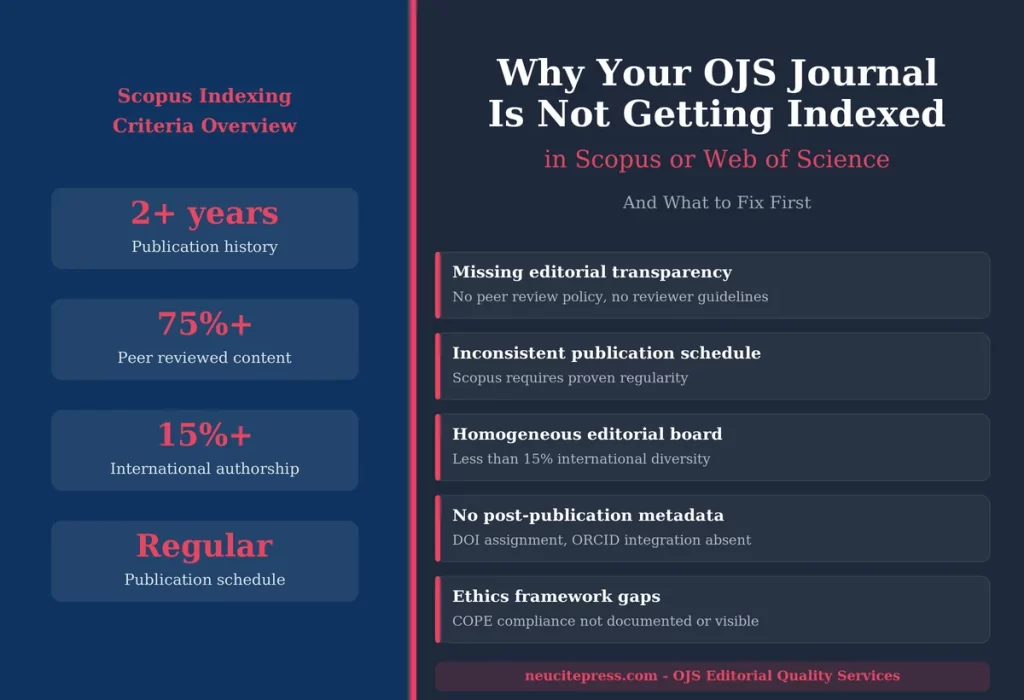
Scopus Indexing Requirements: 14 Essential Criteria Your Journal Must Meet
For academic publishers and journal editors, achieving Scopus indexing represents a transformative milestone. This prestigious database indexes over 25,000 active titles from more than 7,000 publishers across 240 academic disciplines, making it one of the world’s most authoritative sources of peer-reviewed research. Understanding the specific Scopus indexing requirements isn’t just beneficial—it’s essential for any journal aiming to join this elite community and gain access to millions of researchers worldwide. In this comprehensive guide, we’ll decode all 14 essential criteria your journal must meet, providing a clear, actionable roadmap to navigate this rigorous evaluation process with confidence.
Reviewed by the NeucitePress Editorial Board — PhD academics, peer-reviewed editors and subject-matter specialists.
What Is Scopus and Why Do Indexing Requirements Matter?
The Scopus database maintains its global prestige through rigorous, transparent evaluation. Every journal undergoes assessment by the Content Selection and Advisory Board (CSAB), an independent panel of international subject matter experts who employ both quantitative and qualitative measures. This meticulous review process ensures that only high-quality, ethically sound publications gain inclusion.
For publishers, the stakes are substantial. Research consistently shows that journals indexed in Scopus receive 3-5 times more citations than non-indexed counterparts. This citation advantage directly influences faculty advancement, institutional rankings, and library acquisition decisions. Yet first-time applicants face daunting rejection rates exceeding 40% across many disciplines—underscoring the significance of understanding these requirements before submitting your application.
The strategic value is undeniable. Enhanced visibility drives readership, which generates citations and attracts superior submissions from leading researchers worldwide. This multiplier effect transforms journal impact and establishes your publication as a serious contributor to global scholarship.
Scopus Indexing Requirements: Understanding the Core Criteria
The evaluation framework encompasses 14 key requirements organized into five major categories. Success requires meticulous attention to each dimension. Let’s break down the essential standards your journal must satisfy.
1. Editorial Policy and Governance Structure
Your journal must have a clearly defined editorial policy that demonstrates legitimate governance. This includes:
- Editorial board composition: Names, affiliations, and expertise of editorial board members visible on your publication’s website or masthead
- Geographic diversity: Editorial teams representing multiple countries and institutions, not concentrated in a single location
- Peer review transparency: Public documentation of how peer review functions (single-blind, double-blind, or open)
- Editorial independence: Demonstration that editorial decisions remain independent from commercial pressures
The CSAB scrutinizes editorial structures because they ensure academic integrity. Publishers using shell organizations or lacking transparent governance face automatic rejection regardless of content quality. Your editorial board should reflect established researchers with verifiable institutional affiliations.
2. Rigorous Peer Review Standards
Journals must demonstrate robust peer review processes that maintain scholarly integrity. The specific methodology—whether single-blind, double-blind, or open—matters less than transparent documentation of your chosen approach.
Essential elements include:
- Written peer review guidelines available to potential reviewers
- Documented reviewer selection criteria and expertise requirements
- Clear timelines for peer review completion
- Mechanisms for handling conflicts of interest
- Regular quality assurance audits of the peer review process
The CSAB evaluates whether your journal implements genuine peer review or merely rubber-stamps submissions. Evidence of rigorous manuscript scrutiny—including rejection rates, revision cycles, and reviewer feedback—strengthens your application. Learn more about building peer review best practices that boost journal credibility to enhance your publication’s standing.
3. Publication Ethics and Integrity Standards
Every journal requires a publicly available ethics statement that covers plagiarism policies, authorship criteria, and conflict-of-interest disclosure. The CSAB expects alignment with guidelines from authoritative organizations:
- COPE (Committee on Publication Ethics): Established standards for addressing research misconduct
- WAME (World Association of Medical Editors): Medical publishing best practices and ethical guidelines
- ICMJE (International Committee of Medical Journal Editors): Standards for authorship, data availability, and reporting
Your ethics policy should explicitly address plagiarism detection procedures, authorship criteria, conflict of interest disclosure, data retention policies, and retraction procedures. Journals demonstrating commitment to publication ethics signal trustworthiness to both researchers and the academic community. This is non-negotiable for Scopus indexing.
4. International Standard Serial Number (ISSN) Registration
Your journal must have an International Standard Serial Number (ISSN) registered with the ISSN International Centre. This unique identifier serves as proof that your publication meets basic bibliographic standards.
If your journal publishes in both print and online formats, you’ll need separate ISSN numbers for each. The ISSN registration process is straightforward and inexpensive, but it’s non-negotiable for consideration. Most publishers complete registration before launching their journal, so ensure this is among your first administrative steps.
5. Publication History and Consistency
A significant 2024 policy change eliminated the traditional two-year publication history requirement, opening doors for newer journals. However, you must still demonstrate consistent, regular publication patterns. The CSAB examines:
- Publication regularity: Adherence to your declared schedule (quarterly, bi-monthly, etc.) without gaps
- Article velocity: Reasonable number of articles published per issue
- Archive completeness: Complete back-issues available and properly dated
- Quality consistency: Evidence that editorial standards have been maintained across all issues
Newer journals can now apply after establishing 12 months of consistent publication, provided they’ve demonstrated the ability to maintain regular schedules. This change recognizes that quality often matters more than longevity. However, any gaps in publication history or irregular schedules raise red flags about journal sustainability.
6. Online Availability and Technical Standards
Your journal must be professionally accessible online with proper technical infrastructure. Requirements include:
- Dedicated website: Professional journal website (not just hosted on social media or free platforms)
- Secure connection (HTTPS): SSL certificate ensuring secure browsing
- Search functionality: Ability for readers to search and filter content
- Proper digital formats: Articles in PDF, HTML, or both with proper metadata
- DOI assignment: CrossRef Digital Object Identifiers for each article
- Stable URLs: Permanent links that don’t change over time
The CSAB checks whether your journal appears professional and stable. Poor website design, broken links, or unstable hosting can lead to rejection. Invest in reliable hosting and ensure your site meets modern web standards.
7. Content Quality and Academic Rigor
The CSAB evaluates whether your journal publishes original research of genuine academic value. Assessors examine:
- Research originality: Whether articles present novel findings or perspectives
- Methodological soundness: Appropriate research designs and statistical rigor
- Writing quality: Clear, professional presentation that meets academic standards
- Contribution to field: Whether published articles advance disciplinary knowledge
Sample articles submitted with your application receive close scrutiny. The CSAB may request additional articles beyond what you provide initially. Your journal’s content quality is perhaps the single most important factor in evaluation.
8. Subject Discipline Coverage and Scope
Your journal must have a clearly defined scope that fits within recognized academic disciplines. The CSAB maintains coverage across 240 disciplines; your journal should align with established subject categories.
Required elements include clearly defined disciplinary focus, rationale for your specific scope, evidence of editorial expertise, and articles that consistently fall within the stated scope. Multidisciplinary journals are acceptable if the scope is clearly articulated and consistently maintained. Vague, overly broad scope definitions invite rejection.
9. Language and Title Criteria
While Scopus indexes journals in many languages, your publication must meet these language requirements:
- English abstracts and titles: Essential even if full articles appear in other languages
- English availability: Content must be accessible to the global research community
- Professional translation: Non-English articles should have accurate, professionally reviewed translations or English abstracts
This requirement reflects Scopus’s commitment to supporting international scholarship. English abstracts enable researchers globally to discover and evaluate your content, even if they can’t read the full article in other languages.
10. Citation Patterns and Research Impact
The CSAB analyzes whether published articles generate citations within their respective fields. This isn’t about immediate citation counts; instead, assessors evaluate whether your journal attracts the kind of research that typically gets cited.
To strengthen this dimension, publish original research likely to be referenced by other scholars, avoid purely review articles without novel contributions, establish your journal as a venue for important findings, and monitor citation metrics once you achieve indexing using Scopus CiteScore explained: What it means for your journal.
11. Author Guidelines and Manuscript Standards
Journals must publish comprehensive author guidelines covering manuscript formatting, citation style, figure and table specifications, structural requirements, submission process, and ethical requirements. Professional author guidelines signal that your journal takes quality seriously. They also facilitate proper formatting of metadata that Scopus indexing requires.
12. Publisher Information and Business Sustainability
The CSAB assesses whether your journal has a sustainable business model. This includes clear publisher identification, transparent business model explanation, stability indicators, and professional registration. Predatory publishers face automatic rejection. Legitimate journals transparently disclose their business operations and demonstrate genuine commitment to scholarly communication.
13. Editorial Continuity and Leadership Stability
The CSAB evaluates whether your journal has stable, qualified leadership through Editor-in-Chief credentials, administrative continuity, succession planning, and professional management. Frequent editor changes or unclear succession plans raise concerns about journal stability. Demonstrate that your publication is built to last.
14. Compliance with Copyright and Open Access Standards
Your journal must have clear policies covering intellectual property, licensing, and access models including copyright ownership, licensing clarity, open access transparency, and reuse permissions. Modern scholarly communication demands transparent IP policies. Whether you operate a subscription, hybrid, or open access model is less important than being transparent about your choices.
The Content Selection and Advisory Board (CSAB) Evaluation Process
Understanding how the CSAB operates helps you prepare a stronger application. This independent panel comprises 15-30 international subject matter experts across different disciplines. Each evaluator brings deep expertise in their field and commitment to maintaining Scopus’s high standards.
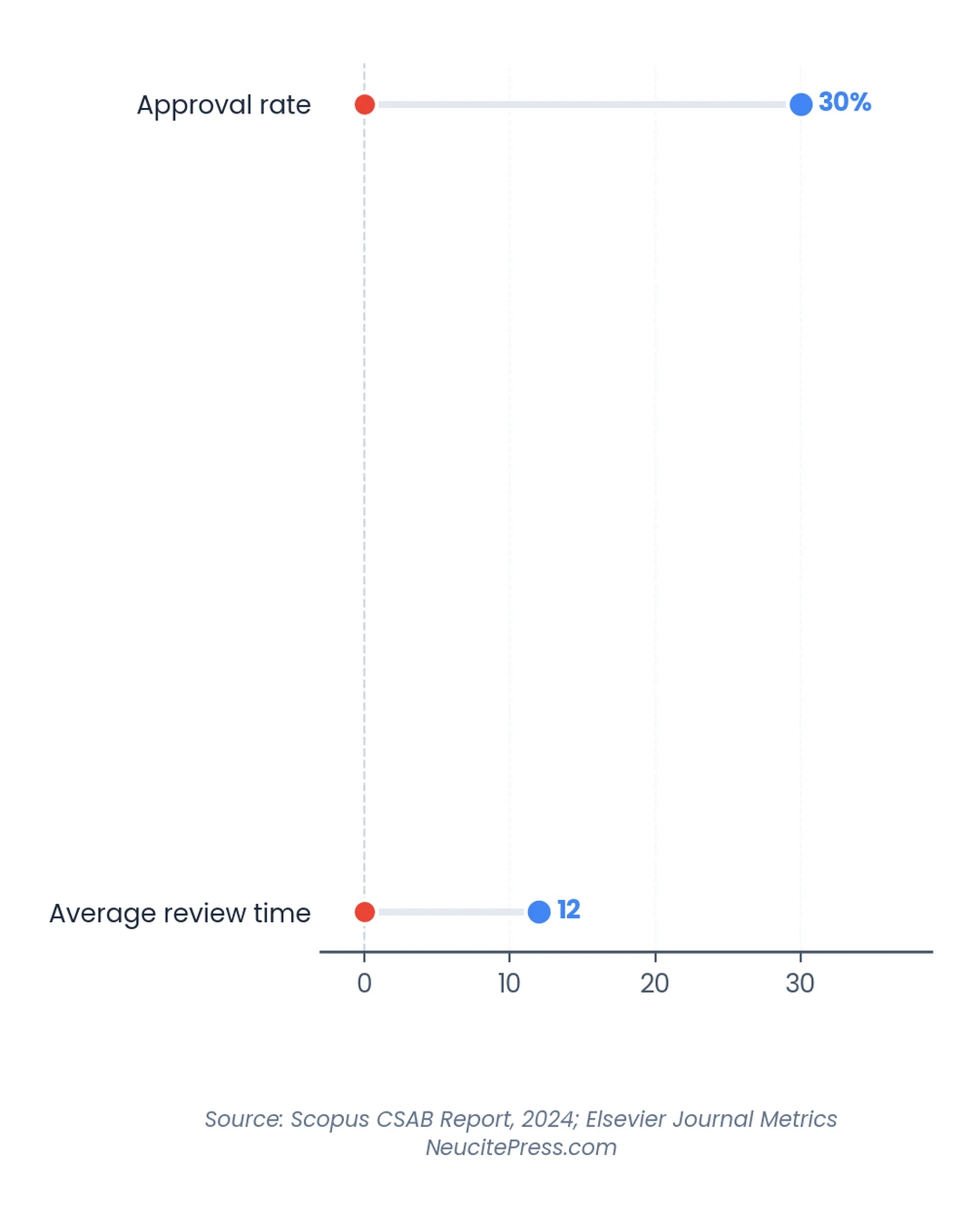
CSAB Evaluation Framework and Methodology
The evaluation employs a structured five-factor framework with Journal Policy weighted at 25%, Content Quality at 35%, Journal Standing at 20%, Publishing Regularity at 10%, and Online Availability at 10%.
Each evaluator provides detailed feedback on these dimensions. The CSAB then makes a consensus recommendation, which is sent to Scopus leadership for final approval. This transparent process ensures that evaluations remain fair and based on objective criteria.
What Happens After Submission?
Upon submission of your title suggestion form, you’ll receive a Tracking ID for monitoring progress. The timeline typically spans 6-18 months, depending on disciplinary area and evaluation queue.
During this waiting period, continue strengthening your journal by addressing any potential weaknesses the CSAB might identify. Discover journal indexing checklist: 25-point pre-application audit to ensure you’ve covered every base before submission.
Strategic Preparation: Your 9-Step Roadmap to Success
Successful applications don’t happen by accident. They result from systematic preparation. Follow this proven framework:
Step 1: Conduct Pre-Application Readiness Assessment
Before submitting your title suggestion form, conduct an honest assessment of your journal’s current state. Review each of the 14 criteria above and rate your journal on a scale of 1-5 for each requirement. Identify gaps that need addressing before submission.
Step 2: Audit Editorial Board and Leadership
Review your editorial board composition. Ensure you have at least 8-12 editorial board members with verified affiliations, representation from multiple countries (minimum 3-4 different nations), clear expertise relevant to your journal’s scope, established publication records, and institutional affiliations at recognized research universities. If your current board lacks diversity or established credentials, recruit new members before applying. A weak editorial board is a common reason for rejection.
Step 3: Formalize and Document Publication Ethics
Create comprehensive ethics statements covering plagiarism, authorship, and conflicts of interest. Reference COPE, WAME, or ICMJE guidelines. Make these policies publicly accessible on your journal website. Implement plagiarism detection software and document your approach.
Step 4: Establish Technical Infrastructure
Ensure your journal meets technical requirements including a professional website with HTTPS, DOI registration with CrossRef, stable permanent article URLs, searchable article database, and professional metadata. Consider whether your current hosting and website platform can support these requirements long-term.
Step 5: Develop and Publish Comprehensive Author Guidelines
Create detailed author guidelines covering manuscript preparation, citation style, ethical requirements, and submission procedures. Make these easily accessible from your journal homepage. Detailed guidelines signal professionalism and help ensure consistent manuscript quality.
Step 6: Compile and Review Sample Articles
Prepare 3-5 representative articles published in your journal. Select articles that represent your journal’s best work, cover different aspects of your stated scope, include strong methodology, demonstrate proper use of peer review feedback, and show adherence to your stated publication standards.
Step 7: Document Publication Regularity and Sustainability
Create a timeline showing your publication schedule adherence including complete issue-by-issue history, number of articles per issue, any deviations from planned schedule, and your journal’s sustainability plan. This reassures the CSAB that your journal will still exist in 5-10 years.
Step 8: Prepare Publisher and Business Documentation
Gather documentation proving your publisher’s legitimacy including publisher registration documents, editorial office contact information, business model explanation, and financial sustainability evidence. Transparency here is crucial.
Step 9: Submit Title Suggestion Form and Track Progress
Once your journal fully meets all 14 criteria, submit your title suggestion form. You’ll receive a Tracking ID for monitoring progress. Don’t expect immediate communication; the evaluation typically takes 6-18 months. During the waiting period, continue strengthening your journal. Learn how long Scopus indexing takes: Realistic timeline revealed to manage your expectations and plan accordingly.
Visual Guide: Scopus Indexing Requirements Infographic
This infographic summarizes all 14 Scopus indexing requirements in a visual format. Use this as a quick reference checklist during your preparation process.
Common Rejection Reasons and How to Avoid Them
Understanding why journals get rejected helps you avoid the same pitfalls. The most common reasons for rejection include insufficient editorial governance, weak or absent peer review, inadequate ethics and integrity standards, poor quality content or low standards, inconsistent or irregular publication, inadequate technical infrastructure, and predatory indicators.
If your journal received a rejection, understand rejected from Scopus? Your 90-day reapplication strategy for how to strengthen your application and reapply successfully.
Timeline and Process: What to Expect From Application to Indexing
Understanding the complete timeline helps you prepare mentally and logistically. During pre-submission (0-6 months before applying), strengthen your editorial board, formalize ethics policies, ensure technical infrastructure meets standards, publish high-quality articles, and document your publication history.
The submission phase (Months 1-2 of evaluation) includes submitting your title suggestion form and receiving your Tracking ID. The evaluation phase (Months 2-12) involves CSAB detailed assessment. The decision and notification phase (Months 12-18) communicates decisions and potential next steps.
Once approved, you’ll work with the Scopus team to establish metadata harvesting and prepare for the first article inclusion. Full indexing typically begins within 2-3 months of approval. Learn more about how to get your journal indexed in Scopus: Complete 2025 guide for end-to-end information about the entire process.
Post-Acceptance: Maintaining Your Scopus Indexed Status
Achieving Scopus indexing is not the end—it’s the beginning of an ongoing commitment to excellence. Scopus conducts annual reviews to ensure indexed journals continue meeting standards including verification of publication schedule consistency, ethics policies active enforcement, editorial board remaining active and qualified, content quality standards maintained, and website and technical infrastructure continuing to function properly.
Journals can be removed from Scopus if they fail to maintain standards. Learn journal removed from Scopus? Here’s your recovery roadmap to understand removal risks and how to prevent deindexing.
Also watch for Scopus discontinuation notice: Warning signs and prevention strategies to keep your journal on good standing long-term.
Once indexed, leverage your Scopus status for marketing your journal, negotiating institutional partnerships, tracking and improving CiteScore metrics, and establishing your journal as a respected venue in your discipline. Your Scopus indexing is a permanent achievement, but only if you continue investing in quality and ethical publication practices.
Additional Resources and Next Steps
Your journey to Scopus indexing doesn’t end with this guide. Consider these additional resources:
- Launch your journal: How to start an academic journal: Step-by-step launch blueprint
- Strengthen peer review: Peer review best practices that boost journal credibility fast
- Pre-application assessment: Journal indexing checklist: 25-point pre-application audit
- Professional assistance: Journal indexing services: How professionals fast-track approval
These resources provide deeper guidance on specific aspects of journal development and indexing strategy.
FAQ: Scopus Indexing Requirements Explained
What is the current status of the two-year publication history requirement?
As of 2024, the traditional two-year publication history requirement has been eliminated. Newer journals can now apply after demonstrating 12 months of consistent, regular publication. However, any gaps in publication or irregular schedules remain red flags that may affect evaluation. The change recognizes that quality often matters more than longevity, but you must still demonstrate reliable, regular publication patterns.
How important is the editorial board to the evaluation process?
Editorial board composition is critically important. A weak or non-existent editorial board is one of the top reasons for rejection. The CSAB expects board members to be established researchers with verified institutional affiliations and relevant expertise. Geographic diversity across at least 3-4 countries strengthens your application significantly. If your current board lacks credentials or diversity, recruit new members before applying.
Can a journal in a non-English language be indexed in Scopus?
Yes. Scopus indexes journals in many languages, but all submissions must include English titles and abstracts at minimum. This requirement reflects the database’s commitment to supporting international scholarship while ensuring the research is discoverable by the global academic community. Full articles can be in any language, but English accessibility is essential.
What happens if my journal is rejected? Can I reapply?
Yes, you can reapply after addressing the feedback provided with your rejection. Most journals that reapply after addressing CSAB concerns are approved on their second attempt. Typically, you should allow at least 3-6 months between rejection and reapplication to meaningfully strengthen your journal. Read our guide on rejected from Scopus? Your 90-day reapplication strategy for specific steps to improve your application.
How long does the evaluation process typically take?
The evaluation timeline typically ranges from 6-18 months depending on your discipline and the current evaluation queue. During this time, you’ll receive minimal communication; your Tracking ID allows you to monitor progress on the official Scopus website. Different disciplines move at different speeds; humanities fields may be slower than STEM fields. For complete timeline details, see how long Scopus indexing takes: Realistic timeline revealed.
What fees are involved in Scopus indexing?
Scopus does not charge journals for inclusion or evaluation. The application process is free. However, you will need to invest in infrastructure (professional website, manuscript management software, DOI registration, etc.). Some publishers use professional indexing services to improve their chances of acceptance, but this is optional. Avoid any service claiming they can “guarantee” Scopus indexing—no legitimate company can guarantee acceptance.
How does Scopus differ from other indexing databases like PubMed or Web of Science?
Each database has different coverage, disciplines, and evaluation criteria. Scopus covers 240 disciplines and emphasizes broad interdisciplinary coverage. PubMed focuses exclusively on life sciences and biomedical literature. Web of Science (now Clarivate) emphasizes citation impact and has traditionally higher impact factors. Choose indexing goals based on your journal’s discipline and target audience. Many journals aim for inclusion in multiple databases.
Does publishing open access affect my chances of Scopus indexing?
No. Scopus indexes journals regardless of their business model—subscription, open access, or hybrid models are all acceptable. What matters is transparency about your access model and consistent execution of quality standards. Whether you charge subscription fees, author fees, or operate fully open access doesn’t affect indexing eligibility as long as you’re transparent about costs and don’t use deceptive practices.
What role does citation impact play in the evaluation process?
Citation impact is evaluated, but it’s weighted appropriately by discipline. The CSAB doesn’t expect new journals to have citation history, but they do assess whether the journal publishes the kind of research likely to be cited. Within established journals, citation patterns are analyzed to ensure the journal attracts quality research that contributes to scholarly discourse. However, citation metrics are only one factor among many in the overall evaluation.
Can I improve my chances by increasing author fees or making the journal open access?
Neither action directly improves your chances, but both should align with your journal’s values and sustainability model. What matters is transparency and ethical practices. If you charge author fees, clearly explain how fees are used and ensure that acceptance is based purely on merit, not ability to pay. If you operate open access, ensure sustainable funding. The CSAB evaluates whether your business model is transparent and sustainable, not whether you’ve chosen a particular model.
Should I hire a professional indexing service to help with my application?
Professional journal indexing services can provide valuable guidance on strengthening your application and navigating the process. However, they cannot guarantee acceptance—only your journal’s actual quality and compliance with standards determine approval. If you’re uncertain about meeting requirements, consider consulting professionals. Learn more about journal indexing services: How professionals fast-track approval to evaluate whether professional assistance is right for your situation.
Conclusion: Your Path to Scopus Indexing Success
Achieving Scopus indexing requires systematic attention to 14 core criteria spanning editorial governance, content quality, publication ethics, technical infrastructure, and sustainability. This comprehensive guide has provided the detailed knowledge and actionable frameworks needed to navigate this rigorous evaluation successfully.
The key to success lies in understanding that the CSAB isn’t trying to exclude journals—they’re trying to maintain a database of high-quality, ethical publications. By demonstrating legitimate governance, rigorous peer review, clear ethical standards, consistent publication practices, and genuine commitment to scholarly excellence, your journal can join this prestigious community.
Remember: the evaluation process takes time, and rejection doesn’t mean failure. Most rejected journals succeed on reapplication after addressing feedback. The investment in strengthening your journal’s infrastructure, editorial board, and publication standards yields benefits regardless of indexing status.
Begin your preparation today. Start with the comprehensive journal indexing checklist: 25-point pre-application audit to identify gaps in your current journal. Then work systematically through each criterion, building a publication that truly merits inclusion in the world’s most respected academic database.
Your journal’s Scopus indexing journey starts now. With dedication to quality, ethical standards, and the frameworks outlined in this guide, success is entirely achievable. We’re here to support you every step of the way.