How to Start an Academic Journal: Complete 10-Step Launch Blueprint
The academic publishing industry is undergoing a transformation. While traditional publishers maintain extraordinary profit margins—often surpassing Apple and Google—a revolutionary shift toward open access models is democratizing scholarly communication. Today is the ideal moment to start an academic journal that challenges outdated systems and serves your research community.
Reviewed by the NeucitePress Editorial Board — PhD academics, peer-reviewed journal editors and medical communication specialists.
Institutions worldwide spend millions on subscription fees while scholars contribute work without compensation. Yet emerging publishing technologies and diverse funding models have dramatically lowered barriers to entry. This comprehensive guide reveals how to launch an academic journal that’s credible, sustainable, and impactful.
Why now? Success stories prove the model works. The International Journal of Music, Health and Wellbeing operates entirely free-to-publish. Psychreg Journal of Psychology thrives with a decentralized editorial structure. Timothy Gowers’ Advances in Combinatorics proved researchers will submit high-quality work to ethically-aligned publications that reject commercial exploitation.
From identifying your niche to achieving indexing in Scopus, we demystify every step. Whether you’re launching a multidisciplinary publication or filling a specialized research gap, this blueprint provides the roadmap for sustainable, credible journal success.
Key Takeaways
- Academic publishing’s profit margins exceed major tech companies, creating opportunity for ethical alternatives
- Open access models eliminate author fees and reader paywalls while maintaining rigorous quality standards
- Modern digital platforms and funding options make journal launches accessible to institutions and researcher groups
- Strategic niche positioning attracts quality submissions from global scholarly communities
- Professional editorial workflows and management software are achievable at reasonable costs
- Systematic approaches to compliance and standards ensure long-term credibility and indexing eligibility
- Dedicated promotion and continuous improvement accelerate growth from launch to recognition
Step 1: Identify Your Niche and Validate the Opportunity
The most critical decision happens before technical setup. Starting an academic journal succeeds when it addresses a genuine gap in scholarly communication. This isn’t about competition—it’s about service.
Research Gaps That Justify New Journals
Conduct systematic research to identify your opportunity. Ask these questions:
- What research areas lack suitable publication venues with acceptable turnaround times?
- Do underrepresented disciplines need dedicated spaces where scholars can publish work that doesn’t fit traditional hierarchies?
- Are researchers frustrated by specific journals’ policies, scope limitations, or access restrictions?
- Can your institution leverage existing expertise, networks, or resources to serve a community uniquely?
Successfully launching requires understanding your target author community deeply. Are they early-career researchers seeking rapid publication? Established scholars wanting ethical publishing homes? Interdisciplinary teams struggling to find venues that value their approach?
Timothy Gowers’ Advances in Combinatorics demonstrates this perfectly. Launched in 2013, it succeeded by explicitly rejecting commercial publisher models. Mathematicians—known for collaboration and openness—responded enthusiastically. The journal now attracts submissions from top institutions globally.
Similar success occurred when researchers in music, health, and well-being discovered no suitable publication venue. They created one. Demand is real; supply was insufficient.
Articulating Your Aims and Scope
Develop a clear, concise aims and scope statement. This document defines:
- Subject coverage: Which disciplines, subdisciplines, or interdisciplinary areas you publish
- Research types: Empirical studies, theoretical work, reviews, case studies, or mixed approaches
- Geographic or linguistic focus: Global audience or specific regions
- Audience: Practitioners, academics, policymakers, or mixed
- Quality standards: How your journal maintains rigor and credibility
- Unique value proposition: What makes your journal distinct and necessary
This statement becomes your north star for editorial decisions. It shapes manuscript evaluation, reviewer selection, and promotion strategy. Transparency about scope attracts aligned submissions and prevents frustration from out-of-scope submissions.
Your competitive advantage might be speed—committing to 3-month review cycles in a field where 18-month waits are normal. Perhaps you champion open peer review in a secretive field. Maybe you’re the first journal dedicated to emerging methodologies your discipline is rapidly adopting.
Step 2: Build Your Editorial Team for Credibility and Quality
Editorial board composition directly impacts your journal’s credibility and submission quality. Strategic recruitment is essential.
Recruiting Editors with Proven Track Records
Start with a diverse editorial team combining:
- Distinguished scholars: Senior researchers with substantial publication records and disciplinary authority
- Subject matter experts: Specialists covering your journal’s scope areas with deep topical knowledge
- Methodological specialists: Editors expertise in research designs and methods your journal will publish
- Emerging voices: Early-career researchers representing future directions in your field
- Diversity advocates: Scholars committed to inclusion and equity in your discipline
Learn more about building a strong editorial board with proven recruitment strategies.
Approach recruitment as relationship-building, not obligation. Explain your mission clearly. Share your vision for ethical publishing, rapid review, or disciplinary innovation. Most scholars—especially those frustrated with commercial publishers—respond positively to invitations that align with their values.
Managing Editorial Workflow and Decision-Making
Define clear roles:
- Editor-in-Chief: Strategic vision, final acceptance decisions, public face
- Managing Editor: Day-to-day workflow management, reviewer coordination, timelines
- Editorial Board Members: Manuscript evaluation, reviewer recruitment, special issue leadership
- Section Editors: Specialty area expertise, initial screening, accept/reject recommendations
Establish clear communication channels—email lists, shared documents, monthly calls. Regular check-ins prevent bottlenecks and maintain momentum.
Document decision-making processes. When does a manuscript move forward? What triggers desk rejection? Who makes final calls? Written procedures prevent confusion and ensure consistency.
Step 3: Establish Policies, Compliance, and Ethical Standards
Professional publishing requires comprehensive policy frameworks. These aren’t bureaucratic obstacles—they’re the foundation of trust, credibility, and legal protection.
Essential Policies for Journal Credibility
Develop and publish these policies on your website:
Copyright and License Frameworks: Plan S funders (supporting hundreds of billions in research funding) mandate that authors retain copyright while using Creative Commons licenses. Decide your position: Will you require CC-BY (most permissive)? Allow author choice? Adopt Plan S compliance from launch?
Conflict of Interest Policies: Define financial relationships, personal connections, and other conflicts requiring disclosure. Specify whether editors and reviewers can evaluate work from their institutions or co-authors.
Authorship Standards: Adopt ICMJE guidelines requiring significant intellectual contributions, not honorary authorship or ghost writing. Specify whether your journal allows single-author papers or requires collaboration.
Data Availability: Will you require open data? Allow exceptions for sensitive information? Implement the Transparency and Openness Promotion (TOP) framework, increasingly expected by funders and research institutions.
Plagiarism Detection: Use tools like Turnitin or CrossRef to screen submissions. Define your response—desk rejection for academic dishonesty, or opportunity for authors to revise?
Peer Review Transparency: Specify your model. Single-blind (reviewers anonymous)? Double-blind (mutual anonymity)? Open peer review (signed reviewers)? Different models suit different disciplines.
| Policy Area | Key Decision Points | Implementation Timeline | Publishing Standard Reference |
|---|---|---|---|
| Copyright & Licensing | Author rights retention, Creative Commons choice, Plan S alignment | Pre-launch | COPE, DOAJ Guidelines |
| Conflict of Interest | Financial disclosure thresholds, institutional affiliations, reviewer eligibility | Pre-launch | ICMJE Standards |
| Data Availability | Open data requirements, sensitive information exceptions, repository integration | Pre-launch | TOP Framework |
| Ethical Standards | Authorship criteria, plagiarism thresholds, research ethics requirements | Pre-launch | COPE Guidelines |
| Peer Review Process | Anonymity model, timeline expectations, reviewer selection criteria | Pre-launch | COPE, OASPA, WAME Standards |
Compliance for Medical and Health-Related Journals
If publishing medical, health, or clinical research, additional compliance is mandatory:
HIPAA Compliance: Patient privacy is non-negotiable. Ensure manuscripts de-identify all patient information. Verify informed consent documentation is proper. Institute Review Board (IRB) approval must be confirmed for human subjects research.
PhRMA Code Compliance: If pharmaceutical companies publish in your journal, the Pharmaceutical Research and Manufacturers of America Code applies. Transparency about company funding, ghostwriting prohibitions, and marketing restrictions is required.
Clinical Trial Registration: Require registration in ClinicalTrials.gov or similar registries before publication. This combats publication bias and ensures research transparency.
These aren’t optional. Regulatory agencies, research institutions, and librarians scrutinize compliance closely. Non-compliance can damage credibility permanently and trigger investigations.
Step 4: Select Technology Infrastructure and Submission Management
Modern submission management software eliminates manual processes and enables quality control. Selecting the right platform is crucial but achievable at reasonable costs.
Choosing Manuscript Management Software
Your primary options:
Open Journal Systems (OJS): The industry standard for open access journals. Free software with comprehensive features—manuscript tracking, double-blind review management, copyediting workflows, issue assembly, and direct publication to your website. Hundreds of successful journals run on OJS. Learn more about the best journal manuscript management systems compared.
Scholastica: Commercial platform offering user-friendly interfaces and integrated publication features. Costs scale with submissions. Best for growing journals needing professional polish and support.
Editorial Manager/Aries: Enterprise-level solutions used by major publishers. Powerful but expensive. Overkill for new journals.
Google Sheets/Airtable: For small journals with minimal submissions. Not scalable but functional for first years. One editor successfully reported: “I use a spreadsheet to keep on top of submissions. It works fine.” This works for low-volume operations but limits your growth ceiling.
Essential Platform Features
Regardless of platform choice, ensure you have:
- Manuscript tracking: Know exactly where each submission stands in review
- Reviewer management: Assign reviewers, track deadlines, collect evaluations
- Author communication: Automated status updates and notifications
- Editorial workflows: Decision templates, appeal processes, revision management
- Plagiarism integration: Automated screening and reports
- Website integration: Seamless author submission and reader access
- Archiving: Permanent content preservation (discussed further below)
Don’t over-invest initially. Start with what serves your launch phase. You can migrate to more sophisticated systems as submissions scale.
Step 5: Design Publishing Workflows and Production Processes
Professional publishing requires repeatable, documented workflows. These become your operational backbone.
Manuscript Evaluation and Peer Review
Design your review workflow:
- Initial Screening (Editor): Does the manuscript fit your scope? Is writing quality sufficient? Is it likely to pass peer review? Desk-reject unsuitable submissions immediately—this respects authors’ time and reduces reviewer burden.
- Reviewer Invitation: Recruit 2-3 qualified reviewers using clear evaluation criteria. Include deadline expectations and interest-specific guidance.
- Review Period: Set realistic timelines. 4-6 weeks is professional. Track late reviewers and send reminders at week 3.
- Editorial Decision: Editor synthesizes reviews, considers author responses, and makes final recommendation. Provide transparent rationale to authors regardless of outcome.
- Revisions: Assign minor or major revision, allowing authors to address feedback. Major revisions require second-round review; minor revisions may need only editor verification.
Commit to rapid publication. Turnaround times are a competitive advantage. If competitors average 6-9 month waits, your 3-month timeline attracts submissions. Learn more about peer review best practices that boost journal credibility fast.
Production, Copyediting, and Final Publication
Professional production doesn’t require expensive vendors. Modern tools are accessible:
Copyediting: Hire freelance copyeditors or use graduate student editors trained in style (APA, Chicago, or your discipline’s standard). Costs range from $30-75 per article. Tools like Hemingway Editor and Grammarly assist but don’t replace human review.
Typesetting and Formatting: Microsoft Word templates with professional styling are adequate. For polished PDFs, libre templates using free fonts (Google Fonts, Font Awesome) eliminate licensing costs. Some journals publish typeset articles; others accept well-formatted Word documents. Both are legitimate.
Publishing Schedule: New journals often adopt rolling publication—articles are published individually as they complete final review and production. This maintains momentum and provides regular content rather than waiting to assemble an issue. After 2-3 years of growth, you can transition to traditional issues.
Web Hosting and Domain: Your journal needs a professional home. Register a domain (journalname.org is ideal; .com works too). WordPress with appropriate themes (Neve, Astra) provides professional websites with minimal cost—often $100-300/year. Integrate your OJS installation or submit management platform seamlessly.
Ensure your journal is indexed in Scopus and other major databases from launch to maximize visibility and credibility.
Step 6: Implement Long-Term Content Archiving
This is non-negotiable. Journals are stewards of scholarly knowledge. Your content must survive server failures, domain expirations, and institutional changes.
Portico: The gold standard. This digital preservation service ingests your content regularly and guarantees permanent access if your journal becomes inactive. Cost is typically $300-600 annually for small journals. Funders and libraries recognize Portico preservation as essential.
CLOCKSS: Alternative archival service using international distributed servers. Similar guarantees as Portico with different governance structure.
Internet Archive/Wayback Machine: Free backup but less robust than dedicated preservation services. Use as supplementary, not primary, archiving strategy.
Including archival commitment in your launch materials signals maturity and professional operation.
Step 7: Develop Revenue Models and Sustainable Funding
How will you fund operations sustainably? Explore journal revenue models compared including subscription vs. open access vs. hybrid approaches.
Funding Options for New Journals
Open Access Model (Free-to-Publish): Authors pay no fees. Readers access content freely. Funding comes from institutions, research grants, or societies. Increasingly common and aligned with funder mandates (Plan S, etc.). Learn about article processing charges and how to price your open access journal properly.
Article Processing Charges (APCs): Authors or institutions pay per-article publication fees ($1,500-5,000 typical). Requires transparent communication about costs. Many funders and wealthy institutions can cover APCs; others cannot. Carefully consider equity implications.
Institutional Sponsorship: Universities or research institutes fund your journal as a scholarly service. Common in newer ventures. Requires institutional commitment and stable funding.
Subscription Model: Readers or institutions pay for access. Generally incompatible with open access mission but can supplement institutional funding.
Hybrid Approach: Combine methods. For example: free-to-publish via institutional subsidies, with optional reader subscriptions for premium features or print editions.
Plan your funding strategy before launch. Understand your cost structure: editor honorariums, platform fees, copyediting, design, promotion, and archiving. Most new journals run lean but need stable funding for at least 3-5 years before becoming self-sustaining.
Step 8: Promote Your Journal and Build Your Audience
Excellent content isn’t discovered passively. Active promotion attracts submissions and builds readership.
Targeted Promotion Strategies
Professional Networks: Present at conferences. Connect with department chairs, research directors, and scholars in your niche. Personal invitations to submit are highly effective.
Social Media and Digital Marketing: Leverage proven digital marketing strategies for academic journals. LinkedIn, Twitter/X, and Facebook reach scholars daily. Share research highlights, author stories, and submission calls. Build an engaged community.
Professional Societies: Partner with disciplinary associations. They have member networks and communication channels you can leverage.
Direct Outreach: Email scholars whose recent publications align with your scope. Invite submissions. Most will appreciate the personal touch.
Indexing Visibility: Get listed in DOAJ (Directory of Open Access Journals), Google Scholar, and major disciplinary databases. These drive discovery.
Promotion is ongoing. Allocate resources toward visibility as you allocate toward editorial operations.
Step 9: Achieve Indexing and Build Credibility
Indexing in major databases dramatically increases submission volume and impact visibility.
Key Indexing Targets
DOAJ (Directory of Open Access Journals): Essential for open access journals. DOAJ inclusion is expected by researchers and required by many funders. Application requires meeting transparency and quality standards. Application is free.
Google Scholar: Inclusion is automatic if your website provides proper metadata. No application necessary but requires correct technical setup.
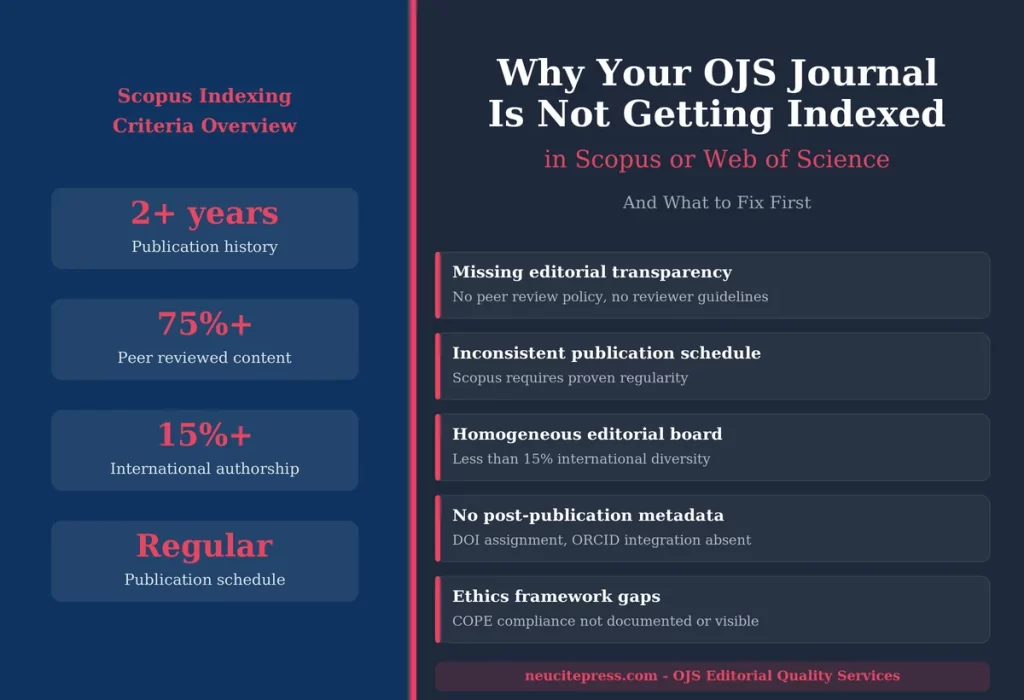
Scopus: Most prestigious scientific database. Inclusion requires demonstrating quality standards and requires proprietary agreement. Learn about Scopus indexing requirements and the 14 criteria your journal must meet.
PubMed Central (PMC): For biomedical journals. Free service with quality requirements. Highly prestigious for medical fields.
Web of Science (formerly ISI): Premium indexing with impact factors. Highly competitive. Demonstrates top-tier quality but less essential than Scopus for new journals.
Disciplinary Databases: Psychology has PsycINFO, Education has ERIC, etc. Research your field’s key databases and apply strategically.
Indexing typically requires 1-2 years of consistent publication demonstrating quality. Don’t wait for indexing to launch; pursue it continuously once operational.
Step 10: Create Your Launch Timeline and Execute Strategically
Implementation is phased:
Months 1-3 (Preparation): Finalize aims and scope. Recruit editorial board. Draft policies. Select platform. Set up infrastructure.
Months 4-6 (Soft Launch): Invite inaugural submissions. Recruit initial reviewers. Pilot workflows with first manuscripts. Build website. Set up archiving.
Months 7-12 (Public Launch): Publish first articles. Promote actively. Apply for DOAJ inclusion. Refine processes based on early experience.
Year 2-3 (Growth Phase): Build submission volume. Apply for Scopus indexing (if appropriate). Scale editorial team. Develop special issues. Establish sustainable funding.
Year 3+ (Maturity): Achieve indexing recognition. Establish impact. Plan expansion (new sections, languages, sister journals). Consider sustainability transition.
This timeline is flexible. Smaller journals or specialized fields may move slower. High-demand niches may accelerate.
FAQs: Common Questions About Starting Academic Journals
How much does it cost to start an academic journal?
Explore how much it costs to start a journal with our complete budget guide. Initial costs include domain registration ($15/year), web hosting ($100-300/year), manuscript management platform ($0-500/year depending on choice), copyediting ($2,000-5,000/year for 10-20 articles), and archiving ($300-600/year). Total first-year startup: $2,500-7,000 minimum. Ongoing operations typically cost $5,000-15,000 annually for small journals, scaling with submission volume. Institutional sponsorship or APC revenue covers these costs sustainably.
How long does it take for a new journal to gain recognition?
Achieving significant recognition requires consistency. Most journals see meaningful submission volume growth within 2-3 years. DOAJ inclusion (essential for open access journals) usually takes 6-12 months of operation. Scopus indexing requires approximately 18-24 months of demonstrated quality and consistency. Impact factors (for journals pursuing them) appear after 2-3 years of data collection. Patient, strategic growth beats aggressive short-term promotion.
What makes a successful academic journal distinct?
Success combines several factors: clearly identified niche addressing genuine scholarly need; respected editorial team that attracts quality submissions; efficient peer review delivering fast publication times; transparent ethical policies building author trust; active promotion reaching target audiences; and commitment to accessibility (open access preferred). No single factor guarantees success; excellence across multiple dimensions does.
Can new journals compete with established publishers?
Absolutely. New journals don’t outcompete incumbents; they serve communities publishers neglect or exploit. Your advantages include speed (faster review and publication), innovation (new approaches to peer review or open science), accessibility (open access models), and mission alignment (ethical publishing focused on scholarship rather than profit). Researchers actively seek ethical alternatives to expensive subscription-based publishers. Success comes through identifying genuine scholarly needs and serving those communities excellently, not through head-to-head competition with established brands.
What’s the best peer review model for new journals?
There’s no universal best—it depends on disciplinary norms. Single-blind (reviewers anonymous) is traditional and trusted. Double-blind (mutual anonymity) reduces bias in some fields but can be impractical when author identity is obvious. Open peer review (signed reviews) increases accountability but may intimidate junior scholars. Most new journals start with single-blind and adjust based on community feedback. Transparency about your choice (published on your website) is what matters most.
How do new journals handle their first articles?
Strategically. Your inaugural articles set the quality bar. Consider inviting 3-5 high-quality submissions from your editorial board to establish credibility. These articles should represent your scope at its best. Simultaneously, accept other quality submissions through normal review. Aim for your first issue to demonstrate excellence and diversity. Avoid publishing mediocre work just to launch quickly; your reputation depends on quality from day one.
Conclusion: Your Path to Starting a Sustainable Academic Journal
The opportunity to launch an ethical, reader-centric academic journal has never been greater. Technology, funding models, and researcher frustration with commercial publishers align perfectly. Your expertise, networks, and institutional resources position you to serve scholarly communities while advancing open science.
Starting an academic journal requires planning, persistence, and people. It’s not a quick project—expect 3-5 years of committed effort before achieving maturity. But the rewards are substantial: you’ll build infrastructure serving research communities for decades, advance your discipline’s knowledge infrastructure, and model ethical publishing alternatives.
Success isn’t guaranteed by this blueprint. It’s earned through strategic niche selection, editorial excellence, operational consistency, and active community engagement. But thousands of journals prove the model works when you combine clear mission with professional execution.
Your next steps: Identify your specific niche and validate author demand. Recruit your founding editorial board. Set your launch timeline. Begin building the scholarly publication your community deserves.
The publishing revolution needs journals like yours. Start now.
FAQ
What are the primary steps for launching a new academic journal?
The 10-step launch process includes: (1) Identifying your niche and validating scholarly need; (2) Building a diverse editorial team with proven track records; (3) Establishing policies around copyright, conflicts of interest, and ethics; (4) Selecting manuscript management software like OJS; (5) Designing peer review workflows; (6) Implementing content archiving via Portico; (7) Developing sustainable funding models; (8) Creating targeted promotion strategies; (9) Pursuing indexing in DOAJ and Scopus; and (10) Executing a phased launch timeline. Each step typically requires 1-6 months depending on institutional support and resources available.
How crucial is the editorial board for a new publication’s credibility?
Editorial board composition is fundamental to success. Scholars evaluate journal credibility partially through board member reputation and diversity. A board combining distinguished senior researchers, subject matter specialists, methodological experts, and emerging voices signals quality and commitment to excellence. Strategic recruitment—emphasizing your mission and values alignment rather than obligation—attracts respected scholars who enhance your journal’s standing with potential authors, reviewers, and readers.
What software is recommended for managing submissions and peer review?
Open Journal Systems (OJS) is the industry standard for open access journals. It’s free, feature-rich, and used by hundreds of successful publications globally. OJS handles manuscript tracking, double-blind peer review, copyediting workflows, and direct publication integration. For growing journals needing premium support and interfaces, Scholastica is reliable. For very small journals in early stages, Google Sheets or Airtable work temporarily but limit scalability. Choose based on current submission volume and growth projections.
What are the key financial considerations when starting a journal?
Initial startup costs range from $2,500-7,000 annually (domain, hosting, software, initial copyediting). Ongoing operational costs typically run $5,000-15,000 yearly depending on submission volume. Funding options include institutional sponsorship, open access funding (free-to-publish via grants or society support), article processing charges (APCs ranging $1,500-5,000 per article), or hybrid models combining revenue streams. Plan sustainable funding before launch; most new journals require institutional support for 3-5 years before becoming self-sustaining through submissions and indexing growth.
How long does it typically take for a new journal to gain traction and indexing?
Meaningful submission growth typically occurs within 2-3 years of consistent publication. DOAJ inclusion (essential for open access journals) usually takes 6-12 months of operation after applying. Scopus indexing requires approximately 18-24 months of demonstrated quality and consistency. Impact factors appear after 2-3 years of citation tracking. Success comes through patient, strategic execution rather than aggressive short-term promotion. Focus on quality content and active, targeted community engagement.
What compliance and ethical standards are mandatory for academic journals?
Journals must adhere to COPE (Committee on Publication Ethics) guidelines covering authorship standards, conflict of interest disclosure, plagiarism detection, and data integrity. Copyright frameworks should reflect Plan S funder mandates (author copyright retention, Creative Commons licensing). For medical journals, HIPAA compliance (patient de-identification), clinical trial registration, and PhRMA Code compliance are mandatory. Transparent peer review policies, data availability expectations, and research ethics verification protect both journals and authors. Publishing these policies prominently on your website builds trust and demonstrates professional maturity.
Can new academic journals compete with major established publishers?
Yes. New journals don’t outcompete incumbents; they serve communities publishers neglect or exploit. Your advantages include speed (faster review and publication), innovation (new approaches to peer review or open science), accessibility (open access models), and mission alignment (ethical publishing focused on scholarship rather than profit). Researchers actively seek ethical alternatives to expensive subscription-based publishers. Success comes through identifying genuine scholarly needs and serving those communities excellently, not through head-to-head competition with established brands.