How Much Does Starting a Journal Cost? Complete Budget Guide (2026)
Launching a new academic journal requires strategic financial planning and a clear understanding of all associated expenses. This comprehensive guide reveals the true cost of starting a journal, breaking down both visible and hidden expenses that impact your publishing venture’s long-term sustainability.
Reviewed by the NeucitePress Editorial Board — PhD academics, peer-reviewed editors and subject-matter specialists.
The financial reality of journal creation extends far beyond initial setup fees. According to peer-reviewed research analyzing scholarly publishing economics, the total cost per published article ranges from $200 to over $1,500 depending on your operational model, editorial approach, and service provider selection. Understanding these cost variations enables founders to make informed decisions about their publication strategy.
What makes starting a journal cost analysis challenging is the distinction between fixed overhead expenses and variable per-article expenses. A publication processing just 50 articles annually faces dramatically different unit economics than one handling 1,000+ submissions. Similarly, choosing between volunteer-led editorial boards and paid in-house staff creates cost variations exceeding $300 per article.
Understanding Journal Launch Expenses: The Complete Picture
The true cost of launching a scholarly publication involves multiple interconnected expense categories. Rather than viewing these costs in isolation, successful publishers understand how different operational choices cascade through their budget.
Direct Publishing Costs vs. Indirect Overhead
Direct costs are expenses incurred for each published article. These include manuscript submission platform fees, peer review coordination, copyediting, typesetting, DOI registration, and plagiarism detection. Direct costs typically range from $150 to $600 per article depending on service quality and provider selection.
Indirect costs represent fixed operational expenses that continue regardless of article volume. These include staff salaries, website hosting, digital preservation services (CLOCKSS/Portico), office facilities, insurance, and administrative overhead. Industry analysis suggests allocating approximately 33% overhead atop direct staff costs to account for infrastructure and support functions.
| Cost Category | Key Components | Per-Article Range | Economies of Scale |
|---|---|---|---|
| Content Acquisition | Submission systems, reviewer coordination, plagiarism checks | $100-250 | High (scales significantly) |
| Content Production | Copyediting, typesetting, metadata preparation, proofs | $150-350 | Moderate (some scaling) |
| Content Dissemination | Platform hosting, preservation, indexing services | $75-200 | High (strong per-unit reduction) |
| Editorial/Management | Editor salaries, administrative support, decision-making | $100-400 | Low (mostly fixed) |
If you would rather see these as priced line items than estimates, our journal launch service lists each component — ISSN registration, policy documentation, platform setup and first-issue production — with its own fee.
Breaking Down the Journal Budget: Cost Components
Manuscript Management Platform Fees
The submission and tracking system forms the foundation of journal operations. Modern manuscript management platforms offer varying feature sets and pricing models. Open Journal Systems (OJS) provides free, open-source functionality but requires self-hosting expertise. Commercial platforms like Manuscript Central charge annual fees typically ranging from $2,000-$8,000 depending on article volume and feature requirements. Scholastica and other boutique providers offer middle-ground solutions at $3,000-$6,000 annually.
Peer Review Infrastructure
Coordinating peer reviewers remains one of publishing’s most time-intensive activities. While peer reviewers donate their expertise, the administrative overhead of recruitment, tracking, and decision management requires significant investment. Industry data indicates editorial staff spend approximately 7.5 hours managing each submitted manuscript through the review process.
Specialized review management platforms add $500-$2,000 annually to operational expenses. These systems automate reviewer contact, response tracking, and decision workflows. For high-volume journals, this automation investment typically pays for itself through staff efficiency gains.
Production and Copyediting Services
Converting accepted manuscripts into publication-ready documents requires professional copyediting and typesetting. Freelance copyeditors charge $50-$150 per hour, typically investing 5-10 hours per article. Professional typesetting adds another $100-$300 per article depending on complexity and whether print and digital formats are required.
In-house production teams reduce per-unit costs but require salary investment. A dedicated production editor earning $50,000-$70,000 annually can efficiently handle 200-400 articles per year, translating to $125-$350 per article in direct labor costs.
Digital Object Identifier (DOI) and Metadata
DOI registration through CrossRef costs approximately $1 per article or requires an annual fee ($275-$660) for organizations with high submission volume. Proper XML metadata preparation ensures discoverability across major databases. This technical infrastructure investment typically costs $50-$150 per article or $2,000-$5,000 annually for organizations handling significant volume.
Plagiarism Detection and Quality Assurance
Plagiarism detection software like Turnitin or iThenticate charges $0.50-$2 per article when using pay-per-use models, or $1,500-$4,000 annually for unlimited submission access. Additional quality assurance activities—author correspondence, revision management, and technical review—add further operational overhead.

Indexing and Discoverability: Essential but Often Underestimated Costs
Database Indexing Services
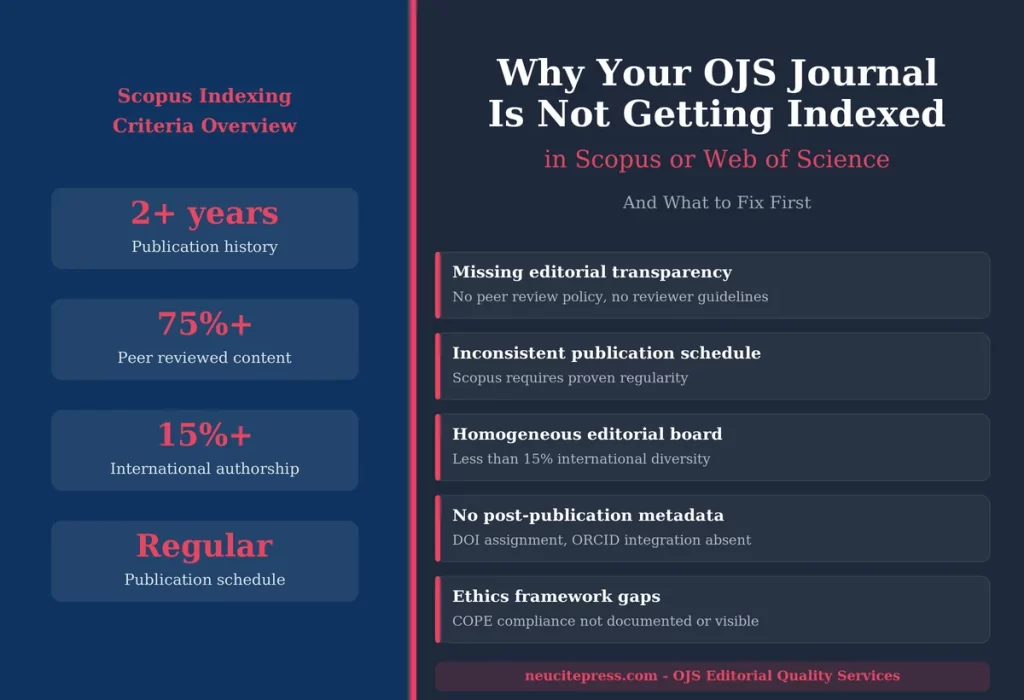
Indexing in major databases dramatically increases article visibility and citation impact. Scopus indexing, considered essential for most academic journals, requires meeting approximately 14 quality criteria and typically involves annual maintenance. DOAJ (Directory of Open Access Journals) indexing is free but requires compliance verification. PubMed Central indexing, essential for biomedical journals, involves annual registration and submission procedures.
While many databases charge no direct indexing fees, achieving and maintaining these listings requires investment in metadata compliance, regular submissions, and quality monitoring. Conservative estimates suggest $1,000-$3,000 annually for indexing support infrastructure.
Website Hosting and Platform Infrastructure
Professional journal websites require reliable hosting, SSL certificates, regular backups, and technical maintenance. Cloud-based hosting providers charge $50-$300 monthly depending on traffic volume and technical requirements. Publishing platforms offering integrated solutions (hosting + manuscript management + production workflow) typically cost $200-$500 monthly.
Digital preservation through services like CLOCKSS or Portico ensures long-term access to published content. These services typically cost $200-$1,000 annually depending on journal size.
Staffing and Editorial Operations
Editor-in-Chief and Associate Editors
Many academic journals operate with volunteer editorial leadership, particularly at the Editor-in-Chief and Associate Editor levels. However, even volunteer editors require compensation for managing editorial systems, corresponding with authors, and making publication decisions. Budget $100-$300 monthly honorariums for volunteer editors, or $40,000-$80,000 annually for full-time Editor positions at larger publications.
Editorial Support and Administrative Staff
Production coordinators, manuscript coordinators, and administrative assistants form the operational backbone of successful journals. A single full-time production coordinator handling 100-200 articles annually costs approximately $35,000-$50,000 in salary and benefits. Larger journals operating at 500+ articles annually benefit from specialized roles (production editor, managing editor, operations coordinator) totaling $100,000-$200,000 in annual payroll.
Technical and Editorial Consulting
Most journals require periodic consulting for technical infrastructure decisions, editorial policy development, and compliance reviews. Budget $2,000-$8,000 annually for specialized expertise in areas like XML formatting, accessibility compliance, and journal policy development.
Operational Scenarios: Real-World Cost Examples
Journal startup costs vary dramatically based on operational model selection. Here are realistic financial projections for different publishing scenarios:
| Scenario Type | 100 Articles/Year | 500 Articles/Year | 1,000 Articles/Year | Primary Model |
|---|---|---|---|---|
| Full-Service Provider Model | $72,316 | $289,264 | $578,528 | Complete outsourcing to commercial platform |
| Hybrid (In-House Editor + Vendors) | $48,500 | $187,250 | $374,500 | Paid editor + external services |
| Open Source + Volunteer Model | $15,200 | $42,800 | $71,500 | OJS platform + volunteer editors |
| Institutional Publishing Program | $18,750 | $52,500 | $97,500 | University library infrastructure |
These projections assume conventional pre-publication peer review models. Post-publication peer review alternatives can reduce costs by 15-25% through streamlined editorial workflows. Additionally, institutional subsidies or funder support can dramatically reduce effective per-article expenses.
Financial Models: Revenue and Sustainability
Article Processing Charge (APC) Model
Gold Open Access journals using APC models typically charge $800-$3,500 per accepted article. This revenue model works best for journals with predictable acceptance rates (30-50%) and strong author funding. Disciplines with well-established research funding (biomedical, engineering) support higher APCs more easily than humanities fields with limited grant resources.
Break-even APC calculations require understanding your operational costs and acceptance rate. A journal spending $50,000 annually with 400 article submissions and 50% acceptance rate needs $250/accepted article to break even ($50,000 ÷ 200 accepted articles). Adding profit margins and sustainability reserves suggests $500-$800 minimum pricing.
Institutional Membership and Sponsorship
Many successful journals combine modest APCs with institutional membership programs. Members pay annual fees ($1,000-$5,000) for reduced author charges, priority publication, and branded content space. This hybrid approach creates more stable revenue streams than APC-only models.
Subscription Revenue (Hybrid Models)
Journals using hybrid subscription models combine institutional subscriptions with author-paid open access. While more complex to administer, this approach provides revenue from both readers and authors. Subscription pricing typically ranges from $200-$1,000 annually for individual institutions, depending on journal size and impact.
Diamond Open Access and Grant Funding
Diamond Open Access journals operate without author fees or subscriptions, relying instead on institutional grants, foundation funding, or society subsidies. While eliminating financial barriers for authors, this model requires securing stable funding sources. Foundation grants typically range from $25,000-$150,000 annually for successful Diamond OA journals.
Technology and Infrastructure Decisions
Platform Selection: Open Source vs. Commercial Solutions
Open Journal Systems (OJS) costs nothing for software licensing but requires technical expertise for installation, customization, and maintenance. Organizations should budget $2,000-$10,000 annually for hosting and technical support for OJS implementations.
Commercial platforms like Manuscript Central or Scholastica include hosting, technical support, and regular updates in their fees. This approach simplifies operations but reduces customization flexibility and requires ongoing subscription payments.
Website and Discoverability Infrastructure
A professional journal website requires more than basic hosting. Modern journals need:
- SSL certificates and security features ($50-200/year)
- Content management system ($100-300/month or licensing fees)
- SEO optimization and indexing support ($1,000-3,000/year)
- Analytics and performance monitoring ($0-500/year)
- Email and communication infrastructure ($10-50/month)
Comprehensive website infrastructure typically costs $3,000-$8,000 annually for established journals, though new publications might start with $1,500-$3,000 annually.
One-Time Launch Costs vs. Ongoing Operating Expenses
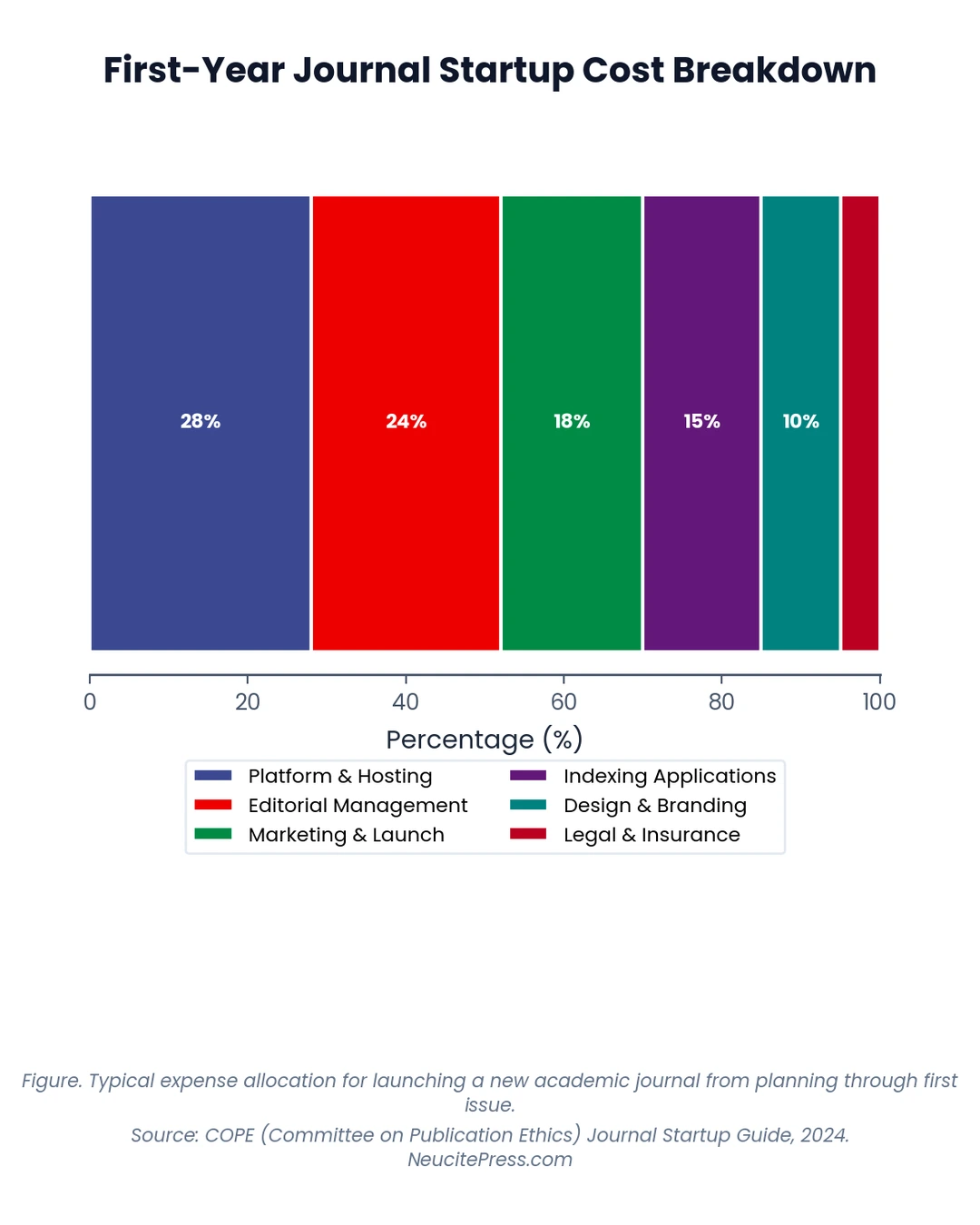
Journal startup differs from ongoing operations. First-year expenses typically include:
- Website development and design: $2,000-$10,000
- Editorial policy and procedure documentation: $1,000-$3,000
- Branding and logo development: $500-$2,000
- Launch marketing campaign: $2,000-$8,000
- Indexing application fees and processes: $500-$2,000
- Staff recruitment and onboarding: $1,000-$5,000
First-year launch budget: $8,000-$30,000 before ongoing operational expenses.
After launch, ongoing operating expenses (as shown in the scenario comparison above) dominate the budget. Successful journals achieve sustainability when revenue models (APCs, memberships, grants) cover both fixed operational costs and per-article variable expenses.
Comparative Analysis: Traditional vs. Open Access Publishing Economics
Subscription-Based Journal Economics
Traditional subscription journals distribute costs through institutional library subscriptions rather than author fees. This model shifts financial burden to readers’ institutions. Subscription pricing for academic journals typically ranges from $200-$2,000 annually for institutional access, with premium titles commanding $3,000-$5,000+ annually.
Subscription revenue stability enables more aggressive editorial investment. Publishers can afford larger editorial teams and more extensive peer review coordination because revenue doesn’t depend on individual article acceptance rates.
Gold Open Access (Author-Funded) Economics
Gold Open Access journals charge Article Processing Charges and make content immediately freely available. This model depends on sufficient author funding to support operations. Success requires either discipline-wide funding traditions (well-established in biomedical sciences) or author willingness to bear publication costs.
Gold OA journals face sustainability challenges in underfunded disciplines. Humanities and social science fields with limited research funding struggle to sustain $2,000-$3,000 APCs that biomedical journals routinely charge.
Hybrid Model Economics
Hybrid journals allow authors to choose between subscription access and paid open access. While broadening author choice, this model creates administrative complexity and faces criticism for “double dipping”—collecting both subscription revenue and author fees for the same content.
Diamond Open Access and Institutional Funding
Diamond Open Access eliminates author fees and reader subscriptions, relying instead on institutional subsidies. University presses, library systems, and academic societies commonly support Diamond OA publications. This model removes financial barriers but requires identifying sustainable institutional supporters.
| Model | Author Cost | Reader Cost | Revenue Stability | Best For |
|---|---|---|---|---|
| Subscription | $0 | $500-$5,000 | High (predictable) | Well-funded institutional access |
| Gold OA | $1,000-$3,000 | $0 | Medium (volume-dependent) | Well-funded research disciplines |
| Hybrid | $1,500-$2,500 | $200-$1,000 | Medium-High | Transitional models |
| Diamond OA | $0 | $0 | Low (grant-dependent) | Equity-focused missions |
Regulatory Compliance and Hidden Operational Costs
Data Protection and Privacy Compliance (GDPR/CCPA)
Scholarly publications operating internationally must comply with data protection regulations like GDPR (European Union) and CCPA (California). Implementing compliant systems for author data, reviewer information, and subscriber details typically requires $1,000-$5,000 in initial setup plus $500-$2,000 annually for ongoing compliance monitoring and updates.
Medical and Healthcare Publishing Compliance
Journals publishing medical research face additional regulatory requirements. HIPAA compliance for patient data protection, PhRMA Code adherence for industry-sponsored research, and FDA regulations for clinical trial reporting all necessitate specialized legal review and policy implementation. Budget $2,000-$8,000 annually for specialized compliance consulting in healthcare publishing.
Copyright and Licensing Infrastructure
Proper implementation of Creative Commons licensing (especially CC BY for funder-mandated open access) requires legal documentation, author agreements, and rights management procedures. While generally straightforward, establishing compliant licensing infrastructure involves $500-$2,000 in legal setup costs.
Accessibility and Technical Standards Compliance
Meeting WCAG 2.1 accessibility standards and ensuring content compatibility with assistive technologies requires testing and remediation. Budget $1,000-$3,000 annually for accessibility audits and ongoing compliance maintenance.
Strategic Planning: Cost Optimization Strategies
Leveraging Institutional Resources
University and research institution affiliation provides significant cost advantages. Many institutions offer:
- Free or heavily subsidized web hosting through institutional servers
- IT support for system maintenance and technical troubleshooting
- Legal review of policies and author agreements
- Marketing and communications support
- Library services for archiving and preservation
Utilizing institutional infrastructure can reduce annual operating costs by 30-50% compared to completely independent operations.
Negotiating Multi-Vendor Relationships
Volume discounts and long-term contracts with service providers significantly reduce per-unit costs. Platforms offering bundled services (manuscript management + hosting + copyediting) often provide 20-30% savings compared to purchasing services separately.
Phased Implementation Approach
New journals don’t require full infrastructure immediately. A phased approach launches with essential services, adding specialized tools as volume increases. Year 1 might include only a manuscript management platform and basic website. Year 2 or 3 can add specialized peer review management and advanced analytics as volume justifies the investment.
Volunteer and Community Contribution Models
Scholar-led journals leverage volunteer editorial boards and advisory committees to reduce staffing costs. Community-supported publications can distribute editorial responsibilities across networks of committed scholars, reducing per-article management costs to $50-$150 when compared to $200-$400 for staffed operations.
Benchmarking Your Journal Costs
Industry Productivity Metrics
Successful journals typically process 4-8 submitted articles per month per editorial staff member. This metric helps estimate staffing requirements for projected submission volume. A journal expecting 400 annual submissions requires approximately 1 full-time equivalent editorial staff member, or distributed responsibility across multiple part-time editors.
Cost per Published Article Benchmarks
Benchmark your expected costs against industry standards:
- Volunteer-led open source: $100-$300 per article
- Hybrid (volunteer editors + vendor services): $300-$600 per article
- Paid editorial staff + mixed services: $400-$800 per article
- Full-service commercial platform: $600-$1,200 per article
These benchmarks assume 50% acceptance rates. Post-publication peer review models can reduce these figures by 15-25%.
Annual Burn Rate and Sustainability Timeline
Calculate your journal’s annual operating costs and project when revenue will cover expenses. Many successful journals operate at a loss during launch years 1-3, relying on grants or institutional subsidies until circulation stabilizes. Plan for 2-3 year breakeven timeline, requiring 12-18 months of operating reserve.
Future Cost Trends in Academic Publishing
Technology Innovation and Cost Reduction
Emerging technologies promise significant cost reductions:
- AI-Assisted Peer Review: Machine learning for manuscript screening and reviewer matching could reduce submission processing time by 30-40%
- Automated Copyediting: Advanced language models assist with grammar and style correction, reducing professional copyediting time
- Workflow Automation: Robotic process automation reduces manual administrative tasks
However, maintaining quality assurance and human editorial judgment remains essential despite technological advances.
Funder-Mandated Open Access Requirements
NIH, NSF, and international funders increasingly mandate immediate open access to research outputs. This trend favors open access publishing models but creates cost pressures for journals to adopt free or low-cost business models. Publishers will likely see increased demand for Diamond OA models or low-cost Gold OA options.
Consolidation and Scale Economics
Increased publishing consolidation creates significant economies of scale for multi-journal platforms. Publishing networks managing 10-50 related journals share infrastructure costs, reducing per-journal overhead from $20,000-$50,000 annually to $5,000-$15,000.
Decision Framework: Choosing Your Publishing Model
Select your operational model by answering these key questions:
- Author Funding Reality: Do authors in your discipline have grant funding for publication fees? (If yes, consider Gold OA; if no, consider Diamond OA or institutional support)
- Institutional Support: Can your affiliated institution provide infrastructure or subsidies? (If yes, leverage institutional resources; if no, budget for commercial solutions)
- Editorial Capacity: Do you have volunteer editors willing to donate significant time? (If yes, reduce staff costs; if no, budget for paid positions)
- Technical Expertise: Does your team have IT skills for open-source platforms? (If yes, consider OJS; if no, choose user-friendly commercial solutions)
- Volume Projections: Are you starting with 50 articles annually or 500+? (Low volume justifies lean operations; high volume supports specialized staff)
- Sustainability Timeline: How long can you operate at a loss before achieving break-even? (1 year = aggressive bootstrapping; 3+ years = requires grants or subsidies)
Your answers to these questions determine which operational scenario—full-service commercial, hybrid, open-source volunteer, or institutional—best fits your journal’s sustainability needs.
Practical Implementation Checklist
Pre-Launch Planning (Months 1-3)
- Define journal scope, target audience, and publication frequency
- Research competitive journals and their pricing models
- Assemble Editorial Board and negotiate volunteer commitments
- Select manuscript management platform and set up test account
- Develop author guidelines, conflict of interest policies, and copyright terms
- Create preliminary budget based on projected article volume
Infrastructure Setup (Months 3-6)
- Develop and launch journal website
- Configure manuscript management platform
- Register DOI prefix with CrossRef
- Establish and test submission workflows
- Complete DOAJ indexing application
- Set up financial and accounting systems
Launch and Growth (Months 6-12)
- Open submissions and execute marketing campaign
- Process first submission batches
- Establish and track financial metrics
- Begin indexing applications (Scopus, PubMed Central, etc.)
- Gather and publish first issue
- Monitor costs against budget projections
FAQs About Journal Startup Costs
What’s the minimum budget to launch an academic journal?
A minimal startup budget for a volunteer-led, open-source journal costs approximately $5,000-$15,000 annually for domain registration, web hosting, and basic infrastructure. However, this requires significant volunteer contribution and technical expertise. Most successful journals budget $20,000-$50,000 for launch year including basic website development, policies, and initial marketing.
Can I start a journal with zero budget?
Technically possible but not recommended. Free manuscript management platforms (OJS), free hosting services, and volunteer labor can theoretically launch a journal cost-free. However, this approach typically fails due to insufficient technical support, limited discoverability, and unsustainable volunteer burden. Investing $5,000-$10,000 in professional infrastructure significantly improves sustainability prospects.
How long before a journal becomes financially sustainable?
Most newly launched journals operate at a loss for 2-3 years before achieving sustainability. During this period, they rely on grants, institutional subsidies, or founder investment. A well-managed journal might reach break-even at 200-300 published articles annually if operating on a $30,000-$50,000 annual budget. Higher-cost operations (with paid staff) require 500+ articles annually for sustainability.
What’s the difference between Article Processing Charges and subscription costs?
Article Processing Charges are one-time fees authors pay to make their work openly available (typically $1,000-$3,000). Subscription costs are annual fees institutions pay for reader access (typically $200-$2,000 per institution). APCs fund open access journals; subscriptions fund traditional journals. Some journals use hybrid models charging both.
Should I choose volunteer editors or hire staff?
This depends on volume and quality standards. Volunteer editors work best for 50-150 articles annually with manageable submission rates. Hired editorial staff become cost-effective at 200+ articles annually. Hybrid approaches (volunteer Editor-in-Chief with paid managing editor) often provide optimal balance of cost and quality.
What costs do Diamond Open Access journals require?
Diamond Open Access journals eliminate author and reader fees but require institutional funding. Annual costs typically range from $15,000-$50,000 depending on article volume and service level. This funding comes from universities, research institutions, foundations, or academic societies supporting the publication mission.
Resources and Next Steps
Launch your journal with confidence using these actionable resources:
- Complete step-by-step journal launch guide
- Detailed revenue model comparison
- APC pricing strategy guide
- Open access business models analysis
- Manuscript management platform comparison
- Journal marketing strategies
- Journal promotion tactics
- Scopus indexing requirements
- Guide to Scopus indexing
- Editorial staffing guide
Successful journal launches combine realistic financial planning with strategic operational choices. Understanding the true cost of starting a journal—and selecting an operational model matching your resources—creates the foundation for sustainable scholarly communication ventures.
Frequently Asked Questions
How much does it cost to start an academic journal in 2026?
Startup costs range from $8,000-$50,000 depending on your operational model. Volunteer-led open-source journals cost $8,000-$15,000 in year one. Hybrid models with paid editors cost $20,000-$35,000. Full-service commercial platforms cost $30,000-$50,000. After launch, annual operating costs range from $15,000-$100,000+ depending on article volume and service levels.
What are the biggest cost drivers when starting a journal?
The three largest cost categories are editorial staffing (if using paid editors), manuscript management platform fees, and website/infrastructure hosting. Additionally, production services like copyediting and typesetting represent significant per-article costs. Together, these typically account for 70-80% of total operating expenses for new journals.
Can institutional affiliation reduce journal startup costs?
Yes, significantly. University and research institution affiliation provides free or discounted IT infrastructure, legal support, accounting services, and marketing assistance. Institutional support can reduce effective operational costs by 30-50% compared to independent ventures. Many successful journals leverage institutional resources to achieve sustainability faster.
Is it cheaper to use an open-source platform like OJS?
Open Journal Systems (OJS) costs nothing for software licensing, but requires expenses for hosting ($1,500-$3,000 annually), technical support, and maintenance. This approach is cheaper than commercial platforms for low-volume journals (50-200 articles/year) but requires technical expertise. Commercial platforms provide better value for journals with limited IT resources despite higher licensing costs.
What’s the typical per-article cost for publishing in scholarly journals?
Per-article costs range from $150-$500 for pure variable expenses (copyediting, typesetting, review management) to $400-$1,200 when allocating indirect overhead. Volunteer-led operations achieve $200-$400 per article. Fully staffed commercial operations cost $600-$1,200 per article. These figures assume 50% article acceptance rates; they decrease with higher acceptance rates and higher article volume.
How do open access Article Processing Charges compare to journal startup costs?
Article Processing Charges ($1,000-$3,500) are per-article author fees covering publication costs. Journal startup costs ($8,000-$50,000) cover one-time infrastructure development. Annual operating costs ($15,000-$100,000+) support ongoing publication operations. A journal publishing 100 articles annually at $1,500 APC generates $150,000 in revenue, exceeding typical $40,000-$50,000 annual operating costs and enabling profitability or reinvestment.
Ready to launch your academic journal? Start with honest financial planning and transparent operational decisions. Understanding the true cost of starting a journal enables founders to make sustainable choices supporting long-term scholarly communication success.
Need help with this? Rather than piecing together vendors and platforms yourself, NeucitePress offers the Journal Launch — Basic Package ($4,999) — OJS setup, ISSN registration, CrossRef/DOI integration and a professional journal website, delivered in 6–8 weeks so you launch with the fundamentals right the first time. Learn more →