How to Get Your Journal Indexed in Scopus: Complete 2026 Guide
Reviewed by the NeucitePress Editorial Board
— PhD academics, peer-reviewed journal editors and medical communication specialists.
Last updated: July 2026 • Reviewed by the NeucitePress Editorial Board • Reading time: 8 minutes
Getting a journal indexed in Scopus remains one of the most sought-after milestones in academic publishing. For editors, publishers, and society journals alike, Scopus indexing signals credibility, expands a journal’s international readership, and gives authors the citation metrics they need for tenure, grant applications, and promotion. But the path to acceptance is neither quick nor guaranteed. This guide walks through what Scopus indexing actually means, how the evaluation process works, the criteria reviewers apply, and what to do if your first application does not succeed.
What Scopus Indexing Means and Why It Matters
Scopus is Elsevier’s abstract and citation database, one of the two dominant multidisciplinary indexes in scholarly publishing alongside Clarivate’s Web of Science. When a journal is “indexed in Scopus,” every article it publishes going forward is captured in the database, made discoverable to millions of researchers, and factored into citation-based metrics such as CiteScore, SJR (SCImago Journal Rank), and SNIP (Source Normalized Impact per Paper).
For authors, publishing in a Scopus-indexed journal often matters for institutional requirements, national research assessment exercises, visa and immigration points systems in some countries, and grant eligibility. For journal editors and publishers, indexing increases submission volume, attracts stronger manuscripts, and provides an independent quality signal that supports subscription or open-access sustainability. Because of this value, Scopus receives a very high volume of title suggestions each year and accepts only a fraction of them — which is why understanding the process in detail, rather than guessing at it, matters.
The CSAB Evaluation Process
Every journal suggested for Scopus indexing is ultimately reviewed by the Content Selection & Advisory Board (CSAB), an international group of independent, practicing subject-matter experts organized by broad discipline area (life sciences, health sciences, physical sciences, and social sciences and humanities). The CSAB does not simply check a box; each subject-area subcommittee evaluates the journal against a shared set of qualitative and quantitative criteria and makes an independent recommendation to Elsevier’s Scopus content team.
Before a title ever reaches the CSAB, Elsevier’s in-house content team performs a technical and administrative screening. Only titles that pass this initial screening — confirming a valid ISSN, a working and stable website, and basic compliance with Scopus’s minimum criteria — move forward to full CSAB review. This two-stage structure (technical screening, then subject-expert review) is why the overall process can take many months even for strong candidates.
Since a 2024 policy update, Scopus removed its long-standing requirement that a journal had to have been publishing for at least two years before it could be suggested for review. However, the CSAB still expects to see a track record: enough published issues and articles to meaningfully assess peer-review rigor, editorial consistency, and content quality. A journal with only one or two thin issues is unlikely to present enough evidence for a favorable recommendation, regardless of the two-year rule change.
Core Acceptance Criteria
The CSAB’s review criteria fall into five broad categories: journal policy, content quality, journal standing, regularity of publication, and online availability. The table below summarizes what reviewers look for in each area.
| Criteria Category | What Reviewers Assess |
|---|---|
| Journal Policy | Existence and rigor of a formal peer-review process; a clearly published, publicly accessible publication ethics and publication malpractice statement; diversity of the editorial board and of published authors across institutions and countries (rather than a board or author pool concentrated at one or two institutions) |
| Content Quality | Academic contribution and relevance of the articles to the field; clarity, quality, and completeness of English-language abstracts and article titles (even if the journal publishes in another language); overall editorial and copyediting standards |
| Journal Standing | Citedness of the journal’s own previously published articles within Scopus; standing and publication record of the editor-in-chief and editorial board members within their field |
| Regularity of Publication | Adherence to a stated publication schedule (e.g., quarterly, bimonthly) without significant delays or skipped issues; consistent volume of articles per issue over time |
| Online Availability | A functional, professional journal website; full text (or at minimum, abstracts) available online; English-language tables of contents so international researchers can evaluate content regardless of the journal’s publication language |
In addition to these qualitative factors, the journal must satisfy baseline technical requirements before it is even eligible for CSAB review: it must publish peer-reviewed content, hold an ISSN confirmed by the ISSN International Centre, publish on a regular and predictable schedule, provide English-language abstracts and titles for every article, and display a clear publication ethics and malpractice statement (most journals satisfy this by adhering to COPE — the Committee on Publication Ethics — guidelines).
How to Prepare Your Journal for Submission
Before suggesting your title, it is worth auditing your journal against the criteria above as if you were a CSAB reviewer yourself. In practice, this means:
- Confirm your ISSN is valid and registered with the ISSN International Centre, and that it matches exactly what appears on your journal’s website and issue front matter.
- Publish a visible peer-review policy describing the review type (single-blind, double-blind, or open) and the general workflow from submission to decision.
- Post a formal publication ethics and malpractice statement, ideally aligned with COPE guidelines, covering plagiarism, authorship disputes, conflicts of interest, and retraction procedures.
- Diversify your editorial board and author base. A board composed entirely of members from one university or country is a common rejection trigger. Aim for genuine international representation with editors who have their own publication records.
- Ensure every article has an English abstract and title, even if the journal’s primary language is not English.
- Maintain a strict publication schedule. Gaps, delayed issues, or irregular article counts per issue are red flags for reviewers assessing “regularity.”
- Keep your website current and professional, with full issue archives, clear contact information, and English-language tables of contents.
- Build a citable track record. Since citation potential is assessed, journals benefit from encouraging rigorous, original research that other scholars are likely to cite — rather than prioritizing volume over quality.
Most consultancies, including editorial services teams like ours, recommend running at least two to three full volumes under these standards before submitting, so the CSAB has a genuine body of consistent practice to evaluate rather than a handful of recent issues assembled specifically for the application.
Submitting Your Journal: The Scopus Title Suggestion Process
Once your journal meets the baseline technical and editorial criteria, you can suggest it through Elsevier’s official Scopus Title Suggestion tool (accessible via the Scopus support pages, sometimes referred to as the “suggestor” tool). Before submitting, search the existing Scopus source list to confirm your title is not already indexed or under review.
The submission form typically asks for:
- The journal’s title, ISSN, and publisher information
- The journal’s website URL
- Contact details for the editor-in-chief or managing editor
- Links to, or uploads of, the two to three most recent issues
- Basic information about publication frequency and subject scope
After submitting, you will receive an automatic acknowledgement email along with a unique tracking ID. This ID can be entered into Scopus’s Title Evaluation Tracker so you can monitor whether your title is still in technical screening, under CSAB review, or has reached a final decision — without needing to email Elsevier for status updates.
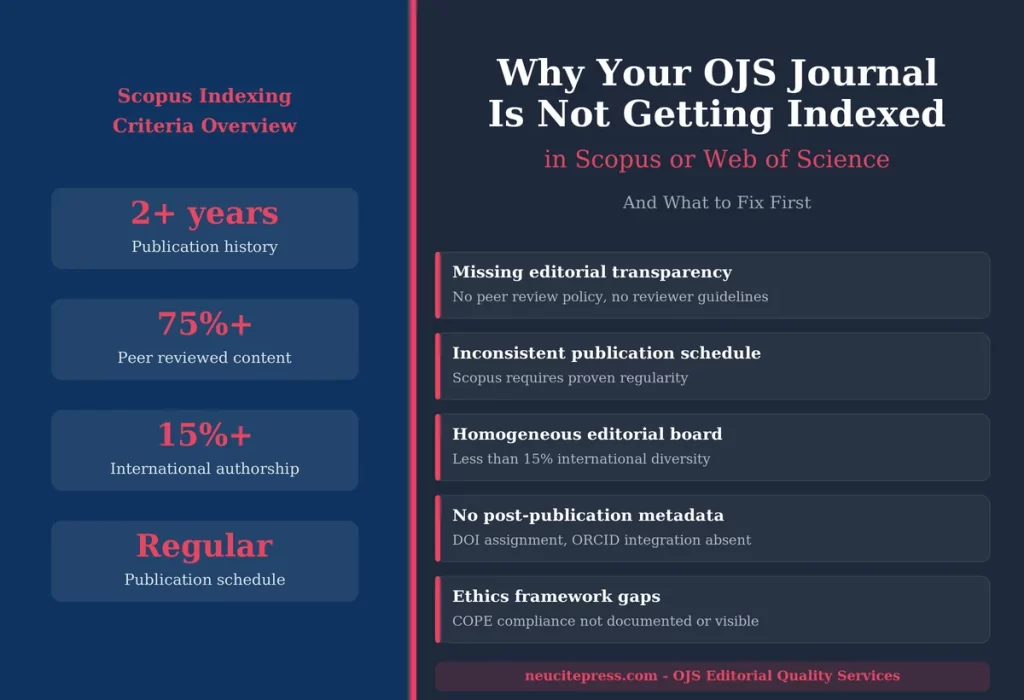
Common Reasons Journals Get Rejected
Editors are sometimes surprised by a rejection, especially when they believe their content quality is strong. In our experience supporting journals through this process, the most frequent rejection reasons include:
- Insufficient editorial or authorial diversity — boards and author pools concentrated at a single institution or country.
- Inconsistent or delayed publication schedules, including “catch-up” issues that combine multiple months into one release.
- Weak or missing English abstracts, or abstracts that read as machine-translated rather than properly edited.
- No visible, substantive publication ethics statement, or one that is copied generically without reflecting the journal’s actual practices.
- Questionable peer-review rigor, such as extremely fast turnaround times that suggest inadequate review, or a lack of transparency about the review model.
- Low citation potential, where previously published articles show little uptake or relevance within the field.
- Website and accessibility issues, including broken archives, missing full text, or no clear way to browse past issues.
Many of these issues are entirely within an editor’s control to fix before resubmitting — which is precisely why a pre-submission audit against the criteria table above is worth the time investment.
A Realistic Timeline
Journal editors should plan for a multi-stage, multi-month process rather than a quick turnaround:
| Stage | Typical Duration |
|---|---|
| Title suggestion submitted; acknowledgement email and tracking ID issued | Immediate |
| Technical and administrative screening by Elsevier’s content team | Several weeks to a few months |
| Full qualitative review by the relevant CSAB subject subcommittee | Several months |
| Final decision communicated (accept, reject, or request more information) | Commonly around 6–12 months from submission, though it can run longer |
Because the CSAB meets periodically rather than continuously, and because subject subcommittees review large batches of suggestions, timelines can vary significantly by discipline and by submission volume in a given cycle. Editors should treat any estimate as a planning range, not a guarantee, and should use the Title Evaluation Tracker rather than assuming a fixed date.
What to Do If Your Journal Is Rejected
A rejection is not necessarily final. If your title is not accepted, Scopus will generally indicate that the journal may be reconsidered after a waiting period — commonly cited as approximately two years, though the exact interval can vary depending on the reasons for rejection and any subsequent policy updates, so editors should always confirm the current guidance on Elsevier’s Scopus support pages at the time of resubmission. Use the interim period productively:
- Address the specific concerns raised in your rejection notice, if any feedback was provided.
- Rebuild your editorial board with a genuinely international, subject-credible group of scholars.
- Tighten your publication schedule and eliminate gaps or irregular issue sizes.
- Invest in professional English-language editing for abstracts, titles, and full text.
- Strengthen your publication ethics infrastructure, including plagiarism screening and a documented editorial workflow.
- Continue publishing consistently so that, by the time you resubmit, you have a longer and stronger track record for the CSAB to evaluate.
Many journals that are rejected on a first attempt are successfully indexed on a second or third suggestion once these structural issues are resolved — rejection is often a signal to strengthen specific, identifiable weaknesses rather than a verdict on the journal’s overall potential.
Sources
- Elsevier — Scopus Content Policy and Selection
- Elsevier — Scopus Content Selection and Advisory Board (CSAB)
- Elsevier Support Center — Can I suggest new titles to be indexed in Scopus?
- Elsevier — Scopus Content Overview
- Scopus Blog — Elsevier
Scopus indexing rewards journals that treat editorial rigor, international diversity, and consistency as ongoing practices rather than one-time application requirements. By auditing your journal against the CSAB’s actual criteria, preparing a complete and honest submission, and using any rejection as a roadmap for targeted improvement, you put your title in the strongest possible position for eventual acceptance.